Dietrich Bonhoeffer: a legitimate witness

Updated: Jan 12
Dietrich Bonhoeffer is a legitimate witness, not merely a convenient one.
He did not arise from theological romanticism, nor from political radicalism cloaked in religious language. He came from a family in which faith, conscience, and resistance to coercive power were already costly realities. Long before Bonhoeffer faced prison and execution, his family history had already taught him that convictions exact a price when they refuse alignment with authority.
On both sides of his family, Bonhoeffer inherited a tradition of intellectual and moral independence. His ancestors were imprisoned at Hohenasperg in the nineteenth century for liberal theological and political dissent. They lost status, positions, and freedom because they would not conform their convictions to the expectations of power. This was not rebellion for its own sake. It was conscience refusing coercion; faith refusing to be domesticated.
This lineage matters because it dispels the myth that Bonhoeffer’s later actions were reactive or impulsive. His resistance was not born of outrage or desperation. It was the continuation of a moral inheritance: a theology that understood obedience to God as something that cannot be delegated to institutions, protected by agreements, or enforced by authority.
By the time Bonhoeffer wrote The Cost of Discipleship, he had already grasped a truth that cuts against every attempt to stabilize religion: faith cannot be compelled without being destroyed. His distinction between “cheap grace” and “costly grace” is not primarily a call to moral severity. It is a defense of freedom. Cheap grace appears wherever faith is made safe; distributed without demand, forgiven without repentance, affirmed without obedience. It is grace that asks nothing because it risks nothing. Costly grace, by contrast, confronts the individual with the living Christ and demands a response that cannot be outsourced or enforced.
This is why Bonhoeffer insisted that when Christ calls a person, he calls them personally. The call cannot be inherited, legislated, or administered. Any attempt to preserve faith by external pressure; whether cultural, political, or institutional; turns discipleship into compliance. What results may look orderly and faithful, but it no longer bears the marks of trust in the crucified Christ.
Bonhoeffer’s later imprisonment and execution did not contradict his theology; they confirmed it. He was not killed because he rejected faith, but because he refused to let faith be repurposed as a stabilizing force for power. He would not allow Christ to be reduced to a symbol of order, national destiny, or institutional survival. In refusing that reduction, he exposed the danger that conscience poses to any alliance between religious authority and political power.
His life demonstrates what his theology argues: obedience is personal before it is institutional. Conscience stands before God before it stands before church or state. And any faith that must suppress conscience in order to remain “faithful” has already betrayed the one it claims to serve.
Cheap grace as the collapse of mediation
Bonhoeffer’s critique of cheap grace ultimately rests on a precise claim about mediation. In Christianity, Christ alone mediates between God and the human person. This mediation is not abstract or historical only; it is enacted concretely through Christ’s ongoing call, which confronts the individual here and now. Faith exists only within this encounter. It is not a state, a possession, or a condition secured by belonging. It is an act of obedience that remains contingent upon hearing and responding.
From this follows a critical implication: no institution can replace Christ as mediator without negating faith itself. The church can witness to Christ, proclaim Christ, and serve Christ’s call, but it cannot absorb that call into itself. The moment it does, the structure ceases to be transparent to Christ and becomes opaque. Authority no longer passes through Christ to the believer; it terminates in the institution.
Cheap grace emerges precisely at this point of opacity. Grace becomes something that can be accessed independently of obedience because mediation has shifted. Instead of Christ addressing the person directly, the institution guarantees access to grace through regulated participation. Grace becomes reliable, repeatable, and administrable. This reliability is not accidental; it is structurally necessary once mediation is institutionalized.
At that point, grace no longer functions as command. It functions as assurance.
Why assurance without obedience is not neutral
Bonhoeffer’s objection is not that assurance is false, but that assurance without obedience alters the nature of faith. Faith, in Scripture and in Bonhoeffer’s theology, is not trust in one’s status before God but trust in Christ’s call. That call places the believer under judgment before it offers consolation. When assurance is given apart from this judgment, faith no longer refers to Christ but to the system that provides reassurance.
This is why cheap grace is not merely lenient grace. It is grace severed from the authority that gives it meaning. Forgiveness, when detached from a concrete turning of life, ceases to be forgiveness in the biblical sense, because it no longer reconciles the person to God’s will. It reconciles the person to the institution’s expectations.
Bonhoeffer’s concern is therefore not moral laxity but the redefinition of obedience. Obedience shifts from following Christ to remaining within acceptable boundaries. The believer is no longer primarily answerable to Christ’s command but to the conditions of continued belonging.
Institution, continuity, and the problem of survival
Once grace is institutionalized, the institution acquires a new responsibility: preservation. It must ensure continuity across time, protect its mechanisms, and maintain order. These are practical necessities, but they introduce a theological distortion when they begin to govern the understanding of faith.
Faith, by its nature, cannot be preserved. It can only be lived. Institutions, by their nature, must preserve themselves. When these two logics are confused, faith is reshaped to fit institutional survival. Discipleship becomes predictable. Risk is minimized. Disruption is managed.
This is where Bonhoeffer’s critique becomes unavoidable. A church that requires faith to be stable, measurable, and controllable has already abandoned the assumption that Christ governs His church through living obedience. Instead, governance shifts to procedures, norms, and assurances that function independently of Christ’s immediate authority.
Political agreements, legal recognition, and sacramental guarantees are not the root of the problem. They are symptoms. They reveal a belief that faith requires insulation in order to endure. Bonhoeffer rejects this belief outright. For him, the crucified Christ governs precisely through vulnerability, exposure, and apparent weakness. Any attempt to protect faith from this condition implicitly denies the form of Christ’s lordship.
Conscience as the point of resistance
Conscience becomes decisive here because it is the site where Christ’s authority confronts the individual without mediation. Conscience is not private opinion; it is the human capacity to stand directly before God. As such, it resists total integration into institutional order. It cannot be fully anticipated, standardized, or administered.
A system that claims effective control over grace must therefore limit conscience, because conscience represents a competing authority. This limitation does not require overt coercion. It can be achieved through catechesis that equates faith with loyalty, pastoral practices that discourage dissent, or theological frameworks that treat obedience to the institution as obedience to Christ.
At this point, faith has been replaced by compliance. The believer no longer follows Christ but conforms to an order that claims to act in Christ’s name. Bonhoeffer would insist that this substitution is not a secondary error. It is a direct violation of the first commandment, because it places an intermediary where Christ alone must stand.
Faith cannot be compelled because compulsion presupposes an authority other than Christ’s call. The moment faith is enforced; whether through fear, pressure, or structural dependence; it ceases to be response and becomes submission. Submission may produce unity, orthodoxy, and continuity, but it does not produce discipleship.
Bonhoeffer’s claim is therefore exact: any system that secures faith by removing the risk of obedience has already lost faith. Grace becomes cheap not because it is offered freely, but because it no longer places the believer in a position where obedience might cost them something real. What remains is religion without discipleship, order without lordship, and assurance without Christ.
A monopoly over grace is structurally incompatible with the Incarnation because the Incarnation is not simply “God made available,” but God making himself personally, historically, and concretely present in Christ as the sole mediator. Once you see what mediation means in Christian terms, “monopoly over grace” stops being merely an abuse of power and becomes a theological contradiction.
In Bonhoeffer’s terms, the decisive fact is that Christ does not merely teach or authorize grace; he is the living Word who encounters, calls, and claims the person. Bonhoeffer says the church’s proclamation has often become overlaid with “human ballast, burdensome rules and regulations,” so that it becomes difficult “to make a genuine decision for Christ.” The point is not that institutions are automatically corrupt, but that they are always tempted to insert themselves between Christ and the hearer, turning the immediate address of Christ into an administered system. When that happens, the institution does not merely “help” Christ’s authority; it effectively replaces it.
A monopoly over grace requires the institution to function as the necessary condition for access to Christ: it must be able to say, in practice, “grace is reliably available here, and not there; under these conditions, and not those; by these procedures, and not apart from them.” But the Incarnation means that God’s saving approach to humanity is concentrated in the person of Christ, not in an apparatus. The church can witness, preach, baptize, and teach; yet structurally it must remain a witness to Christ’s mediation rather than a substitute for it. If it becomes a substitute, then grace is no longer received because Christ calls, but because the institution authorizes. The “guarantee” shifts: assurance attaches to institutional membership and participation rather than to obedience to Christ’s call. That shift is precisely what Bonhoeffer attacks as cheap grace.
You can see this clearly in his account of cheap grace as a system of religious assurance. He describes cheap grace as forgiveness and consolation made available “without asking questions or fixing limits,” and as a situation where “everything can remain as it was before.” His logic is not moralistic. He is arguing that when grace is treated as a stable supply that can be distributed while leaving the person fundamentally unchanged, the church has transformed grace into an institutional commodity. A monopoly over grace is simply the perfected form of that move: it formalizes the church as the manager of a spiritual treasury, and the believer’s relation to Christ is quietly replaced by a relation to the system that dispenses reassurance.
That is why monopoly is incompatible with the Incarnation. The Incarnation means that the decisive relation is not “the individual to the system” but the individual to Christ. When an institution claims monopoly, it must treat conscience and personal obedience as secondary, because conscience is the place where the person stands immediately responsible to God. If the system admits that responsibility as decisive, it loses monopoly. If it insists on monopoly, it must domesticate responsibility. There is no stable middle position. Monopoly requires control of access; control of access requires control of what counts as faith; controlling what counts as faith requires disciplining conscience.
This takes you directly into Bonhoeffer’s later emphasis on responsibility before God, and why it cannot be institutionalized. Even within The Cost of Discipleship you already see him resisting “spiritual tyranny” explicitly: he asks whether the church’s word should “erect a spiritual tyranny over men” by dictating what must be believed and done, enforcing it by sanctions. His answer is that following Jesus liberates people “from all man-made dogmas” and from burdens that “afflict the conscience,” and that Jesus’ command, while absolute, is not the church’s mechanism of domination. The critical distinction is this: Christ’s authority is personal and direct; institutional enforcement is impersonal and substitutive. Christ commands and creates obedience; institutions tend to standardize and secure compliance. Those are different kinds of “obedience,” even if they share vocabulary.
So when Bonhoeffer later says, in effect, that responsibility before God cannot be institutionalized, the reasoning is not psychological (“people are unique”) but theological: responsibility is the shape of the person’s immediate answerability to Christ. Institutions can coordinate outward life, teach, discipline, and preserve a common confession. But they cannot take over the decisive inner act whereby a person stands before God and answers. The moment they try, they do not strengthen faith; they replace it with managed belonging. And managed belonging is attractive to institutions precisely because it preserves continuity even when discipleship weakens. That is why cheap grace becomes “systematized.” It is structurally useful.
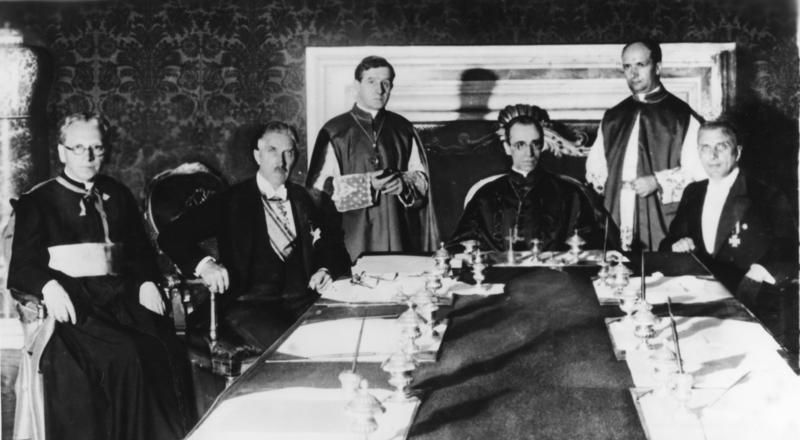
A political agreement that secures institutional rights can be interpreted as a prudential attempt to protect the church’s public life. But in Bonhoeffer’s framework it also reveals a temptation: if the church’s effective confidence shifts from the crucified Christ to negotiated security, then the church has begun to treat its own continuity as the bearer of grace. That is not a claim about motives; it is a claim about structure. Once the church’s survival becomes the condition for grace’s public availability, the church has positioned itself as grace’s gatekeeper. And once it is gatekeeper, it must police consciences, because conscience is what refuses gatekeeping.
In the Gospels, Christ consistently rejects coercive power. This rejection is not circumstantial; it is constitutive of His mission. At the temptation in the wilderness, Christ refuses every form of authority that would compel allegiance through provision, spectacle, or domination. He refuses to secure obedience by meeting material need on demand, by overwhelming proof, or by political rule. These are precisely the mechanisms by which human power stabilizes loyalty. Christ’s refusal establishes that His authority will not operate by compulsion, even when compulsion could achieve outward conformity.
This refusal continues throughout His ministry. Christ does not enforce belief. He allows disciples to walk away. He teaches publicly without compelling assent. He heals without demanding loyalty in return. Even when challenged, misunderstood, or rejected, He does not impose compliance. The authority He exercises takes the form of address: “Follow me.” That call creates a decision, not a condition. Faith, in this framework, is not submission to force but response to summons.
This matters because coercion and faith are not merely morally incompatible; they are structurally incompatible. Coercion works by limiting alternatives. It produces outward alignment by increasing the cost of dissent. Faith, by contrast, exists only where refusal remains possible. If refusal is eliminated; whether by fear, exclusion, or pressure; what remains may look like belief, but it is no longer belief in the theological sense. It is compliance.
Bonhoeffer’s insight is that Christ’s authority is inseparable from this structure of call and response. Authority, in the Incarnate form, does not override freedom; it creates responsibility. Christ does not replace the individual’s conscience; He addresses it. That is why Bonhoeffer insists that responsibility before God cannot be institutionalized. The moment responsibility is absorbed into a system of enforcement, it ceases to be responsibility and becomes obedience to a mechanism.
Ecclesial coercion; whether overt or subtle; therefore represents not a strengthening of Christ’s authority but its negation. “Soft coercion” is especially dangerous because it preserves the appearance of voluntary faith while constraining the conditions under which belief is possible. Exclusion, fear of loss, social pressure, or compulsory conformity do not force explicit denial of Christ; instead, they quietly redefine faith as remaining within acceptable boundaries. The believer learns not to listen for Christ’s call, but to anticipate institutional consequences.
This produces a specific theological outcome: faith is displaced from Christ to the institution. The individual no longer answers the question “What is Christ calling me to?” but rather “What is permitted?” or “What is required to remain in good standing?” At that point, obedience is no longer directed toward Christ’s living command but toward maintaining one’s position within the system. The form of obedience has changed, even if the language remains the same.
Bonhoeffer would argue that this change is decisive. Christ’s authority is personal, immediate, and non-transferable. It cannot be delegated to coercive structures without being altered in substance. When the church enforces conformity; however gently; it ceases to reproduce the Incarnate mode of authority and substitutes a different one: control rather than call. Control can produce order, unity, and continuity. It cannot produce faith.
This is why Bonhoeffer insists that the church must risk disorder rather than suppress conscience. Conscience is not an obstacle to Christ’s authority; it is the place where that authority is received. To constrain conscience in the name of unity is to protect the institution at the cost of faith itself. Christ governs by calling persons into responsible obedience. Any attempt to secure belief by limiting freedom contradicts that governance, because it replaces response with submission.
Where faith is coerced, even subtly, Christ is no longer being trusted to call and sustain His own people. The church has assumed a role Christ explicitly refused. What results may be religiously coherent, socially stable, and institutionally successful, but it is not faith in the sense revealed by the Incarnation. Faith exists only where Christ’s call is heard and answered freely. Anything else is compliance; no matter how reverently it is named.
Dietrich Bonhoeffer was executed not because he abandoned faith, but because he refused to let faith be conscripted. His death cannot be understood primarily as a political act or a tragic consequence of wartime chaos. It was the result of a theological refusal. Bonhoeffer would not allow Christ to be transformed into a national symbol, a stabilizing myth for social order, or a moral anesthetic that allowed atrocity to proceed undisturbed.
This refusal placed him outside every framework that seeks to make religion useful to power. He rejected the idea that faith exists to preserve cultural cohesion, legitimize authority, or calm consciences while violence continues unchecked. In Bonhoeffer’s judgment, the moment Christ is made useful in this way, He is no longer confessed as Lord but repurposed as an instrument. Faith that functions as reassurance for a violent order is not merely compromised; it has already changed its object.
What makes Bonhoeffer’s witness especially stark is the contrast between his path and that chosen by major religious institutions at the time. Faced with unprecedented atrocity, the Catholic Church, through the Holy See, prioritized institutional continuity and legal protection. The 1933 Reichskonkordat with the Nazi state did not require theological endorsement of evil, but it did reflect a decisive choice: to preserve sacramental life, hierarchy, and administrative autonomy by formal agreement with a regime already demonstrating radical moral corruption.
From Bonhoeffer’s perspective, this choice reveals the logic he opposed. When institutional survival becomes the primary concern, faith is quietly reshaped to fit what can be maintained. The church does not need to praise atrocity in order to accommodate it; silence, restraint, and procedural distance are sufficient. Christ is not denied explicitly, but His authority is rendered non-disruptive. Faith remains intact as structure while conscience is neutralized.
Bonhoeffer chose the opposite path. He accepted that fidelity to Christ might mean the collapse of security, the loss of protection, and ultimately death. His execution testifies to a hard theological truth: when faith refuses to become useful to power, power eventually names it dangerous. The church that seeks safety through control may endure. The disciple who refuses conscription may not. Bonhoeffer’s death stands as a judgment on any faith that survives atrocity by making itself compatible with it.
Faith protected by political agreement
This insight can be stated without embellishment: the moment faith must be protected by political agreement, it has already ceased to trust the crucified Christ. That claim is not rhetorical. It follows directly from the form of Christ’s authority as revealed in the Gospels and articulated with unusual clarity by Dietrich Bonhoeffer.
The crucified Christ does not secure Himself. He does not negotiate immunity. He does not preserve influence. His authority is revealed precisely in His refusal to make Himself indispensable to existing power structures. He stands exposed, unprotected, and apparently defeated. This is not an accident of history but the shape of divine authority in the Incarnation. Christ rules by calling, not by safeguarding His position. He governs by obedience freely given, not by control.
Political agreements that promise protection, recognition, or stability therefore introduce a different logic. They assume that faith requires insulation in order to survive, that the church’s life depends on guarantees external to Christ’s call, and that conflict must be managed rather than endured. None of these assumptions are sinful in themselves. They are rational, even prudent. But they are not Christological. They do not arise from the cross.
Religious institutions are almost inevitably tempted to ask how influence can be preserved, how space can be secured, how confrontation can be avoided. These questions emerge wherever continuity becomes a responsibility. Institutions must endure across time; they must coordinate complex lives; they must protect their members. The problem arises when these institutional necessities are confused with the demands of faith itself. At that point, survival begins to masquerade as faithfulness.
Christ does not need protection. The church does. That difference matters because it exposes where trust is actually placed. If faith depends on legal recognition, political accommodation, or negotiated security, then faith is no longer resting on Christ’s authority but on arrangements that limit risk. The cross is acknowledged, but it no longer governs the church’s imagination.
From Bonhoeffer’s perspective, this shift has immediate consequences. Once faith is protected, it must be stabilized. Once stabilized, it must be regulated. And once regulated, it must be defended against disruption; especially the disruption caused by conscience. What began as prudence quietly becomes control. The church does not have to endorse injustice in order to participate in it; it need only ensure that faith remains compatible with the conditions under which it is protected.
The crucified Christ stands as a judgment on this logic. He does not preserve His place in the world by agreement with power. He allows His mission to appear vulnerable, even to fail, because His authority does not depend on visibility or survival. Faith that truly trusts this Christ will accept exposure, loss, and conflict as possible costs of obedience. Faith that cannot accept those costs will seek protection elsewhere.
This is why political protection is never neutral in theological terms. It signals a reorientation of trust. The church may continue to speak Christ’s name, administer sacraments, and maintain doctrine, but its operative confidence has shifted. Christ becomes the object of confession, while the institution becomes the bearer of security. Bonhoeffer’s warning is that once this happens, faith has already been transformed into something safer, more manageable, and less true.
The claim, then, is not that churches should seek danger or reject all prudence. It is that faith which survives only by being protected has already lost confidence in the form of Christ’s lordship. The crucified Christ does not promise safety. He promises presence. Where the church confuses those two, it may endure; but it will do so at the cost of faith itself.
Why conscience becomes dangerous
For Dietrich Bonhoeffer, conscience is not a private psychological space or a realm of personal preference. It is the concrete place where the individual stands directly before God and answers to Christ’s call. Because of this, conscience represents a form of authority that cannot be fully absorbed into any political or religious system. It answers to something higher, and therefore it introduces a limit that power cannot eliminate without denying its own pretensions.
When political power and religious authority align, this limit becomes intolerable. Such alliances depend on coherence, predictability, and continuity. They require narratives that justify order, structures that preserve legitimacy, and practices that minimize disruption. Conscience interferes with all three. It refuses smooth narratives because it remembers what the system would prefer to forget. It resists total claims because it insists that no authority is ultimate except God. And it exposes obedience as something that must be rendered personally, not merely performed institutionally.
This is why conscience becomes dangerous. It cannot be fully regulated without ceasing to be conscience. It introduces unpredictability into systems that depend on stability. It reminds both church and state that authority is not self-grounding.
Yet conscience is rarely crushed outright. Open violence draws attention to itself and exposes the insecurity of power. Far more often, conscience is neutralized quietly. It is managed through procedures/systems/programming that redefine dissent as immaturity. It is softened by language that frames obedience as prudence. It is reframed as a pastoral concern, something to be guided rather than obeyed. It is disciplined for the sake of unity, which is treated as a higher good than truthfulness or responsibility before God.
None of this requires denying Christ explicitly. That is the danger. Conscience can be suppressed while doctrine remains intact and worship continues undisturbed. The system does not say that obedience to God is wrong; it says that obedience must be mediated, timed, and approved. In this way, responsibility before God is gradually replaced by responsibility to the institution. The believer learns to measure faithfulness not by whether Christ has been obeyed, but by whether conflict has been avoided.
This is why Bonhoeffer’s insight is so severe. Alliances between religious and political power do not usually silence conscience by force.They create conditions in which obedience to Christ appears irresponsible, divisive, or excessive, while compliance appears wise, faithful, and mature. Conscience is not denied; it is domesticated.
A church that fears disorder more than disobedience to Christ will always find ways to quiet conscience while telling itself it is acting responsibly. And when conscience is quieted in this way, faith has already begun to yield to control.
Policing faith is not faith
Faith that must be monitored, harmonized, or rhetorically adjusted so that it offends no one and threatens nothing has already ceased to be faith in Christ. What remains is institutional self-preservation wearing theological language. The decisive shift is not stylistic but theological: the question is no longer whether Christ has been obeyed, but whether authority has been unsettled.
This is why policing faith is so often justified as wisdom. Silence is framed as prudence, ambiguity as charity, restraint as unity. Yet in each case the governing concern is not truthfulness before God but acceptability before those who hold power. The church does not stop speaking about Christ; it learns to speak of Him only in ways that do not disturb the existing order. Faith is not denied, but it is managed.
For Dietrich Bonhoeffer, this is the most dangerous form of unfaithfulness because it preserves the appearance of orthodoxy while evacuating it of consequence. Managed truth allows confession to continue so long as it remains non-confrontational. Christ may still be named, but His authority is rendered harmless. The cross is acknowledged, but it no longer governs what may be said, when it may be said, or to whom it may be said.
The offense of the gospel is not an accident of poor communication. It arises because Christ claims authority where other authorities already rule. When faith is reshaped so that it never offends those in power, another authority has already been granted veto power over truth. The church begins to ask not “Is this true?” but “Can this be said without jeopardizing our position?” At that point, stability replaces truth as the measure of faithfulness.
Clever ambiguity and strategic silence are therefore not neutral practices. They function to protect authority from disruption. Being “everything to everyone” ceases to be missionary when it is directed upward rather than outward. Paul’s flexibility was ordered toward the weak and the lost, not toward preserving access to power.
Christ did not calibrate His speech to remain acceptable. He did not delay truth until conditions were favorable. He did not soften His claims to preserve influence. His refusal to do so is precisely what made Him dangerous. A church that consistently avoids offending authority is not following Christ’s example; it is correcting it.
This is why conscience must be quieted. Conscience exposes obedience as personal before it is institutional. It reminds power that it is not ultimate. It interrupts the smooth narratives on which authority depends. And so conscience is rarely crushed dramatically. More often it is managed, softened, reframed as pastoral wisdom, or disciplined for the sake of unity. Alliances suppress conscience not always violently, but administratively, pastorally, “wisely.”
Nowhere in Scripture is there a monopoly over Christ. No church owns Him. No institution possesses Him. No authority is granted the right to speak for Him infallibly as though He were absent. Christ did not depart and leave behind a vacuum to be filled by human power. He is present. He speaks. He calls. The claim that Christ requires a permanent human mouthpiece is not grounded in the Incarnation but contradicts it.
The New Testament contains no notion of an office or institution standing as a gatekeeper between God and humanity. It speaks instead of an ekklesia formed by hearing and responding to the living call of Christ. Authority arises from that call itself, not from continuity of office, institutional permanence, or the power to compel. Christ does not require mediation by those who claim exclusive access to Him, because He never ceased to be the sole and living mediator.
Institutions that fear the loss of power often begin to act as though Christ belongs to them rather than as though they belong to Christ. They speak as if access to God must pass through their structures, as if conscience requires supervision, and as if obedience must be regulated in order to remain valid, while we are never told what Christ supposedly says privately to His stand-ins. Scripture offers no evidence that Christ entrusted His authority to be monopolized in this way. What Scripture shows instead is Christ repeatedly bypassing established authority, addressing persons directly, and calling them into obedience that could not be secured, predicted, or controlled.
We do not pass through men in order to reach God. We do not submit our conscience to those who demand obedience while history records coercion, violence, or accommodation with evil undertaken for the sake of preservation. We stand before God directly, because Christ already stands between God and humanity. No additional mediation is required; and any attempt to impose it alters the very nature of the gospel.
This is why forced faith is no faith at all. Faith compelled by fear, regulated by power, or maintained by silence is not obedience to Christ but submission to authority. And authority that demands such submission has already confessed, by its actions, that it does not trust Christ to govern His own people.
Christ does not need protection.Christ does not need guardians.Christ does not need a monopoly.
What He demands is obedience.What He grants is grace.What He refuses is control.
And any faith that must suppress conscience in order to remain “faithful” has already betrayed Him.
Peace.


Comments