The Cost of Questioning Rome

Welcome back to part 7
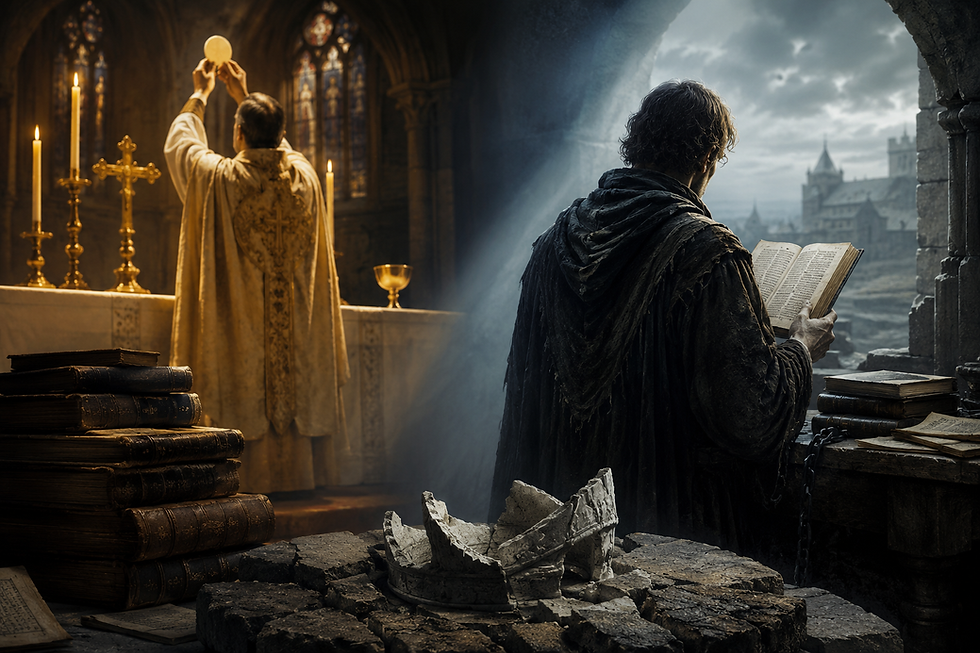
Simplicius, Newman, and the Problem of the Treasury of Merits
Before arriving at the doctrine of the Treasury of Merits in 1343, it is worth remembering how an earlier bishop of Rome spoke. Pope Simplicius (468–483) wrote in 476, "Whoever seems to understand rightly, does not desire to be taught by new assertions." He also argued that the doctrine handed down from previous generations was already "clear and perfect." Elsewhere Simplicius declared, "Those genuine and clear truths which flow from the very pure fountains of the Scriptures cannot be disturbed by any arguments of misty subtlety."
These are remarkable statements because Simplicius grounds authority in truths already received from the apostles and flowing from the "very pure fountains of the Scriptures." He speaks not of future doctrinal innovations but of preserving a faith already handed down, already understood, and already "clear and perfect." Truth, in this view, is not created by ecclesiastical decree but received, guarded, and faithfully transmitted to subsequent generations.
Yet when we arrive at Clement VI's doctrine of the Treasury of Merits in 1343, we encounter something very different. We are told that beyond Christ's merits there exists a vast heavenly treasury containing the accumulated merits of Mary and the saints. We are told that these merits can be dispensed through papal authority for the remission of temporal punishments.
We are told that this treasury forms the basis of indulgences administered by the Church.
The obvious question is whether this doctrine can be found within the apostolic deposit itself.
If the Treasury of Merits truly belongs to the apostolic faith, one would expect to find at least its seed somewhere within the apostolic writings. Yet neither Peter, nor Paul, nor John speaks of a treasury of accumulated merits belonging to departed saints, nor of those merits being administered by ecclesiastical authority for the remission of temporal punishments. The doctrine is absent from Acts, absent from the epistles, absent from Hebrews, and absent from every explicit explanation of salvation found in the New Testament. It appears not as a teaching drawn directly from Scripture but as a theological construction that emerges many centuries later.
At this point defenders of development often appeal to the theory later articulated by John Henry Newman (1801–1890) was an English theologian, Anglican priest, philosopher, and later a Roman Catholic cardinal. H Newman argued that authentic doctrine may develop over time, but only if it already exists in seed form within the original apostolic deposit. That qualification is crucial. A tree develops from a seed because the tree was already present potentially within the seed. An acorn becomes an oak because the oak was there from the beginning in embryonic form. Development unfolds what already exists; it does not create something entirely new.
That principle immediately raises another question. If the Treasury of Merits is a legitimate development, where is the seed? Not the finished doctrine, but the apostolic germ from which this vast medieval structure naturally grows. Where do we find even the smallest trace of a treasury of accumulated merits, surplus righteousness belonging to saints, transferable merits, papal administration of those merits, indulgences drawn from that treasury, or remissions of temporal punishments through the application of those merits?
If these things truly existed in seed form, the apostles never identify them. The early fathers never clearly describe them. The apologists never defend them. The ecumenical councils never define them. The doctrine appears not as a seed gradually unfolding but as a fully developed structure emerging many centuries later.
This is precisely where Simplicius becomes relevant. If the doctrine handed down from the fathers was already "clear and perfect," and if genuine truths flow from the "very pure fountains of the Scriptures," one must ask how a doctrine absent from those fountains can later become binding upon the consciences of Christians.
An additional question follows. Modern Roman Catholic theology teaches that under specific conditions the Roman Pontiff can teach infallibly in matters of faith and morals. Yet if an earlier pope emphasizes that the faith has already been handed down in a form that is "clear and perfect," while later popes authorize doctrines that appear nowhere in the apostolic writings, how should this be understood?
If papal teaching authority is protected from error, why does the emphasis appear to move from preserving what has already been received to defining increasingly detailed doctrines that earlier generations never articulated? If an authoritative papal teaching is meant to remain a reliable guide to the faith, how can Simplicius' insistence upon the sufficiency of the inherited deposit be reconciled with later doctrines that seem to extend far beyond anything explicitly found within it?
The issue is not whether later theologians were intelligent, learned, or capable of constructing sophisticated systems of thought. The issue is whether theological ingenuity can substitute for apostolic testimony. The question is not whether a doctrine can be explained; the question is whether it was delivered. The issue is whether a doctrine can legitimately be called a development when the alleged seed cannot be found in the apostolic deposit itself.
When a doctrine appears centuries later without a clear apostolic foundation, however, the question becomes unavoidable: is this truly development, or is it addition?
This is precisely the standard later articulated by Newman himself. A genuine development must be traceable to an original principle present from the beginning. It may become clearer, more explicit, and more carefully defined over time, but it must remain identifiable in its earliest form.
The question therefore remains. If Simplicius was correct that the truths of the faith already flow from the pure fountains of Scripture, and if Newman was correct that authentic development must exist in seed form from the beginning, where exactly is the seed of the Treasury of Merits? Where is the apostolic teaching that the accumulated merits of departed saints form a treasury administered by the Roman Pontiff for the remission of temporal punishments? Where is the doctrine taught by Christ? Where is it taught by Peter? Where is it taught by Paul? Where is it taught anywhere in the New Testament?
Until those questions are answered, the doctrine appears less like the unfolding of apostolic truth and more like a theological construction erected long after the apostolic age had passed.
So let's dive in.....
The Treasury of Merit: When Salvation Became an Ecclesiastical Treasury
In 1343 Pope Clement VI issued a decree that would become one of the foundational texts behind the medieval doctrine of indulgences.
The decree begins with a truth every Christian can affirm:
Christ's sacrifice is sufficient.
His blood is precious beyond measure.
His redemption is complete.
Yet from this biblical foundation the decree proceeds to something entirely different.
It argues that Christ's merits constitute a vast spiritual treasure entrusted to Peter and his successors for distribution.
Not only this, but the merits of Mary and all the saints are said to be added to this treasury.
This accumulated treasure is then dispensed by the papacy for the remission of temporal punishments due to sin.
This is a remarkable claim.
Where do Christ or the apostles ever teach such a treasury?
Where does Scripture say that the righteousness of the saints is transferred into a treasury administered by the Roman Pontiff?
It does not.
The language of the New Testament is far simpler. The apostles direct sinners to Christ, His sacrifice, His grace, and His finished work on the Cross. Salvation rests upon what Christ accomplished, not upon a treasury administered by the Church.
Yet this decree shifts the focus from Christ's completed redemption to a treasury of merits entrusted to ecclesiastical authority. More strikingly, it admits that a single drop of Christ's blood would have been sufficient to redeem the entire human race. If Christ's sacrifice is fully sufficient, why is an additional treasury of merits required at all?
The apostles emphasized the sufficiency of Christ.
Therefore, why is an additional treasury of merits required?
Why are the merits of Mary and the saints added at all?
If Christ's sacrifice is perfect and sufficient, what deficiency remains that requires supplementation from the accumulated merits of others?
The answer appears to be that the system of indulgences required such a treasury in order to function.
Once temporal punishments, satisfactions, indulgences, and remissions had become part of the theological framework, a mechanism was needed to explain how these remissions were granted.
The treasury of merit became that mechanism.
What is striking is how the pattern repeats itself.
A doctrine creates a problem.
A new doctrine is introduced to solve the problem.
That solution then requires further explanations.
The theological structure grows larger and more complex with each generation.
The apostles proclaimed Christ crucified.
The medieval Church increasingly described treasuries of merit, temporal punishments, indulgential remissions, and papal administration of spiritual resources.
One cannot help but notice how often new doctrines appear precisely where Scripture is silent.
And as those doctrines multiply, the institution itself becomes increasingly central.
The further one follows these decrees, the more a recurring pattern emerges. Questions left unanswered by Scripture receive increasingly detailed answers from councils, popes, and theologians. At times this appears less like the preservation of apostolic teaching and more like the gradual construction of a system in which new mechanisms, new authorities, and new requirements continually emerge, making the institutional Church ever more central to the believer's spiritual life.
Nicholas of Autrecourt and the Limits of Human Certainty
In 1347 Nicholas of Autrecourt was forced to retract a series of philosophical propositions. Unlike many of the controversies examined in this series, this dispute was not primarily about papal authority, indulgences, purgatory, or sacramental theology, but about a more fundamental question: how much can human beings actually know?
Autrecourt pushed skepticism to extraordinary lengths, questioning whether causes can be known from effects, whether one thing can be proven to produce another, whether the external world can be known with certainty, and whether anything beyond the most basic logical principles can truly be demonstrated. Some of his statements appear to undermine the possibility of knowledge itself, and in that respect many of the condemnations are understandable. If one cannot know causes from effects, then much of human knowledge collapses.
Yet the controversy raises an interesting question. Throughout these medieval decrees, church authorities repeatedly define invisible realities with remarkable precision. Detailed certainty is asserted concerning the fate of souls, the nature of purgatory, the treasury of merits, the operation of indulgences, the state of the dead, the timing of the beatific vision, and the effects of the sacraments—realities that no living person can directly observe.
Autrecourt's error was to doubt too much. Yet one might ask whether some medieval theologians claimed to know too much. The apostles proclaimed what God had revealed, whereas later theologians increasingly described matters that God had not explicitly revealed. The danger of skepticism is that it destroys certainty; the danger of speculation is that it creates certainty where revelation has remained silent.
Christian faith must navigate between both extremes. Neither radical doubt nor unwarranted certainty serves the truth. If Autrecourt reminds us that human reason has limits, the medieval decrees often remind us that ecclesiastical confidence can sometimes extend beyond the boundaries of revelation itself. The question is not whether truth exists, but how we know it, and where God has chosen to remain silent.
The Papacy at Its Fullest Expression: Development or Innovation?
By 1351 the claims of the Roman Pontiff had reached extraordinary proportions. In a letter addressed to the Armenians, Pope Clement VI required assent to a series of propositions concerning papal authority. These included the assertions that Peter alone received complete jurisdiction over all Christians, that every other apostle's authority was subordinate to his, that every pope succeeds to Peter's universal authority, and that the Roman Pontiff possesses the fullness of Christ's jurisdiction over the entire Church.
The letter further affirmed that the pope can judge all Christians, that he himself can be judged by no one except God, that no appeal may be made against his judgments, that he may transfer, depose, excommunicate, or remove bishops and patriarchs throughout the world, that no secular ruler may judge or depose him, that he alone can establish universal canons and grant plenary indulgences, and that he alone can definitively determine matters of faith for the whole Church. The implication is unmistakable: whatever the pope defines as true must be accepted as true and Catholic.
At this point the question is no longer whether an isolated proof text can be found in support of a particular claim. The question becomes historical. Did the apostles believe these things? Did the first-century Church believe them? Did the second-century Church? Were such claims recognized by the bishops gathered at Nicaea in AD 325? Were they accepted by the Christians of Jerusalem, Antioch, Alexandria, Armenia, Syria, and Asia Minor? Most importantly, are these teachings found in the earliest Christian documents?
When the historical record is traced through the documents examined in this series, a pattern emerges that becomes increasingly difficult to ignore. The earliest sources speak of Rome with respect and honor, yet the claims associated with the Roman bishop expand gradually over time. Julius I (337–352) begins asserting broader Roman authority in episcopal disputes. Leo I (440–461) develops Petrine claims and strengthens Roman primacy. Gelasius I (492–496) advances the doctrine that spiritual authority stands above temporal authority. Gregory I (590–604) upholds Roman primacy while still rejecting the title "universal bishop." Nicholas I (858–867) significantly enlarges papal jurisdictional claims. Gregory VII (1073–1085) pushes papal supremacy over kings and emperors. Innocent III (1198–1216) transforms the papacy into the dominant authority of Western Christendom. Boniface VIII (1294–1303), in Unam Sanctam (1302), declares submission to the Roman Pontiff necessary for salvation. Finally, Clement VI (1342–1352) presents the pope as possessing virtually unlimited jurisdiction over the entire Church while remaining answerable only to God.
The issue is not whether the system became increasingly elaborate. The documents themselves plainly demonstrate that it did. The real issue is whether this elaborate structure existed from the beginning. Appeals are often made to the concept of doctrinal development, but genuine development presupposes an original seed as mentioned. A doctrine may grow in clarity, be defended against heresy, or be expressed with greater precision over time. What it cannot do is emerge where no identifiable foundation previously existed. A seed may become a tree, but a tree cannot grow where no seed was ever planted.
When one returns to the New Testament, Peter unquestionably occupies a prominent position among the apostles. Yet where does Peter teach that all apostolic authority was subject to him alone? Where does he claim universal jurisdiction over every church? Where does he declare that future bishops of Rome will inherit the fullness of Christ's authority over the entire Christian world? Where does he teach that no appeal may be made against his successors, or that whatever they define must be accepted as Catholic truth?
What is particularly striking is that Peter's own writings emphasize something quite different. Rather than directing believers toward a future hierarchy centered upon his successors, he repeatedly points them to Christ. He writes that believers are "living stones" being built into a spiritual house and a holy priesthood (1 Peter 2:5), and again describes them as "a chosen generation" and "a royal priesthood" (1 Peter 2:9). Throughout his epistle Christ remains the cornerstone, the foundation, and the head of God's people.
By the fourteenth century, however, the focus appears to have shifted dramatically. The defining question is no longer simply one's relationship to Christ, but increasingly one's relationship to the Roman Pontiff. The progression revealed by these documents is therefore highly significant. It is often asserted that the papacy merely developed, but development by itself does not answer the historical question. The real issue is whether these later claims represent the organic growth of apostolic teaching or the gradual construction of a system that became increasingly centralized, increasingly juridical, and increasingly dependent upon powers and prerogatives unknown to the earliest generations of Christians.
The further one follows the documentary trail, the more one encounters not merely clarification but expansion. And the greater that expansion becomes, the more pressing the question grows: if these powers were truly granted by Christ from the beginning, why do they emerge so gradually in history? And if they were essential to the faith from the start, why do the apostles themselves speak so little about them?
Confirmation: If Baptism Replaced Circumcision, What Was Missing?
In 1351 Pope Clement VI questioned the Armenians regarding confirmation.
The questions assume several things:
That only bishops ordinarily possess the authority to administer confirmation.
That priests can do so only by special papal permission.
That confirmations performed without proper authorization may be invalid and require repetition.
That the Roman Pontiff possesses the plenitude of power necessary to delegate this authority.
At first glance this may appear to be little more than a dispute over church administration, yet a deeper question lies beneath it. Earlier in these same documents Rome argued that baptism replaced circumcision, using the comparison to defend infant baptism and to explain how children enter the covenant community. If baptism truly fulfills what circumcision foreshadowed, however, an obvious question emerges: why is another sacrament needed to complete what baptism supposedly accomplishes?
Circumcision stood alone. An Israelite child was not circumcised and then later required to undergo a second rite in order to receive covenantal fullness. Yet within the developing sacramental system baptism increasingly appears incomplete without confirmation. The baptized infant receives baptism, later receives confirmation, then the Eucharist, followed by further sacramental participation. The structure becomes progressively more elaborate.
This raises a larger question. Did Christ and the apostles teach such a system, or is this another example of theological expansion? The book of Acts records occasions when apostles laid hands upon believers and they received the Holy Spirit, but it also records other occasions in which believers received the Holy Spirit without such a ceremony. These events are described, yet they are not presented as a universally binding sacrament.
By the medieval period, however, a distinct sacrament has emerged. Its administration is restricted, its validity depends upon proper authority, its ordinary minister is the bishop, its extraordinary minister requires papal authorization, and questions arise concerning whether previous confirmations must be repeated. The pattern is familiar. A simple apostolic practice gradually becomes a regulated sacramental system, and with that development come questions of authority: who may perform it, who may authorize it, who may determine its validity, and who may decide whether it must be repeated? The answers increasingly lead back to the same place—Rome.
The deeper issue, therefore, is not confirmation itself. The issue is whether the New Testament reveals a sacrament requiring episcopal administration and papal delegation, or whether these layers of authority accumulated over centuries as the institutional structure of the Church became increasingly centralized.
Once again the reader encounters a recurring question that appears throughout these documents: is this the unfolding of apostolic teaching, or is it another example of a developing system in which new rites, new requirements, and new authorities emerge long after the apostolic age? If baptism truly replaced circumcision, one might reasonably ask why the apostles never speak of confirmation with anything approaching the prominence that later centuries would assign to it. And if confirmation is essential, why is its fully developed form so difficult to locate in the earliest Christian sources?
The Armenians Revisited: When Disagreement Became Error
In 1351 Rome expressed astonishment that the Armenians had withdrawn from a number of doctrines they had previously accepted in correspondence with the Roman Church. The list is revealing because it combines teachings that belong to historic Christian orthodoxy with others that move into far more detailed theological territory.
Some of the points concern foundational Christian beliefs, including the procession of the Holy Spirit, original sin, the goodness of angels at creation, and the reality of baptism. Alongside these, however, stand a number of teachings that raise a different set of questions. The Armenians were expected to affirm that souls completely purified see God before the final judgment, that souls dying in mortal sin immediately descend into hell, that Christ did not destroy a lower hell by His descent, that the Eucharistic body is numerically identical to the body born of Mary and crucified on the Cross, that only a priest can consecrate the Eucharist, and that salvation requires the confession of all mortal sins distinctly to one's priest.
What is striking is that the discussion is no longer confined to the central truths of the Gospel. It now extends into highly specific doctrines concerning the intermediate state, sacramental power, ecclesiastical authority, and the precise administration of salvation. This raises the same historical question encountered throughout these documents. Did the apostles require belief in all these things? Did Peter preach them at Pentecost? Did Paul require assent to them while establishing churches across the Roman world? Did John present them as necessary marks of Christian orthodoxy?
By the fourteenth century, Christians were increasingly expected to affirm detailed positions on subjects that the apostles themselves either discussed only briefly or never explained in such detail.
Particularly striking is the expectation that souls fully purified see God immediately after death. This had already been defined by Benedict XII in 1336 and now appears among the doctrines expected of the Armenians. Yet where do the apostles explain this doctrine in detail? Where do they distinguish between an immediate vision after purification and the final resurrection? Where do they describe the mechanics of such a state? The pattern appears repeatedly throughout these documents: a theological conclusion is reached, the conclusion becomes doctrine, the doctrine becomes dogma, and the dogma eventually becomes a test of "orthodoxy".
The issue is not whether some of these doctrines may contain elements of truth. The issue is whether they belong to the deposit of faith once delivered to the saints, or whether they represent later theological constructions that were eventually elevated to the level of necessary belief. This distinction matters because there is a profound difference between defending what the apostles clearly taught and requiring Christians to confess what later generations of theologians concluded.
The apostles warned believers not to depart from the Gospel. The medieval Church increasingly required adherence not only to the Gospel itself but also to an expanding network of doctrines, explanations, distinctions, and ecclesiastical determinations. As that network expanded, so too did the number of propositions a Christian was expected to affirm in order to remain within the boundaries of orthodoxy.
A Historical Reflection
As a side note, it is difficult to read these exchanges with the Armenians without reflecting on their later history.
For centuries Rome pressed the Armenians to accept various theological formulations concerning papal authority, purgatory, sacramental administration, the beatific vision, and numerous other doctrinal questions.
Yet the Armenian people would eventually endure one of the great tragedies of Christian history.
Between 1915 and the early 1920s, during the collapse of the Ottoman Empire, an estimated one to one-and-a-half million Armenians were killed, deported, or perished from starvation and exposure in what is widely recognized as the Armenian Genocide. Many Armenian sources place the losses even higher.
The descendants of one of the world's oldest Christian peoples were scattered across the globe.
This history raises a sobering question.
How much energy was spent debating jurisdictional authority, sacramental formulations, and ecclesiastical obedience, while Christian communities living under increasingly hostile powers faced existential threats to their very survival?
The question becomes even more striking in the modern era.
Today many church leaders actively pursue interfaith dialogue with Muslims in the hope of promoting peace, mutual understanding, and coexistence.
Whether one agrees or disagrees with such efforts, the contrast is difficult to ignore.
The same Armenian people who were once repeatedly examined concerning their conformity to Roman definitions would later suffer catastrophic persecution at the hands of a Muslim empire.
History does not provide easy answers.
But it does remind us that theological disputes which once seemed paramount can appear very different when viewed against the backdrop of immense human suffering.
Perhaps one lesson is that Christians should never become so occupied with defining one another's orthodoxy that they forget the real men, women, and children who bear the consequences of history.
Christ, Poverty, and the Growing Wealth of the Church
In 1368 Pope Urban V condemned several propositions concerning poverty and authority.
Among them was the claim that Christ renounced possession and temporal rights.
The condemnation is striking because it touches a question that had troubled Christians for centuries:
What was the relationship of Jesus to wealth, property, and worldly power?
The Gospels repeatedly portray Christ as living with remarkable simplicity.
He was born in humble circumstances.
He declared:
"The foxes have holes, and the birds of the air have nests; but the Son of man hath not where to lay his head." (Matthew 8:20)
He instructed the rich young ruler to sell his possessions and give to the poor.
He warned about the deceitfulness of riches.
He taught that treasures should be laid up in heaven rather than on earth.
Yet by the fourteenth century a debate had emerged over whether Christ and the apostles possessed property.
The question was not merely academic.
It touched the uncomfortable contrast between the poverty of Christ and the immense wealth accumulated by parts of the medieval Church.
As long as Christ could be presented as owning property and exercising temporal rights, the growing wealth and temporal power of the Church could be more easily defended.
If, however, Christ and the apostles deliberately embraced poverty, the comparison became far more difficult.
This controversy therefore reveals something deeper than a dispute over ownership.
It reveals two competing visions of the Church.
One vision looked to Christ's humility, simplicity, and detachment from worldly power.
The other increasingly justified ecclesiastical wealth, property, privileges, revenues, and political influence.
The question is not whether churches may possess property.
The apostles themselves met in homes and made practical use of material resources.
The question is whether the accumulation of wealth and temporal power reflects the pattern established by Christ.
As the centuries progress through these documents, one repeatedly encounters an institution that grows in authority, wealth, legal power, and political influence.
At the same time, voices calling Christians back to apostolic simplicity are increasingly treated as threats.
This does not mean every advocate of poverty was correct.
Some undoubtedly went beyond Scripture.
But the reaction itself raises an important question.
Why did appeals to the poverty of Christ become so dangerous?
Why did they increasingly collide with ecclesiastical authority?
And why did discussions of Christian perfection become intertwined with questions of property, rights, jurisdiction, and power?
The contrast is difficult to miss.
The Jesus of the Gospels rides into Jerusalem on a borrowed donkey.
The medieval papacy increasingly ruled vast territories, collected revenues, exercised judicial authority, granted indulgences, appointed bishops, negotiated with kings, and claimed powers extending across Christendom.
Whether one sees this as legitimate development or a departure from apostolic simplicity, the tension remains.
The further the institution expanded in wealth and power, the more pressing became the question:
Which model more closely resembles the pattern left by Christ and His apostles?
When Theology Begins Solving Problems It First Created
By the late fourteenth century a remarkable shift had occurred. The discussion was no longer simply whether believers should remember Christ through the breaking of bread, nor was it merely whether Christ was spiritually present among His people. The questions had become extraordinarily detailed. During the pontificate of Gregory XI (1370–1378), certain propositions concerning the Eucharist were condemned, including questions about what happens if a consecrated host falls into a sewer or into mud, whether Christ remains present if a mouse or other animal consumes it, whether Christ remains present during digestion, and at what precise moment His presence departs if the host decays.
The existence of such questions reveals something significant. These are not questions raised by Scripture, the New Testament, or the earliest Christian preaching. They arise from a theological system that had developed over centuries and that increasingly required explanations for situations the apostles never discussed. The original Eucharist was not a wafer carried through streets, locked in tabernacles, reserved for adoration, or processed through cities. It was a meal shared among believers gathered around a table in remembrance of Christ. The disciples were not debating whether a mouse could consume the body of the Lord or whether Christ could fall into a sewer. They were gathered in homes, breaking bread together, giving thanks, and proclaiming the Lord's death until He comes.
The very nature of these medieval questions unintentionally highlights how far the discussion had moved from its original setting. The questions themselves strengthen the criticism often directed at the system. If a doctrine repeatedly generates scenarios that appear increasingly detached from the life and practice of the apostolic Church, one must ask whether the doctrine reflects apostolic Christianity or whether it belongs to a very different theological framework.
The deeper issue is not the mouse itself. The mouse merely exposes the difficulties created by the doctrine. If Christ's physical body is truly contained within the host, a series of unavoidable questions follows. Can Christ be eaten by a mouse? Can He be dropped into a sewer? Can He be carried in a pocket, stolen, partially consumed, or digested? Can His body be present simultaneously in thousands of places throughout the world? And if so, what exactly is meant by "body" in such a context?
An even deeper question emerges from Scripture itself. The New Testament repeatedly teaches that Christ's sacrifice is complete. The Epistle to the Hebrews emphasizes that Christ offered Himself once for all, entered the heavenly sanctuary once, sits at the right hand of God, and possesses an eternal priesthood. His sacrifice is perfect and its efficacy never diminishes. More importantly, the risen Christ is not confined to the temporal realm. He stands eternally before the Father as the Lamb who was slain, and His sacrifice remains forever effective before God.
If Christ's sacrifice is eternally present before the Father, why must He continually be summoned to altars on earth? Why must words spoken by a priest be said to effect His bodily presence? Why must Christ be repeatedly brought down into sacramental form? Paul appears to address this very mode of thinking when he writes, "Say not in thine heart, Who shall ascend into heaven? (that is, to bring Christ down from above)" (Romans 10:6). Christ does not need to be brought down. He has already come, already died, already risen, and already entered the heavenly sanctuary. He already stands as our eternal High Priest before the Father. The believer's access to Christ depends not upon a priest summoning Him, but upon the finished work He has already accomplished.
Viewed through the lens of apostolic Christianity, the medieval debates can therefore appear strikingly different from the concerns of the New Testament. The apostles proclaimed a risen and exalted Christ who intercedes forever at the right hand of God. Later theology increasingly devoted itself to explaining how Christ becomes present in bread, what happens when the bread falls into mud, whether a mouse can consume it, whether Christ enters the stomach, and precisely when His presence departs from the elements.
The contrast is difficult to ignore. One approach begins with Christ's finished work and heavenly priesthood; the other increasingly focuses on defining and regulating the mechanics of His sacramental presence. The pattern is revealing. A doctrine is proposed, difficulties emerge from it, further explanations are created to resolve those difficulties, and those explanations in turn generate additional questions. Eventually entire systems arise to explain realities that Scripture itself addresses only briefly.
The result is not simply development but the construction of a theological world far more detailed than anything found in the pages of the New Testament. The apostles preached Christ crucified, risen, ascended, and reigning. Medieval theologians increasingly found themselves debating what happens when a mouse eats the consecrated host. The difference is difficult to miss, and perhaps that difference tells its own story.
Wycliffe: When Reform, Dissent, and Power Collided
In 1415 the Council of Constance condemned forty-five propositions attributed to John Wycliffe. Some of those statements were undoubtedly extreme. Few Christians would defend propositions such as the claim that God ought to obey the devil, that Augustine, Benedict, and Bernard were damned, or that all religious orders were introduced by the devil. Yet mixed among these condemnations were questions that touched some of the deepest tensions that had been building within Western Christianity for centuries.
Among the issues raised were questions concerning clerical wealth, ecclesiastical property, papal authority, indulgences, the authorization of preaching, the use of excommunication, and the claim that the Roman Church stood supreme over all other churches. These were not absurd questions. They were questions that many ordinary Christians were increasingly beginning to ask.
What makes Wycliffe especially significant is that many of the concerns he raised had already appeared repeatedly throughout the centuries traced in this series. The accumulation of wealth, the expansion of papal authority, the increasing centralization of power, the multiplication of ecclesiastical institutions unknown to the apostolic age, and the elevation of traditions and decrees to a status approaching that of Scripture itself had become recurring themes. By the beginning of the fifteenth century these concerns could no longer be dismissed as isolated complaints. They had become a growing challenge to the medieval system itself.
One condemned proposition stands out in particular: "It is not necessary for salvation to believe that the Roman Church is supreme among other churches." This strikes directly at the development we have followed from Julius I (337–352), through Leo I (440–461), Gregory VII (1073–1085), Innocent III (1198–1216), Boniface VIII (1294–1303), and Clement VI (1342–1352). The question had become unavoidable: was universal papal supremacy truly taught by Christ and the apostles, or had it emerged gradually through centuries of ecclesiastical development?
By Wycliffe's day this was no longer simply a theological question. It had become a question of power. Who defines truth? Who controls doctrine? Who possesses authority over kings, bishops, churches, and consciences? These issues stood at the heart of the conflict.
Yet perhaps even more revealing than the condemnation itself is what happened after Wycliffe's death. Wycliffe died in 1384. He could no longer preach, write, debate, or challenge anyone. Nevertheless, in 1415 the Council of Constance formally condemned him, and in 1428 his remains were exhumed from the grave, his bones were burned, and his ashes were scattered into the River Swift.
This raises an uncomfortable question. If an institution is truly secure in its divine authority, why fear a man who has been dead for more than forty years? Why open a grave, burn a skeleton, and scatter ashes? The act appears less like confidence and more like anxiety. History repeatedly shows that when powerful institutions feel deeply threatened, they often attempt not merely to refute ideas but to erase those who hold them.
Nor was Wycliffe unique. Throughout the medieval period the same pattern appears repeatedly. Books were condemned and burned. Writings were suppressed. Teachers were silenced. Dissenters were imprisoned. Others were handed over for execution. In later centuries men would be burned at the stake for rejecting transubstantiation itself.
This raises another profound question. Why was such force necessary? If a doctrine is clearly revealed in Scripture, why must dissent be silenced by coercion? If a doctrine stands plainly upon the teaching of Christ and the apostles, why must books be destroyed and people executed for questioning it?
Consider transubstantiation itself. The term does not appear in Scripture. The apostles never use it. The New Testament never explains the Eucharist through the categories of substance and accidents. Those categories come not from the Bible but from Aristotelian metaphysics. The distinction between a thing's underlying substance and its outward accidents belongs to the philosophical framework of Aristotle, a framework later theologians employed to explain how bread could cease to be bread while retaining every visible characteristic of bread.
The issue is not whether Aristotle was intelligent. The issue is whether the apostles taught the Eucharist using Aristotelian categories. They did not. Yet once these philosophical explanations became established, they were increasingly treated as though they formed part of the faith itself. Those who challenged them could find themselves accused not merely of disagreeing with theologians but of opposing God.
This creates a striking paradox. The Church repeatedly condemned "novelty" and claimed to preserve only the ancient apostolic faith. Yet some of the doctrines most aggressively defended were articulated through philosophical systems and conceptual frameworks that emerged centuries after the apostles. The irony is difficult to ignore. As authority expanded, dissent was increasingly suppressed. As theological systems became more detailed, penalties for questioning them became more severe. As claims of certainty multiplied, coercion appeared with increasing frequency alongside them.
The apostles adopted a very different approach. They did not burn the books of their opponents. They reasoned from the Scriptures, preached Christ, appealed to conscience, and testified to what they had seen and heard. Yet as these centuries unfold another model increasingly emerges, one in which authority defines, authority condemns, authority suppresses, and authority punishes. In such a system the challenger himself gradually becomes the problem.
Whether one agrees with every position Wycliffe held is ultimately beside the point. The larger historical question remains. Why did a dead reformer still inspire fear forty years after his death? Why were books burned? Why were critics silenced? Why were men executed for questioning doctrines explained through philosophical categories absent from Scripture itself? And why did an institution claiming divine certainty so often seem compelled to defend itself through force?
Those questions may reveal as much about the development of the medieval Church as any decree preserved in Denzinger. Behind all these condemnations stood a question that had been building for a thousand years: was the medieval Church preserving the apostolic faith, or had it gradually become something the apostles themselves would scarcely recognize?
Part 8 to follow


Comments