Who Gave Rome This Power?

Welcome back to part 5 of Denzinger
The Waldensians and the Boundaries of Salvation
In 1208 Innocent III required Durand of Osca and his Waldensian companions to subscribe to a profession of faith if they wished to be reconciled to the Roman Church. What makes this document significant is not its statements about the Trinity or the Incarnation, which most Christians would affirm, but the boundaries it establishes around authority, salvation, and the sacraments.
The profession contains a striking declaration:
"We confess the one Church, not of heretics but the Holy Roman, Catholic, and Apostolic Church, outside which we believe that no one is saved."
Here the issue is no longer merely faith in Christ, but communion with a particular visible institution.
Yet Scripture repeatedly places salvation in Christ Himself:
"Neither is there salvation in any other." (Acts 4:12)
"Whosoever believeth in him should not perish, but have everlasting life." (John 3:16)
"For there is one God, and one mediator between God and men, the man Christ Jesus." (1 Timothy 2:5)
The apostles certainly taught the unity of the Church, but they identified that unity with faith in Christ rather than submission to a particular ecclesiastical jurisdiction centered in Rome.
The profession then proceeds to affirm infant baptism, teaching that baptized infants who die before committing personal sins are saved and that baptism removes both original sin and actual sins. Confirmation is likewise declared necessary and reserved to bishops.
Most revealing, however, is the section on the Eucharist.
The document insists that after consecration the bread and wine become the true body and blood of Christ, and it further declares that only a priest ordained by a bishop may consecrate the Eucharist.
Three requirements are listed:
A properly ordained priest.
The prescribed words of the canon.
The proper intention of the minister.
Without these, the sacrifice cannot be offered.
The profession goes even further:
"Whosoever without episcopal ordination believes and contends that he can offer the sacrifice of the Eucharist is a heretic."
This statement reveals how far the sacramental system had developed by the beginning of the thirteenth century.
The New Testament presents believers gathering for the breaking of bread in remembrance of Christ. The emphasis falls upon Christ's finished sacrifice, faith, fellowship, and proclamation:
"For as often as ye eat this bread, and drink this cup, ye do shew the Lord's death till he come." (1 Corinthians 11:26)
By contrast, this profession places extraordinary emphasis upon institutional authority. The validity of the Eucharist now depends upon episcopal succession, priestly ordination, prescribed formulas, and proper intention.
The contrast is striking. The apostles preached Christ crucified and risen. The medieval Church increasingly defined who could administer grace, who could consecrate the elements, who belonged to the true Church, and who stood outside it.
The Waldensians were not merely being asked to confess Christ. They were being asked to confess an entire sacramental and ecclesiastical system.
Whether this represents the preservation of apostolic order or the gradual expansion of institutional authority is precisely the question these documents continue to raise.
Authority, Bloodshed, and the Control of Preaching
This profession of faith required of the Waldensians reveals how far the medieval Church had moved from the circumstances of the apostolic age.
One of the most striking statements concerns preaching:
"We believe that preaching is exceedingly necessary and praiseworthy, yet that it must be exercised by the authority or license of the Supreme Pontiff or by the permission of prelates."
At first glance this may appear reasonable. Yet the New Testament repeatedly portrays preaching as flowing from the command of Christ rather than from institutional permission.
Jesus commanded:
"Go ye into all the world, and preach the gospel to every creature." (Mark 16:15)
The apostles preached because they had received Christ's commission.
When forbidden by authorities, Peter declared:
"We ought to obey God rather than men." (Acts 5:29)
The Waldensians themselves had become known largely for preaching outside the established ecclesiastical structure. Thus this requirement was not merely theological; it was a demand that preaching be brought under hierarchical control.
The profession then makes another remarkable declaration:
"Concerning secular power we declare that without mortal sin it is possible to exercise a judgment of blood."
In other words, the use of capital punishment is affirmed as legitimate under certain circumstances.
Viewed in isolation, this may seem unremarkable. Governments throughout Scripture possess authority to punish evildoers:
"He beareth not the sword in vain." (Romans 13:4)
Yet the context is important.
This statement appears alongside declarations concerning heresy and the authority of the Roman Church. Throughout the medieval period, ecclesiastical judgments increasingly became intertwined with secular punishments.
The Church itself claimed not to shed blood, yet those condemned by ecclesiastical authority could be handed over to secular rulers who did.
The result was a system in which spiritual and temporal power became closely connected.
The profession also states:
"We believe that alms, sacrifice, and other benefits can be of help to the dead."
This introduces another significant development.
The apostles consistently urge believers to care for the living, preach the Gospel, and persevere in faith. Yet here acts performed by the living are said to benefit the dead.
Many readers will immediately ask where such a doctrine is taught by Christ or His apostles. The New Testament repeatedly presents judgment as following death:
"It is appointed unto men once to die, but after this the judgment." (Hebrews 9:27)
The profession offers no biblical defense but simply requires assent.
Finally, the Waldensians are required to confess:
"We believe that tithes and first fruits and oblations should be paid to the clergy."
The apostles certainly taught support for ministers of the Gospel:
"The labourer is worthy of his reward." (Luke 10:7)
"They which preach the gospel should live of the gospel." (1 Corinthians 9:14)
Yet the medieval system had developed far beyond voluntary support. Tithes had become institutional obligations that sustained a vast ecclesiastical structure extending across kingdoms and nations.
Taken together, these statements reveal a Church increasingly characterized by centralized authority, regulated preaching, clerical privilege, financial obligations, sacramental mediation, and cooperation with secular power.
The apostles travelled as witnesses of the risen Christ, often possessing neither wealth nor political influence.
By contrast, the medieval Church had become a vast institution exercising authority over doctrine, preaching, property, law, and, indirectly, even life and death.
Whether this represents the maturation of Christian civilization or a departure from apostolic simplicity remains one of the central questions raised by these documents.
Fourth Lateran (1215): When the Medieval System Reached Full Expression
The Fourth Lateran Council of 1215 stands as one of the most decisive turning points in the history of the medieval Church. Many of the developments that had been gradually emerging for centuries now received formal and authoritative definition.
Most Christians would have little dispute with the council's confession of the Trinity or the Incarnation. The real significance lies elsewhere.
The council declares:
"One indeed is the universal Church of the faithful, outside which no one at all is saved."
This statement raises an immediate question.
When the apostles preached salvation, what did they point people toward?
Peter declared:
"Neither is there salvation in any other." (Acts 4:12)
Paul proclaimed:
"Believe on the Lord Jesus Christ, and thou shalt be saved." (Acts 16:31)
The jailer in Philippi was not told to submit to Rome.
The Ethiopian eunuch was not instructed to seek communion with a future papal hierarchy.
Cornelius was not told that salvation depended upon membership in a particular ecclesiastical institution.
Again and again the New Testament directs men and women to Christ Himself.
Yet by 1215 the language has shifted. Salvation is increasingly spoken of through the framework of the visible institutional Church.
The council then proceeds to one of the most consequential definitions in Christian history:
"The bread (changed) into His body by the divine power of transubstantiation, and the wine into the blood."
This is the first ecumenical council formally to define transubstantiation.
Notice what has happened.
At the Last Supper Christ simply:
"took bread"
"blessed it"
"brake it"
"gave it to the disciples"
And said:
"This do in remembrance of me." (Luke 22:19)
Paul writes:
"For as often as ye eat this bread, and drink this cup, ye do shew the Lord's death till he come." (1 Corinthians 11:26)
Even after discussing the Lord's Supper at length, Paul still calls it:
"this bread"
The apostles never explain substance, accidents, metaphysical transformation, or transubstantiation.
Those categories came not from Jerusalem, Galilee, or Antioch, but from centuries of theological development and philosophical speculation.
The council goes further still:
"No one can accomplish this sacrament except a priest who has been rightly ordained."
This may be the most important statement in the entire chapter.
Why?
Because the system now becomes self-contained.
The Church alone possesses the priesthood.
The priesthood alone possesses the Eucharist.
The Eucharist becomes the body and blood of Christ.
Outside the Church there is no salvation.
The structure is complete.
Grace now flows through an institutional hierarchy.
The contrast with the New Testament is striking.
The apostles preached Christ.
The council defines priests.
The apostles proclaimed the Gospel.
The council defines sacramental jurisdiction.
The apostles gathered believers around the breaking of bread.
The council places the central act of worship exclusively under the control of a sacramental priesthood.
The practical consequences were enormous.
If only ordained priests can consecrate Christ's body and blood, then ordinary believers become dependent upon the clerical hierarchy for access to the central sacrament.
If outside the Church there is no salvation, then separation from the institution becomes spiritually catastrophic.
If the bread is literally transformed into Christ's body, then the object upon the altar becomes the focus of extraordinary reverence and devotion.
This development raises another profound question.
Scripture repeatedly teaches that Christ's sacrifice was completed once and forever.
"By one offering he hath perfected for ever them that are sanctified." (Hebrews 10:14)
"After he had offered one sacrifice for sins for ever, sat down on the right hand of God." (Hebrews 10:12)
Peter likewise says:
"Whom the heaven must receive until the times of restitution of all things." (Acts 3:21)
Christ is seated at the Father's right hand.
His sacrifice is complete.
His priesthood is eternal.
Yet the medieval system increasingly centered worship around altars where priests were believed to effect His sacramental presence through consecration.
One cannot help but ask:
Where do the apostles teach that Christ becomes present through the words of a priest?
Where do they teach that only a bishop-ordained priest may break bread in remembrance of Christ?
Where do they teach transubstantiation?
Where do they teach that salvation is inseparable from communion with the Roman Church?
The council provides assertions.
What it does not provide is apostolic proof.
The apostles consistently appealed to what Christ had done.
The medieval Church increasingly appealed to what the Church could administer.
That difference is not small.
It marks the transition from the relatively simple faith of the apostolic age to the fully developed sacramental system of medieval Christendom.
For this reason, Fourth Lateran is not merely another council.
It is one of the clearest windows into how Christianity had changed by the beginning of the thirteenth century. The Church that once met in homes around the teaching of the apostles had become a vast institution claiming exclusive authority over salvation, priesthood, sacrament, and doctrine.
Whether this represents the flowering of apostolic Christianity or its transformation into something fundamentally different is one of the most important questions raised by the history of the Church.
The Waldensians and the Right to Preach
Perhaps one of the most revealing decrees of Lateran IV concerns preaching itself.
The council declares that anyone who presumes to preach publicly or privately without authorization from the Apostolic See or the local bishop is to be excommunicated.
The justification comes from Romans:
"How shall they preach, except they be sent?" (Romans 10:15)
Yet the crucial question remains: sent by whom?
The council assumes the answer is clear: sent by ecclesiastical authority.
But the New Testament repeatedly presents the Gospel spreading through believers who had encountered Christ and testified to what they had seen and heard.
The scattered disciples preached.
The Samaritan woman testified.
The delivered demoniac proclaimed Christ among his people.
The apostles themselves preached because Christ had sent them.
The text of Romans does not explicitly say:
"How shall they preach unless licensed by the bishop?"
Nor does it say:
"How shall they preach unless authorized by Rome?"
The Waldensians believed that the Word of God should be proclaimed widely and that believers could bear witness to Christ without seeking permission from a distant ecclesiastical hierarchy.
For this they were condemned.
The irony is difficult to ignore.
Centuries later, modern popes would express regret and ask forgiveness for the treatment inflicted upon the Waldensians.
Yet the medieval documents remain as witnesses to the mindset that justified that treatment.
The issue was never merely unauthorized preaching.
It was authority itself.
Who has the right to proclaim the Gospel? According to Peter, all believers, for the Church is "a royal priesthood" (1 Peter 2:9), called to declare the praises of Him who brought us out of darkness into His marvelous light.
Christ's disciples because Christ has called them?
Or only those whom the institutional Church approves?
That question lay at the heart of the conflict then, and it remains relevant now.
"One Flock, One Shepherd" — But Who Is the Shepherd?
Among the most revealing decrees of the Fourth Lateran Council is its treatment of the Greek Churches.
The council complains that the Greeks refused obedience to Rome, regarded Latin altars as defiled, and rebaptized those who had received baptism from Latin clergy. In response, the council commands that the Greeks submit themselves:
"as obedient sons to the holy Roman Church, their mother."
To support this demand, the council appeals to Christ's words:
"There shall be one flock and one shepherd." (John 10:16)
Yet this raises an unavoidable question.
Who is the shepherd?
Christ Himself answers:
"I am the good shepherd." (John 10:11)
Not Peter.
Not Rome.
Not a pope.
Not a patriarch.
Christ.
The passage does not identify a bishop as the shepherd of the universal Church. It identifies the Son of God.
Yet in the medieval system the language increasingly shifts. What Christ says of Himself is gradually applied to an institution. The unity of the flock becomes identified with obedience to Rome. Separation from Rome becomes separation from the Church. Submission to the papacy becomes the measure of Christian unity.
But where do the apostles ever teach this?
When divisions arose among believers, Paul did not say:
"Submit to Rome."
He said:
"Is Christ divided?" (1 Corinthians 1:13)
When controversy erupted in the churches, the apostles pointed believers back to Christ, to the Gospel, and to the Scriptures.
The New Testament repeatedly presents Christ as the living Head of the Church:
"He is the head of the body, the church." (Colossians 1:18)
"Christ is the head of the church." (Ephesians 5:23)
The Church is His body.
The sheep are His sheep.
The flock belongs to Him.
Yet by the thirteenth century one increasingly encounters a different emphasis. The practical question is no longer:
Are you following Christ?
but:
Are you obedient to Rome?
The distinction is not small.
It is the difference between Christ as the center of unity and an ecclesiastical institution as the center of unity.
The irony is striking.
The Greeks themselves appealed to apostolic antiquity. Constantinople, Antioch, Jerusalem, and Alexandria all possessed ancient Christian roots stretching back to the earliest centuries of the faith. They did not regard themselves as rebels against Christianity. They regarded themselves as defenders of the apostolic tradition.
Rome, however, increasingly viewed separation from the Roman See itself as evidence of separation from the true Church.
Thus the argument subtly changes.
The apostles preached:
Christ is the Head.
The medieval papacy increasingly argued:
Rome is the measure of communion with the Head.
These are not identical claims.
One cannot help but notice how frequently passages concerning Christ become attached to ecclesiastical authority.
Christ is the Rock.
Peter becomes the Rock.
Christ is the Shepherd.
Rome becomes the shepherd of the flock.
Christ possesses the keys of death and Hades (Revelation 1:18).
The keys become associated with papal jurisdiction.
Christ is the Bridegroom.
The Church becomes increasingly organized around earthly courts, legal systems, and claims of universal monarchy.
The question therefore is larger than East and West.
It is whether the center of Christian unity is Christ Himself or submission to a particular institution claiming to act in His place.
The Fourth Lateran Council leaves little doubt where the medieval Church stood.
But the words it cites still remain:
"I am the good shepherd."
And nowhere in that chapter does Christ identify anyone else as the shepherd of the universal flock.
That silence may be as important as anything the council itself says.
Lateran IV and the Birth of Mandatory Confession
Among the most influential decrees of the Fourth Lateran Council was the requirement that every Christian confess all sins at least once a year to his own priest.
The council states:
"Let everyone of the faithful of both sexes, after he has arrived at the years of discretion, alone faithfully confess all his sins at least once a year to his own priest."
This decree would shape Western Christianity for centuries.
The question, however, is not whether confession is biblical.
Scripture certainly speaks of confession.
John writes:
"If we confess our sins, he is faithful and just to forgive us our sins." (1 John 1:9)
James (the Lords brother) writes:
"Confess your faults one to another." (James 5:16)
The issue is whether the apostles established the system described by Lateran IV.
Where does Christ command annual confession to one's parish priest?
Where do the apostles require every believer to disclose all sins to an ordained cleric?
Where do they threaten exclusion from the Church and denial of Christian burial for failure to do so?
The council provides no apostolic command.
Instead, what appears is the growing sacramental structure of the medieval Church.
The believer's relationship with God becomes increasingly mediated through ecclesiastical offices.
The priest not only teaches.
The priest not only administers the sacraments.
The priest now becomes the ordinary and required recipient of the believer's confession.
Even more striking is the penalty.
Failure to comply results in exclusion from the Church during life and denial of Christian burial in death.
Thus confession is transformed from a spiritual practice into a legal obligation.
The contrast with the New Testament is noteworthy.
The apostles preached repentance toward God and faith in Christ.
Peter proclaimed:
"Repent ye therefore, and be converted, that your sins may be blotted out." (Acts 3:19)
The emphasis falls upon turning to God.
By the thirteenth century, however, repentance increasingly operated through an ecclesiastical framework of confession, priestly absolution, assigned penance, and canonical discipline.
The council does contain one provision that deserves recognition.
It strictly forbids priests from revealing sins heard in confession and threatens severe punishment for any priest who betrays a penitent.
This principle became known as the seal of confession and offered a measure of protection for those seeking spiritual counsel.
Yet even here the larger question remains.
Did Christ establish a system in which every believer was required to confess all sins annually to a priest?
Or had the Church developed a structure that went far beyond anything explicitly taught by the apostles?
The Fourth Lateran Council leaves no doubt about its answer.
The practice was no longer optional.
It had become law.
Relics for Sale: When the Council Admitted the Scandal
One of the more revealing decrees of the Fourth Lateran Council concerns the relics of the saints.
The council states:
"Since, because certain ones expose the relics of saints for sale and exhibit them at random, the Christian religion has often suffered detraction..."
This admission is extraordinary.
The council itself acknowledges that the trade and exhibition of relics had become a cause of scandal and reproach.
The solution, however, was not to abandon the practice.
Instead, the council attempted to regulate it.
Ancient relics were not to be displayed outside proper containers, and newly discovered relics could not be publicly venerated unless (again) approved by the Roman Pontiff.
Yet the decree raises a deeper question.
Where in the New Testament do the apostles instruct believers to venerate relics?
The apostles preached Christ crucified and risen.
They proclaimed repentance and faith.
They devoted themselves to prayer, fellowship, and the breaking of bread.
Nowhere do they establish a system for identifying, authenticating, displaying, or venerating the bodily remains of saints.
Scripture repeatedly directs attention away from the dead and toward the living Christ:
"He is not here: for he is risen." (Matthew 28:6)
The contrast becomes even more striking when one considers the practical reality of the medieval period.
Across Europe churches, monasteries, and shrines competed to possess relics.
Fragments of bones, clothing, hair, teeth, and countless other objects were claimed to belong to saints. Pilgrims travelled great distances to see them. Donations flowed to the places where they were displayed. Unsurprisingly, fraud flourished alongside devotion.
The council's decree is therefore significant not because it condemns relic veneration, but because it admits that abuse had become widespread enough to bring reproach upon Christianity itself.
Yet one cannot help but ask why such a system was necessary in the first place.
The apostles left behind no instructions concerning papal authentication of relics.
Peter never instructed believers to seek the bones of saints.
Paul never established procedures for their public exhibition.
John never taught that spiritual blessing would come through their veneration.
The New Testament points believers to Christ.
The medieval Church increasingly pointed believers toward relics, shrines, pilgrimages, and authorized objects of devotion.
The irony is that while the council sought to protect the reputation of the Church by regulating relics, it simultaneously confirms how deeply embedded relic culture had become within medieval Christianity.
The question remains whether such practices represent a continuation of apostolic faith or a development that emerged centuries later.
What is certain is that by 1215 Rome considered relics important enough not to abolish, but to place under papal control.
Gregory IX, Philosophy, and the Irony of Medieval Theology
In 1228 Gregory IX issued a stern warning to the theologians of Paris. He lamented what he viewed as a growing tendency to move beyond the boundaries established by the Fathers, to pursue "profane novelty," and to subject sacred theology to the methods of philosophy and natural reason.
Again and again the pope calls scholars back to inherited tradition. He warns them not to go beyond established terminology, not to allow philosophy to dominate theology, and not to explain divine mysteries through purely natural reasoning. Theology, he argues, should remain queen, while philosophy remains merely her handmaid.
On the surface, the warning appears straightforward. Gregory feared that Christian doctrine would be distorted by speculative philosophy. He feared that scholars would trust human wisdom more than divine revelation.
Yet this decree raises a remarkable historical irony.
For by the very period in which these warnings were being issued, many of the Church's most important theological formulations were already being expressed through philosophical categories that neither Christ nor the apostles had ever used.
The New Testament speaks of bread and wine.
The New Testament speaks of remembrance.
The New Testament speaks of communion.
But it never speaks of substance and accidents.
It never speaks of metaphysical categories.
It never explains the Eucharist through the language of Aristotelian philosophy.
Yet only a few years earlier, the Fourth Lateran Council had formally defined transubstantiation. The doctrine itself was not merely stated; it increasingly came to be explained through categories associated with Aristotle: substance, essence, accidents, and the distinction between appearance and underlying reality.
Christ simply said:
"This do in remembrance of me." (Luke 22:19)
Paul simply wrote:
"For as often as ye eat this bread, and drink this cup, ye do shew the Lord's death till he come." (1 Corinthians 11:26)
Yet medieval theology increasingly turned to Greek metaphysics to explain how bread could remain bread in appearance while becoming Christ's body in substance.
This raises an obvious question.
If Gregory warns against moving beyond the language of the Fathers, where did the language of substance and accidents come from?
If theology must not be ruled by philosophy, why are Aristotelian categories employed to explain one of the Church's central doctrines?
The tension becomes even more striking in later centuries.
The Renaissance witnessed the revival of ancient philosophical traditions under the patronage of powerful figures such as Cosimo de' Medici. Platonic, Neoplatonic, and Hermetic writings were translated and studied with enthusiasm. Scholars such as Marsilio Ficino introduced new generations to intellectual systems that had been unknown to the apostles and foreign to the earliest Church.
Meanwhile medieval cosmology and ecclesiastical structures increasingly reflected hierarchical patterns often associated with Neoplatonic thought: ascending orders, chains of being, celestial hierarchies, mediating ranks, and graduated participation in divine realities.
Whether these developments were conscious borrowings or simply parallel ways of thinking is debated by historians. Yet the resemblance is difficult to ignore.
The irony is therefore profound.
Gregory IX warns theologians against novelty.
He warns them against philosophy.
He warns them against venturing beyond inherited language.
Yet the medieval Church itself increasingly employed philosophical frameworks drawn from Aristotle and concepts that would later resonate with Platonic and Neoplatonic modes of thought.
If philosophical innovation is dangerous, why is it welcomed when it supports ecclesiastical doctrine?
If theology must remain within the language of the Fathers, why are doctrines increasingly explained through concepts that arose outside Scripture?
If natural reason must remain subordinate, why does so much of medieval sacramental theology depend upon philosophical distinctions unknown to the apostolic writings?
Perhaps the deepest question raised by Gregory's letter is not whether philosophy should serve theology, but whether the Church itself consistently followed the principle it proclaimed.
For the same institution that warned against "profane novelty" would eventually define doctrines using categories derived from philosophical systems far removed from the world of Galilee, Jerusalem, and the apostles.
The result is one of the great tensions of medieval Christianity: a Church that publicly warned against philosophical innovation while increasingly relying upon philosophical language to explain its most sacred mysteries.
When Rome Gave Purgatory a Name
Among Innocent IV's instructions to the Greek Churches in 1254 is one of the most revealing statements in the entire medieval period.
The pope acknowledges that the Greeks believed prayers for the dead could benefit departed souls and that some form of purification after death was possible. Yet he also admits something highly significant:
"They say a place of purgation of this kind has not been indicated to them with a certain and proper name by their teachers."
This admission deserves careful attention.
The Greek Churches traced their heritage to some of the oldest centers of Christianity in the world: Jerusalem, Antioch, Alexandria, Constantinople, and the wider Christian East.
Many of these communities preserved traditions older than those of medieval Western Europe.
Yet Rome admits that these churches did not possess the same clearly defined doctrine or even the same terminology.
The response is revealing:
"We indeed, calling it purgatory according to the traditions and authority of the Holy Fathers, wish that in the future it be called by that name."
Notice what has happened.
The apostles never use the word "purgatory."
Christ never uses the word "purgatory."
The book of Acts never uses the word "purgatory."
The epistles never use the word "purgatory."
The doctrine appears nowhere in the plain teaching of the New Testament.
Instead, a concept that had gradually developed through centuries of theological reflection is now receiving official terminology and increasingly precise definition.
This raises an unavoidable question.
If purgatory formed part of the faith once delivered to the saints, why do the apostles never mention it?
Why do they repeatedly speak of resurrection, judgment, eternal life, paradise, and condemnation, yet never describe a temporary post-mortem place of cleansing?
Paul writes:
"To be absent from the body, and to be present with the Lord." (2 Corinthians 5:8)
Christ tells the repentant thief:
"Today shalt thou be with me in paradise." (Luke 23:43)
Scripture speaks clearly of heaven.
Scripture speaks clearly of hell.
Scripture speaks clearly of resurrection.
Yet the elaborate medieval doctrine of purgatory emerges centuries later.
Even more striking is that Rome is not merely defending a doctrine here. It is standardizing terminology and requiring ancient Christian communities to adopt it.
This reflects a broader pattern visible throughout the medieval period.
The Church increasingly defines reality through technical theological language:
transubstantiation,
sacramental character,
canonical mission,
and now purgatory.
The apostles preached Christ.
The medieval Church increasingly defined systems.
The apostles proclaimed the Gospel.
The medieval Church increasingly described the mechanics of salvation, satisfaction, purification, merit, jurisdiction, and sacramental administration.
The issue is not whether God can purify souls after death.
God can do whatever He wills.
The question is far simpler:
Where did Christ teach purgatory?
Where did Peter teach purgatory?
Where did Paul teach purgatory?
Where did John teach purgatory?
The answer is nowhere explicitly.
Yet by the thirteenth century not only was the doctrine widely accepted in the Latin West, Rome was instructing other apostolic churches to adopt its terminology as well.
What began as theological speculation had become ecclesiastical definition.
And what had once been debated was now increasingly treated as established doctrine.
For this reason the significance of Innocent IV's decree lies not merely in the word "purgatory" itself, but in what it reveals about the development of doctrine. The further one moves from the apostolic age, the more Christianity appears not only to preserve inherited teachings, but also to generate new categories, new definitions, and new theological structures that the earliest Christians would never have recognized by name.
The irony is difficult to miss. The same Church that condemned "profane novelty" and warned theologians not to move beyond the language of the Fathers now stands defining a doctrine whose name cannot be found in the words of Christ, the apostles, or the New Testament itself.
Burn the Book: Authority and Dissent in the Thirteenth Century
In 1256 Pope Alexander IV condemned the writings of William of Saint-Amour, a critic of the growing mendicant orders and of certain developments within the medieval Church.
The pope describes the work as:
"wicked, criminal, and detestable"
and condemns its teachings as:
"wicked, false, and impious."
Yet the most striking part of the decree is not the criticism itself, but the remedy.
Alexander IV orders that anyone possessing the book must:
"burn it and entirely destroy it"
within eight days.
The issue is larger than William of Saint-Amour.
Throughout these centuries a recurring pattern appears.
When disputes arose in the apostolic age, the apostles reasoned from Scripture, appealed to eyewitness testimony, and persuaded through teaching.
The Bereans were commended because:
"They searched the scriptures daily, whether those things were so." (Acts 17:11)
Truth was tested.
Claims were examined.
Arguments were answered.
By contrast, the medieval response increasingly relied upon condemnation, censorship, excommunication, and suppression.
The troubling question is obvious.
If a position is false, should it not be refuted?
Why must it also be destroyed?
A false doctrine can be exposed by truth.
A weak argument can be defeated by a stronger argument.
The command to burn books often reveals something different: not confidence in persuasion, but confidence in authority.
The irony is particularly striking when placed beside earlier papal warnings against "profane novelty."
The Church repeatedly claimed to be the guardian of truth.
Yet increasingly it also claimed the authority to determine which questions could be asked, which teachings could be heard, and which books could survive.
The result was a system in which ecclesiastical authority did not merely teach doctrine; it controlled access to competing ideas.
William of Saint-Amour may have been wrong in many of his criticisms. That is not the central issue.
The central issue is the method.
The apostles answered error with preaching.
The medieval Church increasingly answered error with prohibition.
The apostles wrote letters.
The medieval Church increasingly burned books.
And whenever an institution possesses the authority not merely to answer its critics but to silence them, an important question arises:
Is truth being defended?
Or is authority protecting itself?
For if truth belongs to God, it has little to fear from examination. The Gospel spread through proclamation, discussion, persuasion, and witness. Yet by the thirteenth century the Church increasingly met dissent not only with argument but with censorship, condemnation, and destruction.
That development reveals much about the changing relationship between authority and inquiry in medieval Christendom.
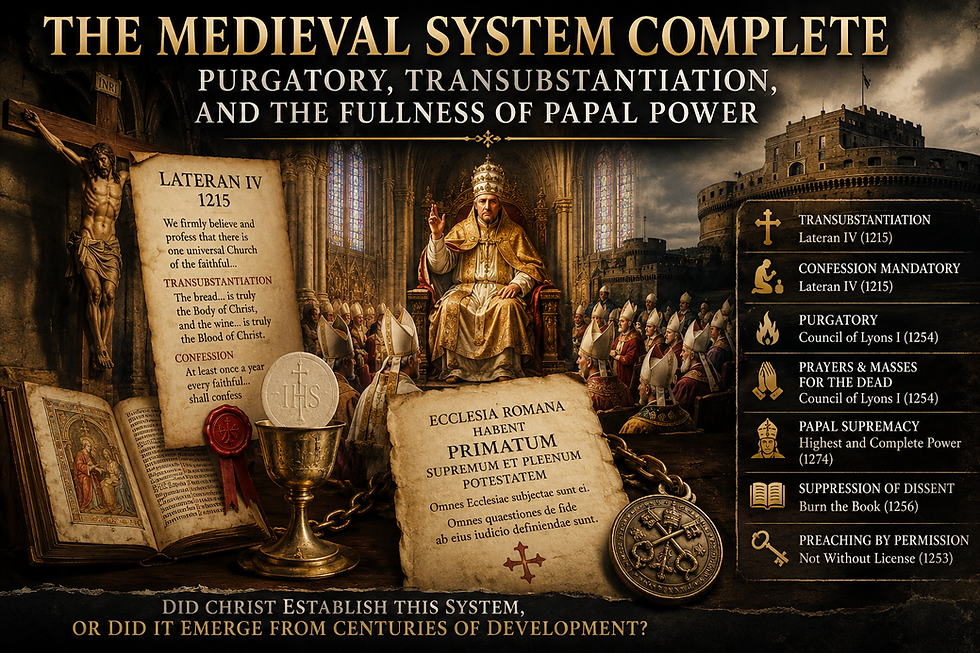
The Medieval System Fully Defined
By the late thirteenth century the Roman Church was no longer merely defending individual doctrines. It was presenting an entire theological system.
This profession of faith reads almost like a summary of everything that had developed throughout the preceding centuries.
Purgatory is affirmed.
Prayers and Masses for the dead are affirmed.
The seven sacraments are affirmed.
Confirmation by bishops is affirmed.
Transubstantiation is affirmed.
The Roman understanding of the Eucharist is affirmed.
And above all, the authority of Rome itself is affirmed.
The most revealing statement appears near the end:
"The same holy Roman Church holds the highest and complete primacy and spiritual power over the universal Catholic Church."
The language is extraordinary.
The claim is not merely that Rome possesses honor.
The claim is not merely that Rome occupies first place among bishops.
The claim is not merely that Rome preserves apostolic tradition.
The claim is that Rome possesses:
"highest and complete primacy"
over the entire Church.
The statement continues:
"all questions shall arise regarding faith they ought to be defined by her judgment."
And again:
"all churches are subject to her."
And finally:
"such a plentitude of power rests in her."
This is one of the clearest expressions yet of the medieval papal vision.
The apostles proclaimed:
"For we preach not ourselves, but Christ Jesus the Lord." (2 Corinthians 4:5)
Peter described himself as:
"a fellow elder." (1 Peter 5:1)
When disputes arose in the apostolic age, the appeal was repeatedly made to Scripture, apostolic testimony, and the guidance of the Holy Spirit.
Yet here the final court of appeal increasingly becomes Rome itself.
The progression is striking.
The Church began with Christ as its foundation.
It proclaimed the Gospel.
It gathered around the apostles' teaching.
But century after century additional structures emerged:
patriarchates,
canon law,
sacramental systems,
mandatory confession,
purgatory,
indulgences,
clerical hierarchies,
universal papal jurisdiction.
Each development was defended as a natural unfolding of apostolic truth.
Yet taken together they reveal something much larger than the simple communities described in the New Testament.
By the end of the thirteenth century the Roman Church presents itself not merely as a church among churches, nor even as the leading church among churches, but as the supreme authority over all churches, possessing the right to define doctrine, judge disputes, govern the faithful, and receive the obedience of the entire Christian world.
This raises perhaps the central question of the medieval period.
Did Christ establish such a universal monarchy within His Church?
Or did this structure emerge gradually through centuries of theological development, political change, ecclesiastical centralization, and institutional expansion?
Whatever answer one gives, the claim itself is unmistakable.
The language of this profession is no longer the language of local assemblies gathered in homes.
It is the language of a global institution claiming supreme jurisdiction over the Christian world.
And for that reason this document stands as one of the clearest windows into the mature vision of medieval Roman Catholicism.
Part 6 to follow


Comments