From Christ to Trent: How Far May the Church Go Beyond the Apostles?
- Michelle Hayman

- Jun 6
- 22 min read
Denzinger Part 17
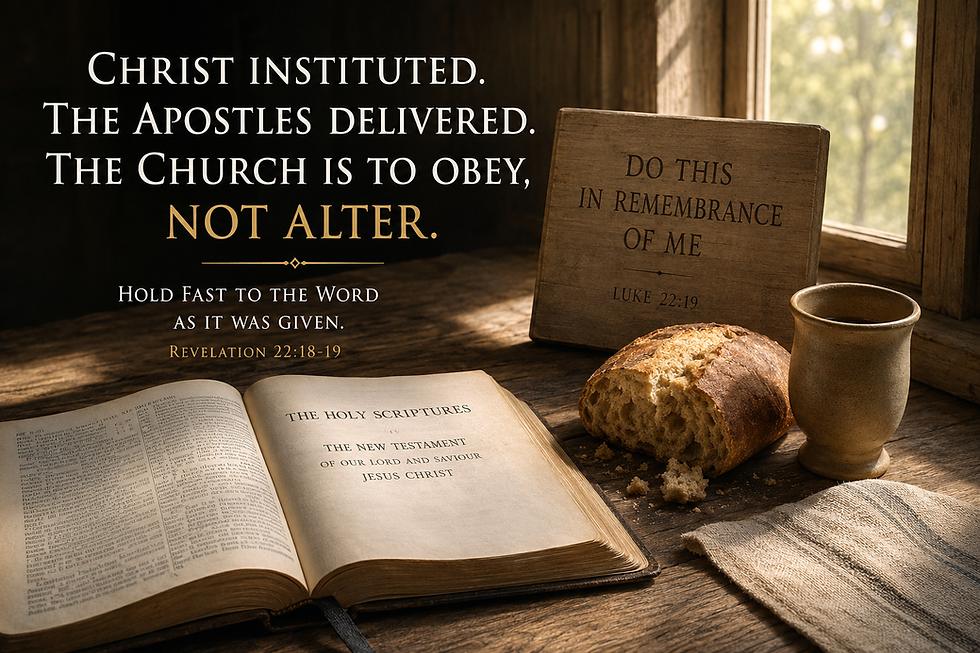
When the institution Becomes the Master of the Mysteries
The text under examination is the passage identified in Denzinger 931, the Council of Trent, Session XXI, chapter 2, “The Power of the Church Concerning the Administration of the Sacrament of the Eucharist.”
The chapter reads as follows
“It [the Council] declares furthermore that this power has always been in the Church, that in the administration of the sacraments, preserving their substance, she may determine or change whatever she may judge to be more expedient for the benefit of those who receive them or for the veneration of the sacraments, according to the variety of circumstances, times, and places. Moreover, the Apostle seems to have intimated this in no obscure manner, when he said: ‘Let a man so account of us as of the ministers of Christ and the dispensers of the mysteries of God’ [I Cor. 4:1]; and that he himself used this power is quite manifest in this sacrament as well as in many other things, not only in this sacrament itself, but also in some things set down with regard to its use, he says: ‘The rest I will set in order when I come’ [I Cor. 11:34]. Therefore holy mother Church, cognizant of her authority in the administration of the sacraments, although from the beginning of the Christian religion the use of both species was not infrequent, nevertheless, since that custom in the progress of time has been already widely changed, induced by weighty and just reasons, has approved this custom of communicating under either species, and has decreed that it be considered as a law, which may not be repudiated or be changed at will without the authority of the Church [can. 2].”
In the corresponding Trent text, canon 2 then pronounces anathema on anyone who says the Church erred in communicating the laity under bread alone.
In clear modern language, Trent is saying that Christ entrusted the sacraments to the Church, and that the Church therefore has authority to regulate how they are administered. The Council does not claim that the Church may abolish a sacrament or destroy what makes it what it is. It claims something more precise and more consequential. It says that the Church may preserve what it calls a sacrament’s “substance” while altering what it judges to be non-essential features of administration. On that basis Trent argues that, although the use of both bread and wine was known from early Christianity, the Church had authority to approve communion under one species for the laity and to make that practice binding. The deepest question is therefore not whether Christ can be wholly received under either species in a given theological system. The deepest question is whether Christ ever gave the Church authority to reclassify elements of His own ordinance as mutable administrative details.
That is where the biblical difficulty begins. Trent’s controlling phrase, “preserving their substance”, is not a phrase drawn from 1 Corinthians 4:1 or 1 Corinthians 11:34. Those verses simply do not articulate a doctrine under which the Church may distinguish an ordinance’s unchangeable essence from its changeable mode and then legislate accordingly. Paul says ministers are “stewards of the mysteries of God”, yet his next sentence states the rule for stewardship: “it is required in stewards, that a man be found faithful.” He also says, in the Eucharistic context itself, “Now I praise you, brethren, that ye remember me in all things, and keep the ordinances, as I delivered them to you,” and then, “I have received of the Lord that which also I delivered unto you.” The movement of the text is therefore reception, transmission, and fidelity. It is not institutional discretion to alter Christ’s ordinance and then call the alteration administrative rather than substantial. When Paul adds, “the rest will I set in order when I come,” he is correcting Corinthian disorder in the assembly, not laying down a principle that later ecclesiastical institutions may change the ordinary form of a sacrament instituted by the Lord.
Scripture repeatedly warns God’s people not to add to or diminish what He has commanded. “Ye shall not add … neither shall ye diminish” is the language of Deuteronomy. “Add thou not unto his words” is the warning of Proverbs, lest one “be found a liar.” Revelation 22, in its immediate context, warns against adding to or taking away from “the words of the prophecy of this book,” and it should not be handled carelessly as though it were a proof-text for every later controversy. Even so, taken together with Deuteronomy 4:2 and Proverbs 30:5–6, it crystallises a canonical principle that runs all through Scripture: God’s word is received, guarded, and obeyed, not augmented or reduced at human pleasure. That principle becomes especially serious when Christ Himself institutes a covenant sign. Numbers 23:19 reminds the reader that God “is not a man, that he should lie,” and therefore when He speaks His people are not at liberty to treat His enacted word as provisional until later authority decides otherwise.
The institution narratives intensify the difficulty for Trent rather than relieve it. In Matthew 26 Christ takes bread and also the cup, and says, “Drink ye all of it.” Luke 22 presents the bread and then the cup again, with the words, “This cup is the new testament in my blood.” Paul’s account in 1 Corinthians 11 is the same pattern. He says he “received of the Lord” this tradition, recounts bread and cup, and then expressly links the cup to the church’s continuing proclamation: as often as believers eat this bread and drink this cup, they show the Lord’s death till He come. The issue is not whether later theologians can argue that Christ is present under either species within their own sacramental system. The issue is that Christ instituted a sign-form of bread and cup, and the apostolic witness describes the church as continuing in that sign-form. No text in the Gospels or in Paul says that the gathered church may later receive only one element because a subsequent authority has judged the other to belong merely to administration.
The apostolic pattern confirms the same point. Acts says that the first believers “continued stedfastly in the apostles’ doctrine and fellowship, and in breaking of bread, and in prayers.” That summary statement is not by itself a detailed liturgical script, but the more explicit witnesses that stand beside it point in the same direction. The Didache opens its Eucharistic thanksgiving with the words, “First, concerning the cup,” and then turns to “the broken bread.” Justin Martyr, in one of the earliest extended descriptions of Christian worship, says that “bread and wine and water are brought” and that there is “a distribution to each” of what has been consecrated. Even the Catholic historical tradition acknowledges that public communion in church was ordinarily under both kinds through the first centuries, while also noting exceptional one-kind administrations in special cases such as the sick, domestic reservation, or child communion. That distinction matters. Acknowledging occasional exceptions does not alter the evidence for the ordinary public pattern of the gathered church. Trent is rebutting that ordinary pattern not by an explicit dominical command but by a later theory of authority.
The question of authority must therefore be faced directly. Christ’s authority is absolute. The apostles’ authority is unique, foundational, and unrepeatable in the history of redemption. Acts 1 defines the replacement of Judas in terms of a man who had accompanied Jesus from John’s baptism and who must become “a witness … of his resurrection.” Paul speaks of “the signs of an apostle.” Ephesians 2:20 says the household of God is “built upon the foundation of the apostles and prophets, Jesus Christ himself being the chief corner stone.” A foundation is laid, not perpetually relaid. That is why the New Testament distinguishes apostles from later continuing ministries. In Ephesians 4 and 1 Corinthians 12, apostles are named distinctly before pastors, teachers, helps, and governments. Later overseers have real responsibilities, but those responsibilities are pastoral and custodial. Acts 20 tells overseers to shepherd the church God purchased with His own blood. Titus 1:9 says an elder must hold fast the faithful word “as he hath been taught.” Hebrews 13:17 gives leaders genuine authority because they watch for souls and must give account, yet that text gives them no licence to modify Christ’s ordinance. None of these passages makes the leap from pastoral oversight to a later episcopal or conciliar right to determine what in Christ’s "institution" may be changed.
This is where the New Testament understanding of the Church becomes decisive. The true Church is the ekklesia: the assembly Christ gathers to Himself by His word and Spirit. Lexically, ekklesia denotes an assembly or gathering; theologically, the New Testament presents that assembly as one created by Christ’s own call. Jesus says, “My sheep hear my voice,” and He says that He knows them and they follow Him. Paul says that by one Spirit believers are baptised into one body. Peter addresses believers as “a royal priesthood,” and Revelation says that Christ has made His people “kings and priests unto God.” Hebrews then draws the practical conclusion: believers have “boldness to enter into the holiest by the blood of Jesus” and are told, “Let us draw near.” The Church, then, is not first a self-authorising hierarchy standing over Christ’s people and deciding the limits of their covenant signs. It is the congregation of those whom Christ Himself calls, indwells, and joins to His body. Its ministers serve that body; they do not become lords of the ordinances by which Christ nourishes it.
The historical development that Trent itself admits only sharpens the problem. Trent says that from the beginning of Christianity the use of both kinds “was not infrequent”, but that the custom was later “very widely changed”. A Catholic historical survey goes further and states that public communion in the churches was ordinarily under both kinds down to the twelfth century, while also explaining that the thirteenth century saw the “gradual abolition” of communion under the species of wine for the laity. The Council of Constance in 1415 then declared that, although Christ instituted the sacrament under both bread and wine, it was possible for the Church to observe the custom whereby the laity received “only under the form of bread.” Trent in 1562 did not uncover an overlooked apostolic command. It ratified a medieval development and defended the mechanism by which that development had been justified. Even the brief illustration of Ambrose of Milan shows why later episcopal office must not be romanticised into automatic apostolic equivalence. Britannica records that Ambrose was unexpectedly acclaimed bishop in 374 and passed from unbaptised layman to bishop in eight days. Whatever one thinks of Ambrose’s later importance, that history is enough to show that later episcopal office cannot simply be equated with the unique, directly constituted authority of Christ’s apostles.
Trent’s argument also suffers from a striking circularity. The Council claims that the Church may alter sacramental administration while preserving sacramental substance, but Scripture nowhere gives the Church a list separating those two categories in this matter. The Church therefore defines the category, claims authority over the category, and then invokes the authority it has claimed in order to validate the definition it has made. That is why the argument feels so final inside its own system and so unproved outside it. If the Church alone may decide what is substantial, and if the Church’s decision is itself the proof of the Church’s right to decide, then the debate has been settled by circular reasoning rather than by apostolic demonstration. Paul’s own language breaks that circle. He does not say, “I judged the Supper’s deeper substance and therefore altered its outward form.” He says, “I received” and “I delivered.” He praises churches for keeping the ordinances as delivered. He requires stewards to be faithful. That is not the rhetoric of sacramental revision. It is the rhetoric of covenant trust.
The Christological test exposes the deepest weakness in Trent’s claim. Does this doctrine magnify Christ, preserve direct access to the Father through Him, and safeguard the sufficiency of His finished work, or does it shift decisive weight onto institutional mediation and control? The New Testament answer is clear. “There is one God, and one mediator between God and men, the man Christ Jesus.” Christ says, “I am the way … no man cometh unto the Father, but by me.” Romans says that, being justified by faith, “we have peace with God” and “access by faith into this grace.” Hebrews says that Jesus has an “unchangeable priesthood,” that He saves those who come to God “by him,” that by one offering He has perfected His people for ever, and that because of His blood believers may enter the holiest and come boldly to the throne of grace. Those texts do not abolish church order, pastoral care, or sacramental observance. They do, however, insist that the Church exists under Christ’s mediatorial supremacy, not as a parallel source of authority empowered to reshape His own ordinances at will.
For that reason the sharpest rebuttal to Denzinger 931 is not a denial that churches must arrange practical matters of time, place, and order. Of course they must. The issue is whether Christ gave the Church authority to alter the ordinary sign-form of a covenant ordinance that He Himself instituted and that the apostles delivered. Trent says yes, but it does so by asserting a power that Scripture never expressly grants and by appealing to texts that speak instead of faithful stewardship, orderly correction, and preservation of what has been received. Scripture calls the Church back to a different posture. The apostles warn believers not to preach another gospel, to guard the deposit, to hold fast the faithful word, and to contend for the faith once delivered to the saints. The true Church is the assembly Christ gathers by His voice, the body purchased by His blood, and the royal priesthood that draws near to God through Him. Where Christ has spoken, believers do not need a later institution to tell them that obedience may be replaced by authorised modification. They need to hear the Shepherd, hold fast what was delivered, and rest in the sufficiency of the Son who has given Himself once for all.
The conclusion, then, is as serious as the claim Trent makes. If no text of Christ or His apostles teaches that the Church may change an ordinance’s administration while “preserving” its substance, then the central principle of Denzinger 931 is not apostolic doctrine but later theological construction. If the institution narratives and the apostolic witness present bread and cup as the ordinary form of the Lord’s Supper, then the medieval restriction of the cup to the laity is a historical development rather than a demonstrated command of God. If apostolic authority was foundational and unrepeatable, then later episcopal and conciliar claims must be judged by the apostolic word, not confused with it. And if believers are indeed Christ’s flock, Christ’s body, and a royal priesthood with access to God by the blood of Jesus, then the final appeal must not be to “holy mother Church” as an authority above the text, but to Christ Himself, to the Scriptures God has given, to the apostles He chose, and to the gospel that directs sinners not to institutional sovereignty but to the crucified and risen Son.
When Baptism Replaces New Birth
Denzinger 933, from the Council of Trent, Session XXI, Chapter 4, is not only a statement about little children and the Eucharist. It is also a revealing statement about baptism, regeneration, original sin, sacramental grace, and the way the institutional Church came to treat infants as already incorporated into Christ through a ritual act. The chapter appears modest at first, because it simply says that little children are not bound to receive sacramental Communion. Yet the reason Trent gives for this conclusion exposes a much larger theological system.
Trent declares:
“Finally, the same holy Synod teaches that little children without the use of reason are not bound by any necessity to the sacramental communion of the Eucharist, since having been ‘regenerated’ through ‘the laver’ of baptism [Tit. 3:5], and having been incorporated with Christ they cannot at that age lose the grace of the children of God which has already been attained.”
In modern language, Trent is saying that infants do not need to receive the Eucharist because baptism has already regenerated them. According to this reasoning, the baptized child has already been incorporated into Christ, already possesses the grace of the children of God, and cannot yet lose that grace because the child has not reached the age of reason. Trent therefore rejects the idea that infant Communion is necessary for salvation, while still assuming that infant baptism has already made the child regenerate.
This is the crucial point. Trent is not arguing that little children are safe because Christ receives them, because they are without moral knowledge, or because the kingdom belongs to such as these. Trent is arguing that baptized infants have already received regeneration through water baptism. The Eucharist (rememberance meal) is unnecessary for them because baptism has already accomplished their incorporation into Christ.
That claim needs to be tested carefully against Scripture.
The first difficulty is that Scripture nowhere plainly teaches that a child inherits Adam’s personal guilt in such a way that the child must be sacramentally cleansed by water baptism before being received by God. Scripture certainly teaches that death entered the world through Adam and that humanity is deeply affected by sin. Romans 5:12 says, “By one man sin entered into the world, and death by sin.” Yet the question is not whether Adam’s fall affected the human race. The question is whether Scripture teaches that infants are personally guilty before conscious sin and must therefore be regenerated by sacramental baptism.
Ezekiel gives a direct principle of moral accountability:
“The son shall not bear the iniquity of the father, neither shall the father bear the iniquity of the son” (Ezekiel 18:20).
This text does not deny that sin has consequences across generations. It does not deny that children can suffer in a fallen world because of the sins of others. But it does deny the principle that a child is personally guilty for the father’s sin. Ezekiel’s argument is moral and judicial. The soul that sins shall die. The righteous son is not condemned for the wickedness of the father. The wicked son is not saved by the righteousness of the father. Each person stands before God in moral responsibility.
This creates a serious tension with a system that treats infants as needing sacramental regeneration from inherited guilt before they have any knowledge of good and evil. Scripture itself recognizes that children can exist before moral discernment. Deuteronomy speaks of “your children, which in that day had no knowledge between good and evil” (Deuteronomy 1:39). The point is not that children are divine or sinless in an ultimate metaphysical sense. The point is that Scripture recognizes a real distinction between fallen human nature and accountable moral rebellion. Little children are not treated as conscious covenant rebels who must be restored through a priestly sacramental mechanism.
Christ’s own treatment of children is especially important. When the disciples tried to hinder children from coming to Him, Jesus did not command that they be sacramentally regenerated before they could belong to the kingdom. He said:
“Suffer little children, and forbid them not, to come unto me: for of such is the kingdom of heaven” (Matthew 19:14).
Mark records the same event with even greater tenderness:
“Suffer the little children to come unto me, and forbid them not: for of such is the kingdom of God” (Mark 10:14).
Luke also records Christ saying:
“Suffer little children to come unto me, and forbid them not: for of such is the kingdom of God” (Luke 18:16).
Christ does not speak of infants as excluded from God until a sacramental rite incorporates them. He receives them. He blesses them. He presents them as belonging, in some profound sense, to the kingdom’s pattern. He says that the kingdom of God belongs to such as these. This does not establish automatic universalism, and it does not answer every question about children and salvation. But it does strongly challenge any system that makes the child’s safety rest on sacramental administration rather than Christ’s own reception of the little ones.
The second difficulty is Trent’s use of Titus 3:5. Trent appeals to “the laver of baptism,” referring to Paul’s words:
“Not by works of righteousness which we have done, but according to his mercy he saved us, by the washing of regeneration, and renewing of the Holy Ghost” (Titus 3:5).
The question is whether Paul is teaching that the external act of water baptism automatically regenerates an infant apart from conscious faith, repentance, and reception of Christ. The text itself does not say that. Paul speaks of salvation by God’s mercy, through the washing of regeneration and renewing of the Holy Ghost. The renewing agent explicitly named is the Holy Spirit. The emphasis is not on water as a mechanical instrument but on divine renewal by the Spirit.
This agrees with the wider New Testament. John the Baptist distinguishes his water baptism from the greater baptism of Christ:
“I indeed baptize you with water unto repentance: but he that cometh after me is mightier than I... he shall baptize you with the Holy Ghost, and with fire” (Matthew 3:11).
This distinction is fundamental. Water baptism is outward. The baptism that truly saves and renews is the work of Christ by the Holy Spirit. John can apply water, but Christ gives the Spirit. A minister can perform an outward sign, but only God can give new birth.
Jesus says the same thing to Nicodemus:
“Except a man be born again, he cannot see the kingdom of God” (John 3:3).
He then explains:
“That which is born of the flesh is flesh; and that which is born of the Spirit is spirit” (John 3:6).
The new birth is not presented as a humanly controlled ecclesiastical operation. It is the sovereign work of the Spirit.
Jesus says:
“The wind bloweth where it listeth... so is every one that is born of the Spirit” (John 3:8).
That verse cuts against any system that treats regeneration as automatically attached to a sacramental action performed by the Church. The Spirit is not bound by ecclesiastical machinery. The Spirit gives life. The Church may bear witness, preach the Gospel, baptize believers, and teach disciples, but the Church does not command the Spirit by ritual administration.
The New Testament pattern consistently joins baptism with repentance, faith, and reception of the word. In Acts 2, Peter says:
“Repent, and be baptized every one of you in the name of Jesus Christ” (Acts 2:38).
The same chapter then says:
“Then they that gladly received his word were baptized” (Acts 2:41).
In Acts 8, the Samaritans believe Philip’s preaching and are baptized. In Acts 8, the Ethiopian eunuch asks to be baptized after hearing Christ preached from Isaiah. In Acts 10, Cornelius and his household receive the Holy Spirit before water baptism, proving that water itself is not the cause of regeneration.
Peter says:
“Can any man forbid water, that these should not be baptized, which have received the Holy Ghost as well as we?” (Acts 10:47).
That order is devastating to a mechanical sacramental theory. They received the Holy Spirit, and then they were baptized with water. The water followed the inward divine work. It did not produce it.
Peter later interprets that event by saying:
“And God, which knoweth the hearts, bare them witness, giving them the Holy Ghost, even as he did unto us; and put no difference between us and them, purifying their hearts by faith” (Acts 15:8-9).
The purification of the heart is by faith. It is not said to be by infant water baptism. God knows the heart. God gives the Spirit. God purifies by faith.
This also explains Peter’s statement in 1 Peter 3:21:
“The like figure whereunto even baptism doth also now save us.”
If the sentence ended there, sacramentalism might appear stronger. But Peter immediately clarifies:
“Not the putting away of the filth of the flesh, but the answer of a good conscience toward God.”
Peter explicitly refuses to locate saving baptism in the mere external washing of the body. The outward washing is not the saving essence. The saving reality concerns the conscience before God through the resurrection of Jesus Christ. Baptism saves as a figure joined to the inward appeal, answer, or pledge of a conscience toward God. That cannot be reduced to water applied to an uncomprehending infant.
The third difficulty is that Trent treats incorporation into Christ as something already accomplished in little children through baptism. Yet the New Testament consistently describes union with Christ in relation to faith.
John writes:
“As many as received him, to them gave he power to become the sons of God, even to them that believe on his name” (John 1:12).
The children of God are those who receive Christ and believe in His name. John does not say that those who receive water baptism apart from personal faith are thereby made children of God. He says that those who receive Christ are given the right to become children of God. The following verse emphasizes that this birth is not of blood, nor of the will of the flesh, nor of the will of man, but of God.
Paul says:
“Ye are all the children of God by faith in Christ Jesus” (Galatians 3:26).
Again, sonship is linked to faith in Christ Jesus. Baptism is then mentioned in the next verse, but in the context of faith. Paul does not present baptism as a rite that creates faithless incorporation. He presents baptism as the outward sign of belonging to Christ by faith.
Romans 6 speaks of baptism into Christ’s death and resurrection, but the entire passage addresses believers who are being exhorted to live consistently with their union with Christ. Paul says:
“Reckon ye also yourselves to be dead indeed unto sin, but alive unto God through Jesus Christ our Lord” (Romans 6:11).
That exhortation presupposes moral understanding. It is not addressed to unconscious infants. It explains what baptism signifies for those who are called to live by faith in Christ’s death and resurrection.
The fourth difficulty is that Trent’s reasoning quietly creates a sacramental security for infants that is not stated in the New Testament. It says that baptized children “cannot at that age lose the grace of the children of God which has already been attained.” But Scripture does not define children’s standing before God by saying that baptized infants possess sacramental grace which they cannot yet lose. Scripture speaks instead of Christ receiving little children, of children lacking knowledge of good and evil, and of salvation belonging to those who receive Christ, believe in Him, and are born of the Spirit.
This does not mean that little children are rejected by God. On the contrary, Christ’s words strongly oppose that fear. The point is that their hope rests in Christ Himself, not in a sacramental system. The Lord who said “of such is the kingdom of God” is a safer foundation than an ecclesiastical theory of baptismal regeneration.
The fifth difficulty is that Trent’s statement exposes a broader pattern in which the Church claims authority to define invisible grace by visible administration. In Chapter 2, Trent claimed authority to change sacramental administration while preserving substance. In Chapter 3, it claimed that Christ whole and entire is received under either species. In Chapter 4, it now claims that infants are regenerated through the laver of baptism and incorporated into Christ before conscious faith. The same system is operating throughout. The institutional defines the sacrament, administers the sacrament, controls the sacrament, and then declares what grace has been conferred by the sacrament.
The New Testament gives a different emphasis. Christ gives life. The Spirit gives birth. The Gospel calls for faith. Baptism bears witness to union with Christ. The Church receives and guards what was delivered. The Church does not become the mechanism by which invisible grace is presumed to be dispensed apart from the personal call of Christ and the work of the Holy Spirit.
This matters because God is not a liar.
Numbers 23:19 declares:
“God is not a man, that he should lie; neither the son of man, that he should repent.”
God’s word is true. If God tells us that His children are those who receive Christ, then we must not replace that with another foundation. If Christ says that the little children are not to be hindered because the kingdom belongs to such as these, then we must not imply that they are outside until sacramentally incorporated. If Scripture says that the son shall not bear the iniquity of the father, then we must be careful before building a doctrine that treats infants as personally condemned by Adam’s guilt in a way requiring ecclesiastical cleansing.
Proverbs 30:5-6 gives the warning:
“Every word of God is pure... Add thou not unto his words, lest he reprove thee, and thou be found a liar.”
This principle is directly relevant. The danger is not only denying Scripture. The danger is adding a theological system on top of Scripture and then treating that system as though God had spoken it. Scripture teaches the reality of the Fall. Scripture teaches the universality of human sin. Scripture teaches that death entered the world through Adam. Scripture teaches the necessity of being born again. Scripture teaches water baptism as an outward sign and the baptism of the Holy Spirit as the saving work of God. Scripture teaches the work of the Holy Spirit. Scripture teaches that Christ receives little children. But Scripture does not plainly teach that infants inherit Adam’s personal guilt, are regenerated by water baptism apart from faith, and are thereby incorporated into Christ through a sacramental act administered by the Church.
The apostolic pattern also gives no clear example of infant baptismal regeneration. The baptisms in Acts are connected with preaching, hearing, repentance, faith, receiving the word, and receiving the Holy Spirit. Household baptisms are sometimes cited, but the text never says that unconscious infants were baptized or that they were regenerated apart from faith. That conclusion is inferred. It is not demonstrated. A doctrine this weighty should not rest on silence.
The true Church is the ekklesia, the called-out assembly belonging to Christ. It is composed of those whom Christ calls, those who hear His voice, and those who belong to Him. Jesus says:
“My sheep hear my voice, and I know them, and they follow me” (John 10:27).
"He that is of God heareth God's words: ye therefore hear them not, because ye are not of God."
John 8:47 (KJV)
The Church is not fundamentally a sacramental registry. It is Christ's flock. It is His body. It is His temple. It is His bride. It is the people called by His voice and born by His Spirit. God repeatedly forbids the making and veneration of religious images, saying, "Thou shalt not bow down thyself to them, nor serve them" (Exodus 20:5). The true Church therefore cannot be defined merely by outward succession or institutional claims. It is recognized by those who hear the voice of Christ, believe His word, and obey His commandments, even when that obedience stands against long-established religious traditions.
Peter says of believers:
“Ye are a chosen generation, a royal priesthood, an holy nation, a peculiar people” (1 Peter 2:9).
This royal priesthood does not need a sacramental hierarchy to mediate childhood before God. Believers come to God through Christ.
Hebrews says:
“Having therefore, brethren, boldness to enter into the holiest by the blood of Jesus” (Hebrews 10:19).
The access of God’s people rests on the blood of Christ, not on a clerical administration of water. Baptism matters because Christ commanded it, but water is not the Savior. The Church administers the sign. Christ gives the reality. The minister applies water. The Spirit gives life.
Therefore, Trent’s statement about little children is not a harmless pastoral clarification. It rests on a series of assumptions that must be challenged from Scripture. It assumes that baptism regenerates infants. It assumes that infants are incorporated into Christ through the sacramental act. It assumes that the grace of divine childhood is attained through baptism before personal faith. It assumes that the Church may speak authoritatively about the invisible state of the child because the Church has administered the visible rite.
But Scripture gives a more direct and safer testimony. Little children are received by Christ. Children without knowledge of good and evil are not treated as conscious rebels. The son does not bear the iniquity of the father. Those who receive Christ and believe in His name are children of God. Those who are born of the Spirit belong to the kingdom. Baptism is the outward sign of the inward reality, not the automatic cause of regeneration apart from the Spirit’s work.
The final question, therefore, is not whether children need the Eucharist. Trent is correct to deny that little children must receive sacramental Communion in order to be saved. The deeper issue is why Trent says they do not need it. Trent argues that they do not need it because water baptism has already regenerated them and incorporated them into Christ. Scripture points in a different direction. Little children are not presented as recipients of sacramental regeneration, but as those whom Christ Himself receives. Jesus says, "Suffer little children to come unto me, and forbid them not: for of such is the kingdom of God" (Luke 18:16). Their acceptance is grounded not in a rite administered by the Church, but in the mercy, grace, and welcome of Christ Himself. The New Testament consistently teaches that those who hear the Gospel and come to Christ do so through faith, yet little children are repeatedly treated as a special case by the Lord, who receives them before any discussion of sacramental incorporation. The Church therefore has no warrant to replace Christ's welcome with a doctrine of baptismal regeneration. Salvation is of the Lord. New birth is by the Spirit. The children of God belong to Him because of His grace and calling, not because an ecclesiastical ceremony has conferred regeneration upon them.
The confidence of the believer must therefore return to Christ Himself. Christ receives the little children. Christ baptizes with the Holy Spirit. Christ gives life. Christ calls His sheep by name. Christ opens the way to the Father by His blood. The Church may administer water, but it cannot manufacture regeneration. The Church may teach water baptism, but it must not replace the mystery of the Spirit’s work with an institutional claim. The true foundation is not ecclesiastical control of sacramental grace, but the living Christ who said, “Suffer little children to come unto me, and forbid them not: for of such is the kingdom of God.”


Comments