The Doctrine Scripture Never Wrote

Updated: Aug 5
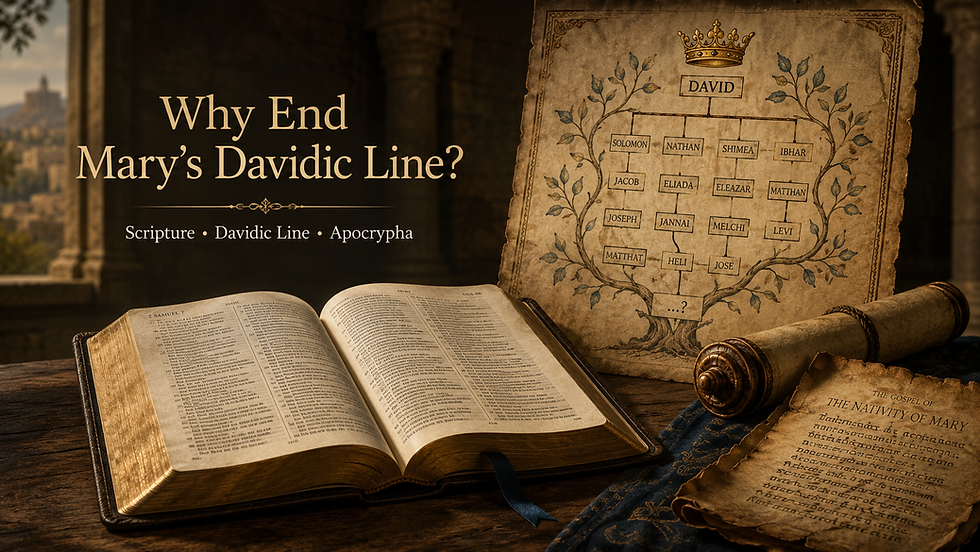
Why Would God End Mary’s Davidic Line?
The doctrine of Mary’s perpetual virginity is not the doctrine of the virgin conception. Scripture plainly teaches that Mary was a virgin when Jesus Christ was conceived by the Holy Ghost. Matthew and Luke establish that truth beyond dispute. The question is whether Mary continued to abstain permanently from normal marital relations with Joseph after Christ was born. On that point, Scripture never says that she did.
That silence is especially important because Scripture is fully capable of stating when a woman has not known a man, when her virginity is relevant, and when an unmarried condition continues until death. The Bible does not leave such matters to centuries of speculation when they form part of the truth God intends His people to believe.
The doctrine of perpetual virginity therefore rests not on an explicit apostolic statement but on a later interpretation of biblical silence, supported by an apocryphal infancy narrative and maintained through increasingly elaborate explanations of the ordinary language of the Gospels.
When Scripture Means to Record Virginity, It Records It
The relevant passage concerning Jephthah’s daughter is Judges 11:39:
“And it came to pass at the end of two months, that she returned unto her father, who did with her according to his vow which he had vowed: and she knew no man.” — Judges 11:39
There are two major interpretations of her fate. One holds that Jephthah actually sacrificed her. Josephus understood the account that way, writing that Jephthah sacrificed his daughter as a burnt offering, while condemning the act as unlawful and unacceptable to God. The other interpretation holds that she was dedicated to permanent virginity and never married.
The argument here does not depend upon settling that dispute. Under the sacrifice interpretation, Scripture explicitly records that she died without ever knowing a man. Under the permanent-dedication interpretation, Scripture explicitly records the very condition that defined the remainder of her life. Either way, her virginity is not supplied by later tradition. It is written in the inspired account.
The same biblical precision appears elsewhere. Rebekah is described as:
“A virgin, neither had any man known her.” — Genesis 24:16
This is stronger than merely calling her a young woman. Her virginity is stated, and the meaning is reinforced by the words “neither had any man known her.”
Concerning Abishag, Scripture says:
“But the king knew her not.” — 1 Kings 1:4
Mary herself says:
“How shall this be, seeing I know not a man?” — Luke 1:34
Philip’s daughters are described as:
“Four daughters, virgins, which did prophesy.” — Acts 21:9
Paul distinguishes between a married woman and a virgin in 1 Corinthians 7:34. Scripture therefore has no difficulty identifying virginity when it exists and when it matters to the subject under discussion.
But none of these descriptions automatically establishes perpetual virginity. Calling a woman a virgin describes her condition at the time unless the text adds something showing that the condition continued for life. That is precisely why Judges 11 is significant. The narrator does not merely introduce Jephthah’s daughter as a virgin; he closes her story by stating that “she knew no man.”
There is no corresponding statement about Mary after the birth of Christ. Scripture never says, “Mary knew no man all the days of her life.” It never says that she vowed perpetual virginity. It never says that Joseph became the guardian of a consecrated temple virgin rather than her husband. It never says that they mutually agreed to live permanently without marital relations. It never says that Mary remained a virgin until her death.
If this condition were essential Christian doctrine, the absence is extraordinary.
What Scripture Actually Says About Mary
Scripture teaches that Mary was a virgin when Christ was conceived:
“Now the birth of Jesus Christ was on this wise: When as his mother Mary was espoused to Joseph, before they came together, she was found with child of the Holy Ghost.” — Matthew 1:18
The words “before they came together” protect the truth of Christ’s divine conception. They exclude Joseph from His conception. Yet the expression also assumes that Mary and Joseph were an ordinarily betrothed couple for whom “coming together” would normally follow.
The angel did not tell Joseph to withdraw from Mary or become the custodian of a woman who had made an undisclosed vow never to fulfil the ordinary duties of marriage. He said:
“Joseph, thou son of David, fear not to take unto thee Mary thy wife.” — Matthew 1:20
Joseph obeyed:
“Then Joseph being raised from sleep did as the angel of the Lord had bidden him, and took unto him his wife.” — Matthew 1:24
Matthew then writes:
“And knew her not till she had brought forth her firstborn son: and he called his name JESUS.” — Matthew 1:25
The purpose of the statement is unmistakable: Joseph did not have sexual relations with Mary before Christ’s birth. That establishes that Joseph was not Christ’s biological father.
But Matthew could easily have written that Joseph never knew Mary. He did not. He wrote that Joseph “knew her not till she had brought forth her firstborn son.”
Defenders of perpetual virginity correctly observe that the word “till” does not invariably prove that a condition changed afterward. Scripture sometimes uses “until” without requiring the opposite condition to begin immediately afterward. Therefore, Matthew 1:25 should not be isolated and treated as though the single word “till” mathematically proves subsequent intercourse.
Nevertheless, language must be read in its natural context. Matthew has already said that Mary became pregnant “before they came together.” Joseph is then commanded to take Mary as his wife. He does so, but abstains from knowing her “till” Jesus is born. The cumulative narrative naturally distinguishes the period before Christ’s birth from the marriage that followed it.
The perpetual-virginity interpretation requires the reader to believe that “before they came together” describes something that never happened, that Joseph took Mary as his wife without the ordinary marriage relationship, and that “knew her not till” was deliberately chosen even though he never knew her afterward. That reading is possible only after the doctrine has already been assumed. It is not the conclusion an ordinary reader would derive from Matthew alone.
Yadaʿ and Ginōskō: What It Means to “Know” a Man or Woman
The Hebrew verb yadaʿ fundamentally means “to know.” It can refer to knowledge, recognition, understanding or personal acquaintance. In certain contexts it functions as a reverent biblical expression for sexual relations:
“And Adam knew Eve his wife; and she conceived.” — Genesis 4:1
The context makes the meaning undeniable. Adam’s “knowing” Eve resulted in conception.
The Greek verb ginōskō likewise normally means “to know,” but it carries the same sexual meaning in biblical usage. The Greek Old Testament uses it in Genesis 4:1, and the New Testament uses it in Mary’s question:
“Seeing I know not a man.” — Luke 1:34
It is also the verb used in Matthew 1:25 when Joseph “knew her not.”
Mary was not saying that she had never met or spoken with a male person. She meant that she had not had sexual relations with a man. Matthew likewise means that Joseph did not have marital relations with her before the birth of Jesus.
This language supplies another important argument. If Matthew intended to reveal perpetual abstinence, “Joseph never knew her” would have been direct and unmistakable. Instead, the abstinence is expressly connected to the period preceding Christ’s birth.
Mary’s Question Does Not Reveal a Secret Vow
One Roman Catholic argument claims that Mary’s words, “How shall this be, seeing I know not a man?” prove that she had already vowed perpetual virginity. Otherwise, it is argued, a betrothed woman would have understood that she would eventually conceive through her husband.
But that conclusion is not present in the text. Mary asks how the announced conception will happen because she presently knows no man. The angel answers by explaining that this conception will not await normal marital relations:
“The Holy Ghost shall come upon thee, and the power of the Highest shall overshadow thee.” — Luke 1:35
Nothing in the exchange says, “I have vowed never to know a man.” Nothing says Joseph was informed before the betrothal that the marriage would never be consummated.
Indeed, the theory creates the very difficulty the apocryphal stories later attempted to solve.
Why would a woman who had vowed lifelong virginity enter an ordinary Jewish betrothal without Scripture explaining the arrangement? Why would Joseph be repeatedly called her husband? Why would the angel command him to take her as his wife rather than to become guardian of a consecrated virgin?
The simplest answer is that Mary had made no such vow. She was a genuinely betrothed virgin who expected an ordinary marriage, but God caused her to conceive Christ miraculously before that marriage was consummated.
Marriage Was Not a Defilement from Which Mary Needed Protection
The doctrine also rests on an ascetic assumption that marital intercourse would somehow have made Mary less holy after bearing Christ. Scripture teaches no such thing.
“Marriage is honourable in all, and the bed undefiled.” — Hebrews 13:4
Marital relations are not a desecration of the body. They belong to the marriage covenant instituted by God. Paul teaches that husbands and wives possess mutual marital obligations and should not permanently withhold themselves from one another:
“Defraud ye not one the other, except it be with consent for a time, that ye may give yourselves to fasting and prayer; and come together again, that Satan tempt you not for your incontinency.”—1 Corinthians 7:5, KJV
A mutually agreed period of abstinence for prayer is permitted, but Paul says that the spouses should “come together again.” Permanent marital abstinence is not presented as the ordinary form of Christian marriage.
Therefore, the objection is not that God lacked the power to command Mary and Joseph to live permanently without relations. God could have done so. The objection is that Scripture never says He did. A doctrine requiring such an exceptional marriage arrangement cannot be established by treating marriage itself as spiritually unworthy of the woman who bore Christ.
Mary’s holiness did not depend on rejecting God’s institution of marriage. Having further children would not have contaminated Christ, reversed the virgin conception, entered retrospectively into His paternity, or diminished His divine identity.
“Firstborn” Is Not Enough by Itself, but It Belongs to the Cumulative Evidence
Luke writes:
“And she brought forth her firstborn son.” — Luke 2:7
The word “firstborn” does not, by itself, prove that Mary later bore another child. Under the law, the child who first opened the womb was called the firstborn even if no later child was born. The Roman Catholic answer on this narrow point is valid.
Yet that does not make “firstborn” meaningless. It is part of a larger pattern. Jesus is called Mary’s firstborn; Matthew says Joseph abstained until His birth; and the Gospels repeatedly name Jesus’ brothers and mention His sisters.
No single expression must carry the entire argument. The force lies in the convergence of the evidence.
The Brothers and Sisters of Jesus
The inhabitants of Nazareth asked:
“Is not this the carpenter’s son? is not his mother called Mary? and his brethren, James, and Joses, and Simon, and Judas?” (Jude)
They continued:
“And his sisters, are they not all with us?” — Matthew 13:55–56
Mark gives the same family setting:
“Is not this the carpenter, the son of Mary, the brother of James, and Joses, and of Juda, and Simon? and are not his sisters here with us?” — Mark 6:3
The structure is domestic and specific. His mother is named. Four brothers are named. Multiple sisters are mentioned. These are not vaguely described members of Israel or spiritual brethren. They are presented as the family known to the people of Nazareth.
John distinguishes Jesus’ brethren from His disciples:
“After this he went down to Capernaum, he, and his mother, and his brethren, and his disciples.” — John 2:12
His brethren initially did not believe in Him:
“For neither did his brethren believe in him.” — John 7:5
After the resurrection, they appear with Mary and the apostles:
“These all continued with one accord in prayer and supplication, with the women, and Mary the mother of Jesus, and with his brethren.” — Acts 1:14
Paul refers to “the brethren of the Lord” in 1 Corinthians 9:5 and calls James “the Lord’s brother” in Galatians 1:19.
The ordinary meaning is straightforward: Mary was the mother of Jesus, and Jesus had brothers and sisters.
The Greek word adelphos, “brother,” can sometimes be used more broadly for a fellow believer or a member of the same people. Context determines its meaning. But in a list that names a mother, four brothers and unnamed sisters, the natural family meaning carries enormous weight.
Greek also possessed words for broader relationships. Colossians 4:10 uses anepsios for a cousin. Luke 1:36 describes Elizabeth as Mary’s syngenēs, a relative or kinswoman. The writers were therefore capable of distinguishing a brother from another kind of relation.
The Stepbrother Theory Came from Apocryphal Books
One answer claims that Jesus’ brothers were Joseph’s sons by an earlier marriage. Scripture never says Joseph had been married previously, never calls him a widower, never mentions older sons travelling with Joseph and Mary to Bethlehem, and never explains why these supposed sons are absent from the infancy narratives.
The source of the theory is not apostolic Scripture. Origen openly acknowledged where it came from. Discussing Jesus’ brothers, he wrote that some based the claim on “the Gospel according to Peter” or “The Book of James.” He then identified the motive: they wished to preserve Mary “in virginity to the end.”
That statement is extraordinarily revealing. The interpretation was not first drawn from Matthew and Mark. An apocryphal account supplied Joseph with an earlier wife and children because interpreters already wished to preserve Mary’s lifelong virginity. The narrative was constructed to protect the desired conclusion.
The evidence did not produce the doctrine. The doctrine produced the explanatory story.
Jerome’s Cousin Theory Was Another Later Solution
Jerome rejected the stepbrother explanation and argued that the brothers were cousins or other relatives. His treatise against Helvidius was written around AD 383, showing that Christians were still publicly debating the question centuries after the apostles. Helvidius maintained that Mary and Joseph had children after Christ and appealed to Scripture, Tertullian and Victorinus. Jerome answered him with great hostility.
Jerome declared:
“We do reject what is not written.”
That is a sound principle. Yet he did not apply it consistently. It is not written that Mary vowed lifelong virginity. It is not written that Joseph vowed lifelong virginity. It is not written that Jesus’ named brothers were all cousins. Jerome nevertheless concluded that Joseph remained a virgin because Scripture did not state that he had another wife.
Silence cannot honestly be used in opposite ways. One cannot reject Mary’s normal married life because the text does not explicitly narrate each marital act while simultaneously affirming lifelong virginity which the text never states at all.
Jerome’s argument also reveals an increasingly negative attitude toward marriage. His wider defence of perpetual virginity was tied to his belief in the spiritual superiority of virginity over matrimony. The doctrine was therefore not developing in a theological vacuum. It grew within an ascetic culture that increasingly treated sexual renunciation as a higher state.
Hegesippus Distinguished a Brother from a Cousin
The cousin theory encounters an important historical difficulty in Hegesippus, whose writings survive principally through quotations in Eusebius.
Eusebius reports that after James’s death, Symeon the son of Clopas was chosen to lead the church at Jerusalem. He then explains that Symeon was regarded as a cousin of the Saviour because Clopas was Joseph’s brother.
Yet the same historical tradition calls Jude “the Lord’s brother according to the flesh.”
This distinction matters. Hegesippus was capable of identifying Symeon as a cousin and explaining the exact family connection. He did not describe Jude in that manner. Jude was remembered as the Lord’s brother “according to the flesh.”
That does not produce mathematical certainty about maternity, but it seriously weakens the claim that early Christians simply called every cousin a brother without distinction.
Josephus and James, the Brother of Jesus
Josephus was not writing a defence of Christian doctrine. In his account of the high priest Ananus, the surviving text of Antiquities identifies:
“The brother of Jesus, who was called Christ, whose name was James.”
Josephus then describes James being brought before the Sanhedrin and stoned.
Josephus does not discuss Mary’s later life and cannot by himself determine whether James and Jesus shared the same mother. Nevertheless, his testimony shows that “the brother of Jesus” was not merely an obscure expression created by later readers of the Gospels. James was publicly identifiable by that relationship.
The historical evidence therefore begins with the obvious meaning of the New Testament rather than with perpetual virginity. It is the perpetual-virginity doctrine that requires James to be transformed into a cousin or stepbrother.
Jude’s Grandsons and the Living Line of David
Eusebius preserves an account from Hegesippus concerning two grandsons of Jude during the reign of Emperor Domitian. Eusebius introduces Jude as one “said to have been a brother of the Saviour according to the flesh.” He then records that Jude’s grandsons were accused because they belonged to the family of David and were related to Christ. When Domitian asked whether they were descendants of David, they confessed that they were.
One detail should be corrected. In Eusebius’s surviving account, the two grandsons are not themselves named Judas. Jude or Judas is their grandfather. A later manuscript note gives the grandsons’ names as Zoker and James, but those names do not appear in Eusebius’s quotation itself.
Domitian was reportedly concerned that members of the Davidic royal family might present a political threat. The grandsons explained that they were poor labourers who supported themselves by working a small piece of land. Domitian dismissed them when he understood that Christ’s kingdom was not an earthly political kingdom. Eusebius says they later led churches because they were witnesses and relatives of the Lord.
This testimony has several consequences.
First, the earthly family of Jesus did not disappear from early Christian memory. His relatives were known, and their relationship to Him mattered. James, whom Paul calls “the Lord’s brother,” became one of the principal leaders of the church at Jerusalem. Eusebius, quoting the earlier historian Hegesippus, records that “James, the brother of the Lord, succeeded to the government of the Church in conjunction with the apostles.” He was not the leader of the Jerusalem Temple, although Hegesippus says that he regularly entered the Temple to pray and had become widely respected for his righteousness.
Around AD 62, James was brought before a Sanhedrin assembled by the high priest Ananus and was condemned to be stoned. Josephus specifically identifies him as “the brother of Jesus, who was called Christ, whose name was James.” Ananus acted during the interval after the Roman governor Festus had died but before his successor Albinus had arrived. Josephus says that many of the more conscientious citizens protested because Ananus had assembled the Sanhedrin without the governor’s permission; Albinus threatened him, and King Agrippa removed him from the high priesthood. This is important because it shows both that James was publicly recognised as Jesus’ brother and that his death was not approved by everyone in Jerusalem.
It would not be strictly accurate to say that the very same individual members of the Sanhedrin who condemned Christ also killed James nearly thirty years later. It was, however, the same high-priestly establishment and the same governing institution. In Christ’s case, the religious leaders acknowledged that they could not lawfully execute Him themselves—“It is not lawful for us to put any man to death”—and therefore delivered Him to Pontius Pilate, whose Roman authority carried out the crucifixion. In James’s case, Ananus exploited the temporary absence of a Roman governor and acted before Roman permission could be obtained.
The relationship between the high-priestly leadership and Rome was therefore one of political dependence and mutual advantage rather than true independence. Josephus records that the Roman governor Valerius Gratus repeatedly removed and appointed high priests and ultimately installed Joseph Caiaphas, who remained in office when Pilate succeeded Gratus. The office that claimed to speak for God was consequently maintained at Rome’s pleasure.
John’s Gospel exposes what occupied the minds of these rulers when they considered Christ. Their fear was not principally that He was teaching falsehood, but that “all men will believe on him: and the Romans shall come and take away both our place and nation.” When Pilate asked whether he should crucify their King, the chief priests answered, “We have no king but Caesar.” Their own words reveal leaders more concerned with preserving their position, authority and political security beneath Rome than with receiving the truth standing before them.
This must not be turned into a condemnation of the Jewish people as a whole. Jesus, Mary, Joseph, the apostles, James and the earliest believers were themselves Jewish, and Josephus records that honourable citizens protested against James’s unlawful execution. The guilt belongs to the particular ruling priestly elite who protected their institutional power by accommodating Rome when Rome was useful, yet defied Roman procedure when an opportunity arose to silence James. The same establishment that pressed the Roman governor to crucify Christ later seized a gap in Roman supervision to put the Lord’s own brother to death.
Second, Jude’s descendants were regarded as belonging to the house of David.
Third, the family line continued through children and grandchildren. Early Christian history does not present the Lord’s kindred as a family defined by universal celibacy. It presents a continuing biological family whose Davidic descent was sufficiently well known to attract imperial attention.
Did Mary Belong to the Line of David?
Scripture explicitly identifies Joseph as belonging to David’s house:
“Joseph also went up from Galilee… because he was of the house and lineage of David.” — Luke 2:4
The angel calls him:
“Joseph, thou son of David.” — Matthew 1:20
Scripture does not contain the exact sentence, “Mary was the daughter of David.” Nevertheless, Paul says that Christ:
“Was made of the seed of David according to the flesh.” — Romans 1:3
Since Joseph was not Christ’s biological father, Christ’s physical descent from David must ultimately involve His maternal ancestry, unless “according to the flesh” is emptied of its natural meaning. Mary was Christ’s true biological mother, not merely the container in which an unrelated body developed.
Early Christian writers also preserved traditions about the Davidic ancestry of the Lord’s wider family. Julius Africanus wrote of the desposyni, the relatives belonging to the Saviour’s family, who preserved genealogical information concerning their descent. Hegesippus’s account of Jude’s grandsons likewise identifies them with David’s family.
Why Would God End Mary’s Davidic Branch?
Perpetual virginity would not have extinguished every descendant of David, because David had many sons and many surviving branches. But it would have ended the particular household in which God placed the Messiah. Joseph is explicitly called “thou son of David,” and he went to Bethlehem “because he was of the house and lineage of David” (Matthew 1:20; Luke 2:4). Mary’s Davidic descent is not stated in one equally direct sentence, but it is strongly implied by the declaration that Christ “was made of the seed of David according to the flesh” (Romans 1:3). Since Joseph did not beget Jesus, Christ’s physical descent from David must ultimately have come through Mary. Both the legal household and the physical maternity surrounding Christ therefore belonged to the royal house of David.
Why, then, should Christians assume that God brought the promised King into this Davidic household only to command that household to become permanently barren immediately after His birth? Where does God say that Mary’s royal branch had fulfilled its purpose and must now terminate? Where does He command Joseph never to know his wife? Where does He declare that the lawful marriage bed would somehow be unworthy of two descendants of David after Christ had been born? Scripture says none of these things.
Instead, it names Jesus’ brethren; James, Joses, Simon and Judas, and also refers to His sisters. The natural reading is not that the Davidic household was sealed shut, but that it continued.
The account concerning Emperor Domitian is especially revealing.
Why would a Roman emperor care whether two poor farmers descended from a Jewish king who had died years earlier? Their poverty alone clearly did not answer the first question. Their lineage had brought them before him. David was not merely an ancestor; he was Israel’s royal king, and the promised Christ was proclaimed as David’s heir. Jesus had been executed under the Roman title “King of the Jews.” A living family related to Him, descended from David and attached to a movement proclaiming the return of Christ’s kingdom could therefore be interpreted by a suspicious emperor as the seed of a rival royal claim.
Domitian’s recorded conduct makes that concern historically understandable. Suetonius portrays him as increasingly suspicious of rivals and reports that he executed men on slender allegations of revolutionary ambition. One senator, Mettius Pompusianus, was killed partly because it was commonly reported that his horoscope gave him an “imperial nativity”; that the stars (remember previous posts on astral magic) marked him as a future emperor.
This was not an isolated superstition existing on the margins of Roman society. Rome was a pagan state in which religion, political authority and divination were deeply intertwined. The Senate did not merely debate laws and taxation; it also exercised authority over public religious affairs. Magistrates took auspices before assemblies, elections and military undertakings; augurs interpreted the flight of birds, thunder and lightning; haruspices examined the entrails of sacrificed animals; reported prodigies were brought before the Senate; and the Sibylline oracles were kept under state control and could not be consulted without senatorial authorization.
Many senators also occupied the great Roman priesthoods. Pagan religion was therefore embedded within the machinery of government itself.
Astrology and private magical prediction occupied a more dangerous position. Roman rulers might consult astrologers, interpret dreams, fear omens and claim divine favour, yet the same practices became criminal when they appeared to predict an emperor’s death or identify a possible successor. Casting a ruler’s horoscope could therefore function as a political act, because a prediction that another man was destined to reign could make that man appear to possess divine authorization for the throne. Domitian was particularly controlled by such fears. Suetonius records that astrologers had predicted the time and manner of his own death, while Cassius Dio says that Domitian carefully investigated the birth dates and hours of prominent men and destroyed some merely because their horoscopes appeared to promise imperial power.
Domitian himself worshipped Minerva with what Suetonius describes as excessive superstition, trusted omens concerning the goddess Fortune, feared dreams, lightning and astrological predictions, and condemned diviners whose prophecies threatened him. He could therefore believe in pagan signs while killing those whose interpretation of those signs endangered his rule. The issue was not consistent disbelief in astrology or divination; it was control. Pagan prophecy was tolerated when it confirmed the emperor’s authority and punished when it suggested that heaven had chosen someone else.
This helps explain why Domitian would have taken the descendants of David seriously. In a political culture that attached meaning to bloodlines, omens, prophecies, royal birth and supposed indications of destiny, the surviving relatives of a man executed as “King of the Jews” could not automatically be dismissed as harmless. They belonged to the ancient royal house of David and were connected by blood to Jesus Christ, whose followers proclaimed Him as the promised King who would return. To an emperor already willing to execute a senator because of a threatening horoscope, a living Davidic family associated with an expected kingdom could appear far more dangerous than two poor labourers appeared outwardly. Their royal descent was itself the perceived threat. Domitian even put his own cousin to death on slight suspicion. Whether every hostile story told about Domitian is reliable or not, the picture preserved by Roman historians is of an emperor intensely alert to possible claimants and conspiracies. A recognised Davidic family connected with a man proclaimed as Christ and King would therefore have been politically dangerous in Roman eyes even if its members possessed neither wealth nor weapons.
This is what makes the later perpetual-virginity doctrine so consequential. It does far more than praise Mary’s chastity. It redraws the genealogy of Christ’s own household. It declares that no son or daughter ever proceeded from the marriage of Mary and Joseph after Jesus. James, Joses, Simon and Judas must therefore be removed from Mary’s womb and transformed into cousins or children of a previous wife whom Scripture never mentions.
Jude’s grandsons may remain relatives of Christ and descendants of David, but they can no longer be acknowledged as descendants proceeding from Mary’s own Davidic branch.
The doctrine therefore accomplishes in theology what imperial suspicion attempted to accomplish politically: it prevents the public recognition of a continuing royal family descending from the household in which Christ was born. Domitian sought out David’s descendants because Rome understood that royal blood, messianic expectation and allegiance to another King could become politically explosive. The doctrine of perpetual virginity later ensured that Mary herself could never be regarded as the mother of an ongoing line of Davidic descendants after Christ.
It cannot be proved from the surviving evidence that this political effect was the original reason the doctrine was invented. The earliest surviving narrative promoting the idea, the Protoevangelium of James, arose before Christianity possessed imperial power, and its immediate purpose appears to have been the exaltation of virginity and the protection of Mary from what its author considered bodily defilement. Therefore, it would go beyond the evidence to claim as established fact that the Roman state created the doctrine specifically to erase David’s line.
Nevertheless, the effect of the doctrine is undeniable. Once Rome adopted and enforced perpetual virginity as binding tradition, it required Christians to deny the most natural meaning of the Gospel household. Mary could have no further children. Joseph could never truly know his wife. The named brethren could not be her sons. The descendants of Jude could not continue Mary’s maternal branch. A doctrine never stated by an apostle thus severed the visible connection between the mother of Christ and the later relatives whom early history remembered as members of David’s family.
This raises a question that Rome has never answered from Scripture: Why would God preserve the line of David through centuries of war, exile, foreign occupation and attempted destruction; bring Mary and Joseph together within that royal house; cause the promised Son of David to be born from Mary’s flesh; and then command that their Davidic household must immediately cease—without recording that command anywhere in His word?
God repeatedly acts to preserve the promised seed. The Old Testament records threats against the royal line precisely because the continuation of that line mattered to His promise. Yet when the Gospel names brothers and sisters of Jesus, later tradition reverses the pattern and insists that the very household of the Son of David produced no further children. It turns continuation into impossibility without one verse saying that God desired such an ending.
The burden of proof therefore lies entirely upon those who declare Mary perpetually virgin.
They must not merely show that perpetual abstinence was theoretically possible. They must show where God required it. They must explain why the inspired writers carefully stated when Jephthah’s daughter “knew no man,” yet never made an equivalent statement concerning Mary. They must explain why Matthew wrote that Joseph “knew her not till she had brought forth her firstborn son” rather than saying that he never knew her. They must explain why the Gospels named Jesus’ brothers and sisters in the language of an ordinary household. And they must explain why early history remembered Jude’s grandchildren as members of David’s family whom an emperor considered sufficiently significant to interrogate.
Until that evidence is produced, perpetual virginity cannot be treated as a revealed act of God. It is a later doctrine whose practical consequence was to close Mary’s womb, dissolve the natural meaning of Christ’s family, and deny the continuation of her particular Davidic branch. Scripture never says that God wanted that branch to end.
More importantly, the historical testimony concerning Jude’s descendants fits naturally with the understanding that Mary’s other sons continued the family line. It does not formally prove that Jude was Mary’s biological son, but it belongs to a cumulative case that is much more natural than the claim that every apparent sibling was actually a cousin or child from an unrecorded previous marriage.
Why Was Mary Entrusted to John?
John 19:26–27 is often offered as proof that Mary had no other children. If she had sons, it is argued, Jesus would not have entrusted her to John.
But the passage does not say, “Jesus did this because Mary had no other children.” That explanation is added to the text.
At the time of Jesus’ earthly ministry, His brothers did not believe in Him. Entrusting Mary to the beloved disciple may therefore have expressed spiritual faithfulness rather than the absence of biological relatives. Jesus repeatedly taught that obedience to God created a family bond deeper than natural descent.
His brothers later believed and joined the disciples in prayer, as Acts 1:14 records. Nothing in John 19 cancels the repeated references to them elsewhere.
A narrative act whose reason is not stated cannot outweigh explicit family terminology appearing throughout several New Testament books.
The Story of Mary Living in the Temple
The canonical Gospels say nothing about Mary being brought to the Jerusalem Temple at the age of three. They do not name her parents Joachim and Anna. They do not say that she lived in the Holy of Holies, received food from an angel, made a vow of virginity, or was entrusted to an elderly widower named Joseph who already had children.
Those stories come principally from the Protoevangelium of James, also called the Book of James.
It is an ancient text, but antiquity is not the same as apostolic authenticity. The work presents itself as though written by James, but it is generally dated to the later second century or possibly the beginning of the third. Paul Foster describes it as having little or no historical value concerning the events it narrates, while showing the growth of Marian piety in that later period.
The book says Mary was placed in the Temple as a small child, lived in sacred precincts and received food from an angel. It makes Joseph an older widower who protests that he already has sons. It later includes a physical test conducted by a midwife to establish that Mary remained physically intact even after giving birth.
These are precisely the narrative elements needed to establish doctrines missing from the canonical Gospels. Mary receives a childhood dedication. Joseph receives earlier sons. Their marriage becomes a guardianship. Jesus’ brothers become stepbrothers. Mary’s virginity is tested after childbirth.
The story solves later theological problems too perfectly to be treated as independent confirmation.
It is the literary source of the solutions.
Some modern scholarship has identified possible Jewish motifs behind the Temple narrative, including girls associated with weaving Temple curtains and female Nazirites. That may explain how the author constructed the story, but literary use of Jewish themes does not turn a second-century composition into eyewitness history. Even scholarship sympathetic to Jewish elements recognises that the work is a second-century Christian portrayal created to defend Mary’s purity.
Historical method cannot prove with mathematical certainty that no part of Mary’s childhood story happened. But the burden belongs to those asserting it as fact. The account appears too late, under a false apostolic name, without first-century corroboration, and with a transparent doctrinal purpose. It cannot establish an article of faith.
A later Western list known as the Gelasian Decree placed writings concerning the infancy and nativity of Mary and the Saviour among the apocryphal books. The decree’s precise authorship and date are disputed, so it should not simply be presented as an unquestioned decree personally written by Pope Gelasius. Nevertheless, it demonstrates that the infancy traditions were not universally received as authentic ecclesiastical history.
The Earliest Defenders Were Already Relying on Apocrypha
Origen’s testimony is decisive for understanding the development of the doctrine. He did not say that Matthew plainly taught Joseph’s earlier marriage. He admitted that those who made the brothers Joseph’s sons relied on the Gospel of Peter or the Book of James. He also stated their purpose: preserving Mary’s virginity permanently.
That is doctrinal development in plain sight. The canonical text named brothers. The desired doctrine required Mary to have no other children. An apocryphal narrative supplied an old Joseph, a previous marriage and stepchildren.
Jerome later rejected the old-widower solution but still retained the conclusion. He turned the brothers into cousins and argued that Joseph also remained a virgin. The explanation changed, but the predetermined doctrine remained untouched.
This is not apostolic transmission proceeding clearly from revelation. It is successive theological reconstruction.
Tertullian Did Not Read the Family Language as Fiction
Tertullian, writing considerably earlier than Jerome, treated the references to Jesus’ mother, brothers and sisters as real family language. He argued that no one would have announced that Christ’s mother and brothers were outside unless those people genuinely existed and were recognisable as His relatives.
In another passage, Tertullian insisted upon the reality of Mary’s motherhood against those denying Christ’s genuine flesh. He wrote that Mary “was a virgin when she conceived” but called her a wife when she brought forth her Son. His purpose was not to provide a complete doctrine of Mary’s later married life, but his language hardly resembles the later insistence that her body must remain permanently untouched because it had borne Christ.
The very existence of Helvidius’s fourth-century challenge, supported by his appeal to earlier writers, shows that perpetual virginity was not a self-evident truth received without dispute from the apostles. Jerome had to argue for it aggressively because Christians reading the Gospel language naturally reached another conclusion.
Pseudonymous and Forged Authority in Church History
The existence of forged documents does not prove that every ancient tradition is false. It does prove that an impressive name, a claim of antiquity and centuries of acceptance cannot substitute for evidence.
The Donation of Constantine purported to be an imperial grant from Constantine giving immense privileges and authority to the Roman bishop. It was used in support of papal claims during the Middle Ages and was exposed through historical and linguistic criticism, famously by Lorenzo Valla in the fifteenth century.
The writings attributed to Dionysius the Areopagite, Paul’s first-century Athenian convert, were actually composed by a Christian Neoplatonist in the late fifth or early sixth century. Their supposed apostolic authorship gave them enormous influence before their true historical setting was recognised.
The Pseudo-Isidorian Decretals appeared in the ninth century under false names. They included numerous fabricated papal letters attributed to early bishops of Rome. Even the Catholic Encyclopedia acknowledges that dozens of these letters were forgeries and that later popes and canonists used material from the collection. The collection appears to have been created partly to protect bishops from secular and metropolitan interference while strengthening the authority of the Roman see.
These examples do not establish one universal conspiracy extending through every century. Their motives differed, and some pseudonymous writings may have been composed as devotional literature rather than as calculated political fraud. But they demonstrate a serious historical reality: false attribution could confer authority, and documents accepted for centuries could influence theology, law and ecclesiastical power before their origins were exposed.
The Protoevangelium of James must therefore be tested rather than trusted because it calls itself ancient. Its apostolic name is not genuine. Its claims are not corroborated by the canonical Gospels. Its narrative directly serves doctrines that Scripture never states. It cannot bear the theological weight later placed upon it.
Why Perpetual Virginity Became Important
The doctrine grew in a culture increasingly devoted to asceticism. Virginity came to be regarded not merely as a particular calling but as spiritually superior to marriage. Once Mary became the supreme model of consecrated virginity, ordinary marital relations began to appear unworthy of her.
This reasoning does not come from the biblical doctrine of marriage. It comes from a hierarchy of bodily states.
Paul valued singleness as a gift that could permit undistracted service, but he did not call marriage unclean. He expressly taught that marriage was lawful and that spouses should not permanently deprive one another. Scripture never says Mary became less holy by being Joseph’s true wife.
The later doctrine also became connected to an expanding Marian system whose shrines and exalted titles bore troubling similarities to older devotion to Ashtoreth
NB. Ashtoreth was worshipped as Baal’s consort, while Baal is called “the son of Dagon” in Ugaritic tradition; Dagon was associated with grain, although claims that the fish-shaped mitre originated with him are disputed.
Once Mary’s perpetual virginity was accepted, the brothers had to be reassigned. Once her body was considered perpetually inviolable, increasingly exalted claims could be built upon that exceptional status. The doctrine thus served as one stone in a larger theological structure.
But the authority of Scripture does not operate backward. A later system cannot be used to determine what Matthew must have meant.
What Pius VII Actually Said About Vernacular Scripture
In 1816 Pope Pius VII wrote the epistle Magno et acerbo to the Archbishop of Mohileff. He complained that biblical books were being widely distributed in vernacular languages with interpretations that did not conform to Roman Catholic rules.
He wrote:
“If the sacred books are permitted everywhere without discrimination in the vulgar tongue, more damage will arise from this than advantage.”
Pius VII continued by saying that the Roman Church accepted the Vulgate and permitted vernacular versions only when supplied with explanations selected from Catholic Fathers and doctors.
Honesty requires acknowledging the Roman defence. Pius VII was not claiming that every translation into an ordinary language was intrinsically sinful. He feared unauthorized translations, doctrinally hostile notes and private interpretation outside ecclesiastical supervision.
Yet the actual principle remains deeply troubling. The ordinary believer was not to receive unrestricted access to Scripture in the language he understood. Access was to be filtered through versions and annotations approved by the institution whose doctrines were being tested.
Pius VII appealed to Pope Innocent III’s 1199 letter to believers at Metz:
“The secret mysteries of faith are not to be exposed to all everywhere.”
In its original setting, Innocent III was also concerned about laypeople holding private meetings, assuming the office of preaching and treating their priests with contempt. He did not simply condemn every desire to understand Scripture. Nevertheless, his argument treated the depth of Scripture as a reason for restricting who could expound it, even comparing the unlearned reader approaching Scripture’s heights to the beast forbidden to touch Sinai. Pius VII repeated that reasoning in an epistle opposing widespread vernacular distribution.
But this clerical claim collapses under the words of the very apostle from whom Rome claims succession. Peter did not declare a separate Roman caste to be the sole possessors of priestly authority; he told the redeemed people of Christ, “Ye are a chosen generation, a royal priesthood” (1 Peter 2:9). Rome therefore appealed to Peter while contradicting Peter, placing ordinary believers beneath a clerical barrier that the apostle himself never created.
Leo XII and the Bible Societies
Pope Leo XII repeated and intensified the warning in his encyclical Ubi Primum, issued on 5 May 1824.
He complained that Rome’s enemies were attempting to turn “even the Sacred Literature” to the harm of religion. He accused Bible societies of seeking to translate: or, in his judgment, mistranslate, the Scriptures into the ordinary languages of every nation. He then repeated the principle that unrestricted vernacular Bibles would produce “more harm…than advantage.”
Again, the official concern was not merely that people might possess a book called the Bible. It was that they might possess and interpret Scripture without Roman ecclesiastical control.
That distinction does not remove the problem. It reveals it.
The institution claimed the authority to determine which translations ordinary people might read, which annotations must accompany them and which interpretations were permissible. Scripture was treated as dangerous when separated from the Roman interpretive system.
This provides the historical setting in which unsupported doctrines could be protected. When the people cannot freely compare doctrine with Scripture, ecclesiastical explanations become difficult to challenge. When Scripture is available only with approved notes, the institution effectively controls both the evidence and its interpretation.
Scripture Commands Examination Rather Than Blind Submission
The biblical pattern is markedly different.
Moses commanded that God’s words be taught diligently within ordinary households:
“And thou shalt teach them diligently unto thy children.” — Deuteronomy 6:7
The Bereans were praised because they tested apostolic preaching:
“They received the word with all readiness of mind, and searched the scriptures daily, whether those things were so.” — Acts 17:11
Paul reminded Timothy that he had known the Holy Scriptures from childhood:
“And that from a child thou hast known the holy scriptures.” — 2 Timothy 3:15
The Colossians were commanded to circulate Paul’s letter:
“And when this epistle is read among you, cause that it be read also in the church of the Laodiceans.” — Colossians 4:16
The Thessalonians were told:
“Prove all things; hold fast that which is good.” — 1 Thessalonians 5:21
Christ said:
“Search the scriptures; for in them ye think ye have eternal life: and they are they which testify of me.” — John 5:39
Revelation begins by pronouncing a blessing on the person who reads and those who hear its prophecy. The apostolic writings were addressed to congregations, not locked inside a clerical school.
Scripture certainly requires careful interpretation. Peter warned that some people wrest the Scriptures to their destruction. Teachers bear special responsibility, and ignorance can produce error. But the biblical answer to misuse is sound teaching, not withholding God’s word from the people.
The shepherd must feed the sheep with Scripture, not make the sheep dependent upon the shepherd’s undocumented traditions.
The Central Question Rome Cannot Answer from Scripture
Where does Scripture say Mary remained a virgin after Christ’s birth?
It does not.
Where does Scripture say she vowed perpetual virginity?
It does not.
Where does Scripture say Joseph was an elderly widower?
It does not.
Where does Scripture say Jesus’ brothers were Joseph’s children by a previous wife?
It does not.
Where does Scripture identify James, Joses, Simon and Judas as Mary’s nephews?
It does not.
Where does Scripture describe Mary entering the Temple at three years old?
It does not.
Where does Scripture say she lived in the Holy of Holies and received food from angels?
It does not.
Where does Scripture say that marital relations with Joseph would have defiled her?
It does not. Scripture says the marriage bed is undefiled.
The doctrine is maintained not by an inspired statement but by a chain of protective interpretations. “Till” must not be allowed its natural narrative implication. “Before they came together” must describe a coming together that never occurred. “Brothers” must mean stepbrothers or cousins. Joseph must be supplied with an unrecorded earlier marriage or an unrecorded vow of virginity. Mary must be supplied with an unrecorded childhood dedication. An apocryphal book must fill the historical silence.
That is not the exposition of a revealed doctrine.
It is the construction of one.
Conclusion: The Gospel Must Not Be Hidden Behind Tradition
The virgin conception of Christ is glorious because it is revealed. It establishes that Jesus Christ came in true human flesh while being conceived by the Holy Ghost. That miracle does not require Mary to remain permanently outside the ordinary marriage covenant afterward.
Perpetual virginity adds nothing to the identity, sinlessness, atoning death or resurrection of Christ. It does not make His conception more miraculous. It does not make Mary His mother more truly. It does not preserve Him from contamination, because lawful marriage is not contamination.
Its absence from Scripture cannot be repaired by a later book written under James’s name. Its historical difficulties cannot be resolved by changing brothers into stepbrothers in one century and cousins in another. Its lack of apostolic evidence cannot be overcome by declaring the doctrine too sacred for ordinary readers to judge.
The danger of spiritual blindness is real, but Scripture identifies the adversary who blinds rather than illuminates:
“But if our gospel be hid, it is hid to them that are lost:In whom the god of this world hath blinded the minds of them which believe not, lest the light of the glorious gospel of Christ, who is the image of God, should shine unto them.” — 2 Corinthians 4:3–4
Peter calls the devil “your adversary” in 1 Peter 5:8. The name Satan itself expresses that character: the opponent, accuser and adversary, some may know him as Baal.
The answer to blindness is not to restrict the light. It is to proclaim it.
The answer to falsehood is not to protect tradition from examination. It is to bring every doctrine into the light of the word of God.
The answer to apocryphal invention is not ecclesiastical authority. It is the testimony God actually gave.
Mary was a virgin when Christ was conceived. Scripture declares it. Mary was a virgin when Christ was born. Scripture establishes it. But that Mary remained a virgin for the remainder of her life is never written.
Where God has spoken, faith must submit. Where God has not spoken, no church has authority to manufacture an article of faith and bind it upon the conscience.


Comments