THE KINGDOM OF THE DEAD

Bashan, the Rephaim, Rome, Babylon, Isis and the Beast — and the Christ Who Came to Destroy Death
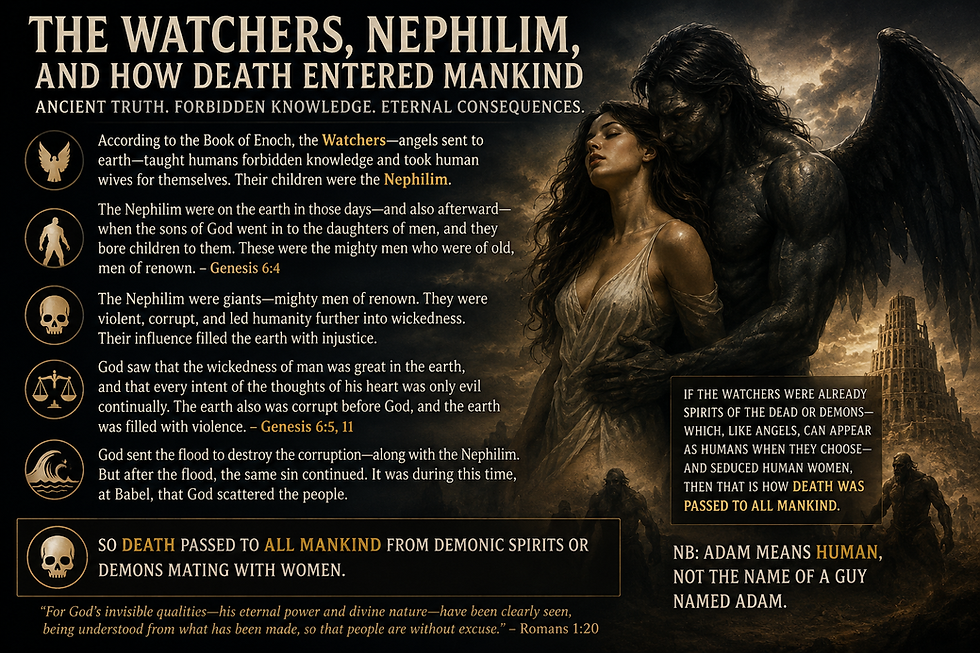
There is a remarkable network of ideas running through the Bible and the ancient world that becomes visible only when passages normally studied in isolation are placed beside one another. Bashan is associated with Og and the Rephaim; the Rephaim are both an ancient people and, elsewhere in Scripture, inhabitants of the realm of the dead; Ugaritic texts place cognate rpum or Rapiuma within royal and funerary traditions; Psalm 22 surrounds its suffering figure with the terrifying “bulls of Bashan” as he approaches the “dust of death”;
Second Temple Jewish literature explains the origin of evil spirits through the death of the giant offspring of the Watchers; the demons encountered by Christ fear being sent into the abyss; Revelation later reveals a Beast that rises from that same abyss and describes Babylon as a dwelling place of demons and every unclean spirit. When the Roman world is brought into the picture, the pattern becomes even more arresting, because Rome maintained cultic relationships with its ancestral dead, offered sacrifices at tombs, burned incense before corpses, formally transformed deceased emperors into divi, and inhabited a wider religious world in which goddesses associated with heaven, Venus, the underworld and the dead were progressively identified with one another.
Against this entire religious landscape stands the central Christian proclamation that Christ came to defeat death itself. Hebrews says that Christ partook of flesh and blood “that through death he might destroy him that had the power of death, that is, the devil” (Hebrews 2:14 KJV). Paul calls death “the last enemy” that shall be destroyed (1 Corinthians 15:26), while Revelation places in the mouth of the risen Christ the declaration that he possesses “the keys of hell and of death” (Revelation 1:18). This makes Christ's promise in Matthew 16:18 especially significant: “the gates of hell shall not prevail against” his church. The Greek is the gates of Hades, the realm of the dead. Christianity therefore entered a Roman world saturated with rituals directed toward dead ancestors and dead rulers while proclaiming that the Messiah had broken the dominion of death, possessed the keys of Hades and would ultimately abolish death altogether.
The question raised by this material is not whether every ancient use of incense was necromancy, nor whether every pagan deity was literally one demon using multiple historical names. The stronger question is whether Scripture repeatedly contrasts the living God and the life found in Christ with religious and political systems fascinated by the dead, ancestral powers, deified rulers, images, sacrifices and supernatural beings associated with the underworld. When that question is asked, the relationship between Bashan, the Rephaim, Rome and Revelation deserves far more careful consideration than it normally receives.
Bashan Was the Land of the Rephaim Before It Was Ever the Land of Famous Cattle
The investigation begins with Robert D. Miller II's important article, “Baals of Bashan,” published in Revue Biblique 121/4 in 2014. Miller challenges the almost automatic assumption that the “strong bulls of Bashan” in Psalm 22 simply refer to famously impressive livestock. His environmental argument examines the reconstructed ecology of Iron Age Bashan and the Golan, including basalt-derived soils, heavy clay, hydrology, rainfall and ancient vegetation, and argues that the region was poorly suited to the sort of exceptional cattle economy commonly imagined by commentators. This does not prove that ancient Bashan contained no cattle, and Miller's environmental comparisons cannot by themselves prove that Psalm 22 means supernatural beings. What his research does very effectively is remove the supposed certainty of the conventional explanation and force us to ask why the biblical author chose Bashan in particular.
The Bible's own characterization of Bashan provides the obvious starting point. Deuteronomy 3:13 describes “all Bashan” as “the land of giants,” but the Hebrew word translated “giants” is רְפָאִים, Rephaim. Og, king of Bashan, is described in Deuteronomy 3:11 as remaining “of the remnant of giants,” and Joshua 12:4 repeats that Og was “of the remnant of the giants” and dwelt at Ashtaroth and Edrei. The first securely demonstrable chain therefore requires no Ancient Near Eastern reconstruction at all: Bashan is Rephaim territory, and Og is a Rephaim ruler.
That geographical identity becomes far more significant because Rephaim does not function exclusively as the name of an ancient giant people. In a second group of biblical passages, the same Hebrew word denotes the dead or shades of the underworld. Job 26:5 is especially important because the KJV obscures the underlying noun when it says, “Dead things are formed from under the waters, and the inhabitants thereof.” The “dead things” are Rephaim, and the following verse immediately says that Sheol is naked before God. Psalm 88:10 asks whether the dead will arise and praise God, again using Rephaim. Proverbs 9:18 says that the Rephaim are “in the depths of hell,” while Proverbs 2:18 places the paths of the strange woman's house among the Rephaim.
The conclusion that Rephaim could designate inhabitants of the realm of the dead is therefore explicit biblical evidence, not an interpretation imported from Ugarit. What remains debated is how that meaning relates historically to the Rephaim remembered as ancient formidable peoples. The Bible itself does not provide an explanatory sentence saying that the giant Rephaim died and became the Rephaim of Sheol. Nevertheless, the fact that one term crosses both worlds is crucial, particularly when Ugaritic material independently associates cognate rpum with royal ancestors and funerary ritual.
Isaiah 14 Gives Us Rephaim Who Are Dead Kings
Isaiah 14 provides perhaps the clearest biblical evidence for the royal dimension of the Rephaim. When the proud ruler falls, “Hell from beneath is moved” to meet him, and Sheol “stirreth up the dead for thee.” Those “dead” are Rephaim, but Isaiah immediately explains who they are: “all the chief ones of the earth” and “all the kings of the nations.” The passage therefore presents a scene in which dead rulers inhabit Sheol as Rephaim and rise symbolically from their thrones to greet another fallen king.
This matters because it gives us an explicitly biblical tradition of dead kings retaining a shadowy royal identity in the underworld. Revelation 17 will later speak about fallen kings in connection with a Beast who “was, and is not,” yet returns from the abyss. That does not permit us simply to declare that Revelation's kings are Rephaim, but it means that the combination of kingship, death, underworld existence and return belongs to an established biblical symbolic vocabulary long before John writes Revelation.
Isaiah 26 adds another important element but also corrects a tempting overstatement. Isaiah 26:14 says of defeated rulers, “They are dead, they shall not live; they are deceased, they shall not rise,” and the word translated “deceased” is again Rephaim. Yet Isaiah 26:19 uses Rephaim once more when the earth gives up its dead. Consequently, the chapter does not establish a special species of Rephaim that can never rise. Instead it confirms that Rephaim had become a genuine Hebrew designation for the dead, capable of being used of different groups whose final destinies depend upon God. The lexical connection between Rephaim and the dead is therefore even more secure than a rigid supernatural interpretation would suggest.
Og, Ashtaroth, Edrei and Hermon Create a Remarkably Specific Geography
The geographical concentration of the Rephaim tradition is another reason the Bashan material cannot easily be dismissed as generic folklore. Scripture associates Og not merely with Bashan but specifically with Ashtaroth and Edrei, while Joshua 12 extends his territory toward Mount Hermon. A secure biblical sequence can therefore be written as Bashan, Og, Rephaim, Ashtaroth, Edrei and Hermon.
This becomes extraordinary when compared with Ugaritic KTU 1.108. The text concerns a figure called Rapiu, belonging to the broader rpum or Rephaim tradition, and an influential interpretation places him in connection with Athtarat and Edrei, corresponding strikingly with biblical Ashtaroth and Edrei. Miller emphasizes this geographical correspondence because the Bible and Ugaritic tradition appear independently to associate Rephaim-related royal figures with the same two places. There are philological difficulties surrounding the exact reading of the Ugaritic name corresponding to Edrei, so this should not be presented as universally uncontested, but the correspondence is sufficiently specific to deserve serious weight.
Mount Hermon then becomes important for another reason. First Enoch later locates the descent and oath of the Watchers upon Hermon. That does not mean that Deuteronomy itself secretly narrates the Watcher story, but Second Temple Jewish authors placed their Watcher-and-giant tradition in precisely the wider geographical world that the Hebrew Bible had already associated with Og and the Rephaim. The relationship is therefore not proof of identical traditions, yet it provides a plausible explanation for why Hermon became such an important location within later Jewish supernatural geography.
The Ugaritic Rephaim Belong to a Royal and Funerary World
KTU 1.161, the Ugaritic tablet RS 34.126, takes the investigation from biblical memory into an actual royal funerary setting. The text is generally understood as a royal funerary liturgy associated with the death of King Niqmaddu and the continuation of the dynasty. It invokes ancient Rapiuma and Rapiuma associated with the underworld. Here we possess independent Northwest Semitic evidence connecting figures linguistically related to biblical Rephaim with dead royalty, ancestral ritual and the underworld.
The other Ugaritic Rephaim texts, especially KTU 1.20–1.22, reinforce this picture because the rpum are not represented as meaningless corpses. They assemble, travel, participate in ritual activity and possess sacred or quasi-divine status. Some individual words remain damaged or disputed, and scholarship varies over whether particular terms should be translated as “dead,” “men,” “heroes” or something similar, yet there is little doubt that the Rephaim belong to the supernatural and ancestral world of Ugaritic religion.
KTU 1.22 further associates figures with “Rephaim of Baal” and “warriors of Baal.” This does not mean that every Rephaim is Baal or that the biblical Rephaim are simply Baal worshippers. Miller himself stresses that the specific Baal connection is less secure than the wider supernatural interpretation. Nevertheless, Rephaim, divine warriors and Baal can demonstrably inhabit the same ancient conceptual environment.
The much-discussed bull connection emerges most clearly in Miller's treatment of KTU 1.161. He argues that the underworld or ancient Rephaim receive a title that can be rendered “Bull Eternal.” The Ugaritic element ṯr can carry the meaning “bull,” although translations differ over whether the entire expression should be translated as a bull title or partly treated as a personal or divine name. It would therefore be excessive to say that Ugaritic texts prove that all Rephaim were literally conceived as bulls. What can responsibly be stated is that bull terminology appears inside the same Rephaim and royal-funerary complex, which becomes extremely important when Psalm 22 speaks specifically about the “bulls of Bashan.”
Psalm 22 May Be Describing Two Levels of Enemies at Once
Psalm 22 portrays the suffering righteous figure surrounded by terrifying enemies. “Many bulls have compassed me,” he says; “strong bulls of Bashan have beset me round.” They gape like a ravening lion, while a few verses later “dogs” surround him and “the assembly of the wicked” encloses him. At the same time his body is failing and God has brought him “into the dust of death.”
There is no difficulty recognizing that the animals can symbolize human enemies. The psalm itself effectively confirms this by placing dogs and an assembly of wicked men in parallel. The mistake would be to assume that because the images have human referents they cannot simultaneously contain older supernatural associations. Biblical poetry regularly permits imagery to work on more than one level, and the geographical qualifier Bashan is too specific to ignore when Bashan is elsewhere explicitly the land of the Rephaim.
When the ancient evidence is brought together, the possibility of a second layer becomes substantial. Bashan is Rephaim territory; Rephaim are elsewhere biblical inhabitants of Sheol; Isaiah includes dead kings among the Rephaim; Ugaritic rpum belong to royal funerary and underworld traditions; and disputed but genuine bull terminology appears within that same Ugaritic Rephaim world. Psalm 22 then places “bulls of Bashan” around a suffering figure as he approaches the “dust of death.” Miller consequently argues that “Bulls of Bashan” may have been multivalent language capable of evoking giants, spirits of the dead, Baal and other supernatural associations rather than functioning as a simple reference to livestock.
The strongest conclusion is therefore not that invisible Rephaim can be proved to have literally stood around the cross. It is that Psalm 22's human enemies may be described through imagery possessing an ancient Bashan–Rephaim–death resonance. This matters profoundly for Christianity because Jesus places Psalm 22 upon his own lips during the crucifixion, while the Passion narratives reproduce other details of the psalm. The New Testament elsewhere interprets Christ's death as a victory over “principalities and powers” in Colossians 2:15, so the crucifixion is not presented merely as a clash with Pilate, Roman soldiers and Jerusalem authorities. It has an unseen dimension.
Bashan, the Waters and the Depths
Psalm 68 contributes another suggestive association when God declares, “I will bring again from Bashan, I will bring my people again from the depths of the sea.” Bashan and the depths therefore occupy corresponding positions within the poetry. Miller discusses a possible relationship between “Bashan” and Ugaritic bṯn, a serpent term belonging to the wider linguistic world of Yamm and Leviathan, although he correctly warns that scholars go too far when they simply equate Bashan with the Canaanite hell.
That caution should remain. Psalm 68 never says, “Bashan is Sheol.” Nevertheless, Job 26 has already placed Rephaim beneath the waters with Sheol immediately in view, while Bashan itself is the biblical land of the Rephaim. Consequently, Bashan, Rephaim, depths, waters and death repeatedly occupy neighbouring symbolic territory even before the later Jewish concept of the abyss is considered.
The Watchers, Giant Spirits and the Origin of Demons
Second Temple Judaism provides a bridge that the Hebrew Bible itself never explicitly constructs. Genesis 6 speaks of the “sons of God,” the daughters of men, the Nephilim and the mighty men of old, but Genesis does not state what became of the giants' spirits after they died. First Enoch supplies an answer. It says that the giants produced from the union of heavenly Watchers and human women become evil spirits upon the earth after their deaths, and that evil spirits proceed from their bodies. These spirits afflict humanity and remain active until judgment. Jubilees preserves essentially the same demonological tradition, explicitly understanding demons as spirits proceeding from the dead giant offspring of fallen heavenly beings.
This distinction is extremely important because it prevents us from reversing the chronology of the surviving Enochic text. The Watchers themselves are not presented by 1 Enoch as already-dead giant spirits. They are heavenly beings who descend, take human women and produce giants; after those hybrid offspring die, the giants' disembodied spirits become evil spirits. Therefore the proposition that the Watchers were themselves originally spirits of dead Rephaim is an intriguing hypothesis but is not supported by 1 Enoch.
There is nevertheless a related question worth investigating. Scripture makes clear that heavenly beings can appear to human beings in a form indistinguishable from ordinary men. Genesis 18 describes Abraham seeing “three men,” while Genesis 19 identifies the visitors arriving at Sodom as angels. Hebrews 13:2 can consequently tell Christians that some people have “entertained angels unawares.” The idea that heavenly beings could assume an embodied human appearance therefore belongs to biblical narrative itself, which makes the sexual union imagined by Genesis 6 and 1 Enoch intelligible within their ancient conceptual world without requiring the Watchers first to have been deceased human spirits.
A further hypothesis can nevertheless be formulated without pretending Scripture has already proved it. If an ancient tradition existed in which hostile spirits could assume embodied human form, sexual corruption between spiritual powers and humankind could be understood as an invasion of human creation by the powers of death. Such a model would make Genesis 6 an escalation in the corruption of humanity rather than the first appearance of death. That distinction matters because Paul's account in Romans 5 does not attribute the original entrance of death into humanity to the Watchers. He says, “by one man sin entered into the world, and death by sin; and so death passed upon all men, for that all have sinned.”
The Hebrew word אָדָם, ’adam deserves careful attention here. It certainly means “human,” “man” or “humankind,” and Genesis 5:2 proves that the word can be collective because God creates male and female and “called their name Adam.” Modern Jewish translations therefore legitimately render the verse as God calling them Humankind. It is therefore misleading to imagine that adam began simply as an arbitrary personal name comparable with David or Abraham. The word fundamentally denotes the human creature or humanity. At the same time, Genesis subsequently uses Adam as the designation of the individual ancestral human, and Paul in Romans 5 unmistakably constructs an argument involving one man whose trespass is contrasted with the one man Jesus Christ. Consequently, “Adam means humanity” is linguistically correct, while “there was therefore no individual Adam in Paul's argument” would go beyond what the text permits.
This produces a potentially important refinement. One may legitimately investigate whether the Genesis narrative is simultaneously telling the story of the archetypal human and of the human race represented in that figure. However, the claim that death first entered humanity biologically because demons mated with women in Genesis 6 cannot be established from the biblical or Enochic texts. The stronger evidence-led proposal is that death enters the human story through sin, while Genesis 6 depicts a later catastrophic contamination of humankind by rebellious heavenly beings, producing giants whose dead spirits become demonic powers in Second Temple Jewish interpretation.
That distinction actually strengthens the larger thesis because it leaves Christ's victory over death encompassing both problems: the mortality and sin that afflict humanity and the hostile spiritual powers that exploit, corrupt and dominate the world.
Legion Knows Exactly What the Abyss Is
The Gospel account of Legion brings the Second Temple supernatural world directly into the New Testament. Luke records that the demons beg Christ not to command them “to go out into the deep” (Luke 8:31). The Greek word is ἄβυσσος, abyssos, the abyss. The spirits therefore recognize a supernatural place of imprisonment or judgment and understand that Christ possesses authority to send them there.
The exact geography of the Legion episode requires care because Gospel manuscript traditions preserve different forms such as Gerasenes and Gadarenes, and it would be too confident simply to place the event in the precise heartland of ancient Og's Bashan. Miller nevertheless sees the broader trans-Jordanian setting as compatible with the old Bashan supernatural tradition. The geographical connection is plausible rather than conclusive, but the conceptual connection is unmistakable: demons fear the abyss.
Revelation then uses precisely the same term as a major part of its supernatural geography. Revelation 9 opens the abyss and releases terrifying beings; Revelation 11:7 speaks of “the beast that ascendeth out of the bottomless pit”; Revelation 17:8 says that the Beast “shall ascend out of the bottomless pit”; and Revelation 20 casts Satan into that abyss. Luke's demons fear being sent into the place from which Revelation's hostile supernatural powers emerge and into which Satan is finally imprisoned. That continuity is one of the strongest links in the entire investigation.
The Beast Belongs to Both Politics and the Supernatural Realm
The Beast of Revelation should not be forced into an either-or choice between an earthly empire and a supernatural being. Daniel has already prepared readers for both levels. Daniel 7 represents kingdoms as monstrous beasts, while Daniel 10 depicts earthly kingdoms as possessing corresponding supernatural “princes.” Revelation inherits precisely this apocalyptic logic.
Revelation 13 unmistakably uses Daniel's beasts, combining leopard, bear, lion and horn imagery, so the Beast certainly represents political and imperial power. Yet Revelation 13:2 simultaneously says that “the dragon gave him his power, and his seat, and great authority.” Revelation 12 has explicitly identified that Dragon as “that old serpent, called the Devil, and Satan.” The Beast is therefore an earthly religious/political power whose authority is derived from an explicitly supernatural satanic source.
Revelation 16 removes any possible doubt that the Beast system possesses a demonic dimension. John sees unclean spirits issuing from the mouths of the Dragon, Beast and False Prophet and calls them “the spirits of devils, working miracles.” The Beast does not have to be reduced to one disembodied demon for the passage to be supernatural; the text portrays a political system, its ruler or rulers and the demonic power behind them as operating together.
Revelation 17 deepens that mystery by describing the Beast as something that “was, and is not,” yet will ascend from the abyss. Revelation 13 has already shown a head of the Beast appearing mortally wounded and then healed. The Beast is therefore surrounded by a deliberate death-and-return parody, an imitation of resurrection that stands opposite the genuine death and resurrection of Christ.
This is where Isaiah 14 becomes particularly interesting. Isaiah describes a fallen king descending into Sheol, where Rephaim who are themselves dead kings rise to receive him. Revelation describes fallen kings and a Beast associated with kingship that existed, ceased to exist and returns from the abyss before going to destruction. The passages are not identical, and the seven kings of Revelation cannot simply be renamed Rephaim, yet John operates within a biblical symbolic universe in which dead rulers and underworld power were already connected.
The Mark Is a Counterfeit Seal, Not a Demon
The mark of the Beast should remain conceptually distinct from the spirits empowering the Beast system. Revelation calls the mark a χάραγμα, charagma, a mark, stamp or engraved impression. It never calls the mark itself a demon or spirit. Nevertheless, the system imposing the mark is explicitly satanic and accompanied by “spirits of devils.”
The theological meaning of the mark becomes clearer when it is compared with God's own markings in Revelation. God's servants are sealed in their foreheads in Revelation 7; the followers of the Lamb bear the Father's name in their foreheads in Revelation 14; and Revelation 22 says that God's name shall be in the foreheads of his servants. The Beast creates an imitation of divine ownership. His followers bear his mark, his name or the number of his name, while God's people bear the name of their God.
The mark is therefore fundamentally connected with belonging, worship and allegiance, not merely technology or economics. Economic exclusion is one mechanism by which allegiance is enforced, but Revelation itself repeatedly binds the mark to worship of the Beast and his image.
666 Does Not Spell “Rephaim,” but Daniel Gives Us a More Serious Six-Connection
A responsible investigation of 666 has to include negative evidence. Standard Hebrew numerical values do not make Rephaim equal 666, nor do ordinary Hebrew words for death, dead, Sheol, giant or spirit produce a persuasive 666. Standard Greek calculations for demon, death, abyss, Hades or Beast likewise fail to produce a legitimate hidden Rephaim equation. Any method that alters spellings or numerical conventions until the desired number appears would weaken the entire case.
There is nevertheless a fascinating giant tradition involving repeated sixes. Second Samuel 21:20 and 1 Chronicles 20:6 describe a giant warrior associated with Rapha who possessed six fingers on each hand and six toes on each foot. That is a genuine biblical connection between the giant tradition and abnormal repeated sixes, but Scripture never relates the man to Revelation 13, and his twenty-four digits do not amount to 666. It should therefore be recorded as suggestive rather than made into proof.
Daniel 3 provides a much stronger background. Nebuchadnezzar's image measures sixty cubits high and six cubits wide. The imperial ruler gathers peoples and nations, commands them to worship his image and threatens death for refusal. Revelation 13 presents an imperial Beast, an image, universal coercion, compulsory worship, death for those refusing worship and the number 666. The literary correspondence between Daniel 3 and Revelation 13 is therefore considerably more substantial than modern numerical speculation.
Seven unquestionably functions throughout Revelation as a symbol of fullness and completed divine ordering, appearing in churches, spirits, candlesticks, seals, trumpets, bowls and numerous other structures. Consequently, interpreting repeated six as a counterfeit or failure to attain seven is possible. Nevertheless, Scripture never gives the formula 777 = life, so that modern numerological claim should remain separate from the demonstrable argument.
Ezekiel's Feast of Dead Warriors Leads Directly Into Revelation
Ezekiel 39 provides another remarkable bridge back to Bashan. God summons birds to a sacrificial feast in which they eat “the flesh of the mighty” and drink “the blood of the princes of the earth,” symbolically described among rams, lambs, goats and “bullocks, all of them fatlings of Bashan.” Once again Bashan cattle imagery appears in a context dominated by slaughtered warriors and princes.
Revelation 19 clearly reuses this scene when an angel summons the birds to “the supper of the great God” so that they may eat the flesh of kings, captains and mighty men. John's dependence upon Ezekiel is unmistakable. Revelation does not repeat the explicit phrase “fatlings of Bashan,” so we should not claim that every element of Miller's Bashan theory is consciously present in Revelation 19. Yet the broader transformation is clear: political and military powers that appeared invincible become sacrificial carrion under God's judgment.
Rome Did Not Merely Remember Its Dead; It Maintained Cultic Relations With Them
The Roman background makes these biblical themes far more significant. Roman religion recognized the Di Manes, the spirits or collective divinity of the dead. The Oxford Classical Dictionary describes the Manes explicitly as Roman spirits of the dead and notes that graves could bear the dedication Dis Manibus, while the dead received collective worship at the Parentalia, Feralia and Lemuria. Roman funerary religion therefore involved more than sentimental memory. The dead occupied a recognized religious category and could receive ritual attention.
The Parentalia and Feralia particularly maintained the relationship between families and deceased ancestors. Offerings brought to tombs included wine, milk, honey, oil and various foods, while other funerary contexts involved animal sacrifice. Roman thought could even regard continued cult as contributing to the deceased person's continuing status among the Manes. The Oxford discussion of Roman attitudes to death describes the deceased as entering a new category among the di manes, who received regular cult.
Elite Roman funerals made this relationship between political authority and dead ancestors visible in extraordinary fashion. Polybius describes wax likenesses of deceased aristocrats that were preserved and then worn by men in later family funerals. These representatives dressed according to the rank the deceased had held, rode in chariots and sat publicly according to their former offices. The ancestral dead were therefore symbolically made present at the funeral of their descendant, and political legitimacy was displayed through the reappearance of dead magistrates.
The imperial cult intensified the same relationship between death and authority. A Roman divus was specifically a person who had obtained divine status posthumously; Oxford scholarship distinguishes this from a deus, a deity that had never been mortal. Deceased emperors could be formally declared divi, after which state priests and state temples were established for their worship. Revelation was therefore read within an imperial environment where the transformation of a dead ruler into a cultic divine figure was not mythological speculation but an official institution.
This does not prove that Revelation's seven kings are simply Roman Manes or that the Beast is the ghost of one emperor. It does mean that John's imagery of kings, death, return, worship, images and supernatural authority entered a cultural world in which deceased rulers could literally acquire temples, priests and divine honours.
Rome Also Burned Incense Before Its Dead
The connection with incense is particularly important. A Roman funerary relief from the tomb of the Haterii depicts a corpse lying in state while small flaming vessels burn at the head and foot of the bier. The scholarly study of the monument identifies these vessels as acerrae used for burning incense before the dead, and one attendant appears to be placing additional incense into the flame.
This needs to be distinguished from other funerary uses of aromatics. Ancient cultures employed fragrant substances in several ways: some were burned; some were applied directly to corpses; others were deposited with bodies or incorporated into burial preparations. John 19, for example, describes Nicodemus bringing myrrh and aloes for Jesus' burial, while the women prepare spices. That is not the same thing as burning incense as an offering. Second Chronicles 16:14 and Jeremiah 34:5, however, preserve royal Jewish funerary “burnings” associated with aromatic honour for deceased kings.
Roman culture therefore gives us historically secure evidence for incense being burned before the dead, but it would still be inaccurate to say that every funerary use of incense was necromancy. Veneration of the dead and deliberate summoning of the dead are different practices. Roman literature nevertheless knew the latter as well, so ancestor cult, funerary incense and necromancy all existed within the same wider religious civilization even when they should not be collapsed into one ritual.
This is precisely why the Christian question about incense has to be framed carefully. Incense does not intrinsically summon the dead, because Scripture itself uses incense positively in God's sanctuary. The real question is to whom the incense is offered and what the ritual means.

If Christ Fulfilled the Sacrificial Order, Why Does Revelation Still Show Incense?
Revelation itself prevents us from arguing that incense is automatically evidence of necromancy. Revelation 5:8 describes the elders holding golden bowls “full of odours, which are the prayers of saints.”
Psalm 141:2 already provides the biblical background when it asks, “Let my prayer be set forth before thee as incense.” Incense in Revelation therefore does not mean that heaven literally requires smoke because heaven is unclean, nor does it mean that the completed work of Christ has somehow failed and a new material sacrifice must continue. Revelation employs the imagery of the sanctuary symbolically to describe prayer, divine presence and heavenly worship.
That answer, however, makes Revelation 18 more striking rather than less so. Babylon's merchants traffic in cinnamon, fragrances, incense, myrrh and frankincense among the luxury commodities of her corrupt commercial system. The Greek list includes both thumiama, incense, and libanos, frankincense. Revelation therefore places incense on both sides of its great contrast. In the true heavenly sanctuary, incense signifies or accompanies the prayers of the saints. In Babylon, incense has become part of a luxury economy bound to idolatrous wealth, kings, merchants and ultimately human bodies and souls.
Even more significant is Revelation 18:2, where fallen Babylon becomes “the habitation of devils” and the hold of “every foul spirit.” Babylon therefore unites corrupt commerce, luxury aromatics, kings, spiritual uncleanness and demonic habitation. This does not mean that Revelation says the merchants buy incense specifically to summon the dead, but it provides a much stronger argument than the assertion that incense by itself must be necromantic. Revelation contrasts the legitimate heavenly meaning of incense with a Babylonian world in which cult, wealth, idolatry and unclean spirits have become entangled.
Isis Calls Herself Queen of the Manes
Apuleius' Metamorphoses, written within the Roman imperial world, supplies a remarkable illustration of how fluid pagan divine identities could become. In Book XI Isis reveals herself and describes herself as rerum naturae parens, parent of nature; elementorum omnium domina, mistress of all the elements; saeculorum progenies initialis, primordial offspring of the ages; summa numinum, supreme among divine powers; and most significantly for this investigation, regina manium, queen of the Manes. She also claims authority over the celestial heights, the sea and the silences of the underworld.
Apuleius then places an extraordinary claim in her mouth: the whole world worships her one divine power under different rites and many names. Among those identities he explicitly includes Paphian Venus, Stygian Proserpine, Ceres, Juno, Bellona, Hecate and others before saying that Egyptians call her by her true name, Queen Isis. Modern scholarly commentary consequently describes Isis here as “queen of the dead” and emphasizes her power over both life and death.
What Apuleius himself unquestionably gives us is already striking enough: a Roman-period goddess who identifies herself with Venus and underworld goddesses while calling herself queen of the spirits of the dead.
Ishtar, the Queen of Heaven, Venus and the Road Back to Babylon
The Babylonian strand can nevertheless be established independently. Ancient Assyrian documentation preserves Šarrat-šamê, “Queen of Heaven,” explicitly as a title of Ishtar. Ishtar/Inanna was also associated with the planet Venus and possessed one of Mesopotamia's most famous underworld myths. A Neo-Assyrian tablet in the British Museum preserves the “Descent of Ishtar into the Nether World,” in which Ishtar passes through the gates of the underworld and even threatens to release the dead upon the living.
This gives us a real ancient cluster: Ishtar, Babylonian religion, Queen of Heaven, Venus and the underworld. Jeremiah's condemnation of those who “burn incense unto the queen of heaven” therefore becomes highly relevant, although Jeremiah never gives that goddess the personal name Ishtar. Scholars have debated whether Jeremiah's Queen of Heaven should be identified specifically with Ishtar, Astarte, Anat or a related goddess tradition. The Ishtar connection is nevertheless historically substantial because “Queen of Heaven” is an independently attested Ishtar title.
The next stage of the relationship occurs through centuries of Mediterranean syncretism. The Phoenician goddess Astarte became closely associated with Greek Aphrodite, particularly in Cyprus. Archaeological scholarship explicitly describes the Cypriot Great Goddess as influenced by Astarte and later assimilated with Aphrodite. Aphrodite in turn corresponds with Roman Venus. Apuleius then explicitly makes Paphian Venus one of the forms of Isis.
It would therefore be historically crude to write a simple equation saying “Ishtar = Astarte = Aphrodite = Venus = Isis” as though one unchanged cult travelled from Sumer to imperial Rome without alteration. The stronger and historically defensible conclusion is that these goddesses became progressively identified, translated and absorbed into one another through ancient religious syncretism. By Apuleius' period, a pagan Roman author could speak of a single goddess appearing under numerous local names, including Venus and underworld deities, while calling that universal goddess Queen of the Manes.
That provides a legitimate road back from Roman Isis through Venus/Aphrodite and the eastern goddess tradition toward Astarte and Ishtar. It is a historical network of religious identifications rather than proof that every culture secretly worshipped one unchanged goddess.
Can the Woman Called Babylon Be Identified With Ishtar?
Revelation 17 describes a woman clothed in purple and scarlet, seated upon the Beast and bearing a golden cup. Upon her forehead appears the name “MYSTERY, BABYLON THE GREAT, THE MOTHER OF HARLOTS AND ABOMINATIONS OF THE EARTH.” She is drunk with the blood of the saints and the martyrs of Jesus.
John does not call this woman Ishtar, Isis, Venus or Astarte, and that fact must remain visible in any serious argument. Yet calling her Babylon inevitably evokes Babylon's entire scriptural and historical world, including imperial arrogance, idolatry, false worship and the religious environment in which Ishtar possessed supreme importance. Ancient evidence gives Ishtar the title Queen of Heaven and associates her with Venus and the underworld, while later Mediterranean syncretism links eastern goddess traditions with Aphrodite/Venus and eventually with the universal Isis of Apuleius.
The strongest interpretation is therefore not, “John secretly tells us the woman's literal personal name is Ishtar.” It is that John's Babylonian woman can legitimately be read against the ancient goddess and imperial traditions represented by Babylon, while the later Roman world in which Revelation circulated had already fused comparable female divine identities into Venus, Isis, underworld goddesses and the queen of the Manes.
If one wishes to call the mother of Revelation's abominations “Ishtar” as a theological identification, it should therefore be presented as an argued symbolic identification rather than something Revelation explicitly states. That distinction makes the conclusion harder to dismiss because the historical chain remains visible at every stage.
Babylon's Incense and the Queen of Heaven
Jeremiah adds another important bridge because the Queen of Heaven is repeatedly worshipped with incense. The people openly tell Jeremiah that they intend “to burn incense unto the queen of heaven, and to pour out drink offerings unto her” (Jeremiah 44:17 KJV). The practice therefore combines goddess worship, incense and rebellious rejection of Yahweh.
Revelation later gives Babylon incense and frankincense among its merchandise, while simultaneously describing Babylon as a habitation of demons and every unclean spirit. This does not allow us to say that Revelation explicitly identifies Babylon's incense trade as a ritual for summoning dead ancestors. Yet the combination deserves serious theological attention because incense appears in several sharply contrasting religious contexts: as lawful sanctuary imagery associated with prayer to God; as an element of idolatrous Queen-of-Heaven worship in Jeremiah; as funerary honour before the Roman dead; and as part of Babylon's luxury commerce in Revelation.
The question “Why continue incense if everything is fulfilled in Christ?” consequently needs a more precise answer. No additional material incense is required to complete Christ's sacrifice, and Revelation's heavenly incense does not reinstitute a sacerdotal sacrifice of Christ. John himself interprets the imagery through prayer. When later religious systems employ physical incense, the biblical question is therefore not whether aromatic smoke is inherently demonic, but whether that ritual has scriptural warrant, what it signifies, to whom it is directed and whether it reintroduces mediations, sacrifices or relationships with the dead that the apostolic Gospel does not command.
If physical incense is used specifically to approach, honour, invoke or seek assistance from the dead, the contrast with Christ's victory over Hades becomes especially serious. The New Testament directs believers toward the living Christ, the one mediator between God and men, not toward ancestral spirits or deceased religious figures.
Christ Came Into a World That Venerated the Dead in Order to Defeat Death
This is where the Roman and biblical strands finally converge with full theological force. Roman religion honoured the Manes, maintained tomb cult, represented deceased ancestors publicly and formally deified selected dead emperors. Pagan literature described underworld deities and magical rites involving the dead. Isis could be called queen of the Manes. Ishtar could descend into the underworld. Revelation's Babylon ultimately becomes a dwelling place of demons.
Christianity announces something radically different. Christ does not become divine because men deify him after death. He rises from death by the power of God. He is not another dead emperor whose memory is sustained by priests, temples and offerings. He returns bodily from the grave and declares that he possesses the keys of Hades and death.
This contrast becomes sharper when Roman imperial apotheosis is remembered. Rome could take a dead ruler and proclaim him divus, establishing priests and temples for his worship. Revelation presents Jesus as the exact opposite of that process. His divine authority does not originate in a senatorial decree, priesthood or imperial cult; rather, the Roman empire itself ultimately stands under the judgment of the Lamb whom imperial power crucified.
Hebrews goes even further by identifying the devil with “the power of death” and saying that Christ entered mortality in order to destroy that power. The Christian Gospel is consequently not another refinement of ancestor religion. It is the proclamation that the entire dominion represented by death, Hades and hostile spiritual powers has been defeated in Christ.
Matthew 16:18 should therefore be heard with its full ancient force. “The gates of Hades shall not prevail” does not mean merely that a church institution will survive political difficulties. Hades is the realm of the dead. Christ is promising that death cannot ultimately hold his assembly because the one who builds it is himself about to pass through death and break its gates from the other side.
Against that claim, a civilization venerating the dead and divinizing deceased rulers presents a profound theological contrast. The Gospel turns worship away from the dead toward the living God and the risen Christ.
Two Mothers: Babylon Below and Jerusalem Above
Revelation's two women now produce one of the most compelling contrasts in the entire argument. Babylon is explicitly called “the mother of harlots and abominations of the earth.” She sits upon the Beast, intoxicates kings, participates in corrupt commerce, persecutes the saints and ultimately becomes a dwelling place of demons.
Scripture simultaneously develops another maternal image. Genesis 3:20 calls Eve “the mother of all living.” Even the meaning of adam reminds us that Genesis is dealing not merely with isolated individuals but with humanity. Yet Paul's language in Galatians 4 moves the maternal theme upward when he declares, “Jerusalem which is above is free, which is the mother of us all.”
Revelation then reveals the New Jerusalem coming down from God out of heaven, prepared as a bride adorned for her husband. The New Jerusalem is therefore not directly called “mother of all living” in Revelation, and the phrase should not be placed in John's mouth. Nevertheless, a striking canonical trajectory exists: Eve is mother of all living; Paul calls Jerusalem above the mother of us all; Revelation identifies the heavenly Jerusalem as the Bride whose city contains the river and tree of life.
The contrast with Babylon is profound. Babylon is the mother of abominations (the dead), while Jerusalem above is the mother of God's people. Babylon is associated with persecution, intoxication, merchants, kings, demons and eventual death; New Jerusalem is associated with the Lamb, holiness, living water, the tree of life and a creation in which “there shall be no more death.”
Within that theological framework, it is entirely reasonable to describe the New Jerusalem as the eschatological mother-city of the living, provided we recognize that this is a synthesis of Genesis 3:20, Galatians 4:26 and Revelation 21–22 rather than a single biblical quotation.
The opposition could hardly be sharper. One mother produces or embodies abominations and harlotry; the other belongs to the new creation where death disappears.
The Final Pattern: Death Imitates Life, but Christ Destroys Death
Once all these strands are brought together, Revelation begins to look less like an arbitrary collection of strange symbols and more like the climax of an ancient conflict between divine life and counterfeit powers bound to death.
Bashan is remembered as the land of the Rephaim, and the Rephaim themselves can signify the dead. Isaiah places dead kings among them in Sheol. Ugaritic texts preserve cognate Rephaim within royal funerary traditions and connect them with the same geographical world associated with Og. Psalm 22 places “bulls of Bashan” around the suffering figure as he approaches the dust of death. Second Temple Judaism teaches that the spirits of the dead giant offspring of the Watchers become demons upon the earth. The demons encountered by Christ fear the abyss. Revelation opens that abyss and brings forth hostile powers, while the Beast himself ascends from it.
The Beast then imitates resurrection. He “was, and is not,” yet returns. His deadly wound is healed. His authority comes from the Dragon. His followers receive a counterfeit mark just as God's servants bear God's name. His image demands worship in a scene deliberately reminiscent of Nebuchadnezzar's image in Daniel 3.
Rome provides the historical counterpart. Deceased emperors can become divi. Ancestors remain cultically present. Incense burns before the dead. The Manes receive offerings. Pagan religion imagines universal goddesses who rule heaven and the underworld, while Apuleius' Isis calls herself queen of the departed spirits. Babylonian Ishtar bears the title Queen of Heaven, belongs to Venus symbolism and descends to the world of the dead. Jeremiah condemns incense offered to the Queen of Heaven. Revelation's Babylon sells incense and frankincense and becomes a habitation of demons.
Yet Scripture never ends with the triumph of that system.
The Beast that rises from the abyss goes into perdition. The kings who ally with him are destroyed. Babylon falls. The birds consume the flesh of kings and mighty men just as Ezekiel had foretold. The Dragon is cast into the abyss and then into the lake of fire. Death and Hades themselves are thrown into the lake of fire. The last enemy disappears.
Then New Jerusalem descends.
The transition is astonishing because Revelation moves from a woman called Babylon, the mother of abominations, to another woman-city, the Bride, Jerusalem descending from above. Babylon's commerce includes luxury, human exploitation and incense; Jerusalem contains the water of life freely given. Babylon becomes the habitation of devils; Jerusalem is illuminated by the glory of God. Babylon is drunk with the blood of saints; the servants of God reign in the New Jerusalem. Babylon belongs to death; New Jerusalem explicitly belongs to the world in which “there shall be no more death.”
This gives the whole investigation a theological centre that is stronger than any individual proposed identification. The controlling conflict is not finally Bashan versus Jerusalem, Ishtar versus another goddess, or even Rome versus Christianity. It is death versus life, and Revelation claims that life belongs solely to God and the Lamb.
The powers of the old world repeatedly mimic life. Dead rulers receive divine cult. Spirits of dead giants remain active. The Beast imitates death and resurrection. Ancient goddess traditions claim sovereignty over heaven and the underworld. Empires try to perpetuate themselves through images, cults and deified rulers.
Christ does something none of them can do.
He actually conquers death.
That is why Paul's declaration is so important: “Christ being raised from the dead dieth no more; death hath no more dominion over him” (Romans 6:9). It is why Revelation begins with the risen Christ holding the keys of Hades and death and ends by destroying both Hades and death. It is why the gates of Hades cannot finally prevail against those who belong to him.
The evidence does not allow us to say that every Rephaim is a demon, that the Watchers were originally dead Rephaim, that the Beast is certainly one deceased Rephaim spirit, that 666 secretly spells “dead,” or that Revelation explicitly calls Babylon Ishtar. Those claims remain speculative. Nor does the evidence allow us to say that every ancient use of incense was an attempt to summon the dead, because Scripture itself uses incense positively as an image of prayer.
What the evidence does allow us to say is substantial. Bashan is genuinely the biblical land of the Rephaim. Rephaim genuinely become terminology for the dead and dead kings. Ugaritic Rephaim genuinely belong to funerary and royal ancestral traditions. The Second Temple giant tradition genuinely produces evil spirits from dead giant bodies. New Testament demons genuinely fear the abyss. Revelation's Beast genuinely emerges from the abyss and is empowered by Satan. Rome genuinely venerated the Manes and deified deceased emperors. Romans genuinely burned incense before the dead. Apuleius genuinely calls Isis queen of the Manes and identifies her with Venus and underworld goddesses. Ishtar genuinely bears a Queen-of-Heaven title and belongs to the Venus and underworld complex. Jeremiah genuinely condemns incense offered to the Queen of Heaven. Revelation genuinely describes Babylon as a habitation of demons and lists incense and frankincense among her merchandise.
Those facts create a coherent and historically grounded world of dead rulers, ancestral powers, underworld spirits, empire, cult, incense, false resurrection and counterfeit divinity.
Against that world stands the Son of God who does not teach mankind how to venerate death.
He destroys it.
Ezekiel 13:19–20 KJV:
“And will ye pollute me among my people for handfuls of barley and for pieces of bread, to slay the souls that should not die, and to save the souls alive that should not live, by your lying to my people that hear your lies? Wherefore thus saith the Lord GOD; Behold, I am against your pillows, wherewith ye there hunt the souls to make them fly, and I will tear them from your arms, and will let the souls go, even the souls that ye hunt to make them fly.”

Daniel 2:43 KJV:
“And whereas thou sawest iron mixed with miry clay, they shall mingle themselves with the seed of men: but they shall not cleave one to another, even as iron is not mixed with clay.”
Daniel 2:43 KJV:
“And whereas thou sawest iron mixed with miry clay, they shall mingle themselves with the seed of men: but they shall not cleave one to another, even as iron is not mixed with clay.”
Genesis 3:15 KJV
“And I will put enmity between thee and the woman, and between thy seed and her seed; it shall bruise thy head, and thou shalt bruise his heel.”
Between the souls of the living and the spirits of the demonic realm.


Comments