The Occult-Like Rituals of the Romano-Germanic Pontifical

An investigation into medieval ecclesiastical rituals, sacred objects, supernatural powers and their relationship to ceremonial magic
What happens when we look beyond the familiar ceremonies of the Roman Catholic Church and examine the actual Latin instructions given to its clergy centuries ago? Where did its exorcisms of material objects, consecrated candles, invocations of saints and "angels", and elaborate rituals of spiritual protection originate? More importantly, which of these practices were commanded by Jesus Christ and His apostles?
Our investigation into the historical relationship between Christianity, natural magic and occult philosophy has led us to an extraordinary source: the Pontificale Romano-Germanicum, or Romano-Germanic Pontifical.
This is not a hostile description written by Protestant reformers. We are examining medieval ecclesiastical instructions preserved in Latin manuscripts and published in a scholarly edition by the Vatican Apostolic Library.
The edition, Le Pontifical Romano-Germanique du Dixième Siècle, was prepared by Cyrille Vogel, professor at the University of Strasbourg, in collaboration with Reinhard Elze, professor at the Free University of Berlin, drawing upon earlier manuscript research by Monsignor Michel Andrieu. Its second text volume was published in Vatican City in 1963 as Volume 227 of the Studi e Testi series.
The collection preserves ceremonies for episcopal ordinations, blessings, consecrations, exorcisms and religious observances. Its importance lies in the influence these liturgical traditions exercised upon the development of Western Christian worship.
Yet even its historical origins are disputed.
Vogel associated the compilation with Saint Alban's Abbey at Mainz around the middle of the tenth century. However, historian Henry Parkes, in The Making of Liturgy in the Ottonian Church (2015) and Henry II, Liturgical Patronage and the Birth of the 'Romano-German Pontifical' (2020), challenges this traditional reconstruction.
Parkes proposes that the principal liturgical orders developed within the royal circles of Henry II between approximately 1002 and 1009, before being assembled for the newly founded cathedral at Bamberg.
This places the collection within an important political and religious setting: the German-speaking territories of the Ottonian dynasty and the developing Holy Roman Empire, whose rulers claimed the inheritance of Roman imperial authority. Otto I had received the imperial crown in 962.
The Western Roman Empire did not simply become Germany. Nevertheless, Roman ecclesiastical traditions were being reshaped, transmitted and invested with new authority within this German-centred imperial world.
Parkes does not accuse Henry II of sponsoring occult practices. His research concerns the origins, development and royal patronage of the liturgical collection. But his findings raise an important question concerning the relationship between imperial authority and the ceremonies that came to define medieval Western Christianity.
Who established these rituals, and upon what authority were they presented as Christian worship?
The apostles of Jesus Christ were chosen and commissioned by divine authority, not appointed through an inherited ecclesiastical title. Scripture records the replacement of Judas by Matthias (Acts 1:21–26) and the appointment of elders to oversee congregations (Acts 14:23), but appointing church leaders is not the same as transferring the unique authority of Christ's apostles to successive generations of bishops or Roman pontiffs. What the New Testament explicitly requires is faithfulness to the doctrine delivered by the apostles: "And they continued stedfastly in the apostles' doctrine and fellowship" (Acts 2:42, KJV). Paul likewise instructed Timothy to entrust his teaching to faithful men who could teach others (2 Timothy 2:2). Therefore, the essential test of any claimed apostolic succession is fidelity to apostolic teaching, not merely succession to ecclesiastical office. Where, then, did Christ or His apostles institute the exorcism of salt, wax and ashes, the ritual expulsion of unclean spirits from infants, or the priestly powers claimed in the Romano-Germanic Pontifical? Their absence from the recorded apostolic instructions does not by itself prove that no early Christian ever practised them, but neither can an alleged chain of episcopal succession establish their divine authority. As Peter and the other apostles declared: "We ought to obey God rather than men." — Acts 5:29, KJV.
I digress.....
Regino of Prüm: The Church That Condemned Magic
The section we are translating, Section XCIX, also identified as Ordo L (Order Fifty), concerns religious observances throughout the year.
Vogel and Elze identify earlier sources incorporated into its compilation, including older Roman liturgical orders, material attributed to Pseudo-Alcuin and writings associated with Regino of Prüm.
Regino, a Benedictine monk and former abbot who died in 915, compiled Libri duo de synodalibus causis et disciplinis ecclesiasticis around 906. This collection of ecclesiastical regulations assisted bishops in governing their communities and identifying forbidden religious practices.
It preserves the famous Canon Episcopi, condemning beliefs concerning women who supposedly travelled at night in the company of Diana, the pagan Roman goddess. The text treats these experiences as diabolical deception.
Regino is particularly relevant because his collection illustrates the medieval Church's determination to distinguish legitimate religion from superstition and forbidden magic.
Yet when we examine the Romano-Germanic Pontifical, we encounter ecclesiastical blessings involving exorcised substances, appeals for "angelic" intervention and material objects associated with the expulsion of demons.
This does not establish that Regino personally composed or approved the blessings that follow. Nor does it mean that his condemnation of the night rides with Diana was itself inconsistent with the Church's theology of blessings.
But it raises a question that will recur throughout this investigation:
By what authority did the Church determine that certain rituals involving supernatural powers were diabolical, while other rituals involving consecrated objects and spiritual protection were holy?
Was that distinction established by the words of Christ, or by ecclesiastical tradition?
Janus, Theophany and the Transformation of Religious Festivals
The Pontifical itself acknowledges the presence of pagan traditions within the religious calendar.
In paragraph 8, the compiler discusses the January Kalends and the Roman god Janus (Janus was also associated with Saturn (Cronus),and Apollo), linked to beginnings, transitions and doorways.
The author condemns the pagan observances associated with the beginning of January, describing them as diabolical practices, and explains that the Church established a public fast in opposition to them.
Other unfamiliar names in the text have different origins.
Theophania and Epiphania are Greek terms referring to divine manifestation or appearance, particularly the revelation of Christ at His baptism.
Hypapante means the Meeting or Encounter, referring to Simeon's meeting with the infant Jesus in the Temple.
These Greek names are not occult terms. They refer to events or commemorations rooted in Christian tradition. The question concerns the additional doctrines and ceremonies subsequently attached to those events.
For example, paragraph 10 declares concerning Christ's baptism:
Necnon per baptismi sacramentum caput draconis est contritum.
"Furthermore, through the sacrament of baptism, the head of the dragon was crushed."(But who taught this?)
The defeat of the serpent is certainly biblical, particularly in Genesis 3:15 and Revelation 12. Yet the Pontifical associates this victory with the sacrament of baptism.
This requires careful distinction between Christ's victory over Satan and the spiritual efficacy attributed to a religious ceremony.
The issue becomes far more pronounced when we reach the feast of the Purification of Mary.
When Candles Were Consecrated Against Demons
In Luke 2, Mary and Joseph bring Jesus to Jerusalem in accordance with the Law of Moses. Simeon recognises the child as the promised salvation of God:
"For mine eyes have seen thy salvation, Which thou hast prepared before the face of all people; A light to lighten the Gentiles, and the glory of thy people Israel." — Luke 2:30–32,
Simeon was speaking about Jesus Christ Himself.
Yet in paragraphs 13–27, this event becomes the setting for an elaborate ecclesiastical ceremony involving blessed candles, exorcised salt and water, incense, appeals to "Mary" and the saints, and a procession carrying relics.
The Pontifical attributes the establishment of related processions to Pope Sergius, who ordered litanies associated with Marian festivals and the Presentation of Christ.
The clergy are instructed to wear black vestments, recite appointed prayers, approach and kiss the altar, and distribute consecrated candles.
Then, in paragraph 15, comes an extraordinary instruction:
Tune exorcizetur sal et aqua ad respergendos exinde cereos.
"Then let the salt and water be exorcised, so that the candles may afterwards be sprinkled with them."
Why should salt and water undergo exorcism before being used to bless wax candles?
Scripture records Christ casting out devils and His apostles exercising authority in His name. In Acts 16:18, Paul commands an evil spirit to depart in the name of Jesus Christ.
But where does Christ command believers to exorcise salt, bless water and apply it to candles as part of a ceremony of spiritual protection?
The instructions become even more explicit in paragraph 17, where the priest asks Christ to bless the wax through the power of the cross, so that wherever the wax is lit or placed, the devil will flee.
The Latin states:
Discedat diabolus et contremiscat et fugiat pallidus cum omnibus ministris suis.
"Let the devil depart, tremble, and flee pale with fear, together with all his ministers."
The purpose of this blessing extends beyond symbolising the light of Christ. It associates the presence of consecrated wax with protection against demonic beings.
And this is not the end of the ceremony.
Matthew 7:22–23 (KJV)
Many will say to me in that day, Lord, Lord, have we not prophesied in thy name? and in thy name have cast out devils? and in thy name done many wonderful works?And then will I profess unto them, I never knew you: depart from me, ye that work iniquity.
Raphael, Tobias and the Sanctification of Wax
In paragraph 18, the priest asks God to send the angel Raphael, recalling the story of Tobias and Sarah in the Book of Tobit.
Tobit belongs to the Catholic deuterocanonical Scriptures and appears in the Apocrypha of some editions of the King James Bible, but not within the Protestant Old Testament canon.
The Pontifical asks that Raphael drive away the demon through the sanctification of the wax:
Per huius cerae sanctificationem conterat illum.
"Through the sanctification of this wax, may he crush him."
The prayer then identifies the places from which the demon is to be expelled: churches, houses, corners, beds, dining rooms and wherever the servants of God sleep, walk or rest.
Here, the blessing of a physical object is explicitly connected with protection throughout the ordinary domestic environment.
The priest is petitioning God to send Raphael rather than independently commanding the angel. Nevertheless, the sanctified wax is presented as an instrument associated with the desired expulsion.
Then comes paragraph 19, perhaps the clearest statement of all:
Benedico te, cera, in nomine sanctae trinitatis.
"I bless thee, O wax, in the name of the Holy Trinity."
The prayer continues:
Ut sis ubique diaboli effugatio atque omnium contubernalium suorum exterminatio.
"That thou mayest everywhere put the devil to flight and bring about the expulsion of all his companions."
The priest is addressing an inanimate substance, blessing it so that it may serve against invisible spiritual enemies.
It is important to recognise that the ritual attributes its power to divine blessing, not to some independent supernatural property of wax. This is how ecclesiastical authorities distinguished sacramentals from prohibited magic.
But invoking the Trinity does not, by itself, demonstrate that Christ instituted the ceremony.
If Christ possesses authority over demons, why was it considered necessary to consecrate wax and place it in buildings for spiritual protection?
And why are these practices absent from the instructions Christ gave His apostles?
The ceremony also includes a petition for Mary's intercession, together with all the saints, in paragraph 16.
Yet Scripture declares:
"For there is one God, and one mediator between God and men, the man Christ Jesus." — 1 Timothy 2:5, KJV.
Catholic theology distinguishes the intercession of saints from Christ's unique mediation. But that distinction does not remove the need to examine whether such invocations were taught by the apostles.
What makes the Pontifical's consecration of wax even more extraordinary is that, centuries later, Heinrich Cornelius Agrippa discussed remarkably similar ecclesiastical practices in his Three Books of Occult Philosophy (1533), Book III, Chapter 63. Agrippa describes "waxen seals, in which are imprinted the figure of Lambs", explaining that the blessing of the Roman pontiff was believed to endow these objects with protective power against lightning and storms. He then states that "holy waxed lights" used at Easter and the Feast of the Purification received similar virtue, before describing blessed salt and water as possessing power to drive away evil spirits. These are not connections being imposed upon the evidence: Agrippa himself places papally blessed wax, consecrated candles and exorcised substances within his discussion of sacred powers and magical philosophy. The tenth-century Pontifical predates Agrippa by approximately six centuries, so his account does not prove that its ceremonies originated in occult magic. It does, however, demonstrate that a major Renaissance occult philosopher regarded these ecclesiastical consecrations as relevant examples of spiritual power transmitted through material objects. Why was the Church consecrating wax to repel demons, while an occult philosopher was describing those same religious practices as examples of supernatural efficacy? More importantly, where did Christ or His apostles instruct believers to seek protection from evil spirits through objects consecrated by a priest or pontiff? The authority of Jesus Christ over demons is beyond question; the supposed necessity of spiritually empowered wax is precisely what must be established from Scripture.
Primary source: Three Books of Occult Philosophy — Book III, Chapter 63, What Things May Be Called Holy, What Consecrated.
Incense, Holy Water, Relics and the Procession
The ceremony continues with further blessings intended for the bodily and spiritual health of those carrying the candles.
In paragraph 25, the instructions state:
Tune aspergantur cerei cum aqua benedicta et thure adoleantur et illuminentur.
"Then let the candles be sprinkled with blessed water, incensed and lit."
The candles are subsequently distributed, and in paragraph 27 the relics of the saints and banners are raised while the clergy proceed around the church.
The text does not explicitly say that this procession itself expels demons. But the wider ceremony unmistakably combines exorcised substances, consecrated objects, "angelic" intervention, saintly intercession, incense and ritual movement.
Some elements have precedents within biblical worship. Incense was used in the Tabernacle and Temple, for example, and Acts 19:11–12 describes extraordinary miracles worked by God through objects associated with Paul.
But an exceptional miracle recorded in Scripture is not necessarily authorisation to create an elaborate and permanent ecclesiastical ceremony.
Christ told the Samaritan woman:
"But the hour cometh, and now is, when the true worshippers shall worship the Father in spirit and in truth: for the Father seeketh such to worship him." — John 4:23, KJV.
The question is whether these medieval rituals were expressions of that worship, or additional religious requirements developed through human authority.
The Ordination of Priests: Consecration and Sacred Authority
The Pontifical's ceremonies extend beyond candles.
In paragraphs 31–33, prayers concerning fasting seek divine protection through Peter's intercession and the supporting merits of the apostles.
One passage refers to:
Beatissimo Petro apostolo suffragante.
"With the blessed Apostle Peter interceding."
Another invokes:
Apostolicis suffragantibus meritis.
"Through the supporting merits of the apostles."
The authority and merits of departed apostles have therefore become part of formal ecclesiastical prayer.
In paragraph 37, concerning ordination, the priestly stoles must be placed upon the altar throughout the preceding night. They are then taken by the archdeacon and placed around the candidates' necks.
The candidates lie prostrate before the altar, and the pontiff consecrates them while facing east.
These actions do not, by themselves, establish magical practice. The text does not claim that leaving vestments overnight imparts supernatural power to them.
Nevertheless, we are seeing how ecclesiastical office came to be conferred through prescribed ceremonial sequences involving sacred objects, bodily postures, ritual orientation and consecratory prayers.
Such practices require historical examination alongside the development of priestly authority and the later use of similar ceremonial forms in learned magic.
Ezekiel 8:16 (KJV)
And he brought me into the inner court of the LORD'S house, and, behold, at the door of the temple of the LORD, between the porch and the altar, were about five and twenty men, with their backs toward the temple of the LORD, and their faces toward the east; and they worshipped the sun toward the east.
The resemblance between ecclesiastical ceremonies and medieval ceremonial magic is not merely a modern suspicion.
Richard Kieckhefer, in Forbidden Rites: A Necromancer's Manual of the Fifteenth Century (1997), studies a surviving manuscript of learned magic containing Christian prayers, conjurations, invocations of spirits, consecrations and elaborate ceremonial instructions.
His research demonstrates that some medieval ritual magic employed forms recognisably associated with Christianity. Yet he also distinguishes medieval ecclesiastical blessings from what contemporaries classified as illicit magic.
This distinction is important, but it raises the very question that concerns us: how did similar ritual actions acquire legitimacy in one context and become forbidden in another?
A particularly revealing example appears in the pseudo-Agrippan Fourth Book of Occult Philosophy, first published in 1559 and falsely attributed to Heinrich Cornelius Agrippa.
Unlike Agrippa's authentic Three Books of Occult Philosophy, this later text is pseudonymous. Nevertheless, it provides valuable evidence for the development of ceremonial magical practice.
Its chapter on consecrations discusses holy water, anointing oils, incense, fire, wax lights, scriptural formulas and exorcism. More strikingly, it explicitly describes adapting sacramental rites of the Church for the consecration of other objects, classifying such transfers among superstitious operations.
We therefore have a magical text openly acknowledging that ecclesiastical ceremonies could provide models for magical consecration.
Compare that with the Pontifical's instructions to exorcise water, sanctify wax, bless candles and incense them.
The ritual similarities are substantial.
This does not prove that the author of the Fourth Book copied the specific candle blessings of the Romano-Germanic Pontifical. But it demonstrates that the language and methods of Church ritual could be appropriated and transformed within ceremonial magic.
Further evidence comes from Sophie Page, whose Magic in the Cloister (2013) examines more than thirty magical texts collected by monks at St Augustine's Abbey in Canterbury during the late thirteenth and early fourteenth centuries.
These included natural magic, image magic and Christian ritual magic (Scripture condemns the practice of magic because it places confidence in human attempts to command supernatural powers rather than in faith and obedience to God. The magician seeks to exercise spiritual power through his own methods, whereas the true believer trusts in the authority and will of God alone.)
Page demonstrates that some medieval monks did not merely denounce magical literature; they collected and studied it within religious institutions, sometimes finding ways to reconcile those interests with their monastic vocation.
The division between the monastery and the world of occult learning was not always as absolute as might be imagined.
An even more direct comparison appears in Michael Barbezat's study, An Herb for Speaking to the Dead: The Liturgical and Magical Life of Hyssop in the Latin Middle Ages (2022).
Barbezat examines how hyssop, associated with purification and the sprinkling of blessed water in Christian liturgy, was incorporated into magical rituals, including practices described in the Liber Razielis and a fifteenth-century necromantic collection.
He discusses the relationship between liturgical practices, including cemetery consecration associated with William Durand's Pontifical, and magical ceremonies.
This is a particularly important scholarly connection because it documents the adaptation of familiar Christian ritual forms within magical literature.
Frank Klaassen, in The Transformations of Magic (2013), likewise traces the development of learned ritual magic and its relationship to later Renaissance occult philosophy.
Taken together, these studies establish that ecclesiastical ritual culture and learned ceremonial magic were not wholly isolated traditions.
The question of direct borrowing must be investigated text by text. But the use of consecrated substances, prescribed prayers, ritual purification and appeals to supernatural powers clearly crossed the boundary between authorised worship and forbidden magical practice.
Where Did Christ Command These Things?
We have now examined the opening forty-two paragraphs of Section XCIX of the Romano-Germanic Pontifical.
Not everything within these paragraphs is objectionable. Much concerns biblical readings, fasting, prayer and the remembrance of events recorded in Scripture.
Yet alongside these familiar practices, the collection includes prescribed exorcisms of material substances, consecrated wax intended to repel demons, requests for angelic intervention, appeals to departed saints and elaborate rituals surrounding priestly authority.
These practices were regarded by ecclesiastical authorities as legitimate religious observances, not as illicit magic.
But the authority of a medieval pontiff to prescribe a ceremony is not equivalent to evidence that Christ commanded it.
Jesus declared:
"I am the light of the world: he that followeth me shall not walk in darkness, but shall have the light of life." — John 8:12, KJV.
He also warned:
"But in vain they do worship me, teaching for doctrines the commandments of men." — Matthew 15:9, KJV.
The central distinction is therefore between the power of Christ Himself and the spiritual effects attributed to religious ceremonies performed in His name.
We have not established that the Romano-Germanic Pontifical originated in occult philosophy, nor that its authors deliberately practised forbidden magic. Such conclusions require more evidence.
What we have established is that long before Agrippa and Trithemius wrote their influential works, the medieval Western Church possessed elaborate systems of blessings and consecrations connecting physical objects, spoken formulas and protection against spiritual beings.
Later magical literature demonstrably employed comparable ceremonial methods, sometimes openly adapting ecclesiastical rites.
And that leaves us with a question that cannot be answered merely by appealing to the authority of Church tradition:
If Christ is the Light of the World, why were believers taught to seek spiritual protection through consecrated wax? If He gave His followers authority over evil spirits, where did He command the exorcism of salt and water? And if He is the one mediator between God and men, by what scriptural authority were additional heavenly intercessors incorporated into ecclesiastical ritual?
These questions remain open as we continue translating the Latin.
The next passages may help establish how much further the medieval Church developed these practices, and whether additional connections with ceremonial magic, religious symbolism and imperial ecclesiastical authority can be documented.
Investigation continues with Section XCIX, paragraph 43.
Whose Kingdom Was It? Christ Never Gave His Kingdom to Rome or Germany
Before proceeding, we must address a fundamental question. Where did Jesus Christ ever declare that His kingdom belonged to the Roman pontiff, the Roman Empire, or the rulers of Germany?
He did not.
Christ declared:
"My kingdom is not of this world: if my kingdom were of this world, then would my servants fight, that I should not be delivered to the Jews: but now is my kingdom not from hence." — John 18:36, KJV.
The apostle Peter described God's people not as an imperial religious institution, but as a spiritual house:
"Ye also, as lively stones, are built up a spiritual house, an holy priesthood, to offer up spiritual sacrifices, acceptable to God by Jesus Christ." — 1 Peter 2:5, KJV.
Where, then, did Christ establish an imperial priesthood with authority to offer Him in sacrifice, exercise dominion over His spiritual house, or claim the keys of heaven through a succession of ecclesiastical offices?
Catholic theology appeals particularly to Matthew 16:18–19 and John 21:15–17 in support of Petrine authority and papal succession. Yet neither passage names Rome, grants Christ's kingdom to a Roman emperor, or establishes Germany as the seat of His spiritual government.
The risen Christ did refer to Rome when He told Paul he must bear witness there (Acts 23:11). But Rome was named as a place where the Gospel was to be preached, not as the new owner of Christ's kingdom.
And concerning the alleged authority of priests to offer Christ in sacrifice, Scripture declares:
"But this man, after he had offered one sacrifice for sins for ever, sat down on the right hand of God." — Hebrews 10:12, KJV.
Catholic doctrine describes the Mass as making that one sacrifice sacramentally present, rather than crucifying Christ again. Nevertheless, the biblical question remains: where did Christ command a continuing priestly sacrificial system of this kind?
The Holy Roman Empire might claim the political inheritance of ancient Rome. Its ecclesiastical authorities might claim succession from the apostles. But neither imperial succession nor priestly office is, by itself, evidence that Christ granted His spiritual kingdom to those institutions.
His house belongs to Him. Its foundation and authority must be established from His own Word, not simply from the pronouncements of men who claim to represent Him.
Continuing the Investigation into the Romano-Germanic Pontifical — Section XCIX, Paragraphs 43–84
Our examination of the Romano-Germanic Pontifical has already uncovered instructions for exorcising salt and water, blessing wax to drive away demons, invoking angelic protection and processing around the church with relics.
But the next passages reveal something arguably more disturbing: the authority that medieval ecclesiastical officials claimed over repentance, forgiveness, sacrifice and the relationship between ordinary believers and Jesus Christ.
We are no longer examining only the alleged spiritual power of consecrated objects. We are encountering a system in which priests claim authority to offer sacrifice, judge penitents, impose satisfaction for sins and act as mediators.
The question is not whether repentance, prayer, confession or church discipline are biblical. They are. The question is whether the particular authority claimed by this medieval priesthood can be established from the New Testament.
In paragraph 44, the Pontifical describes how a person should approach confession and reconciliation during Lent.
The priest is to examine the penitent, assign appropriate penance and prepare the individual for reconciliation with the Church.
But then comes an extraordinary declaration:
Sicut autem sacrificium offerre non debent nisi episcopi vel presbiteri quibus claves regni caelestis traditae sunt, sic nec iudicia ista alius usurpare debet.
"For just as no one ought to offer sacrifice except bishops or priests, to whom the keys of the kingdom of heaven have been entrusted, so no one else ought to presume to exercise these judgments."
— Pontificale Romano-Germanicum, Section XCIX, paragraph 44.
Here the ecclesiastical priesthood asserts two closely related forms of authority: the right to offer sacrifice and the right to pronounce penitential judgments, both associated with possession of the keys of heaven.
But where did Christ give the keys of His kingdom to a Roman ecclesiastical institution, much less to the rulers or priesthood of the Holy Roman Empire?
Catholic theology appeals to Matthew 16:18–19, where Jesus speaks to Peter concerning the keys of the kingdom of heaven. It also appeals to John 20:23 concerning the remission of sins.
Neither passage, however, mentions the Roman Empire, Germany or the establishment of an imperial priesthood authorised to offer Christ in sacrifice.
The apostle Peter described believers themselves as a holy priesthood:
"Ye also, as lively stones, are built up a spiritual house, an holy priesthood, to offer up spiritual sacrifices, acceptable to God by Jesus Christ." — 1 Peter 2:5, KJV.
Notice what Peter actually says. The house is spiritual. The priesthood consists of living stones. The sacrifices are spiritual and are acceptable to God by Jesus Christ.
The Pontifical, however, asserts a distinct sacrificial privilege belonging to bishops and priests.
The very next paragraph is even more revealing.
In paragraph 45, the priest prays to God, expressing gratitude for having been appointed to the priestly office.
He then describes his position in these words:
Et me exiguum humilemque mediatorem constituisti ad adorandum et intercedendum dominum Deum nostrum Iesum Christum pro peccantibus et ad paenitentiam revertentibus.
"And thou hast appointed me, insignificant and humble, as a mediator to pray to and intercede with our Lord God Jesus Christ on behalf of those who sin and return to repentance."
— Section XCIX, paragraph 45.
The important Latin word is mediatorem — mediator.
The priest does not merely say that he will pray for another person. He expressly describes himself as having been constituted a mediator.
Of course, a priest praying on another person's behalf is not automatically equivalent to claiming Christ's unique role as Redeemer. Christians are instructed to pray for one another.
But the Pontifical places this description within a ceremony in which the same priest exercises judgment over the penitent, determines the necessary satisfaction and receives submission to his authority.
Consider the apostle Paul's words:
"For there is one God, and one mediator between God and men, the man Christ Jesus." — 1 Timothy 2:5, KJV.
Christ is the one mediator because He gave Himself as a ransom for mankind.
The medieval priesthood may insist that its mediation is subordinate to Christ's, but where does Scripture establish such an ecclesiastical mediatorial office, with the powers subsequently claimed for it?
The issue becomes even more serious when we examine how ordinary believers were instructed to approach these priests.
The Penitent at the Feet of the Priest — Did Peter Ever Permit This?
Paragraphs 46–49 describe an extensive examination of the sinner.
The priest considers the person's age, sex, social position, occupation and circumstances. He may impose fasting, almsgiving, repeated kneeling or standing in a cruciform posture.
The text also requires the penitent to forgive those who have offended him, reflecting Christ's teaching concerning forgiveness.
Indeed, paragraph 55 instructs priests to impose lighter fasting obligations upon servants, recognising that they do not control their own circumstances. Not everything in this penitential system lacks pastoral concern.
But in paragraph 54, the relationship between priest and penitent takes a remarkable turn.
The penitent is commanded to lie upon the ground, producing sighs, groans or tears. When permitted to rise, he must await the priest's judgment with trembling and humility.
Then the instruction states:
Prosternat se penitens pedibus illius.
"Let the penitent prostrate himself at the priest's feet."
The Latin does not explicitly say that he must kiss the priest's feet. It commands him to prostrate himself there.
But consider what follows.
The penitent must obey the priest's judgment.
Ac si ab ipsius divinae maiestatis ore oportuna salutis suae medicamenta susceperit.
"As though he had received the remedies necessary for his salvation from the very mouth of Divine Majesty itself."
— Section XCIX, paragraph 54.
These instructions deserve to be read alongside Acts 10.
When Cornelius encountered the apostle Peter, he fell down at Peter's feet and worshipped him.
Scripture records Peter's immediate response:
"But Peter took him up, saying, Stand up; I myself also am a man." — Acts 10:26, KJV.
What a contrast.
Peter would not allow Cornelius to remain prostrate before him in an act of worship. He raised him and reminded him that he too was merely a man.
The Pontifical describes penitential submission rather than explicitly commanding worship of the priest. That distinction should be recognised.
Nevertheless, the medieval penitent is commanded to prostrate himself at the priest's feet and obey the priest's judgment as though receiving words from the mouth of Divine Majesty.
If Peter himself rejected being treated as an object of worship, surely such language concerning priestly authority deserves the closest biblical scrutiny.
Christ also warned His disciples against exercising authority in the manner of worldly rulers:
"But it shall not be so among you: but whosoever will be great among you, shall be your minister." — Mark 10:43, KJV.
The question is whether this medieval ceremony reflects that model of Christian service, or whether priestly office has been elevated into a position of spiritual domination.
The prayers that follow become particularly significant when read alongside our previous investigation into the Catholic doctrine of the Mass.
In paragraph 61, the priest addresses God with the words:
Qui peccatis nostris offenderis, satisfactione placaris.
"Who art offended by our sins and appeased by satisfaction."
The prayer proceeds to ask God to forgive the penitent and grant him the grace to undertake the appointed penitential observance.
There is nothing unbiblical about repentance itself. Scripture repeatedly calls sinners to turn away from wrongdoing.
But the concept of satisfaction requires careful attention.
Has the sinner been reconciled to God through the completed work of Jesus Christ, or must an ecclesiastically prescribed system of satisfaction contribute to obtaining divine favour?
In paragraph 67, the Pontifical prescribes a Mass following confession.
Paragraph 68 then declares:
Ut haec salutaris oblatio famulum tuum N. et a propriis reatibus indesinenter expediat et ab omnibus tueatur adversis.
"That this saving offering may continually deliver thy servant N. from his own guilt and protect him from all adversities."
The phrase salutaris oblatio means a saving or salutary offering.
Paragraph 70 continues by petitioning God:
Et per haec sacramenta quae sumpsimus, averte ab eo iram indignationis tuae et dimitte ei omnia peccata sua.
"And through these sacraments which we have received, turn away from him the wrath of thine indignation and forgive him all his sins."
— Section XCIX, paragraphs 68 and 70.
These prayers attribute spiritual benefits to the sacramental offering and reception.
They do not explicitly assert that Christ is physically sacrificed again, and they should not be misquoted as though they do. But they belong to a religious system in which priestly offerings and sacramental actions are understood to participate in the application of divine forgiveness.
Compare the simplicity of John's words:
"If we confess our sins, he is faithful and just to forgive us our sins, and to cleanse us from all unrighteousness." — 1 John 1:9, KJV.
John directs believers to the faithfulness and justice of God.
And Hebrews declares:
"By the which will we are sanctified through the offering of the body of Jesus Christ once for all." — Hebrews 10:10, KJV.
Why, then, did a system of priestly offerings, penitential judgments and prescribed satisfaction become so central to the medieval Church?
The issue is not whether Christians should repent. It is whether the Church's additional sacramental requirements were authorised by Christ.
The ritual becomes more extraordinary in paragraphs 71–73.
First, ashes are placed upon the penitent's head, accompanied by the reminder that man is dust and will return to dust.
Why did the medieval Church prescribe placing ashes upon penitents, when Scripture speaks of God's servants receiving His seal and the beast's followers (death) receiving his mark?
Sackcloth is then imposed, and the penitent is urged to humble himself.
These outward signs have biblical precedents. The prophets frequently describe repentance through fasting, ashes and sackcloth.
But paragraph 73 transforms the ceremony into a dramatic expulsion.
The priest is commanded to cast the penitent out of the church and declare:
Ecce eiceris hodie a sinu matris tuae sanctae ecclesiae propter peccatum tuum sicut Adam primus homo eiectus est a paradiso propter transgressionem suam.
"Behold, today thou art cast out from the bosom of thy mother, the Holy Church, because of thy sin, just as Adam, the first man, was cast out of Paradise because of his transgression."
— Section XCIX, paragraph 73.
This is a remarkable theological comparison.
The institutional Church is presented as the penitent's mother, and expulsion from its assembly is dramatised as an equivalent of Adam's expulsion from Paradise.
The New Testament certainly recognises church discipline. Matthew 18:15–17 describes how the community should respond to an unrepentant offender, and Paul addresses the removal and eventual restoration of offenders within the Church.
But did Christ prescribe a ceremony in which a priest must expel a repentant sinner from a church building while declaring that he is being cast out of his mother as Adam was cast out of Eden?
The comparison is especially striking when we remember Christ's words concerning the place of true worship:
"Woman, believe me, the hour cometh, when ye shall neither in this mountain, nor yet at Jerusalem, worship the Father." — John 4:21, KJV.
Christ was not establishing a new earthly temple in Rome or Germany. He was announcing worship in spirit and truth.
And Peter described believers as living stones forming a spiritual house.
Where, then, did Christ identify the institutional Church as a replacement Paradise from which priests could ceremonially expel sinners in imitation of Adam's judgment?
The distinction between the spiritual body of Christ and the structures of ecclesiastical government is fundamental to this investigation.
The Church Commands an "Angel" to Bless Ashes
We now encounter another extraordinary development.
Earlier, the Pontifical prescribed the exorcism of salt and water and the sanctification of wax to drive away demons.
In paragraph 74, a similar protective purpose is associated with ashes.
The priest petitions God:
Et mittere dignare sanctum angelum tuum de caelis qui benedicat et sanctificet hos cineres.
"And deign to send thy holy angel from heaven, that he may bless and sanctify these ashes."
Notice that the priest asks God to send the angel; he does not directly command an angel independently of God.
Yet what is the intended purpose of the blessing?
The prayer asks that the ashes become a remedium salubre, a saving or beneficial remedy, and continues:
Corporis sanitatem et animae tutelam percipiant.
"That they may receive health of body and protection of soul."
The ashes are therefore associated not merely with remembrance of human mortality, but with bodily health and spiritual protection.
The ceremony continues in paragraph 76 with a prayer that grace be poured upon the heads of those touched by the sprinkled ashes.
Again, we encounter familiar features of ecclesiastical consecration: material substances, prescribed words, divine invocation, bodily contact and requested supernatural benefits.
But then, in paragraph 83, the text becomes even more explicit.
"I Exorcise Thee, O Ashes": The Ashes of the Red Heifer Reappear
In paragraph 83, the priest is instructed to exorcise ashes intended for those preparing for baptism.
The Latin begins:
Exorcizo te, cinis, in nomine Dei patris omnipotentis et Iesu Christi filii eius et spiritus sancti.
"I exorcise thee, O ashes, in the name of God the Father Almighty, and of Jesus Christ His Son, and of the Holy Spirit."
The words are strikingly similar in structure to the earlier blessing addressed directly to wax.
The prayer then appeals to the Old Testament ceremony involving the ashes of the heifer and Moses:
Ut sicut iussione Dei per sanctum famulum eius Moysen cinis vitulae in populo aspersus omnem congregationem Israel sanctificaverit...
"So that just as, by the command of God through His holy servant Moses, the ashes of the heifer sprinkled among the people sanctified the whole congregation of Israel..."
The priest asks that the exorcised ashes sanctify the baptismal candidates.
The prayer continues:
Ut diabolus non lateat, sed manifestetur atque expellatur.
"So that the devil may not remain hidden, but may be revealed and cast out."
— Section XCIX, paragraph 83.
This is a direct appeal to the old covenant purification ritual as a justification for a medieval Christian exorcism of ashes.
And here we encounter a particularly important passage from Hebrews.
"For if the blood of bulls and of goats, and the ashes of an heifer sprinkling the unclean, sanctifieth to the purifying of the flesh: How much more shall the blood of Christ, who through the eternal Spirit offered himself without spot to God, purge your conscience from dead works to serve the living God?" — Hebrews 9:13–14, KJV.
The contrast could hardly be more relevant.
The writer of Hebrews acknowledges the old covenant purification involving the ashes of a heifer, but points directly to the greater cleansing accomplished through the blood of Christ.
Yet the Romano-Germanic Pontifical draws upon the earlier ceremony to support the exorcism of ashes for Christian baptismal candidates.
This raises a serious theological question.
If the blood of Christ accomplishes the true purification of the conscience, why are medieval priests returning to the ashes of the heifer as a model for consecrated substances intended to expose and expel the devil?
The Pontifical invokes the Holy Trinity and attributes the efficacy of the rite to God. It does not claim that ashes possess independent magical powers.
Nevertheless, the ritual goes far beyond the simple remembrance of repentance represented by ashes.
It explicitly addresses and exorcises a physical substance and associates that substance with the sanctification of candidates and the exposure of demonic influence.
The similarity with the earlier exorcism of wax is difficult to overlook.
The Opening of the Ears and Nostrils
One further ceremony deserves attention.
In paragraph 82, the Pontifical describes a day called the apertio aurium, or Opening of the Ears, when baptismal candidates undergo a formal scrutiny.
The instructions state:
Eadem die tanguntur aures et nares cathecuminorum digitis presbiterorum.
"On that day the ears and nostrils of the catechumens are touched by the fingers of the priests."
The candidates are then instructed concerning the four Gospels and receive the Lord's Prayer and the Creed.
Touching the ears has a recognisable biblical parallel: in Mark 7:33–35, Jesus touches a deaf man's ears and tongue while healing him.
But the Gospel records a specific miracle performed by Christ, not a general instruction that future priests must touch baptismal candidates' ears and nostrils as part of an initiation ceremony.
The physical actions do not prove the presence of magic. Yet they belong to the expanding structure of priestly ceremonies that we are documenting.
As with the blessed candles and exorcised ashes, the question remains whether such prescribed actions were directly instituted by Christ or developed through later ecclesiastical tradition.
The Investigation Deepens
The significance of these newly translated passages becomes clearer when considered alongside the earlier findings.
In paragraphs 15–20, we discovered the exorcism of salt and water and the blessing of wax for protection against demons.
Now, in paragraphs 44–84, we have encountered priestly claims concerning the keys of heaven, the right to offer sacrifice, a priest describing himself as a mediator, penitential submission at the priest's feet, and the command to obey priestly judgment as though it came from the mouth of Divine Majesty.
We have also found prayers for forgiveness associated with a sacramental offering, the dramatic expulsion of penitents from the bosom of "Mother Church", the blessing of ashes for bodily and spiritual protection, and the exorcism of ashes intended to expose and expel the devil.
These practices were part of an authorised ecclesiastical ritual collection, not an independently identified magical manual.
Yet the earlier research of Richard Kieckhefer, Sophie Page, Frank Klaassen and Michael Barbezat has already demonstrated that medieval ceremonial magic could adopt prayers, consecrations and ritual structures from Christian religious practice.
The pseudo-Agrippan Fourth Book of Occult Philosophy provides particularly explicit later evidence that ecclesiastical consecrations could be adapted to magical purposes.
Our investigation must therefore proceed carefully. Similarities in ceremonial method do not prove that the medieval Pontifical originated in occult philosophy. But the relationship between liturgical consecration and learned ritual magic is historically real and demands examination.
There is also a deeper question than whether these ceremonies resemble magic.
At what point did the authority of Christ become surrounded by an expanding system of priestly judgments, sacrificial claims, consecrated substances, spiritual intermediaries and ceremonies presented as necessary or beneficial to the Christian life?
The apostle Peter refused to be worshipped as more than a man. Paul declared Christ the one mediator. Hebrews proclaimed the perfection of His offering. And Jesus taught that true worshippers would worship the Father in spirit and in truth.
Yet centuries later, the Romano-Germanic Pontifical records a highly developed religious system in which the priest mediates, judges, offers sacrifice, receives penitential submission and performs exorcisms upon material objects.
The historical existence of such ceremonies is not in dispute. Their precise development, meaning and biblical legitimacy are.
And as we continue translating this medieval book, we will examine each additional claim against the words of Christ and His apostles, while tracing any demonstrable relationships with the ritual practices of medieval magic.
For if Christ has already provided the perfect sacrifice, established His spiritual house and opened the way to the Father, by whose authority were men appointed to stand between the sinner and God, pronounce judgments as though from Divine Majesty, and consecrate earthly substances to accomplish spiritual protection?
The investigation continues with Section XCIX, paragraph 85.
Question?
Where is their Faith?
The Passover Calendar, Wednesday and the Hour of Christ's Crucifixion
Before examining the next ceremonies in the Romano-Germanic Pontifical, we must recognise an important chronological question concerning the Passover and the crucifixion of Jesus Christ.
The Gospels preserve a remarkable difficulty that has puzzled biblical scholars for centuries: Christ had already eaten His Passover meal with His disciples, but the Jewish authorities had not yet eaten theirs when they brought Him before Pilate.
Luke records Christ's own words at His final meal:
"And he said unto them, With desire I have desired to eat this passover with you before I suffer." — Luke 22:15, KJV.
Yet John records what happened after Christ's arrest, when He was brought before the Roman governor:
"Then led they Jesus from Caiaphas unto the hall of judgment: and it was early; and they themselves went not into the judgment hall, lest they should be defiled; but that they might eat the passover." — John 18:28, KJV.
This distinction must not be overlooked. Jesus had eaten the Passover with His disciples, while the authorities taking Him before Pilate still wished to eat the Passover.
Why?
Some scholars understand John's reference to eating the Passover as referring to another meal during the wider festival. Others have investigated whether different Jewish calendar traditions might explain the apparent difference.
The Dead Sea Scrolls provide evidence of a fixed 364-day calendar associated with the Qumran community, in which Passover was assigned to a Tuesday. This is significant because it demonstrates that different ways of reckoning sacred time existed within ancient Judaism.
Our proposed reconstruction places Christ's final Passover meal on Tuesday evening, with the understanding that biblical days were reckoned from sunset to sunset. Thus, at sunset on Tuesday, the Jewish calendar day of Wednesday had already begun.
Christ was arrested during that night, brought before the Jewish authorities, interrogated and tried, and subsequently delivered to Pilate. There is no proposed intervening day between His arrest and His crucifixion. The events proceed through the night and into the daylight hours of the same Jewish calendar day: Wednesday.
Mark records:
"And it was the third hour, and they crucified him." — Mark 15:25, KJV.
The third hour corresponds approximately to 9 a.m.
Then, after the darkness that began at the sixth hour, Mark records:
"And at the ninth hour Jesus cried with a loud voice, saying, Eloi, Eloi, lama sabachthani?" — Mark 15:34, KJV.
Shortly afterwards:
"And Jesus cried with a loud voice, and gave up the ghost." — Mark 15:37, KJV.
The ninth hour corresponds approximately to 3 p.m. Matthew 27:45–50 likewise places Christ's final cry and death around the end of the ninth hour.
Therefore, under this proposed Wednesday chronology, Christ ate His Passover meal on Tuesday evening, was arrested and tried through the night, crucified during Wednesday's daylight hours and died at approximately 3 p.m. Wednesday.
This interpretation differs from the traditional Friday-crucifixion chronology and remains disputed. The existence of the Qumran calendar does not independently prove that Christ followed it or that the crucifixion occurred on Wednesday. Nevertheless, John 18:28 presents a genuine question concerning the timing of the Passover meals, one that deserves to be examined rather than dismissed.
And this brings us to a curious detail in the Romano-Germanic Pontifical.
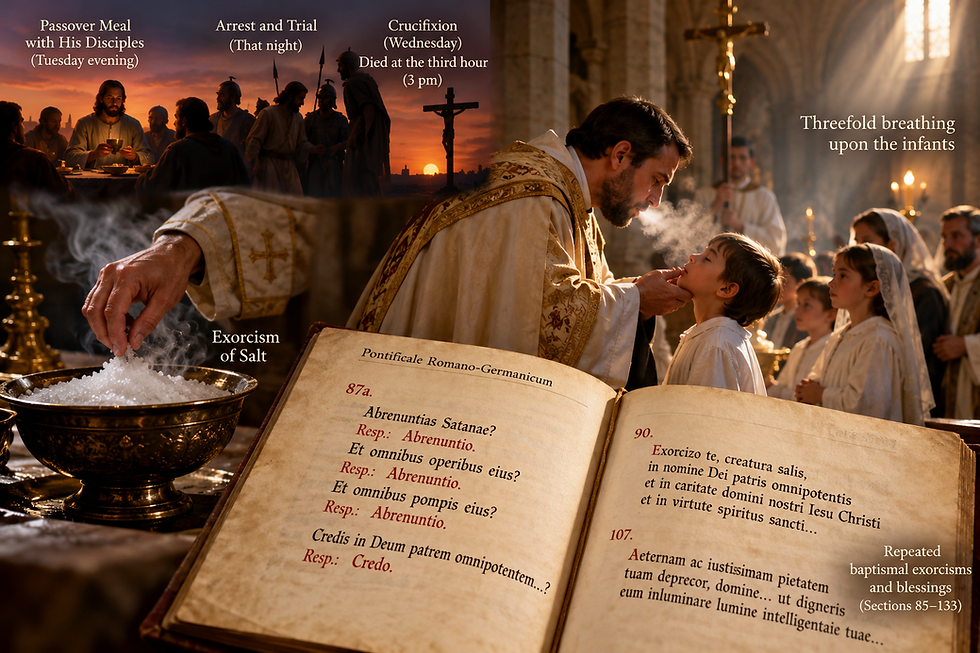
In Section XCIX, paragraphs 85–87, the medieval Church appoints a baptismal scrutiny for Wednesday at the third hour, approximately 9 a.m.
The hour corresponds to the time Mark associates with Christ's crucifixion, although the Pontifical does not claim that this scrutiny was instituted to commemorate a Wednesday crucifixion.
The connection cannot be presented as historical proof. However, it is worth recording as we continue examining how particular days, hours and biblical events were incorporated into medieval ceremonial practice.
What follows in the Pontifical is especially extraordinary: infants are subjected to repeated exorcisms, priests breathe upon their faces three times, salt is exorcised and placed into their mouths, and Satan is repeatedly commanded to depart.
The question now becomes whether these elaborate baptismal ceremonies arose from the commands of Jesus Christ, or whether ecclesiastical authorities constructed a ritual system around the biblical meaning of baptism.
We therefore return to the Latin text, beginning with paragraph 85, where the medieval Church describes the heavenly mystery by which the devil and his pomp are destroyed and the gate of the kingdom of heaven is opened.
Infants, Exorcised Salt and the Destruction of Satan: The Medieval Baptismal Rituals
The preceding discussion of the Passover calendar brought us to Wednesday, the third hour, and the importance of examining how biblical events became incorporated into the medieval Church's ceremonial calendar.
We now encounter a series of instructions that raise even more serious questions about the development of Christian worship.
In paragraphs 85–133, the Romano-Germanic Pontifical describes the examination and preparation of infants for baptism. What follows is not simply a command to repent, believe in Christ and receive baptism. The ceremony involves repeated exorcisms, priests breathing upon children's faces, consecrated salt placed into their mouths, numerous signs of the cross, invocations for angelic protection and a carefully prescribed sequence of religious actions.
These were ecclesiastical rites preserved within the Church's own liturgical tradition.
The question is whether such ceremonies were commanded by Christ or developed through the authority of the medieval priesthood.
In paragraph 85, the Pontifical introduces the scrutiny of those selected for baptism, beginning on Monday of the third week of Lent.
The congregation is subsequently instructed to assemble on Wednesday at approximately the third hour.
The announcement in paragraph 86 describes the purpose of the occasion:
Ut celeste misterium quo diabolus cum sua pompa destruitur et ianua regni celestis aperitur, inculpabili, domino iuvante, ministerio peragere valeamus.
"So that, with the Lord's assistance, we may perform without fault the heavenly mystery by which the devil and his pomp are destroyed, and the gate of the kingdom of heaven is opened."
This is an extraordinary description.
The ceremony is not presented merely as religious instruction for children. It is described as a heavenly mystery through which Satan's dominion is overcome and the gate of heaven opened.
The Wednesday appointment at the third hour is especially interesting in light of our preceding discussion of Mark 15:25, which associates the third hour with Christ's crucifixion. However, the Pontifical makes no explicit connection between this baptismal scrutiny and a Wednesday crucifixion, and such a connection cannot be asserted as historical fact.
More important is the spiritual authority claimed for the ceremony itself.
Christ declared:
"I am the door: by me if any man enter in, he shall be saved, and shall go in and out, and find pasture." — John 10:9, KJV.
Who opens the way to salvation: Jesus Christ, or an ecclesiastical ceremony administered by priests?
Catholic theology would answer that baptism is effective through Christ and that the priest acts as His minister.(said who?) But this does not establish that every ritual subsequently attached to baptism was instituted by Christ.
And when we examine those rituals, the questions become increasingly difficult to ignore.
Three Breaths Upon an Infant to Expel an Unclean Spirit
In paragraph 87, the children are brought into the church and separated according to sex. Boys stand on the right and girls on the left.
Their names, or those of their sponsors, are recorded, and each is called forward.
The priest then asks whether the child renounces Satan, all his works and all his pomp. A profession of faith in the Father, Son and Holy Spirit follows.
The ritual is explicitly concerned with infants, who ordinarily cannot understand or personally articulate such professions. The prescribed responses belong to a ceremony that depends upon others speaking on their behalf.
Then comes a startling physical action.
Paragraph 87a states:
Tune exsufflat in faciem eius tribus vicibus dicens: Exi, inmunde spiritus, et da locum spiritui sancto paraclito.
"Then he blows upon the child's face three times, saying: Go out, unclean spirit, and make room for the Holy Spirit, the Comforter."
The Latin word exsufflat refers to breathing or blowing outward, an action historically known as exsufflation.
The priest is not simply offering a blessing. He performs a repeated physical action accompanied by an imperative addressed to an unclean spirit.
Why?
Where did Jesus command His apostles to blow three times upon infants before baptism?
Scripture records Christ expelling unclean spirits. It also records Him receiving little children.
But the contrast with His actual treatment of children deserves attention.
"Suffer the little children to come unto me, and forbid them not: for of such is the kingdom of God." — Mark 10:14, KJV.
Christ received children and blessed them. Mark 10:16 describes Him taking them into His arms and laying His hands upon them.
That passage contains no threefold breathing, no command addressed to an unclean spirit within the child and no preliminary exorcism of substances.
We must distinguish between the biblical action and the later ceremony.
The existence of this baptismal exorcism does not prove that every infant was believed to be individually possessed in the same manner as the demon-afflicted persons in the Gospels. Medieval baptismal theology frequently associated such rites with humanity's condition under sin and the devil.
But it does establish that an exorcistic action was prescribed for infants as part of their preparation for baptism.
That alone deserves serious scriptural investigation.
"I Exorcise Thee, O Salt": A Consecrated Substance Placed Inside Children
The ceremony then takes an even more unusual direction.
After the priest has performed the prescribed rites over the boys and girls, he is instructed in paragraph 90 to exorcise salt.
The Latin begins:
Exorcizo te, creatura salis, in nomine Dei patris omnipotentis et in caritate domini nostri Iesu Christi et in virtute spiritus sancti.
"I exorcise thee, created substance of salt, in the name of God the Father Almighty, and in the love of our Lord Jesus Christ, and in the power of the Holy Spirit."
Again, an inanimate substance is directly addressed through an exorcistic formula.
The prayer declares that God created the salt for humanity's protection and commanded its consecration by His servants for those coming to faith.
This is a claim made by the ritual itself. We must therefore ask where Scripture records such a command.
The prayer continues:
Ut haec creatura salis in nomine sanctae trinitatis efficiatur salutare sacramentum ad effugandum inimicum.
"That this created substance of salt may become, in the name of the Holy Trinity, a saving sacrament for driving away the enemy."
The word sacramentum is used here in an older and broader liturgical sense; it should not automatically be equated with one of the seven sacraments subsequently defined in Catholic theology.
But the requested spiritual effect is unmistakable: the consecrated salt is associated with driving away the enemy.
The prayer then asks that the salt become:
Perfecta medicina, permanens in visceribus eorum.
"A perfect remedy, remaining within their inward parts."
And what happens next?
Paragraph 91 commands:
Et mittat in ora infantium de ipso sale per singulos.
"And he shall place some of this salt into the mouth of each infant."
The priest accompanies this action with the words:
Accipe salem sapientiae propitiatus in vitam aeternam.
"Receive the salt of wisdom, with divine favour unto everlasting life."
We have now moved beyond blessing a candle to protect a house or exorcising ashes for spiritual purification.
The priest exorcises salt, asks that it become a remedy against the enemy, and physically places it within the mouths of infants.
Christ certainly used salt as an illustration. In Mark 9:50 He said:
"Salt is good: but if the salt have lost his saltness, wherewith will ye season it? Have salt in yourselves, and have peace one with another." — KJV.
But He did not command His disciples to consecrate salt through exorcistic formulas and place it into infants' mouths as a spiritual remedy.
A biblical metaphor involving salt is not, by itself, authorisation to construct a ritual of this kind.
If the salt of wisdom signifies spiritual understanding, why must ordinary salt be exorcised before being placed inside the child? And where did Christ command this procedure?
This is where the research of historian Arthur Westwell becomes especially important.
In Roman Liturgy and Frankish Creativity: The Early Medieval Manuscripts of the Ordines Romani (2024), Westwell re-examines the manuscript traditions behind Roman liturgical orders.
His chapter, The Ordo Romanus of the Baptismal Scrutinies, investigates Ordo Romanus XI, one of the earlier sources incorporated into the Romano-Germanic Pontifical.
Westwell challenges the assumption that the surviving version of this order represents an unchanged ancient Roman ceremony. He identifies substantial Frankish reworking and expansion of material associated with the Gelasian Sacramentary.
His research traces the development of baptismal scrutinies from three in earlier Roman practice to seven in the Frankish liturgical tradition.
This distinction is important because the ceremonies were not simply invented in tenth-century Germany. Earlier Roman baptismal practices were already established, and a sixth-century letter attributed to John the Deacon discusses scrutinies and the initiation of infants.
What Westwell demonstrates is that the ceremonies were also subject to considerable development and adaptation as they passed through the Frankish ecclesiastical world.
This strengthens the historical question raised by Henry Parkes's work on the origins of the Romano-Germanic Pontifical.
The rituals were transmitted, compiled, rearranged and expanded by ecclesiastical authorities over time.
They did not arrive as a complete ceremonial handbook written by Jesus Christ or His apostles.
That does not automatically make every subsequent development unbiblical. But it means each claim of spiritual authority must be tested rather than accepted simply because it appears in a medieval book labelled Roman.
The Repeated Exorcisms of Children
The ceremonies continue in paragraphs 94–108.
The children are recalled into the church after having been sent outside. The deacon instructs them to pray, kneel and rise.
Sponsors make the sign of the cross upon their foreheads. Acolytes repeat the same sign and place their hands upon the children.
In paragraph 95, God is petitioned to send a holy angel to protect the candidate, recalling the angel appointed to guard Israel during the Exodus.
Then, in paragraph 99, the language becomes explicitly confrontational:
Audi, maledicte Sathanas, adiuratus per nomen aeterni Dei et salvatoris nostri filii eius, cum tua victus invidia tremens gemensque discede.
"Hear, O accursed Satan! Having been adjured through the name of the Eternal God and of His Son our Saviour, depart trembling and groaning, defeated in thine envy."
The ceremony assumes that Satan must be commanded to relinquish his claim upon the baptismal candidate.
This procedure is repeated in further prayers.
Paragraph 103 states:
Exorcizo te, inmunde spiritus, in nomine patris et filii et spiritus sancti, ut exeas et recedas ab hoc famulo Dei N.
"I exorcise thee, unclean spirit, in the name of the Father, and of the Son, and of the Holy Spirit, that thou mayest go out and depart from this servant of God N."
Paragraph 105 repeats the command over a female candidate:
Exorcizo te, inmunde spiritus, per patrem et filium et spiritum sanctum, ut exeas et recedas ab hac famula Dei N.
"I exorcise thee, unclean spirit, through the Father, and the Son, and the Holy Spirit, that thou mayest go out and depart from this handmaid of God N."
The prayers invoke Christ's authority, recalling His walking upon the sea, His rescue of Peter, His healing of the man born blind and His raising of Lazarus.
These are genuine biblical events, now incorporated into prescribed exorcistic formulas.
The issue is not whether Christ possesses power over Satan. He does.
The issue is the Church's assumption that these repeated procedures form an appropriate preparation for the baptism of infants.
Why must the child undergo several rounds of ceremonial exorcism when the New Testament nowhere provides these instructions for the baptismal ministry?
The repetition matters. This is not one spontaneous prayer for protection. It is a carefully ordered series of actions involving the priest, acolytes, sponsors, ritual gestures and specific formulas.
The contrast becomes particularly striking when we turn to the baptisms recorded in the Acts of the Apostles.
When Philip preached Jesus Christ to the Ethiopian eunuch, the man saw water and asked:
"See, here is water; what doth hinder me to be baptized?" — Acts 8:36, KJV.
Philip baptized him.
When Cornelius and his household received the Holy Spirit, Peter declared:
"Can any man forbid water, that these should not be baptized, which have received the Holy Ghost as well as we?" — Acts 10:47, KJV.
In Acts 16:30–33, the Philippian jailer asked what he must do to be saved. Paul and Silas directed him to believe on the Lord Jesus Christ, and he and his household were baptized that same night.
These accounts do not prescribe exorcised salt, repeated signs of the cross, seven scrutinies or blowing three times upon the candidates' faces.
Catholic Christians would argue that such rites developed as liturgical expressions of baptism's spiritual significance, rather than as replacements for Christ's saving work.
But the absence of these procedures from the apostolic accounts is significant when we ask whether they were commanded by Christ.
The New Testament teaches that baptism concerns Christ, repentance, faith and identification with His death and resurrection.
Peter writes:
"The like figure whereunto even baptism doth also now save us (not the putting away of the filth of the flesh, but the answer of a good conscience toward God,) by the resurrection of Jesus Christ." — 1 Peter 3:21, KJV.
The apostle directs attention to the resurrection of Jesus Christ.
The Pontifical, meanwhile, introduces a succession of consecrated substances and prescribed ceremonies intended to prepare the child for baptism.
The question is whether these additional ritual actions clarify the Gospel or surround it with practices for which there is no apostolic command.
A further revealing detail appears in paragraph 110.
After the repeated scrutinies, the deacon announces:
Cathecumini recedant. Si quis cathecuminus est, recedat. Omnes cathecumini recedant foras.
"Let the catechumens depart. If anyone is a catechumen, let him depart. Let all the catechumens go outside."
The candidates are then required to wait outside until the solemnities of the Mass have been completed.
This practice reflects the historical distinction between catechumens preparing for baptism and those already admitted to full participation in the Church's Eucharistic worship.
Yet consider which Gospel is read immediately afterwards.
The text appoints Matthew 11:25–30, containing Christ's words:
"Come unto me, all ye that labour and are heavy laden, and I will give you rest." — Matthew 11:28, KJV.
The contrast is arresting.
While the candidates wait outside according to the ecclesiastical order, the Gospel being read within the ceremony records Christ's invitation to come directly unto Him.
This does not establish that the children were being denied salvation or that the Church understood their temporary exclusion in that manner. The dismissal concerns participation in a particular liturgical celebration.
Nevertheless, it illustrates the increasing importance of ecclesiastically controlled stages of admission into Christian worship.
What began in Scripture as an invitation to come to Christ has become surrounded by formal procedures determining when the candidate may enter, remain or depart.
The final significant ceremony in the present extract appears in paragraphs 131–133.
Four deacons emerge carrying four books of the Gospels.
They are preceded by candlesticks and incense, and the books are placed upon the four corners of the altar.
The Latin states:
Et ponunt ipsa evangelia super quatuor angulos altaris.
"And they place the Gospels upon the four corners of the altar."
The priest then explains the identity of the four Gospel writers through the vision of the living creatures in Ezekiel.
Referring to Ezekiel 1:10, the text identifies the faces of a man, a lion, an ox and an eagle.
It declares:
Hos quatuor has figuras habentes evangelistas esse non dubium est.
"There can be no doubt that these four figures represent the evangelists."
The priest then names Matthew, Mark, Luke and John.
But Ezekiel does not actually identify his four living creatures as the authors of the four Gospels.
This identification belongs to the development of Christian symbolic interpretation and was already established in early Christian tradition long before the Romano-Germanic Pontifical.
It is not, by itself, evidence of occult practice.
Nevertheless, the ceremonial arrangement is noteworthy: four Gospel books are placed at four corners of the altar, accompanied by lights and incense, while the priest interprets Ezekiel's vision through the four evangelists.
Fourfold religious symbolism also appears in later natural-magical and occult-philosophical traditions, including the correspondence systems studied by Agrippa.
But numerical or symbolic resemblance does not demonstrate direct borrowing. Any connection would require examination of specific texts, images and their historical transmission.
For our investigation, the importance of the passage lies in the development of ceremonial symbolism around biblical texts, including interpretations not explicitly supplied by the biblical authors themselves.
The Real Historical Question: Who Authorised These Rites?
Our translation through paragraph 133 has uncovered another substantial body of evidence concerning medieval ecclesiastical ceremonies.
We have encountered infants subjected to repeated exorcisms, salt treated as a saving remedy against the enemy, angelic protection invoked over baptismal candidates, signs of the cross repeatedly traced upon foreheads, and a carefully structured ceremony in which candidates enter and leave the church according to prescribed instructions.
The associated Gospel readings themselves are entirely recognisable. Ezekiel speaks of God giving His people a new heart and a new spirit. Isaiah calls sinners to return to the Lord, who will abundantly pardon. Paul teaches believers to put off the old man and put on the new, declaring:
"But Christ is all, and in all." — Colossians 3:11, KJV.
These are profound spiritual teachings.
Yet alongside them, the medieval Church prescribed physical acts and formulas not found in the apostolic baptismal narratives.
Our research into ceremonial magic has already demonstrated that learned magical traditions sometimes appropriated liturgical prayers, sacred objects, consecrations and ritual procedures.
Richard Kieckhefer's Forbidden Rites, Sophie Page's Magic in the Cloister, Frank Klaassen's The Transformations of Magic and Michael Barbezat's research on the magical adaptation of liturgical practices provide historical evidence of that wider relationship.
The material we have translated here does not prove that these baptismal rites were magical in origin. It does, however, establish another set of consecratory and exorcistic practices that can be compared with surviving ritual-magical manuscripts.
Arthur Westwell's research adds another dimension: the baptismal scrutinies were not static, but were reworked and expanded through Frankish ecclesiastical transmission.
This is therefore not simply a debate about whether ancient Christians used symbolic ceremonies.
It concerns the authority through which those ceremonies were developed, multiplied and invested with claims of spiritual efficacy.
Christ commanded His followers to make disciples, to teach them and to baptize them. But where did He command priests to blow upon the faces of infants, exorcise salt, place it inside their mouths, repeat commands against Satan and require multiple ritual examinations before baptism?
The medieval Church preserved these instructions as part of its authorised worship.
But preservation within ecclesiastical tradition is not the same as institution by Jesus Christ.
And as our translation continues, we must keep returning to the distinction between the authority of Christ and the authority claimed by those who constructed ceremonies in His name.
The investigation continues from Section XCIX, paragraph 134.
Thoughts....
Daniel declares that “they shall mingle themselves with the seed of men” (Daniel 2:43). But who exactly are “they”? Could the wording suggest beings attempting to mingle with humanity who are not themselves entirely human? Although Daniel's immediate context concerns earthly kingdoms, the possibility of a deeper spiritual meaning deserves investigation. If Samael, identified in certain Jewish traditions with the angel of death and linked in some later esoteric interpretations with Saturn, was the wicked angel who deceived Eve, could he have assumed Adam's appearance to seduce her? Could this explain the birth of Cain, whom Scripture describes as “of that wicked one” (1 John 3:12)? The Greek myths present a disturbing parallel: Zeus, the son of Cronus (identified with the Roman Saturn), repeatedly disguises himself to seduce mortal women, even assuming the appearance of Alcmene's husband, Amphitryon, to father Heracles. Are these merely pagan inventions, or could they preserve distorted memories of an ancient deception involving the seed of the serpent and the seed of the woman in Genesis 3:15?
And who is “the god of this world” spoken of by Paul in 2 Corinthians 4:4? Scripture commonly identifies this figure with Satan, while elsewhere describing “principalities,” “powers,” and “the rulers of the darkness of this world” (Ephesians 6:12). Could these spiritual authorities have any connection with the planetary rulers of ancient religious and occult traditions? Saturn occupied an important position among the planetary deities, and in Greco-Roman mythology he was the father of Jupiter (Zeus), who in turn fathered Apollo and numerous other divine offspring. Later astrological and esoteric systems attributed spiritual intelligences, rulers and powers to the planets. Are we examining different names and traditions surrounding a supposed hierarchy of spiritual dominion over mankind? Could the pagan accounts of divine offspring, the planetary powers and the biblical principalities describe overlapping ideas, even if their identities cannot be equated without evidence?
And if Samael was understood as the angel of death, what should we make of Babylon's merchandise in Revelation 18:13, which includes “slaves, and souls of men”? Scripture plainly exposes the trafficking and exploitation of human beings, but could the imagery also invite investigation into ancient beliefs about spiritual captivity? Did certain traditions imagine human bodies serving as vessels for other spiritual beings, or even for the spirits of the dead? Were such beliefs connected with the powers that Christ came to defeat? Paul declares that Christ, “having spoiled principalities and powers, he made a shew of them openly, triumphing over them in it” (Colossians 2:15). If the authority of these powers has already been overcome by Christ, why do human religious systems continue to invoke spiritual intermediaries, planetary intelligences and ceremonial methods of supernatural protection?
These connections demand careful examination of Scripture alongside Jewish traditions, classical mythology and the surviving occult texts. The biblical identification of Satan as the god of this world does not itself establish that Satan is Saturn, that planetary deities are his literal offspring, or that Cain was supernaturally fathered. But neither should similarities between these traditions be mistaken for proof that no historical connection exists. The task is to establish what the earliest sources actually say, when these identifications arose, and whether the spiritual powers described by ancient writers can legitimately be connected with the principalities and powers mentioned in Scripture.
Additional Historical Research
Arthur Westwell, Roman Liturgy and Frankish Creativity: The Early Medieval Manuscripts of the Ordines Romani. Cambridge University Press, 2024. Chapter 6, The Ordo Romanus of the Baptismal Scrutinies, pages 140–177. DOI: 10.1017/9781009360500.007.
John the Deacon, Letter to Senarius, early sixth century. An early witness to Roman catechumenal and baptismal practice, including infant scrutinies.
The earlier research of Cyrille Vogel, Reinhard Elze, Henry Parkes, Richard Kieckhefer, Sophie Page, Frank Klaassen and Michael Barbezat remains relevant to the historical and comparative arguments developed throughout this investigation.
Translation note: The original Latin contains scribal variants and some transcription errors in the supplied text. The quotations above reproduce the intended Latin wording where it is reasonably clear. Before final publication, the quotations should be checked against the printed critical edition, especially wherever a small difference in wording might affect the interpretation.
Primary Source for This Continuation
Cyrille Vogel and Reinhard Elze, Le Pontifical Romano-Germanique du Dixième Siècle, Volume II, Le Texte (NN. XCIX–CCLVIII), Vatican City: Biblioteca Apostolica Vaticana, Studi e Testi 227, 1963, Section XCIX, paragraphs 43–84.
Particularly relevant passages: paragraph 44 (priestly sacrifice and the keys of heaven); paragraph 45 (priestly mediator); paragraph 54 (submission at the priest's feet); paragraphs 61, 68 and 70 (satisfaction and sacramental offering); paragraph 73 (expulsion from the Church); paragraphs 74–76 (blessed ashes); paragraph 82 (opening of the ears); and paragraph 83 (exorcism of ashes).
Textual limitation: Paragraphs 51–53 were missing from the supplied extract. They should be examined before claiming to have reviewed every instruction in this penitential order.
Vogel, Cyrille, and Reinhard Elze. Le Pontifical Romano-Germanique du Dixième Siècle. Volume II, Le Texte (NN. XCIX–CCLVIII). Vatican City: Biblioteca Apostolica Vaticana, Studi e Testi 227, 1963. Section XCIX, paragraphs 8–42, especially 15–20, 25–27 and 31–37.
Parkes, Henry. The Making of Liturgy in the Ottonian Church: Books, Music and Ritual in Mainz, 950–1050. Cambridge University Press, 2015.
Parkes, Henry. "Questioning the Authority of Vogel and Elze's Pontifical Romano-Germanique." In Understanding Medieval Liturgy: Essays in Interpretation, pp. 75–101. Ashgate, 2015.
Parkes, Henry. "Henry II, Liturgical Patronage and the Birth of the 'Romano-German Pontifical'." Early Medieval Europe 28, no. 1 (2020): 104–141. DOI: 10.1111/emed.12389.
Regino of Prüm. Libri duo de synodalibus causis et disciplinis ecclesiasticis, c. 906. See the Canon Episcopi.
Kieckhefer, Richard. Forbidden Rites: A Necromancer's Manual of the Fifteenth Century. Pennsylvania State University Press, 1997.
Page, Sophie. Magic in the Cloister: Pious Motives, Illicit Interests, and Occult Approaches to the Medieval Universe. Pennsylvania State University Press, 2013.
Barbezat, Michael. "An Herb for Speaking to the Dead: The Liturgical and Magical Life of Hyssop in the Latin Middle Ages." Church History 91, no. 3 (2022): 492–512. DOI: 10.1017/S0009640722002153.
Klaassen, Frank. The Transformations of Magic: Illicit Learned Magic in the Later Middle Ages and Renaissance. Pennsylvania State University Press, 2013.
Pseudo-Agrippa. Fourth Book of Occult Philosophy, first published 1559. See the section on consecrations and magical ceremonies. This work is falsely attributed to Heinrich Cornelius Agrippa and should not be confused with his authentic three books.
La penitencia pública en códices medievales aragoneses — a study of public penance in medieval Aragonese manuscripts, including the Romano-Germanic Pontifical's ceremony of expelling penitents in imitation of Adam's expulsion from Paradise. This provides independent liturgical context for the practice recorded in paragraph 73.
The scholarship of Vogel, Elze, Henry Parkes, Richard Kieckhefer, Sophie Page, Frank Klaassen and Michael Barbezat cited in Part One remains relevant to this continuation.


Comments