DRAWING DOWN (FIRE FROM) HEAVEN

Muller part 2
Celestial Characters, Sacramental Power and the Priest at the Altar
There is a point at which theological vocabulary can no longer be allowed to conceal theological machinery. A system may call one operation “magic” and another “sacrament,” but names do not by themselves establish that the underlying mechanisms are fundamentally different. If one system employs a qualified operator, prepared matter, determinate words, an impressed character, superior power descending from above and an invisible effect produced below, while another employs an ordained operator, prescribed matter, determinate words, an indelible character, power received “from without” and an invisible effect produced through the operator, then the resemblance must be examined rather than dismissed.
This does not prove that Thomas Aquinas copied Heinrich Cornelius Agrippa. Aquinas lived centuries before Agrippa. It does not prove that Michael Müller consciously practised occultism. Müller explicitly condemns the esoteric and Masonic material reproduced in The Church and Her Enemies. Nor does it establish that two rites are identical merely because each uses material objects and words. Scripture itself contains divinely instituted rites.
The real issue is more serious: what distinguishes a divinely instituted sacrament from a ritual technology claiming supernatural efficacy?
Catholic theology gives a clear answer. The difference is divine institution. God is said to have established the sacrament, determined its matter and form, and pledged Himself to act through its authorized minister. If that answer is correct, the resemblance to magical or theurgic ritual does not make the sacrament magic.
But that defence immediately creates the decisive test: show the institution.
Where did Jesus Christ institute an indelible sacerdotal character? Where did He say ordination would implant an instrumental spiritual power into a man's soul? Where did He declare that correctly pronounced priestly words would bring Him from heaven to an altar irrespective of the priest's personal holiness? Where did He make the priest an efficient instrumental cause of His sacramental presence? Where did He institute a sacrificing mediator whose essential act occurs between himself and God while the congregation remains unnecessary to the act itself?
Those questions cannot be answered merely by repeating that God instituted the system. That is the proposition requiring proof.
And the problem becomes extraordinarily sharp when Michael Müller's books are read together, because Müller condemns one religious system built around celestial influence, secret characters, sacred names, ranks, material correspondences and ritual operations, yet elsewhere celebrates a sacerdotal system in which an especially empowered man pronounces prescribed words over matter, produces an invisible change and is said to bring the Eternal Word down upon his altar.
The comparison is not based upon insinuation. Müller, Agrippa and Aquinas will describe the mechanisms themselves.
The Teutonic Background and the Cross on Müller’s Cover
There is another historical detail worth placing on the table before proceeding, although it must be handled carefully. In Denzinger's record of the Council of Guastalla, AD 1106, under the decree concerning ordinations by heretics and simoniacs, the council speaks of the German ecclesiastical world in striking language:
“For many years now the broad extent of the Teutonic kingdom has been separated from the unity of the Apostolic See.”
It then laments that:
“only a few priests or Catholic clergy are found in such a broad extent of territory.”
The term Teutonic here refers to the German kingdom; it should not be misrepresented as a reference to the later military Order of the Teutonic Knights. But the language is significant because it reminds us that Teutonic was deeply embedded in the medieval Latin ecclesiastical vocabulary for the German world long before later German religious and military symbolism developed.
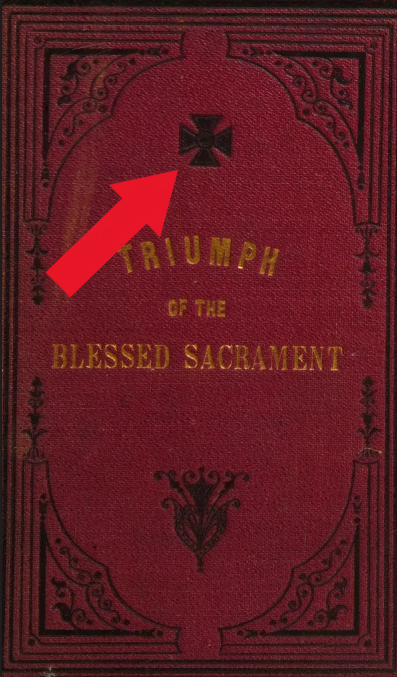
That makes the surviving cover of Müller's 1872 Triumph of the Blessed Sacrament visually noteworthy. Above the title is a prominent black cross pattée; the broad-armed form belonging to the same visual family from which the Teutonic cross and later German Iron Cross imagery are known. The book itself does not label the device, so the cover alone cannot prove that Müller or his publisher intended a specific Teutonic-Knight identification. We should not manufacture that link. But neither should the visual fact be hidden: Müller's Eucharistic triumph book was issued beneath a stark black cross of unmistakably Germanic cross-pattée form.
The importance of this is not that a cross symbol proves occultism or establishes a secret historical lineage. It does not. Its relevance is contextual. We are about to encounter Müller reproducing a ritual order of Knights Adepts of the Eagle or Sun, celestial hierarchies, sacred names, characters, planetary influences, colours, metals and ritual grades; we will then compare those structures with Agrippa's German Renaissance celestial magic and finally with the sacerdotal metaphysics Müller himself embraces. The Denzinger text and Müller's cover therefore belong here as historical framing, not as proof of causation. The evidence must still stand or fall upon the doctrines, words and mechanisms actually documented in the texts.
And those mechanisms are far more important than the emblem on a cover. A cross can be decorative; a ritual system cannot. Müller himself now takes us directly inside a system of ranked adepts, sacred characters, celestial influence and solar symbolism—and because he presents that system as an enemy of the Church, he unwittingly gives us a control against which his own sacerdotal theology can later be measured.

Müller Opens the Door: “Knights Adepts of the Eagle or Sun”
The attached volume is Michael Müller's God the Teacher of Mankind: A Plain, Comprehensive Explanation of Christian Doctrine, The Church and Her Enemies, published in New York, Cincinnati and St. Louis by Benziger Brothers in 1880. The title page identifies Müller as C.Ss.R.; this scan does not state a separate edition number. The following page bears the Imprimatur of Thomas Foley, Bishop Administrator of Chicago, and records Müller's copyright in 1877.
The internal pagination later restarts. Müller's contents explicitly identify “The Third Enemy: Freemasonry,” followed by sections on its objects, oaths and ceremonies. Müller is vehemently hostile to what he reproduces, even describing Freemasonry as an instrument raised against the Catholic Church and connecting it with the restoration of heathenism. That must be stated plainly: the following Masonic material is something Müller condemns, not something he teaches as Catholic doctrine.
Yet precisely because he condemns it, the details he chooses to preserve are remarkable.
On printed p. 35 / PDF p. 431 appears the heading:
“PHILOSOPHICAL LODGE.KNIGHTS ADEPTS OF THE EAGLE OR SUN.”
The presiding officer, “Father Adam,” sits in the east wearing pale yellow. He carries a golden globe and wears:
“a SUN, suspended by a chain of gold around his neck”
with another globe on its reverse.
Seven other officers carry angelic names. Additional initiates are called “SYLPHS,” and Müller records that they serve as:
“assistants in all the ceremonies or operations of the lodge.”
When the lodge opens, the declaration is made that while it is midnight among outsiders:
“the sun is in its meridian in this lodge.”
This is already much more than decorative solar imagery. Müller has reproduced an initiatory order with hierarchy, authorized officers, ritual operations, sacred symbolism and a celestial source of illumination.
The symbolism then becomes an ordered system of correspondences. On printed p. 52 / PDF p. 448, the Sun represents:
“the unity of the Eternal Supreme”
while the ritual connects the planets with colours and the seven cherubim with seven metals—gold, silver, copper, iron, lead, tin and quicksilver.
The Masonic material then moves from symbolism into celestial causation. The candidate speaks of a “great, mysterious, and formidable name” engraved upon a triangle, and when asked to reveal it responds that he cannot disclose the “sacred characters.” The great name “ADONAI” appears within the ritual and is connected with the seven principal degrees.
Then comes one of the most important statements in the whole section. Asked what the seven planets signify, the initiate answers:
“The lights of the celestial globe, and also their influence, by which every matter exists on the surface of the earth or globe.”
The planets are then named:
Sun, Moon, Mars, Jupiter, Venus, Mercury, and Saturn.
Müller's source continues by asking what influence they exercise upon the elements and describing “life, spirit, and body” under the language of salt, sulphur and mercury. The mineral world is then explained through:
“the air penetrating, by the celestial influence, into the earth”
where it meets matter and renders it more or less perfect.
The Sun is elevated further still. On printed p. 53 the moral lodge says:
“The sun represents the divinity of the Eternal”
because one sun illuminates and invigorates the earth just as there is one God. Later the initiate is told that the Sun is:
“the emblem of God”
and should be regarded as:
“the image of the Divinity.”
Again, Müller condemns this system. But look carefully at what he recognizes as belonging to the enemy's ritual universe: grades, a specially qualified operator, sacred characters, sacred names, signs, celestial bodies, metals, colours, material correspondences and invisible influence descending into matter.
Müller knows what such a mechanism looks like when he sees it outside the Church.
That fact makes what follows impossible to ignore.
Agrippa Gives the Mechanism a Name: “Draw New Vertues From Above”
Heinrich Cornelius Agrippa does not conceal the goal of his occult philosophy beneath sacramental terminology. At the beginning of Three Books of Occult Philosophy, Book I, chapter 1, he divides reality into an elementary world, celestial world and intellectual world. The inferior is governed by and receives influence from the superior. The practitioner therefore seeks not only virtues already present in things but to:
“draw new vertues from above.”
That sentence deserves to govern the comparison.
Agrippa's magic is not merely theatrical ceremony. It is a metaphysics of descent. Superior virtue is believed to pass into inferior things.
Book I, chapter 33 explains “Seals and Characters of Naturall things.” Agrippa says the stars impress their seals and characters into lower creation, so that an inferior object may bear a “Character stampt upon it,” containing a particular celestial virtue. He says these characters assist the influences of their stars when made:
“in a fit matter”
and at the appropriate time. (Wikisource)
This is crucial. The matter is not incidental. It must be fit for what is to be received.
Agrippa explicitly lists the “Characters of Saturne (kronos/Mithras),” Jupiter, Mars, the Sun, Venus, Mercury and the Moon. (Wikisource) The character connects the inferior thing to the virtue of the superior body.
Book I, chapter 67 then moves from naturally impressed characters to deliberate magical operation. Its subject is how the human mind may be joined with celestial intelligences so as to impress extraordinary virtues upon inferior things. Agrippa brings characters, figures, words, speech and gesture within the working.
The structure is now complete: a qualified operator aligns himself with a superior power and uses material things, figures and words so that an invisible virtue is impressed into something below.
This is what the phrase drawing down heaven means in Agrippa's world.
The Sun, Its Characters and 666
Agrippa's Book II, chapter 22 develops the planetary machinery further through numerical tables, divine names, intelligences, spirits and characters.
The chapter concerns the sacred planetary tables. Agrippa's system assumes that material figures are not powerful merely because ink has been arranged in a pattern; their force derives from superior intelligences and celestial virtue. A modern translation accurately renders Agrippa's principle as a “power received from God” through the celestial order, applied to matter appropriately disposed for the form through magical skill. (Simon & Schuster)
The Sun's table is a square of six consisting of thirty-six numbers. Its total is 666. The same solar apparatus associates the intelligence Nachiel and the spirit Sorath with the Sun.
That fact should neither be hidden nor sensationalized. Agrippa really does place 666 inside his explicit solar-magical structure. It does not follow that every sunburst, every use of gold or every later solar emblem is therefore the mark of the beast. But neither should the fact be brushed aside. Agrippa's celestial magic genuinely contains a solar numerical structure of 666, solar characters and named spiritual intelligences.
The point is not numerology for its own sake.
The point is the mechanism: number, name, character, intelligence, superior virtue, fitted matter and operator.
“Artificial Things” Receiving Celestial Virtue
Agrippa makes the relationship between matter and invisible power unmistakable in Book II, chapter 35:
“How some artificiall things as Images, Seals, and such like, may obtain some vertue from the Celestial bodies.”
He writes that artificial things, if “rightly exposed” to superior celestial bodies, may receive what he calls an:
“admirable Celestiall vertue.”
He says images, seals, rings, glasses and other instruments, when properly made under the relevant celestial configuration, may receive higher efficacy and have “wonderfull powers” imprinted in them. (Esoteric Archives)
This is not vague mysticism.
Before the operation, there is ordinary matter.
The matter is prepared.
A superior efficacy acts.
Afterwards the object is said to carry a virtue it did not possess by its ordinary physical nature.
And Agrippa openly calls the operation magical.
Now we turn to Aquinas.
Aquinas's Sacramental Machine
Thomas Aquinas does not teach Agrippa's celestial magic. His principal cause "he believes" is God, not a planetary spirit, and his sacraments claim divine institution. That difference is fundamental.
But look at the machinery he builds.
In Summa Theologiae III, question 60, article 7, Aquinas says sensible things in the sacraments function as matter, while words function as form. He insists that if a sacrament requires determinate matter, still more does it require:
“a determinate form of words.” (another name for magic?)
This immediately gives the sacramental action a technical structure. The material is prescribed; the verbal form is prescribed; both together constitute the valid rite.
Aquinas does not say the sound waves themselves possess supernatural force. He says the sacramental effect comes from God.
That distinction matters.
But it does not remove the structure.
It explains where Aquinas believes the power comes from.
Question 63 then supplies the marked operator.
Aquinas asks whether a sacramental character is a spiritual power and answers that:
“a character signifies a certain spiritual power ordained unto things pertaining to the Divine worship.”
He immediately says that this spiritual power is instrumental.
This is already considerably more than ordinary church appointment. Aquinas is not merely saying, “The community recognizes this man as its minister.” He says something invisible is impressed upon the soul and becomes a spiritual instrumental power.
Then comes the statement that should stop every reader:
“a spiritual power coming from without.”
Aquinas's sacramental character is not a natural ability developed within the man. It is a supernatural instrumental capacity added to him.
Question 63, article 3 identifies these sacramental characters as:
“certain participations of Christ's Priesthood, flowing from Christ Himself.”
And in article 5 Aquinas insists that this character is indelible. It remains because its stability depends upon the principal agent rather than the moral condition of the instrument. He says the character remains even in apostates and, astonishingly, after this life even in the wicked, where it increases their shame. (New Advent)
This is the theological architecture that ultimately permits a wicked priest still to function sacramentally.
Question 64 explains why. God is the principal agent; man is an instrument. Aquinas says the sacramental character itself is:
“an instrumental power which flows from the principal agent, which is God.”
This is why Catholic theology can maintain that sacramental efficacy does not depend upon the minister's sanctity. The priest need not be holy enough to generate the effect. He has been made an instrument through which the superior agent acts.
Now place that beside Agrippa without confusing them.
Agrippa: superior celestial efficacy.
Aquinas: divine principal efficacy.
Agrippa: character or seal.
Aquinas: indelible sacramental character.
Agrippa: fitted matter.
Aquinas: determinate matter.
Agrippa: names, words and figures.
Aquinas: determinate form of words.
Agrippa: authorized practitioner aligning the lower with the higher.
Aquinas: ordained instrument deputed to divine worship.
Agrippa: invisible virtue impressed below.
Aquinas: invisible sacramental effect caused instrumentally.
These are not identical theologies.
They are a strikingly similar ritual grammar.
And Michael Müller shows exactly what that grammar permits the Catholic priest to claim.
Scripture however states:
Titus 1:5–9, KJV
"For a bishop must be blameless, as the steward of God; not selfwilled, not soon angry, not given to wine, no striker, not given to filthy lucre"
Five Words Bring the Eternal Word Down
Müller's The Holy Mass leaves very little room for euphemism.
On printed p. 177 / PDF p. 193 he compares the priest's consecratory action with Mary's role in the Incarnation:
“Five words of her humility brought the Eternal Word into her sacred womb. Five words of the power of the priest brings the same Eternal Word on our altar.”
He then says that the priest's action is:
“the efficient cause of Transubstantiation”
and calls what happens:
“the New Incarnation.”
This is the passage that should govern the rest of the exposé.
Müller is not merely saying the priest reminds believers of the Incarnation.
He says priestly words bring the Eternal Word upon the altar.
He does not merely say God acts while the priest watches.
He calls the priest's action the efficient cause.
He does not merely say communion represents Christ.
He calls the result a New Incarnation.
And he says what Mary did once, the priest does every day.
If the phrase “drawing down heaven” appears severe, Müller has made it difficult to use a weaker one. Agrippa says magical art may “draw new vertues from above.” Aquinas describes the marked operator as possessing a spiritual power “coming from without.” Müller tells us what his priest does with that power: he speaks and the Eternal Word comes down upon the altar.
The resemblance is no longer hiding in technical theology.
It is functioning before us.
The following claim is profoundly offensive to any right-minded Christian, because it places the Almighty Christ—the risen Lord of heaven and earth—in a posture of obedience to a mere mortal, as though divine authority could be placed at the disposal of a man invested with religious office and ritual power.
The Priest Speaks; Christ Obeys
Müller goes further still.
On printed p. 257 / PDF p. 273 he says Christ, although reigning in heaven, remains obedient to man. At Mass:
“He renders immediate, universal obedience to every priest who pronounces the words of consecration”
and this is:
“without reference to the virtue of the priest.”
Catholic theology can qualify this by saying Christ voluntarily bound Himself to the sacrament. Müller himself calls the obedience free and voluntary.
But qualification does not remove the extraordinary claim.
A corrupt priest can speak.
A wicked priest can speak.
The man's moral condition does not stop the operation.
If he is the validly ordained instrument and performs the action validly, the effect follows.
This is exactly what Aquinas's instrumental theory predicts.
The character belongs to the priest in a way that does not vanish with personal wickedness. The rite's efficacy comes from the superior principal cause. The operator's holiness is therefore not the decisive factor.
And Müller translates that philosophy into breathtaking devotional language: Christ obeys every priest.
Where did Christ promise this?
Not where Aquinas deduces it.
Not where Müller praises it.
Where does Christ say it?
Right Action, Right Words, Invisible Effect
Müller makes the ritual mechanics explicit again on printed p. 502 / PDF p. 518.
He acknowledges that prayers, instruction and ceremonies may affect people's devotion, but says the sacramental effect is not produced by those things. Rather, it is produced:
“by the actions rightly performed and the words properly pronounced by the priest”
and he describes these as offices “totally and incommunicably peculiar to himself.”
Read those words beside Agrippa.
Matter correctly disposed.
Words correctly employed.
Authorized operator.
Power not originating in ordinary nature.
Invisible effect.
The Catholic answer remains: God instituted ours.
Then show it.
Because if divine institution cannot be demonstrated, the distinction between sacrament and ritual technique has simply been asserted, not proved.
Müller's Triumph of the Blessed Sacrament; or, History of Nicola Aubry, published in Baltimore in 1872, makes the structure even more visible.
In its possession narrative Müller deliberately contrasts consecrated and unconsecrated matter. Protestants, he says, touched Nicola with an unconsecrated host which:
“was only bread”
and Satan supposedly showed no torment whatsoever.
Then comes the consecrated host.
Now the supposed demon reacts.
In another scene the demon allegedly cries that it is the:
“‘Hoc,’ that ‘Hoc,’ that forces me to flee.”
Müller immediately explains what the alleged demon means:
“The devil here refers to the divine words of consecration by which the bread and wine are changed, in holy Mass, into the Body and Blood of our Lord Jesus Christ.”
The architecture is astonishingly clear.
Before the authorized words: ordinary matter, “only bread.”
The authorized words are uttered.
After the words: Müller says an invisible substantial change has occurred.
The difference cannot be seen by ordinary senses, but Müller claims spiritual powers recognize it.
This is almost a diagram of sacramental causation.
And it is precisely the kind of logic Article Two is examining.
The Demon Müller Uses as Witness Is the Demon Müller Later Calls a Liar
There is then a devastating problem within Triumph itself.
Later Müller attacks spiritualism and writes:
“Satan is a liar, and the father of lies.”
He says that if Satan sometimes tells the truth, it may be because he is compelled by superior power, or because:
“truth serves his purpose of deception better than falsehood.”
Yet earlier Müller has built Eucharistic apologetic force around what a supposed demon says and how a supposed demon reacts.
The demon reacts to the host.
The demon identifies the Hoc.
Müller explains the Hoc as the words of consecration.
Protestants supposedly witness it and convert.
Then Müller later warns us that Satan can tell the truth precisely because truth may serve deception.
How, then, can demonic testimony function as theological confirmation?
Scripture gives us the safer method. Demons told the truth about Christ.
“I know thee who thou art, the Holy One of God.”—Mark 1:24, KJV
Christ silenced them.
Acts 16 records a spirit proclaiming that Paul and his companions were servants of the Most High God showing the way of salvation. The statement was true. Paul did not turn the demon into an evangelistic witness. He cast it out.
Truth in a demon's mouth does not establish doctrine.
The doctrine must already stand upon the word of God.
The Priest Finally Holds Christ and Proposes an “Exchange”
Müller's system reaches perhaps its most disturbing devotional expression when he recounts the Curé d'Ars story of a priest offering Mass for a soul in purgatory.
Holding the consecrated host, the priest supposedly says:
“Oh, holy and eternal Father, let us make an exchange.”
Then:
“Thou hast the soul of my friend who is in purgatory, and I have the body of Thy Son who is in my hands.”
Müller does not merely recount this as folklore and move on. He tells his readers to imitate it: “Let us do the same after consecration.”
This is devotional material rather than a conciliar definition, and fairness requires that distinction.
But it reveals the practical imagination created by the theology.
The priest has Christ in his hands.
The priest offers Christ.
The priest proposes an exchange.
The priest is said to possess a power denied to the ordinary believer—but from whom did that power come, if Christ Himself never clearly gave it in the first place?
The system has therefore travelled a remarkable distance from:
“For there is one God, and one mediator between God and men, the man Christ Jesus.”—1 Timothy 2:5, KJV
Catholic theology responds that the priest does not replace Christ but participates in His mediation.
Then again: where did Christ establish this sacrificial secondary mediator?
Scripture Gives Us a Seal—But It Is Not Aquinas's Sacerdotal Character
This is where Aquinas's “character” becomes so important.
The word itself proves nothing. Agrippa's character and Aquinas's character are different things. It would be careless to equate them merely because both use the same English term.
Agrippa's character is a celestial sign or figure carrying correspondence to a higher power.
Aquinas's character is an invisible spiritual instrumental power impressed upon the soul.
The resemblance lies elsewhere.
Both function as a qualification connecting the lower operator with higher efficacy.
Yet the New Testament tells believers explicitly what seals them:
“In whom also after that ye believed, ye were sealed with that holy Spirit of promise.”—Ephesians 1:13, KJV
Aquinas knows Scripture speaks of the Holy Spirit's seal and constructs a distinction between that sealing and sacramental character. (New Advent)
But where did the apostles construct that second ontological category?
Where does Paul say that, beyond the Holy Spirit's seal given after belief, Holy Orders imprints another indelible supernatural character enabling one believer to perform sacrificial acts forbidden to the rest?
Where does Peter say that some Christians receive an invisible power that makes them ontologically capable of bringing Christ to an altar?
He instead says:
“ye are a chosen generation, a royal priesthood.”—1 Peter 2:9, KJV
And:
“an holy priesthood, to offer up spiritual sacrifices, acceptable to God by Jesus Christ.”—1 Peter 2:5, KJV
The continuing sacrifices of the New Covenant are then identified:
“the sacrifice of praise to God continually”—Hebrews 13:15, KJV
and doing good and sharing, “for with such sacrifices God is well pleased” (Hebrews 13:16).
The New Testament knows ministry.
It knows elders.
It knows pastors.
It knows teachers.
What it does not plainly establish is Aquinas's ontologically marked sacrificial operator.
“Do This in Remembrance of Me” Cannot Contain All This
The entire system eventually has to be placed inside Christ's words at the Supper:
“this do in remembrance of me.”—Luke 22:19, KJV
But anamnesis cannot bear the burden.
Hebrews 10:3 uses the same Greek noun:
“But in those sacrifices there is a remembrance again made of sins every year.”—Hebrews 10:3, KJV
The sins were remembered.
They were not ontologically made present again.
Therefore anamnesis does not itself mean “make sacramentally present.”
It certainly does not mean:
imprint an indelible priestly character;
create instrumental spiritual power;
identify determinate matter and sacramental form;
make the priest an efficient cause;
bring the Eternal Word to an altar;
produce a New Incarnation;
constitute separate consecrations as immolation;
give Christ universal obedience to every valid priest;
or empower a priest to offer Christ for souls in purgatory.
All of that has been added to “remembrance.”
If it comes from Christ, show where Christ said it.
Nor can Eucharistic participation prove that the meal becomes a continuing sacrifice.
Paul writes:
“The cup of blessing which we bless, is it not the communion of the blood of Christ?”—1 Corinthians 10:16, KJV
Then:
“Behold Israel after the flesh: are not they which eat of the sacrifices partakers of the altar?”—1 Corinthians 10:18, KJV
The Israelite eating from the sacrifice genuinely participated in the altar.
He did not resacrifice the victim by eating.
Participation therefore does not equal sacrificial reproduction.
The Cross (which one?) may remain once for all while communion genuinely joins believers to its benefits.
And that is precisely where Müller's own language begins to contradict itself. He can say Catholics “only participate in” Calvary, yet elsewhere say Christ “perpetually repeats and uninterruptedly continues His atoning and redeeming acts.”
Those are not naturally equivalent propositions.
One says the act is complete and its benefits are shared.
The other says the atoning acts themselves continue through priestly action.
Hebrews settles the question:
“Who needeth not daily, as those high priests, to offer up sacrifice… for this he did once, when he offered up himself.”—Hebrews 7:27, KJV
“Nor yet that he should offer himself often…”—Hebrews 9:25, KJV
“So Christ was once offered to bear the sins of many.”—Hebrews 9:28, KJV
“For by one offering he hath perfected for ever them that are sanctified.”—Hebrews 10:14, KJV
“there is no more offering for sin.”—Hebrews 10:18, KJV
The inspired contrast is not between a bloody offering once and an unbloody offering endlessly.
The contrast is between repeated priestly offering and Christ's one offering.
Fire From Heaven: Not an Identification, but a Warning
Revelation 13:13 says of the second beast:
“And he doeth great wonders, so that he maketh fire come down from heaven on the earth in the sight of men.”—Revelation 13:13, KJV
This verse should not be turned into a cheap accusation that “the Mass is Revelation 13.” That has not been established, and Scripture must not be manipulated merely because an image is striking.
But the warning embedded in the text is relevant.
Power apparently descending from heaven does not authenticate the religious operator who displays it.
The beast's wonder looks heavenly.
Its source is false.
Therefore “power from above” cannot prove itself merely by producing supernatural effects.
That principle becomes unsettling when placed beside the sources we have examined.
Agrippa seeks to “draw new vertues from above.”
Aquinas defines sacramental character as a “spiritual power coming from without.”
Müller says five priestly words bring the Eternal Word upon the altar.
Then Müller's Triumph presents supernatural manifestations as evidence that the transformation has taken place.
The biblical response is not: “It came from above, therefore bow.”
The biblical response is: test it.
Isaiah says:
“To the law and to the testimony.”—Isaiah 8:20, KJV
John says:
“believe not every spirit, but try the spirits whether they are of God.”—1 John 4:1, KJV
Paul says:
“Prove all things; hold fast that which is good.”—1 Thessalonians 5:21, KJV
And Christ warns that religious signs can deceive.
The spectacle of power therefore increases the need for Scripture. It does not diminish it.
The Love of Religious Preeminence
There is another reason such claims must be examined severely: Scripture repeatedly warns what happens when spiritual office becomes spiritual preeminence.
Christ said of religious leaders:
“they love the uppermost rooms at feasts, and the chief seats in the synagogues”—Matthew 23:6, KJV
and then:
“for one is your Master, even Christ; and all ye are brethren.”—Matthew 23:8, KJV
John later speaks of:
“Diotrephes, who loveth to have the preeminence among them.”—3 John 9, KJV
None of those passages proves every ordained priest is proud. That would be unjust.
They establish something more important: religious claims to exceptional status must never be insulated from testing simply because they are made by religious authorities.
When a theological system tells us that one class of men possesses an indelible character, exclusive sacrificial power, a spiritual capacity unavailable to other believers and the ability to cause Christ's sacramental presence by rightly spoken words, Christians are entitled to ask for overwhelming apostolic evidence.
That is not rebellion against Christ.
It is loyalty to Christ.
We Worship Christ, Not a Sacerdotal Power Structure
Catholic theology does not literally teach that every priest is Jesus of Nazareth. That accusation would be inaccurate.
But the stronger criticism does not require it.
Müller's priest is given functions so extraordinary that the distinction becomes deeply troubling.
He possesses a spiritual power ordinary believers lack.
His properly spoken words cause the sacramental change.
Christ renders obedience to those words.
The man stands as mediator.
The essential sacrificial act belongs to him.
The congregation is unnecessary to that act.
He holds Christ in his hands.
He offers Christ to God.
He may even say, in Müller's approving anecdote, “I have the body of Thy Son.”
One need not claim that the priest literally thinks himself Christ to ask whether the system has placed a human office where Scripture places the Son alone.
We worship Christ.
We do not worship priestly character.
We do not worship sacramental mechanism.
We do not bow before human claims to make the Creator descend.
We do not allow men to insert themselves between the believer and God where the apostle says:
“one mediator between God and men, the man Christ Jesus.”
The veil was torn.
The way was opened.
Christ entered:
“into heaven itself, now to appear in the presence of God for us.”—Hebrews 9:24, KJV
Why rebuild a sacrificial intermediary on earth?
The Catholic Defence Finally Reduces to One Sentence
Every sophisticated defence of this system eventually comes back to one proposition:
It is not magic because Christ instituted it.
Then prove the proposition.
Show Christ instituting the sacerdotal character.
Show Christ saying it is indelible.
Show Christ giving a human minister “spiritual power coming from without.”
Show Christ defining His priest's words as instrumental causes.
Show Christ instituting bread and wine as matter and a technical formula as sacramental form for a propitiatory immolation.
Show Christ promising obedience to the priest irrespective of the priest's virtue.
Show Christ instituting a “New Incarnation.”
Show Christ commanding His own sacrificial offering for souls in purgatory.
Show Christ authorizing the priest to hold His body and present Him in an “exchange.”
If those things truly come from Christ, Scripture should not need Aquinas to invent the metaphysics centuries later and Müller to supply the astonishing implications centuries after that.
When God instituted the Levitical priesthood, He gave instructions so precise that nobody had to infer an altar, priest, victim, blood, fire, vestments or sacrificial procedure from the word “remembrance.”
Yet here an entire sacerdotal universe is supposedly concealed inside:
“this do in remembrance of me.”
That is not sufficient.
Christ Has Already Come Down
This is the final exposure.
Christianity does not need a technique for drawing heaven downward because God has already come down.
“And the Word was made flesh, and dwelt among us.”—John 1:14, KJV
There was an Incarnation.
We do not need Müller's “New Incarnation.”
Christ offered Himself.
We do not need another earthly priest to offer Him.
Christ's blood opened the way.
We do not need another mediator to stand between God and His people.
Christ lives forever.
We do not need to bring Him down so that He may be sacrificed again.
Believers have been sealed:
“with that holy Spirit of promise.”—Ephesians 1:13, KJV
We do not need another invisible sacerdotal seal before we may approach God.
And the sacrifice has already accomplished its purpose:
“For by one offering he hath perfected for ever them that are sanctified.”—Hebrews 10:14, KJV
That is why the structural parallel matters.
Müller condemns an esoteric system in which ranked initiates handle sacred names, characters, signs, celestial correspondences, seven planets, metals and invisible influence descending into matter.
Agrippa openly explains the method: fitted matter, characters, words, intelligences and the drawing of virtue from above.
Aquinas then gives Catholic sacramental theology a remarkably comparable architecture: determinate matter, determinate verbal form, indelible character, spiritual power “coming from without,” instrumental causation and efficacy independent of the moral holiness of the human instrument.
Finally Müller tells us what that architecture supposedly permits the priest to do.
Five words bring the Eternal Word to the altar.
The priest is the efficient cause of the “New Incarnation.”
Christ renders “immediate, universal obedience” to the priest.
Correct actions and correctly pronounced words produce the effect.
Unconsecrated matter remains “only bread,” while after the words an invisible supernatural reality is said to exist.
The priest stands as mediator.
The priest holds Christ in his hands.
The priest offers Christ to God.
At that point the burden of proof no longer rests upon the person asking questions.
It rests upon the system making the claim.
And repeating “God instituted it” is not proof of divine institution.
Show us Christ.
Show us the command.
Show us the apostles teaching the mechanism.
Show us the indelible sacerdotal character.
Show us the priestly power that supposedly makes the Creator obedient to consecratory words.
Until that evidence is produced, all the terminology in the world—character, instrument, form, matter, sacrament, efficient cause—cannot transform an extra-scriptural ritual mechanism into apostolic Christianity.
Agrippa openly sought power from above.
Aquinas constructed the invisible instrumental character.
Müller placed that character before the altar and told us what the empowered man could do.
Scripture gives us something radically different and infinitely safer: one Mediator, one High Priest, one offering, one opened way, one Spirit sealing those who believe, and one Lord to whom the glory belongs.
No man at an altar has the right to stand where Scripture has placed Christ alone.


Comments