Forbidden Rites, False Apparitions and the Hidden History of Ritual Power in the Medieval Church

“For by thy sorceries were all nations deceived.” — Revelation 18:23 (KJV)“Neither repented they of their murders, nor of their sorceries, nor of their fornication, nor of their thefts.” — Revelation 9:21 (KJV)

Part 1
The Book of Revelation does not describe sorcery as an innocent curiosity, an alternative form of spirituality or a harmless collection of ancient "traditions". It identifies sorcery as an instrument of deception through which the nations are led astray. Even under the terrible judgments described in Revelation 9, men (and women) refuse to repent of their idolatry, murders, fornication and sorceries. The warning is especially sobering because spiritual deception does not necessarily announce itself as evil. It can present itself under the appearance of holiness, employ the language of God, and claim authority from heaven while leading people away from the very commandments of Christ.
But what if some of the men practising forbidden magic were themselves priests or monks?
What if necromancers did not merely summon demons through mysterious pagan invocations, but deliberately employed the Christian Mass, the Eucharist, priestly vestments, holy water, penitential psalms, the names of the saints and even the name of Jesus Christ in their attempts to command spirits? And what are we to make of a medieval monk who claimed to receive visions of the Virgin Mary while developing an elaborate system of prayers, sacred images and ceremonies intended to obtain extraordinary knowledge?
These are not accusations invented by modern critics of the Church. They arise from surviving medieval manuscripts, contemporary judicial records and historical testimonies examined by medieval historian Richard Kieckhefer in Forbidden Rites: A Necromancer's Manual of the Fifteenth Century (1997).
Perhaps the most incriminating evidence is an actual necromantic text called the Liber consecrationum, or Book of Consecrations, preserved in the fifteenth-century manuscript Munich Clm 849. It instructs its operator to attend Mass over nine days, place a magical book upon the altar, bind it with a priestly cincture and consecrated stole, sprinkle it with holy water and invoke sacred prayers to empower the book for magical operations. Even the sacrament of Christ's body and blood is invoked in the attempt to consecrate this instrument of necromancy. This is not a hostile rumour about witchcraft. The instructions survive in the manuscript itself. (Kieckhefer, Chapter 1, pp. 10–16; Latin edition, fols. 52r–59v.)
We should understand the gravity of that discovery. A book intended for conjuring spirits was to be brought before the Christian altar and invested with sacred power through ceremonies associated with the Church's worship. The surviving instructions do not identify a particular priest who performed them, but their intended purpose is unmistakable. Christian sacred ritual was being appropriated in an attempt to empower forbidden magic.
In 1437, judicial testimony named Johannes Cunalis, a priest associated with Munich, as the alleged possessor of a book of necromancy. His former servant, Jubertus of Bavaria, claimed that opening the book caused three demonic apparitions to appear, named Luxuriosus, Superbus and Avarus—lust, pride and avarice. These supernatural claims cannot be verified, and judicial accusations are not proof of guilt. Nevertheless, the record explicitly associates a named Christian priest with a necromantic book. (Kieckhefer, Chapter 2, pp. 30–32.)
Even more troubling is the case of John of Morigny, a Benedictine monk whose book of extraordinary prayers and claimed "Marian" visions was condemned in Paris in 1323. His surviving writings reveal a complex relationship between the pursuit of supernatural knowledge, ritual devotion and alleged appearances of the Virgin Mary. If an apparition claims heavenly authority for religious practices Christ never commanded, why should its identity simply be accepted? Scripture warns that Satan himself can appear as an angel of light, and believers are expressly commanded to test the spirits. An apparition calling itself Mary is not thereby proven to be Mary, nor does a visionary claim establish that the message originated with God.
These cases expose something much more serious than isolated tales of medieval superstition: the appropriation of Christian worship, sacred names and ecclesiastical authority for practices that the Scriptures explicitly condemn.
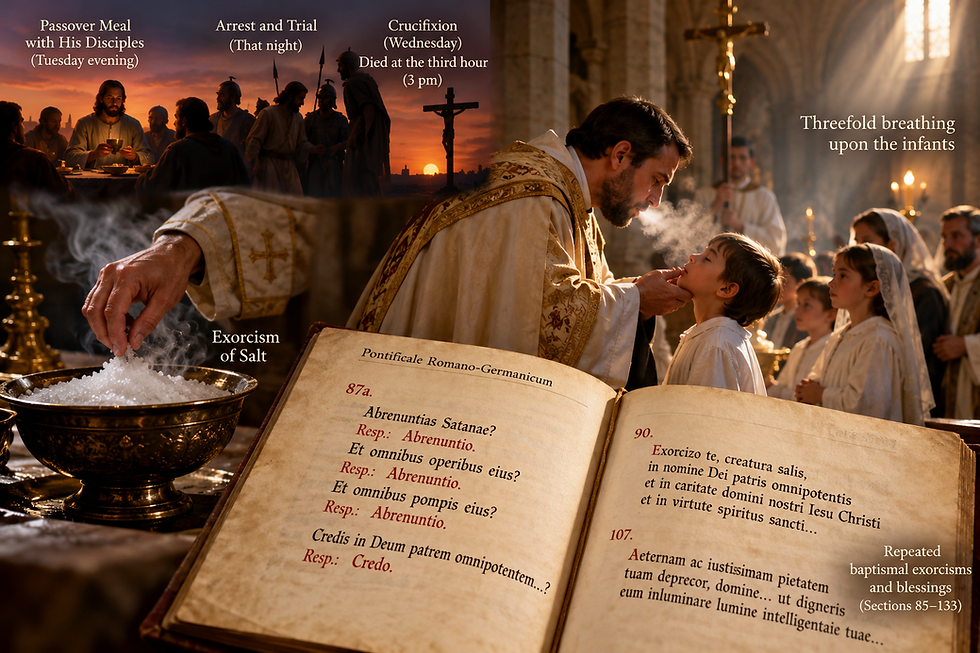
This investigation follows our examination of the tenth-century Romano-Germanic Pontifical, an influential collection of ecclesiastical ceremonies developed centuries before the surviving Munich necromantic handbook. In that earlier study, we encountered elaborate rites involving the exorcism of infants, exorcised salt, ritual breathing, holy water, repeated signs of the cross, consecrated substances and authoritative priestly formulas. These were not procedures recorded in the Gospel accounts of Christ's ministry, nor were they presented as such by the apostles. They belonged to a developing ceremonial tradition whose origins and claims to spiritual authority demand examination.
Now Kieckhefer's research reveals that medieval practitioners of forbidden magic also employed Christian ritual language, consecrations and sacred objects in attempts to exercise power over the invisible world.
It would be historically irresponsible to claim that every priest practised witchcraft, or that the Romano-Germanic Pontifical directly produced the necromantic handbook. Indeed, some ecclesiastical authorities fiercely opposed necromancy and destroyed magical books. But neither should those facts be used to divert attention from the evidence before us. The question is not whether the Church officially condemned witchcraft. It is why forbidden magical practitioners could find in ecclesiastical ritual such a rich vocabulary of spiritual power, consecration, invocation and command.
And beyond the question of historical influence lies a more important biblical test. Christ personally chose His apostles and gave them authority. They were commanded to preach His Gospel, heal the sick, cast out devils and teach others to observe what He had commanded. Where, then, did He teach that objects must be spiritually empowered through prescribed ceremonies? Where did He authorise the conjuration of spirits for hidden knowledge, the invocation of mysterious heavenly rulers, or the use of sacred formulas to confer extraordinary powers upon material objects?
We must not confuse the name of Christ with the authority of Christ. Neither priestly ordination, magnificent vestments, an imposing altar nor the repetition of sacred words can transform disobedience into holiness.
Christ Himself warned that men would claim to have prophesied, cast out devils and performed wonderful works in His name, yet He would reject those who worked iniquity. His warning should be remembered whenever supernatural power is offered as evidence of divine approval.
The contrast with apostolic Christianity could hardly be more striking. In Acts 19:19, those who had practised curious arts brought their magical books together and publicly burned them after turning to the Gospel. They did not carry those books into a Christian assembly to have them blessed. They did not place them upon an altar or attempt to empower them through prayers.
They burned them.
Yet centuries later, the Liber consecrationum instructed an operator to take a book of forbidden magic to the Mass and seek its consecration through the ceremonies and sacred language of medieval Christianity.
That is the extraordinary contradiction at the heart of this investigation, and it demands far more than a reassuring appeal to ecclesiastical "tradition".
For if the nations could be deceived through sorceries, as Revelation declares, then Christians should be especially vigilant whenever forbidden practices appear beneath the outward garments of religion. The presence of a cross does not prove an operation belongs to Christ. An appeal to His blood does not establish obedience to His commandments. A priestly title does not confer permission to seek forbidden spiritual powers, and a beautiful apparition does not establish that the visitor comes from heaven.
The question is not whether these men knew the words of Christianity. Clearly, some knew them exceedingly well. The question is whether they followed Jesus Christ—or attempted to use His name to obtain the very powers He forbade His followers to seek.
Witchcraft Among the Clergy: The Historical Record
The first chapter of Forbidden Rites, entitled Magical Books and Magical Rites, exposes a disturbing aspect of medieval religious history that cannot be dismissed as the invention of Protestant polemicists or modern opponents of Catholicism. From the early fourteenth century, accusations involving necromancy appeared repeatedly in ecclesiastical investigations, aristocratic disputes and papal controversies. Magical books were found in the possession of educated people, sometimes including members of the clergy, while judicial authorities struggled to distinguish forbidden spiritual operations from religious practices bearing an outwardly Christian appearance.
In 1318, Pope John XXII commissioned an investigation into clerics and laymen accused of using necromancy, geomancy and other magical arts. The following year, the Franciscan Bernard Délicieux faced accusations involving attempted necromancy against the pope. Although cleared of that specific charge, he was nevertheless condemned to imprisonment for possessing a book of necromancy. The circumstances reveal the degree of anxiety surrounding magical writings within the papal world, but also demonstrate the distinction between an accusation of magical practice and the established possession of forbidden literature. (Kieckhefer, pp. 1–2, notes 3–4.)
By 1320, allegations of necromancy had also emerged against Matteo and Galeazzo Visconti, members of the powerful ruling family of Milan. Witness testimony referred to books containing experiments intended to produce love, hatred and the discovery of stolen property. In the 1340s, the inquisitor Pietro da l'Aquila accused the physician Francesco di Simone of possessing a herbal text supposedly containing forbidden magical material, although Francesco denied that the book was necromantic. These cases demonstrate how widely the suspicion of magic extended, and why it is necessary to examine the writings themselves rather than accept every inquisitorial accusation at face value.
In 1382, the case of Agnolo di Corso involved an alleged seventy-chapter magical book containing invocations of spirits, including formulas intended to harm people or influence their affections. Two years later, Niccolò Consigli was executed in Florence following proceedings concerning necromancy and unauthorised exorcisms. His judges confiscated and burned the books from which he reportedly obtained his conjurations. These were not merely disputes over unusual theological opinions. They concerned practices understood to involve attempted contact with spirits and the exercise of forbidden supernatural power. (Kieckhefer, pp. 2–3, notes 8–9.)
The involvement of the papacy becomes particularly revealing during the Western Schism. In 1406–1407, investigators examined allegations that clerics had used magical formulas against Benedict XIII, the Avignon claimant to the papacy, and the king of France. The investigation uncovered a collection containing prayers, hymns and conjurations. By 1409, the accusations had been reversed: Benedict XIII himself was charged at the Council of Pisa with employing necromancers and obtaining a costly magical book, supposedly purchased for approximately one thousand francs. One story alleged that such a book had been found beneath his bed.
These accusations against Benedict arose during an intense ecclesiastical and political struggle. They cannot be treated as proof that he practised witchcraft. Nevertheless, the documents demonstrate how necromancy, religious authority and political power became entangled in the affairs of the rival papal courts. Historian Margaret Harvey examines the allegations in Papal Witchcraft: The Charges against Benedict XIII (1973).
The contradiction should not be overlooked. Men claiming supreme authority in the Church were involved in bitter accusations that their opponents employed forbidden supernatural means. Whether any particular charge was true or false, such accusations circulated at the highest levels of ecclesiastical government, while the same religious culture maintained an extensive body of ceremonial practices claiming spiritual efficacy.
Nor were monks immune from investigation. In 1500, Thomas Wryght, a Premonstratensian monk of Sulby monastery in England, was examined after reports that he possessed books of magical experiments and had paid others to instruct him in occult knowledge. Wryght claimed that his interest was theoretical rather than practical. His superiors imposed a comparatively light penance. The proceedings, reproduced in Francis Aidan Gasquet's Collectanea Anglo-Premonstratensia, volume III, pp. 117–118, confirm that books associated with magic could circulate within monastic environments even when their use was officially prohibited.
What emerges is not evidence of a single organised ecclesiastical conspiracy, but something historically more substantial: forbidden magical literature existed within the same educated Christian world that trained clergy, developed liturgies, conducted exorcisms and claimed authority over spiritual matters.
Some religious authorities condemned those writings. Others appeared in accusations concerning their possession. The surviving necromantic manuscripts reveal why the distinction between the two worlds was not always clear in their language or methods.
The Monk Who Claimed Visions of Mary
One of the most unsettling cases in Kieckhefer's first chapter concerns a Benedictine monk whose visionary claims became associated with a controversial form of ritual knowledge.
In 1323, the Grandes Chroniques de France recorded that a monk of Morigny had produced a book supposedly inspired by visions of the Virgin Mary. The chronicle accused him of reviving the condemned ars notoria, a ritual tradition promising extraordinary knowledge through prayers, specially prepared images, fasting and the invocation of mysterious names. It stated that the book contained numerous images honouring Mary and that the ceremonies promised knowledge, wealth, honour or other desired benefits. The authorities in Paris condemned the work and ordered it burned. (Kieckhefer, p. 7, note 21.)
The monk was John of Morigny, and his surviving work, the Liber florum celestis doctrine, or Flowers of Heavenly Teaching, allows us to investigate the claims more closely. Modern scholarship by Claire Fanger and Nicholas Watson has established that the work did not disappear after its condemnation. It survives in several versions and more than twenty manuscript copies. Its central Book of Prayers, developed during John's university studies between approximately 1301 and 1308, promises extraordinary knowledge through devotional procedures requiring the Virgin's authorisation. It also describes petitions for visionary dreams in which Mary supposedly answers questions.
This is a far more significant discovery than the mere existence of a medieval monk who believed he had seen the Virgin. The alleged appearances of Mary were connected to a system through which knowledge was sought by prescribed religious operations and visionary consultation.
John represented his work as an alternative to the corrupt ars notoria, not simply as an endorsement of it. That distinction matters historically. But it does not resolve the biblical question. Substituting the name of Mary for suspect angelic or magical figures cannot, by itself, establish the divine origin of a ceremony. Nor does claiming heavenly permission prove that such permission was actually granted.
How are Christians supposed to distinguish a genuine messenger of God from a deceptive apparition? Scripture does not instruct believers to accept every luminous vision or supernatural claim because it employs a revered name. It commands them to test the spirits.
“Beloved, believe not every spirit, but try the spirits whether they are of God.” — 1 John 4:1 (KJV)
The apostle Paul goes further, warning that Satan himself can be transformed into an angel of light (2 Corinthians 11:14). This is particularly relevant to claims involving apparitions, sacred images and extraordinary messages presented as revelations from heaven.
If a spirit appeared claiming to be Mary and instructed someone to establish a system of ritual knowledge not taught by Christ or His apostles, the claim would require examination rather than automatic reverence. The mere appearance of a beautiful or holy figure would prove nothing about its identity.
John's writings do not establish that an actual supernatural being appeared to him. His experiences may have involved dreams, visionary interpretations, literary constructions or phenomena whose causes cannot now be determined. But from a biblical standpoint, there is no sufficient reason to accept the claimed Marian communications as divine authority, and a deceptive spiritual appearance cannot be ruled out merely because the visionary identified the figure as Mary.
The broader theological problem is the elevation of an alleged private revelation into a source of spiritual knowledge and permission. The apostles did not teach Christians to obtain hidden knowledge through specially prepared Marian images, elaborate ceremonial texts or visionary consultations with the mother of Jesus.
“For there is one God, and one mediator between God and men, the man Christ Jesus.” — 1 Timothy 2:5 (KJV)
John of Morigny's book deserves further study precisely because it shows how the language of prayer, heavenly revelation and Marian devotion could become entangled with the pursuit of extraordinary knowledge.
The question is not whether John sincerely believed in his visions. It is whether those visions, and the practices justified through them, possessed any authority from Christ.
This distinction becomes even more important when we remember that Revelation itself warns against deceptive signs and spiritual seduction. A phenomenon cannot be declared heavenly simply because it is extraordinary, and the use of Mary's name cannot make a religious practice biblical when its authority depends upon revelations outside the teaching of Christ.
Archbishop Antoninus and the Book Said to Contain Demons
Another revealing incident appears in the canonisation proceedings of Antoninus, Archbishop of Florence, who died in 1459.
A witness described Antoninus discovering a suspicious book in the possession of Master Peter, a barber-surgeon who reportedly used the volume in connection with his healing activities. The book had allegedly come from a Cistercian, an association which places its transmission, at least according to the testimony, within a wider Christian religious environment.
Antoninus examined the volume and concluded that it contained magical formulas, incantations and forbidden signs. He subsequently burned it at San Marco in Florence.
The extraordinary element is what the witness claimed happened during its destruction. The atmosphere was said to have darkened, frightening those present. Antoninus reportedly explained that a Mass had previously been celebrated over the book for the purpose of summoning demons, and that the volume was therefore associated with their presence. (Kieckhefer, pp. 5–6, note 16.)
The alleged darkness cannot be verified independently. Neither does the testimony identify the priest who supposedly performed the earlier Mass, nor establish that the Cistercian who supplied the book knowingly participated in witchcraft. But the account is significant for the belief it records.
A Christian Mass had supposedly been employed to turn a book into an instrument for summoning demons.
It is worth considering the implications. Antoninus condemned the book as wicked, yet the explanation attributed to him assumes that a religious ceremony could have been exploited to associate a material object with supernatural power. The same broad ceremonial world in which books, buildings, vestments and other objects received blessings also produced stories of magical books being empowered through religious rites.
Another writer, Michael Scot, associated with the imperial court of Frederick II, related a story about spirits inhabiting a magical book and responding when it was opened. This was a supernatural tale, not proof that such spirits existed within a manuscript, but it reveals the expectation that a book could function as an instrument of spiritual command rather than merely contain written instructions.
The historical contrast becomes clearer in the recorded destruction of a magical volume at Dijon on 6 August 1463. A green-covered book, obtained from the estate of Thomas of Dampmartin, was examined and burned by officials after being judged to contain invocations of devils, divination and forbidden magical figures. Those present included Jehan Bon Varlet, a priest connected with the ducal chapel, Jehan de Molesmes, Ayme d'Eschenon, Jehan Rabustel and Aimé Barjod. The account describes an official judicial action rather than a miraculous event. (Kieckhefer, pp. 6–7, note 20; Jacques Paviot, 1993.)
These incidents establish that some ecclesiastical authorities actively opposed necromancy. But they also reveal a culture in which magical books were feared as instruments of spiritual power and, according to surviving texts, could be subjected to ceremonies intended to strengthen their supposed efficacy.
That brings us to the most incriminating evidence of all: not an accusation, but an actual manuscript instructing its reader to use Christian worship to consecrate a magical book.
The Book of Consecrations: Turning the Mass into an Instrument of Necromancy
The Liber consecrationum is central to this investigation because it provides direct documentary evidence of how Christian ritual forms were incorporated into necromantic operations.
Its instructions survive in Munich Clm 849, folios 52r–59v, with a second version at folios 135r–139r. Related material appears in Bodleian Rawlinson D 252 and a French Livre de consecracion preserved in a Cambridge manuscript.
The text begins from the assumption that magical experiments may lose their efficacy and need to be restored through consecration. Rather than abandon the prohibited operation when it fails, the operator is instructed to employ an elaborate religious ceremony intended to recover its power.
He must undertake nine days of preparation, abstinence and prayer. During that period he must attend Mass, taking the magical book with him and placing it upon the altar until the service is completed.
The Latin instruction reads:
“et librum istum secum deferre et pone super altari donec missa finiatur”
The operator must carry the book and place it upon the altar until the Mass is finished. (Clm 849, fol. 52v; Kieckhefer's Latin edition, p. 291.)
This is not the consecration of a Gospel manuscript for the reading of Scripture. It is a book containing operations intended to invoke and constrain spirits.
After the nine-day period, the operator must retire to a secret location, sprinkle the space with holy water and bind the book using priestly garments. The Latin specifies:
“et cum cingulo sacerdotali et stola dedicata liget eum in modum crucis”
That is, the book is to be bound in the form of a cross using a priestly cincture and a consecrated stole. (Clm 849, fol. 53r; Latin edition, p. 292.)
The instructions then require prescribed prayers, penitential psalms and the litany of the saints.
But what is the purpose of all this apparent devotion?
The prayer asks that the book receive power for the binding, invocation and conjuration of spirits. It is an appeal to God to empower precisely those operations which medieval Christian authorities themselves condemned.
Kieckhefer's English translation of the relevant petition asks that the book obtain power for consecrating spiritual bonds and magical experiments. (Forbidden Rites, pp. 11–12.)
The ceremony then invokes an extraordinary collection of sacred and mysterious names, including On, Jesus Christ, El, Eloy, Tetragramaton, Messias, Emanuel, Sabaoth and Adonay, alongside less readily identifiable names.
The most troubling passage appeals directly to the Eucharist:
“confirmatus per virtutem sacramenti corporis et sangwinis tui”
This asks that the book be confirmed through the power of the sacrament of Christ's body and blood. (Clm 849, fol. 54r; Latin edition, p. 294.)
The significance cannot be overstated.
The name of Jesus Christ, the sacrament of His body and blood, the Christian altar, holy water and priestly vestments were being incorporated into a ceremony whose declared purpose was to empower a book for conjuring spirits.
Kieckhefer's own discussion recognises the implications of this procedure. The instructions appear to presume that the celebrant of the Mass might cooperate, unless the operator himself was a cleric. This does not identify a guilty priest or prove the ceremony was performed exactly as prescribed, but it shows that the manuscript's compiler regarded participation in Christian liturgy as part of the magical operation.
Even the Confiteor, the formula of confession, is included among the supplementary prayers, together with holy water and the sign of the cross.
And the ultimate objective becomes unmistakable when the text refers to the operator seeking power over malign spirits.
There is a fundamental biblical contradiction here. Christ instructed His disciples to remember His death through the bread and cup, while Hebrews describes His sacrifice as complete and His mediation as sufficient. The magical text, by contrast, seeks to employ the Eucharistic sacrament as a means of conferring power upon a book used to constrain spirits.
What authority did Christ grant for such a procedure? Where did He teach that the efficacy of His sacrifice could be applied to magical experiments through a nine-day ceremony involving a priestly stole and the altar?
The biblical response to forbidden magic was not to consecrate it, purify it or surround it with religious language. Acts 19 records the destruction of magical books following conversion to the Gospel.
What the Liber consecrationum demonstrates is not that Christianity itself was witchcraft, but that Christian sacred language and ceremonies could be deliberately appropriated for witchcraft. If the presence of a Mass, cross or invocation of Jesus were sufficient to establish that a practice belonged to Christ, this manuscript would have to be considered Christian worship. Yet its purpose reveals the absurdity of such a conclusion.
That same principle must be applied to ecclesiastical ceremonies themselves. Merely stating that a practice was performed by an authorised priest cannot establish that it came from Christ or His apostles.
Exorcism and Conjuration: An Uncomfortable Similarity
Perhaps the most challenging historical observation in Kieckhefer's first chapter concerns the relationship between Christian exorcism and necromantic conjuration.
He explains that medieval exorcists and conjurers sometimes employed essentially the same kinds of formal commands. Both addressed spirits, invoked sacred authority, used prescribed formulas and anticipated that the spirits might resist their instructions.
The critical difference was their declared purpose. The exorcist sought to expel an unwanted spirit, whereas the necromancer sought to summon a spirit and compel it to perform a service. (Forbidden Rites, pp. 17–18.)
This distinction is important. Expelling a demon and inviting one into an operation are morally and theologically different activities. Christ Himself cast out unclean spirits, while the apostolic writings condemn forbidden magical practices.
Nevertheless, Kieckhefer's comparison forces us to consider how closely the methods of medieval religious exorcism could resemble those of ritual magic.
Both practitioners might appeal to divine names and repeat authoritative commands. Both might understand the encounter as a struggle in which spiritual powers could be constrained through properly performed invocations. The distinction in purpose was therefore essential, particularly where the actual verbal formulas overlapped.
This is directly relevant to the Romano-Germanic Pontifical, whose ceremonies preserve elaborate exorcistic language, including rituals directed towards infants and material substances.
When we examined the Pontifical's baptismal scrutinies, we encountered repeated exorcisms, the use of salt, ceremonial breathing and prescribed crosses. Such practices existed long before the fifteenth-century necromantic manual. The latter cannot simply be assumed to have copied this particular liturgical compilation, but the overlap in religious vocabulary demands investigation.
Why was an infant subjected to repeated exorcistic ceremonies? Why was salt addressed through a prescribed exorcism before administration? What spiritual efficacy was attributed to the priest's words, breathing and gestures, and where are such procedures commanded in the New Testament?
The question cannot be dismissed by saying that ecclesiastical exorcism was authorised whereas necromantic conjuration was forbidden. Authorisation explains an institutional distinction; it does not, by itself, demonstrate apostolic origin.
The central biblical issue is whether the ceremony preserves what Christ commanded or introduces a later system of priestly ritual power.
The apostles cast out demons in the name of Jesus Christ. In Acts 16:18, Paul commands an unclean spirit to come out of a woman in Christ's name. He does not invoke a catalogue of mysterious names, construct ritual circles or attempt to obtain the demon's services.
Acts 19:13–16 supplies an even more pointed warning. Certain Jewish exorcists attempted to use the name of Jesus over a man afflicted by an evil spirit, invoking the Jesus whom Paul preached. Their attempt failed disastrously, exposing the difference between repeating a sacred name and possessing genuine authority.
The name of Jesus is not a magical formula. His authority cannot be possessed or manufactured through the mere performance of a ceremony.
That is the issue raised by the medieval evidence: the difference between obedience to Christ and attempts to employ His name as an instrument of supernatural control.
The Bavarian Priest and the Three Demonic Apparitions
Chapter 2 of Forbidden Rites moves from the general history of magical books to the surviving Munich manuscript and the religious environment in which such writings circulated.
One of its most disturbing historical leads is the trial of Jubertus of Bavaria, a man from Regensburg prosecuted at Briançon in 1437.
During the proceedings, Jubertus claimed to have served Johannes Cunalis, a priest of Munich, for more than ten years. According to his testimony, Cunalis possessed a book of necromancy, and the opening of this book was associated with the appearance of three alleged demons.
If Christ taught that true worship was no longer bound to a temple in Jerusalem, but must be offered to the Father “in spirit and in truth” (John 4:21–24), why did the Church begin placing the bones and remains of the dead beneath or within its altars, surrounded by religious images and statues? Where did Christ or His apostles command such a practice, and what purpose do the remains of the dead serve in the worship of the living God? Are we following the teachings of Jesus Christ, or have later religious traditions introduced sacred objects, shrines and ceremonies for which there is no apostolic command?
Their names were Luxuriosus, Superbus and Avarus, representing lust, pride and avarice.
The record describes extraordinary and disturbing claims involving sexual intercourse with a female apparition, acts of worship directed towards demons, contempt for Christian symbols and attempts to harm other people.
He further described supposed supernatural assistance in attacks upon individuals, including Johanneta, the widow of Johannes Paganus, and Johannes Fabri of Vienna. Other allegations involved extraordinary events occurring during travel and supposed intervention by spirits against enemies.
These claims were preserved in the context of witchcraft prosecutions, and the original testimony must be treated with appropriate scrutiny. Confessions obtained in such proceedings could reflect coercion, suggestion or established expectations about demonic activity. The record does not prove that the apparitions appeared, that the described supernatural events occurred or that Cunalis possessed Clm 849.
But it does preserve the name of a priest alleged to have possessed a necromantic book, within a judicial environment where the association of clerical learning and forbidden magic was considered plausible. (Kieckhefer, pp. 30–32; Joseph Hansen, Quellen und Untersuchungen, pp. 539–544.)
The names given to the apparitions are themselves revealing. Lust, pride and avarice correspond to motives that recur throughout the surviving necromantic literature: the desire to control sexual relationships, acquire influence, impress powerful patrons or obtain wealth and hidden knowledge.
Kieckhefer suggests a thematic relationship between these three alleged spirits and the purposes pursued in the Munich manuscript. He does not establish that they were actual spirits governing its operations, but the comparison illuminates the motives behind the forbidden arts.
The case also reminds us that the victims of magical coercion were frequently other human beings. The concern was not merely strange private beliefs but attempts to manipulate affection, damage reputations, intimidate enemies and gain power over others.
This is precisely why sorcery cannot be reduced to harmless superstition. Even when supernatural effects are unverified, the intention to dominate or injure another person may be clearly expressed in the writings.
Could this same hunger for wealth, influence and power help explain why the papacy became an office pursued through simony—the buying and selling of ecclesiastical positions—and why immensely wealthy Italian banking dynasties, such as the Medici family, came to occupy the papal throne? The Medici produced two popes, Leo X (1513–1521) and Clement VII (1523–1534). Was the papacy increasingly regarded as an opportunity to exercise religious and political dominion rather than a calling to serve Christ? We must remember what Jesus Himself declared: “All power is given unto me in heaven and in earth” (Matthew 28:18, KJV). ALL power was given to Christ, not to a succession of wealthy families or ecclesiastical rulers. Where did He ever appoint a pope as His Vicar, a man supposedly acting in His place on earth? Christ promised, “lo, I am with you alway, even unto the end of the world” (Matthew 28:20), and Scripture declares that there is “one mediator between God and men, the man Christ Jesus” (1 Timothy 2:5). If Christ remains present with His followers, possesses all authority and continues as their mediator, on what biblical grounds can any man claim to occupy His place?
I will gladly and publicly apologise if I am proven wrong, but only when genuine, verifiable evidence is produced—not fabricated documents, altered quotations, misattributed writings or later traditions presented as apostolic truth. Show me precisely where Jesus Christ ordained His apostles to offer HIM as a sacrifice upon an altar, or where He appointed a pope to act as His earthly representative, His so-called Vicar, in His place. I am not asking what later popes, councils or theologians declared. I am asking when did Christ Himself command these things? If such authority truly came from Him, then demonstrate it from His recorded teachings and the testimony of His apostles. For all power was given to CHRIST, and Scripture declares that HE is our one mediator.
Johannes Hartlieb, the German Courts and Forbidden Knowledge
The Bavarian setting also introduces Johannes Hartlieb (c. 1400–1468), a physician and writer associated with the ducal court at Munich.
Between approximately 1456 and 1464, Hartlieb composed Das půch aller verpoten kunst, or The Book of All Forbidden Arts, at the request of Margrave Johann of Brandenburg-Kulmbach, known as Johann the Alchemist.
Hartlieb described seven forbidden arts, including necromancy and various forms of divination. His classification drew upon earlier intellectual traditions associated with Isidore of Seville, Hugh of St Victor and Nicholas Magni of Jawor.
Hartlieb was not an advocate of necromancy. In Chapter 22, he condemned its reliance upon demonic assistance, sacrifices and forbidden spiritual agreements. His work therefore demonstrates that medieval Christian criticism of such practices was explicit and informed.
Nevertheless, his career reveals that occult knowledge was being investigated within the learned circles of German princely courts. His writings describe practices resembling some of those contained in the Munich handbook, including divination and conjurations intended to obtain extraordinary services.
Kieckhefer considers the possibility that Hartlieb encountered such material, but the surviving evidence does not establish his ownership of Clm 849. Nor can its anonymous compiler be identified with the priest Johannes Cunalis.
The manuscript itself, however, contains powerful evidence of a clerical environment. Its compiler presupposes knowledge of the Psalms, litanies, religious prayers and ecclesiastical ceremonies. Kieckhefer concludes that the work most likely originated in the world of educated clerics, perhaps involving a priest or person in lesser orders. (Forbidden Rites, pp. 41–42.)
It was written by someone familiar with the language and instruments of Christian ritual, yet its contents include the conjuration of spirits, divination and attempts to obtain influence through prohibited operations.
This gives us a historically defensible link between the world of clerical education and the transmission of necromantic literature. It does not demonstrate that the entire priesthood practised witchcraft, but it decisively refutes any picture of medieval occult magic as belonging exclusively to outsiders unfamiliar with Christian institutions.
The connection also provides a foundation for our subsequent investigation into the writings of Johannes Trithemius and Heinrich Cornelius Agrippa, whose works developed within a later intellectual world concerned with angelic hierarchies, planetary influences, sacred names and spiritual powers. Any particular connection between their texts and Clm 849 must still be demonstrated, but the broader learned environment in which occult literature circulated is now plainly visible.
When Christian Prayers Were Turned into Magical Commands
Chapter 3 of Kieckhefer's study examines so-called illusionist experiments, including ceremonies intended to produce extraordinary appearances, apparent invisibility or supernatural transportation. Their extravagant promises are less important to this investigation than the means by which the operators claimed to obtain such effects.
The manuscript repeatedly invokes divine names, sacred prayers and spiritual hierarchies while attempting to command beings whose obedience is sought for personal advantage.
One particularly revealing operation appears in Clm 849, experiment 11, folios 28r–29v. It concerns the supposed acquisition of an invisibility cloak, but the underlying ceremony is recognisably religious in its language and objects.
The operator prepares a secret ritual space, employs incense and holy water, and recites words from Psalm 51. The Latin contains the familiar formula:
“Asperges me, domine, ysopo et mundabor”
The corresponding biblical words are:
“Purge me with hyssop, and I shall be clean: wash me, and I shall be whiter than snow.” — Psalm 51:7 (KJV)
David's prayer is a plea for cleansing before God. In this necromantic ceremony, its language has been incorporated into an operation intended to obtain an extraordinary object through spiritual conjuration.
The operator invokes four spirits, named Firiel, Melemil, Berith and Taraor, calling upon the Trinity and directing the spirits to obey his commands. The manuscript's Latin explicitly invokes the one, indivisible Trinity while seeking control over the named beings.
The ceremony eventually instructs the operator to address the cloak itself:
“Ego coniuro te, cappa” — “I conjure thee, cloak.”
The object is then sprinkled with holy water in the name of the Father, Son and Holy Spirit. (Kieckhefer, Chapter 3, pp. 69–70; Latin edition, pp. 255–257.)
Here lies the central issue: biblical prayer, holy water, incense, sacred names and the Trinity are all employed as elements of a ceremony whose objective has nothing to do with repentance, worship or obedience to Christ.
The manuscript also invokes a mysterious king of the East, or rex Orientis, in experiment 14, folios 33v–34r. The operator kneels and addresses this being with language resembling religious supplication, invoking names including On, El, Ely and Tetragramaton. The prayer culminates in an offer of continuing service and obedience to the eastern ruler.
The Latin includes:
“me tibi offero, seruire et semper tuis obedire mandatis”
That is, the operator offers himself to serve and obey the ruler's commands.
We cannot identify this being with a particular planetary angel or pagan god merely from the name Oriens, but the operation raises an unmistakable biblical concern: the offering of personal service and devotion to a spiritual power other than God.
In another operation, the manuscript names Bartha, described as king of the clouds, together with subordinate figures Saltim, Baltim and Galtim. It combines Christian prayers, including the Ave Maria and penitential language, with invocations of these supposed spiritual rulers. (Clm 849, experiment 15, fols. 34r–35v.)
Elsewhere, operators are warned against making the sign of the cross because the summoned spirits would supposedly flee. Thus the same collection contains ceremonies employing Christian symbols to command spirits and others treating those symbols as obstacles to magical operations.
These contradictions reveal the eclectic nature of medieval ritual magic. Religious names and practices were borrowed, reinterpreted and employed according to the operator's desired outcome.
The historical conclusion is substantial: the outward presence of Christian prayers and ceremonies did not prevent a text from being openly necromantic.
For the biblical reader, the warning is equally serious. A ceremony does not become an act of Christian faith merely because its author invokes Jesus, the Trinity or the Psalms.
Luke 20:46–47 (KJV)
Beware of the scribes, which desire to walk in long robes, and love greetings in the markets, and the highest seats in the synagogues, and the chief rooms at feasts;Which devour widows' houses, and for a shew make long prayers: the same shall receive greater damnation.
False Miracles and the Attempt to Imitate Christ's Resurrection
Another extraordinary operation, experiment 10, folios 25v–28r, claims that a specially prepared ring can make a living person appear dead or a corpse appear alive.
The manuscript names six spirits—Brimer, Suburith, Tranauit, Lyroth, Beryen and Damayn—and instructs the operator to invoke the Father, Son and Holy Spirit while commanding these beings to consecrate the ring.
The text proposes that a spirit may enter a corpse and make it appear living again. There is no reliable evidence that such an operation ever succeeded. Indeed, the description concerns an appearance of life through spiritual intervention rather than a genuine resurrection performed by God.
Kieckhefer observes that the ceremony includes a tomb, a white cloth and a Sunday-before-dawn setting, suggesting a deliberate imitation or parody of the resurrection of Christ.
This raises an important connection with medieval Christian discussions of Antichrist and false miracles.
Honorius of Regensburg, in the Elucidarium, discussed whether Antichrist could genuinely raise the dead and concluded that supposed resurrections would be deceptive. Hildegard of Bingen, in her Scivias, likewise warned against the apparent miracles of Antichrist. The medieval Play of Antichrist also portrayed an apparent resurrection as part of the false saviour's deceptive display of power. (Kieckhefer, pp. 72–75, notes 45–47.)
The biblical warning is direct:
“Even him, whose coming is after the working of Satan with all power and signs and lying wonders.” — 2 Thessalonians 2:9 (KJV)
The passage warns that apparent supernatural power can be associated with deception rather than divine authority.
The Gospel account of Lazarus presents an entirely different exercise of power. Christ stands before the tomb and commands Lazarus to come forth. He does not consecrate a ring, construct a magical circle, invoke mysterious rulers or compel a spirit to animate a corpse.
The distinction is not merely ceremonial. It concerns the source and character of the authority being exercised. Christ raises the dead by His own command. The necromantic operator attempts to manufacture an appearance of life through the supposed services of spirits.
This is precisely the danger represented by lying wonders: that extraordinary appearances may be mistaken for demonstrations of divine authority.
The lesson is especially relevant when evaluating claims of supernatural apparitions, miraculous healings and other signs invoked to validate religious teachings. Even if an extraordinary event were genuinely witnessed, that would not establish that its source was God or that the associated message was true.
The truth of the Gospel must not be made dependent upon the performance of wonders. Wonders themselves must be judged against the truth already revealed.
The Deeper Scandal: Sacred Ceremony Without Apostolic Authority
Taken together, the first three chapters of Forbidden Rites expose a religious environment in which forbidden magic could be expressed through the vocabulary of Christian worship.
Magical books were to be placed upon altars. Priestly vestments could be used in ceremonies intended to constrain spirits. Biblical psalms were inserted into conjurations. Penitential prayers accompanied operations seeking supernatural advantages. The Eucharist was invoked to confer supposed power upon magical writings, while the names of Christ and the Trinity appeared alongside obscure spiritual names.
The historical evidence does not justify claiming that every official ecclesiastical ceremony originated in witchcraft. But it does establish that medieval magical practitioners could appropriate Christian forms for purposes that medieval Christian authorities themselves condemned.
The question now is whether ecclesiastical authorisation was sometimes allowed to substitute for demonstrated apostolic authority.
The Romano-Germanic Pontifical shows how developed the medieval ceremonial system had already become by the tenth century. Its rites include elaborate exorcisms, consecrations, repeated crosses, exorcised salt and procedures imposed even upon infants before baptism.
Christ, however, did not establish an elaborate catalogue of compulsory exorcisms over newborn children in the Gospel accounts. He did not instruct His apostles to breathe ritually upon infants, exorcise salt or confer spiritual efficacy upon material substances through prescribed formulas.
That absence does not automatically prove that every later ceremony is demonic. But it places the burden of biblical justification upon those who claim the ceremonies possess Christ's authority.
Why should such practices be binding upon believers merely because an ecclesiastical institution incorporated them into its official liturgy? Why should a priest's declaration be assumed to accomplish a spiritual transformation simply because the ceremony is ancient, elaborate or performed under episcopal authorisation?
These questions become especially serious when we compare the sacerdotal culture of the Middle Ages with the simplicity of the apostolic witness.
In John 4:23–24, Jesus teaches that the Father seeks those who worship Him in spirit and truth. In Acts 17:24, Paul declares that the God who made the world does not dwell in temples made with hands. In Hebrews 7–10, Christ's priesthood and completed sacrifice are presented as sufficient, while the apostolic writings identify Him as the one mediator between God and humanity.
The Church cannot grant itself powers Christ never bestowed merely by creating new ceremonies and declaring them sacred. Neither can a priest's title confer spiritual authority over matters that belong to Christ alone.
This does not mean that every prayer, blessing or symbolic gesture is forbidden. The decisive question is what the ceremony claims to accomplish, upon whose authority it rests, and whether it accords with the teaching and example of Christ.
Kieckhefer's necromantic manuscripts demonstrate how far religious language could be detached from its original purpose. But that observation must also challenge anyone who assumes that the outward form of Christian ceremony is itself sufficient proof of divine approval.
Christ's name is not an instrument through which men may manufacture spiritual power. His authority is not created by vestments, incense, sacred objects, repeated words or institutional succession.
The warning of Acts 19 should be impossible to ignore. Men who attempted to invoke the name of Jesus without possessing the authority they claimed were exposed. Elsewhere in the same chapter, those converted from curious arts brought their magical books together and burned them.
They did not seek to preserve forbidden practices beneath a religious disguise.
When the Victims of Witchcraft Were Condemned Instead of Its Practitioners
There is another disturbing observation in Kieckhefer's analysis which deserves attention.
He notes that medieval necromantic literature often reflected the interests of educated men seeking power over others, including attempts to manipulate affection, obtain sexual compliance, gain favour at court or discover information through forbidden divination.
Such intentions were not merely strange intellectual exercises. They could involve the deliberate violation of another person's freedom, dignity or security.
Kieckhefer also observes that the developing European witch trials frequently fell upon women, even while evidence of learned necromantic practice was associated with men, including clerics.
This creates a historical irony that should not be obscured. The imagined powers and ceremonies of educated male necromancers helped shape ideas about witchcraft, while accusations of witchcraft later brought devastating consequences to women who were not necessarily engaged in anything resembling the complex ceremonial operations described in these manuscripts.
The distinction between an actual practitioner of forbidden magic and someone merely accused of witchcraft is therefore morally indispensable.
Yet this also strengthens the case against those who sought magical control over others. The manuscript's intentions frequently reveal a desire for power, domination, knowledge or advantage, rather than repentance, service or obedience to God.
Christ taught His followers not to lord authority over one another as earthly rulers did. His teaching is incompatible with the pursuit of spiritual power for coercion, sexual exploitation or personal advancement.
It is difficult to imagine a greater departure from that teaching than a religiously educated man attempting to employ the names of God to dominate another person's will.
By Their Sorceries Were the Nations Deceived
The evidence examined in the first three chapters of Kieckhefer's Forbidden Rites presents a formidable challenge to any romanticised picture of medieval Christianity as a world in which sacred ceremonies always represented the faithful continuation of apostolic teaching.
We encounter a papal environment troubled by accusations of necromancy; judicial records naming clerics and magical books; a monk claiming Marian visions in association with extraordinary ritual knowledge; accounts of books supposedly empowered through the Mass; and surviving manuscripts explicitly incorporating Christian prayers, priestly objects, consecrations and Eucharistic language into operations intended to command spirits.
Could the lust, sexual coercion and desire to dominate others revealed in these forbidden rites help us understand a much darker history—the sexual abuse of children, not only within the Church but wherever powerful men have exploited the vulnerable? These manuscripts do not establish that necromancy caused such abuse, but they expose a disturbing pursuit of power over other human beings, sometimes concealed beneath religious language and claims of spiritual authority. Could the same corruption of power help explain how predators have operated behind positions of respectability, how victims have been silenced and how institutions have protected reputations rather than children? And when Christ explicitly warned against those who love the highest seats, exploit the vulnerable and make a show of religion, should we not question any institution that places the authority of men above the protection of the innocent?
Some churchmen resisted these practices, and their resistance is part of the historical record. But that does not erase the forbidden operations preserved in the manuscripts themselves. Nor does it settle the question of whether the increasingly elaborate ceremonial system of the medieval Church always rested upon commands given by Christ.
The contrast with Scripture is profound.
Christ did not teach His followers to seek hidden knowledge from mysterious spiritual rulers. He did not tell His apostles to consecrate books of forbidden experiments, employ sacred objects to command demons into service or accept every apparition claiming heavenly authority. He did not authorise the transformation of His name into a formula through which men could obtain supernatural influence for their own purposes.
Instead, the apostolic teaching calls believers to worship God, reject idolatry, abandon forbidden arts and remain faithful to the Gospel already delivered.
The book of Acts records the destruction of magical writings. Yet the Liber consecrationum shows a medieval necromancer prescribing the opposite: the supposed restoration of a magical book's power through Christian liturgical ceremonies.
That contrast alone should force a serious reconsideration of the relationship between religion and ritual magic.
And the case of John of Morigny raises the equally serious question of spiritual apparitions. A visionary may sincerely believe that Mary, an angel or another heavenly being has appeared, but the claimed identity of the apparition cannot establish its authority. The message must be tested. A religious figure appearing in a dream cannot be allowed to introduce a new means of obtaining spiritual knowledge merely because the experience feels sacred.
Paul warned that Satan can appear as an angel of light. John commanded believers to test the spirits. Christ warned against false prophets and deceptive signs.
Why, then, should Christians surrender their judgment whenever an institution, priest or visionary claims to speak with divine authority?
The same question applies to the ceremonies contained in the Romano-Germanic Pontifical. Their antiquity does not establish their apostolic origin. Their ecclesiastical authorisation does not automatically prove their biblical necessity. Their repeated appeals to sacred names cannot substitute for Christ's commands.
The Gospel is not a system of ceremonies through which men acquire control over the invisible world. It is the proclamation of Jesus Christ, His completed sacrifice, His authority and the salvation offered through Him.
Revelation condemns Babylon because the nations were deceived through her sorceries. The passage does not authorise us to identify every later ecclesiastical rite with Babylon, but it does warn against the spiritual deception that can accompany the pursuit of forbidden powers.
And it makes the question of religious appearance all the more serious. A forbidden operation does not cease to be forbidden because it is performed by a priest, conducted beside an altar or expressed in the language of the Trinity.
Christ warned in Matthew 7:22–23 that many would claim to have prophesied, cast out devils and performed wonderful works in His name, yet He would reject those who worked iniquity.
That warning should silence the assumption that a display of supernatural power, or even the repeated invocation of Jesus' name, automatically demonstrates that a person belongs to Him.
We should therefore judge neither a priest, a prophet, an apparition nor a religious institution by the magnificence of its ceremonies or the grandeur of its claims, but by its fidelity to Jesus Christ.
Christianity means following Christ, not surrendering to men who claim the power to speak, bless, consecrate or command in His name without demonstrating that He gave them such authority.
The question confronting this medieval evidence is ultimately the same question confronting every religious tradition claiming spiritual power.
Did Jesus Christ command it?
For if He did not, then neither a pope, bishop, priest, monk, visionary nor necromancer can make it His command merely by declaring it sacred.
And if the nations were deceived through sorceries, as Revelation declares, then the greatest danger is not necessarily the sorcerer who openly rejects the name of Christ.
It is the possibility of deception appearing beneath the robes of religion, speaking the language of holiness, invoking the name of Jesus Christ, and leading people away from the very Gospel it claims to defend.
Revelation 18:4 (KJV)
And I heard another voice from heaven, saying, Come out of her, my people, that ye be not partakers of her sins, and that ye receive not of her plagues.
Revelation 18:5, continues:
For her sins have reached unto heaven, and God hath remembered her iniquities.
Historical Sources
Richard Kieckhefer, Forbidden Rites: A Necromancer's Manual of the Fifteenth Century (Sutton Publishing, 1997; Pennsylvania State University Press, 1998), Chapters 1–3, together with the edited Latin manuscript of Munich Clm 849. Page references in this article follow the supplied edition.
Cyrille Vogel and Reinhard Elze, editors, Le Pontifical romano-germanique du dixième siècle, three volumes, Studi e Testi 226, 227 and 269 (Vatican City, 1963–1972), particularly Section XCIX.
Claire Fanger and Nicholas Watson, editors, John of Morigny: Liber florum celestis doctrine / The Flowers of Heavenly Teaching (Pontifical Institute of Mediaeval Studies, 2015).
Claire Fanger, Rewriting Magic: An Exegesis of the Visionary Autobiography of a Fourteenth-Century French Monk (Pennsylvania State University Press, 2015).
Joseph Hansen, Quellen und Untersuchungen zur Geschichte des Hexenwahns und der Hexenverfolgung im Mittelalter, pp. 539–544, for the proceedings concerning Jubertus of Bavaria.
Pierrette Paravy, *De la chrét

Comments