The Priest and the Necromancer Part 2

Baptised Images, Child Mediums and the Forbidden Conjuration of Spirits
“For by thy sorceries were all nations deceived.” — Revelation 18:23 (KJV)
“Come out of her, my people, that ye be not partakers of her sins, and that ye receive not of her plagues.” — Revelation 18:4 (KJV)

In the first part of this investigation, we examined the disturbing evidence presented by medieval historian Richard Kieckhefer in Forbidden Rites: A Necromancer's Manual of the Fifteenth Century. We discovered a world in which forbidden magical books circulated among educated men, including some associated with the clergy; priests were accused of possessing necromantic writings; a Benedictine monk claimed visions of the Virgin Mary while developing an elaborate system of ritual knowledge; and the Christian Mass, altar, priestly vestments and Eucharistic language appeared in actual manuscripts prescribing the consecration of magical books.
But the next three chapters expose something considerably darker. We are no longer dealing primarily with books supposedly inhabited by spirits or fantastic stories of supernatural apparitions. We encounter attempts to enslave the wills of other human beings (see Revelation) induce sexual submission, drive victims into madness, obtain influence over kings and prelates, manipulate children into becoming instruments of divination, and compel spirits through ceremonies invoking Jesus Christ, the Virgin Mary, the saints, the Eucharist and the sacraments.
Perhaps the most shocking discovery is found in an actual fifteenth-century manuscript which instructs its operator to baptise a wax image of a woman in the name of the Father, Son and Holy Spirit before attempting to force her into sexual submission.
Elsewhere, a necromantic conjuration explicitly claims that baptism and the other sacraments have given the operator power over a spirit. Another contemporary writer reports that some priests used the consecrated paten from the Mass as an instrument of divination. And when Kieckhefer compares these forbidden formulas with surviving Christian exorcisms, he identifies remarkable similarities in their language, structure and claims of authority.
These discoveries demand more than a passing expression of disapproval. They raise serious questions about the nature of spiritual authority within medieval Christianity and the extent to which sacred ceremonies could be turned into instruments of domination.
Where did Jesus Christ ever command His apostles to baptise images, summon spiritual rulers, obtain revelations through children, or use His name and sacraments to compel supernatural beings to satisfy their personal desires?
The answer cannot be found merely by appealing to priestly ordination, ecclesiastical tradition or the authority of a bishop. If these powers truly came from Jesus Christ, then the evidence must ultimately be sought in His recorded teachings and the testimony of His apostles.
And if they did not come from Him, then the use of Christian language cannot transform them into Christian obedience.
The Cleric, the Sorcerer and the Pursuit of Sexual Power
Chapter 4 of Kieckhefer's Forbidden Rites, entitled Love, Favour and Madness: Psychological Experiments (pp. 79–108), reveals the disturbing purposes for which some medieval magical operations were designed.
The Munich manuscript, Codex latinus Monacensis 849, contains seven experiments classified by Kieckhefer as psychological magic. Their objectives include creating obsessive desire, destroying relationships, inducing madness, compelling obedience and obtaining the favour of important people.
The significance lies not merely in their supposed supernatural mechanism, which remains unverified, but in the intentions openly expressed by the texts. Women were to be deprived of peace until they complied with a man's demands. Enemies were to suffer mental distress. Powerful patrons were to become obedient to those who sought influence over them.
Kieckhefer recognises the coercive nature of these operations and compares their intended effects to sexual violence. Their authors did not merely wish to be loved. They wished to remove another person's freedom to refuse.
This is already a profound departure from the teaching of Jesus Christ, who instructed His disciples to love their neighbours, serve one another and reject the pursuit of power through domination.
Yet the actual historical cases are still more disturbing.
A Carmelite Friar and the Confession of Sexual Necromancy
In 1329, a Carmelite friar named Peter Recordi was tried before an inquisitorial tribunal at Carcassonne in southern France.
According to the confession preserved in the proceedings, Recordi acknowledged performing conjurations over wax images during approximately five years. He reportedly employed substances associated with animal sacrifice and attempted to use the images against women whom he wished to seduce. The figures were placed in locations the women would pass, and the operations were intended to compel their affections or subject them to affliction if they resisted.
Kieckhefer reports that Recordi claimed to have obtained sexual access to three women through these practices and had attempted to influence others. (Forbidden Rites, p. 93, note 41.)
The source identified by Kieckhefer is Henry Charles Lea, A History of the Inquisition of the Middle Ages, volume III, pp. 657–659, with further references in Joseph Hansen's collection of medieval witchcraft records.
We should not confuse an inquisitorial confession with independently verified proof that the supernatural operations worked. Medieval judicial proceedings could involve intense pressure and expectations concerning demonic activity. But the confession, as preserved and reported, associates a member of a Christian religious order with attempts to employ forbidden ceremonies for sexual coercion.
What makes the case particularly serious is its objective. The desired result was not companionship, mutual affection or marriage. The operator sought to impose his will upon women who had not freely chosen him.
If such acts were committed, they were not expressions of love but abuses of power.
The biblical condemnation does not depend upon whether the supposed magic actually worked. A man who intends to overcome another person's will through fear, manipulation or spiritual intimidation has already revealed the corruption of his purpose.
Jesus taught:
“Whosoever will be great among you, shall be your minister: And whosoever of you will be the chiefest, shall be servant of all.” — Mark 10:43–44 (KJV)
There is no place in that teaching for a friar seeking power over women through forbidden conjurations.
William Netherstreet: An English Chaplain Accused in 1377
Kieckhefer records another case involving William Netherstreet, an English chaplain who was accused in 1377 of using conjurations to bring a married woman to his chamber at night for sexual purposes.
The accusation described an intention to compel her into adultery through magical operations.
Netherstreet denied the charge, and that denial must be acknowledged. The accusation does not establish his guilt.
Nevertheless, the historical record demonstrates that such practices were being alleged against men occupying religious offices, and that the alleged objective was the sexual domination of another person.
Kieckhefer cites Margaret Aston, Thomas Arundel: A Study of Church Life in the Reign of Richard II (1967), pp. 63 and 404–405. (Forbidden Rites, p. 93, note 42.)
The important question is why the language of spiritual power could become associated with attempts to obtain sexual access to unwilling women. Was religious authority being understood as an opportunity for service, or as a means through which ambitious men might acquire influence over others?
Christ's warning against those who desire status and authority should be remembered here.
“Beware of the scribes, which desire to walk in long robes, and love greetings in the markets, and the highest seats in the synagogues, and the chief rooms at feasts.” — Luke 20:46 (KJV)
The warning is not an accusation that every man wearing religious garments was corrupt. It is Christ's condemnation of religious ambition, hypocrisy and the exploitation of others under a respectable outward appearance.
A Priest Accused of Baptising Magical Images
One of the most important historical incidents in Chapter 4 took place at Tournai, in the later fifteenth century.
A priest was accused of attempting to seduce a girl through image magic. According to the accusation, he drew her likeness upon a tile, baptised the figure, sprinkled it with holy water, made a second image from wax and baptised that image also. He then attempted to conjure demons according to a magical book.
Kieckhefer records the case on p. 92, citing Paul Fredericq, Corpus documentorum inquisitionis haereticae pravitatis Neerlandicae, volume I, pp. 428–429.
This allegation is particularly significant because the priest was accused of employing recognisable Christian baptismal actions in a procedure intended to influence a girl's affections.
But the importance of the Tournai case becomes even greater when we examine the surviving Munich manuscript.
For the same kind of procedure appears in an actual necromantic experiment, complete with the baptismal wording.
The Baptism of a Wax Image in Clm 849
Experiment 12, folios 29v–31v, describes an operation intended to compel a woman's affections through a specially prepared wax image.
The manuscript includes invocations of Belial, Astaroth and Paymon, along with references to planetary hours and astrological conditions. Its central intention is to subject the woman to such overwhelming desire and distress that she will submit to the operator's sexual demands.
But what follows is especially revealing.
The text directs the operator to give the wax image the woman's name, immerse it three times and pronounce the Christian baptismal formula.
The original Latin reads:
“Sic formata ymagine, christianizes ipsam”
That is, having formed the image, the operator is to baptise it.
The manuscript continues:
“Ego baptizo te, N., in nomine Patris, et Filij, et Spiritus Sancti. Amen.”
Translated:
“I baptise thee, N., in the name of the Father, and of the Son, and of the Holy Spirit. Amen.”
(Clm 849, experiment 12, fol. 30v; Kieckhefer, Chapter 4, p. 100; Latin edition.)
This is not merely a magical operation involving a cross or an unfamiliar spirit name. It is the deliberate incorporation of the Christian baptismal formula into a ceremony intended to subjugate another human being.
The resemblance to Christian baptism is explicit in the text itself. The image is named, immersed three times and addressed with the Trinitarian formula.
And the purpose?
The operator seeks to deprive a woman of peace until she fulfils his sexual wishes.
The same experiment invokes the image of a deer thirsting for water, drawing upon Psalm 41:2 in the Vulgate numbering, corresponding to Psalm 42:1 in the King James Bible.
In Scripture, the hart panting after the water brooks represents the soul longing for God. In this operation, the imagery is transferred to the woman's supposed longing for the man attempting to compel her.
Thus both Christian baptism and biblical language concerning the soul's desire for God are redirected towards sexual coercion.
The significance is unmistakable.
The operator was not simply performing an unusual form of devotion. He was using the words of Christian worship within a ceremony intended to violate another person's freedom.
How can such a procedure be reconciled with Christ's command to love one's neighbour?
It cannot.
Neither can its character be changed merely because it invokes the Trinity.
The baptismal formula does not make a wax image a Christian, and its use in this context does not establish divine authority. The manuscript is evidence of an attempted magical appropriation of baptism, not evidence that genuine Christian baptism originated in witchcraft.
Nevertheless, it raises a serious historical question about the sacred authority attributed to ceremonial words and gestures. Why did the necromancer believe that naming, immersing and pronouncing the baptismal formula could assist an operation of coercion?
The central biblical test remains whether the ceremony was commanded by Christ, not whether its words and gestures were regarded as powerful by those performing them.
Kings, Prelates and the Desire to Rule Other Men
The psychological experiments were not confined to sexual relationships.
One operation in Clm 849 is explicitly designed to obtain the love, favour and obedience of powerful people.
Experiment 4, folios 11v–13v, promises the operator the favour of a king, prelate, lord or other dignitary.
The surviving instructions describe two symbolic images: one representing the intended patron and the other representing the operator. The dignitary's figure is made subordinate to the operator's, with a chain symbolising domination.
But once again, the religious language is central.
The manuscript invokes the Trinity, celestial powers and spiritual beings named Dyacon, Pumeon, Termines, Peripaos, Midain, Fabin, Gebel, Dorayl, Vmeloth, Tereoth and Bireoth.
The operation calls upon Christ's redemptive blood while attempting to make the powerful individual obey the operator's commands.
The text seeks a condition in which the dignitary will never resist the magician's will and will continue to honour and obey him.
The operator's objective is not spiritual guidance or justice. It is personal mastery over another human being.
Kieckhefer notes that the manuscript claims Parmenides used the experiment to obtain favour from the Persian king. This is an ancient name employed to lend authority to the magical procedure, not a verified historical account.
(Forbidden Rites, pp. 87–90.)
Here the relationship between magic, court patronage and ecclesiastical ambition becomes important.
The intended target might be a king, but equally it might be a prelate, a senior official within the Church.
What does it reveal about the mentality of such an operator that he wished to compel a bishop or other dignitary to become obedient to him?
The desire for favour is not necessarily wicked. But the attempt to remove another person's freedom and obtain power through forbidden spiritual intervention is altogether different.
Christ explicitly warned His disciples against imitating the rulers of the Gentiles, who exercised dominion over others. His followers were to become servants, not masters seeking absolute obedience.
Was the purpose of Christian ministry to serve, or to accumulate power over other men?
The question becomes especially relevant when examining the later history of ecclesiastical ambition, simony, patronage and the acquisition of wealthy church offices.
The existence of this magical operation does not prove that papal elections or episcopal appointments were governed by witchcraft. But it demonstrates that medieval magical literature could be directed towards the acquisition of political and ecclesiastical favour.
That is a connection worthy of further investigation rather than dismissal.
Babylon: Trading in the Bodies and Souls of Men
“And slaves, and souls of men.” — Revelation 18:13 (KJV)
Perhaps one of the most chilling accusations against Babylon is found in Revelation 18, where her merchants are described as trading in gold, silver, precious stones and every imaginable luxury, until the list reaches something far more disturbing: slaves and the souls of men. Human beings themselves have become merchandise. What kind of religious, political and commercial system places wealth and power above the lives of those it exploits? And when we consider the history of human trafficking, slavery, sexual exploitation and the abuse of the vulnerable, should we not ask whether Babylon's greatest corruption lies in treating human lives as commodities? Scripture does not merely condemn her riches; it exposes a system in which even human beings are bought and sold. And how fitting that Revelation 18:23 declares, “for by thy sorceries were all nations deceived.” The passage brings together exploitation, immense wealth and spiritual deception, warning us that outward splendour can conceal profound wickedness.
Saturn, Venus, Astaroth and the Spirits of Coercion
Another important feature of Chapter 4 is the appearance of planetary magic.
Kieckhefer compares the Munich experiments with the Latin Picatrix, a work transmitted from the Arabic magical tradition, and with De imaginibus, associated with Thābit ibn Qurra.
Such writings described operations for gaining favour, causing hatred, influencing relationships and damaging enemies through images prepared under particular planetary conditions.
A fifteenth-century manuscript at Cambridge University Library, MS Dd.xi.45, contains the Liber de angelis, annulis, karecteribus et ymaginibus planetarum.
One operation is known as Vindicta Troie, or Vengeance of Troy.
It invokes Saturn(Apollo) including planetary images and signs, in an attempt to cause suffering or death to an enemy. Other operations associate Saturn and Mars with hostility and conflict.
(Forbidden Rites, pp. 81–82, note 5.)
This matters for our continuing investigation into the occult philosophy of Heinrich Cornelius Agrippa and the planetary and angelic hierarchies associated with Johannes Trithemius.
The correspondence is not yet a demonstrated line of textual borrowing. But the earlier existence of planetary spirits, ritual images and spiritually charged names provides important historical context for later Renaissance occult literature.
The same Cambridge manuscript contains an operation invoking a spirit named Zagam, with a sacrificial offering directed towards compelling a woman's affections.
Another Netherlandish operation invokes Astaroth, Aroch, Godras and Vynicon, describing them as spiritual powers associated with the directions.
Most revealingly, that procedure combines a Christian prayer invoking the Creator with appeals to spiritual powers, including Lucifer.
Here we encounter the mingling of Christian sacred language and openly infernal names in a single magical operation.
The biblical significance is plain. The invocation of God does not sanctify a simultaneous appeal to forbidden spiritual powers.
Scripture declares:
“Thou shalt have no other gods before me.” — Exodus 20:3 (KJV)
The magician's attempt to invoke both the Creator and spiritual rulers for personal advantage exposes an understanding of religion far removed from exclusive worship and obedience to God.
The Eucharist as an Instrument of Love Magic
Kieckhefer identifies another troubling tradition in which the supposed power of consecrated Christian objects was applied to erotic magic.
He records accounts in which the Eucharistic host was believed capable of influencing a man's affections when employed in an illicit procedure.
His source references include Peter Browe, “Die Eucharistie als Zaubermittel im Mittelalter”, published in Archiv für Kulturgeschichte, volume 20 (1930), pp. 134–154.
The title itself is significant: The Eucharist as a Magical Means in the Middle Ages.
The question is not whether official Catholic theology permitted the misuse of the Eucharist for love magic. It did not. The question is why people came to believe that a consecrated object associated with Christ's body could be employed to influence another person's will.
This leads directly back to our investigation of Thomas Aquinas, sacramental efficacy and the claim that sacred rites produce effects independently of the personal worthiness of the minister.
Kieckhefer discusses the medieval theological concept of ex opere operato in Chapter 1, while making clear that Aquinas did not regard legitimate sacramental action as magic.
Nevertheless, the historical misuse of consecrated objects shows that some people attempted to exploit the spiritual significance attributed to those objects.
Where does Christ teach that His body and blood are to be treated as instruments through which human beings can acquire power over the affections or decisions of others?
Christ commanded remembrance of His sacrifice. He did not authorise the transformation of that remembrance into a means of magical coercion.
The Darker Purpose of These Experiments
The most important conclusion of Chapter 4 is not found in any single spirit name or astrological symbol. It lies in the purposes openly expressed by the manuscript.
Experiment 2 attempts to induce madness. Experiment 5 is intended to create hatred and conflict. Experiment 4 seeks the obedience of powerful figures, while experiments 3, 12, 13 and 35 are directed towards obtaining sexual affection or compliance through coercion.
The texts describe victims being deprived of sleep, peace and independence until they fulfil the operator's wishes.
Kieckhefer describes these as among the most manipulative and abusive materials in the handbook.
Their significance for Christian history is particularly troubling because some employ prayers, biblical quotations, the Trinity, baptism and sacred names while pursuing ends incompatible with Christ's commandments.
The problem is not simply the belief in supernatural power. It is the desire to dominate other people through that power.
And this raises a further moral question. How often has the language of spiritual authority been used to conceal ordinary human lust, greed and ambition?
The surviving manuscripts do not demonstrate that medieval necromancy caused later sexual abuse within religious institutions, nor do the child-divination texts prove sexual offending. Such conclusions would require separate evidence.
But the documents do reveal that some religiously educated men pursued or were accused of pursuing coercive power over vulnerable people, and that religious language could be incorporated into the attempted abuse.
That should concern every Christian who believes spiritual authority must be exercised according to Christ's teaching.
Children Used as Mediums to Obtain Forbidden Knowledge
Chapter 5, Learning Hidden and Future Things: Divinatory Experiments (pp. 109–144), moves from attempts to control human behaviour to the pursuit of secret knowledge.
Here the medieval evidence becomes especially disturbing because children were repeatedly employed as mediums.
The manuscript describes operations intended to identify thieves, uncover hidden treasure, discover secret information or receive answers from supposed spirits.
Such practices frequently employed mirrors, crystals, vessels, polished bones and children's fingernails.
In several operations, the child was expected to perceive an apparition which the adult operator could not see directly. The boy would then be questioned about its appearance and instructed to communicate with the supposed spiritual being.
The problem is obvious. A child could become the instrument through which an adult's suspicions were transformed into claims of supernatural revelation.
And the consequences were potentially disastrous.
John of Salisbury: A Priest Involved Children in Divination
The twelfth-century scholar and bishop John of Salisbury described an experience from his childhood in the Policraticus, Book II, Chapter 28.
When he was studying Latin grammar, the priest responsible for his instruction involved John and another boy in experiments using polished surfaces.
The priest reportedly prepared their fingernails or employed a reflective vessel before reciting incantations intended to produce visions.
The other child claimed to see indistinct figures, while John himself saw nothing.
John subsequently condemned such practices.
The significance is not that the children genuinely encountered spirits, but that a priest entrusted with educating them was described as involving them in forbidden divination.
Kieckhefer discusses this testimony on pp. 109–110.
The story should be especially troubling to anyone who understands the responsibility of a religious teacher towards children.
Christ did not instruct His followers to expose children to conjurations or use their supposed innocence as a means of obtaining forbidden knowledge.
He warned:
“Whoso shall offend one of these little ones which believe in me, it were better for him that a millstone were hanged about his neck, and that he were drowned in the depth of the sea.” — Matthew 18:6 (KJV)
Johannes Hartlieb Condemned the Harm Done to Children
The fifteenth-century physician Johannes Hartlieb, already encountered in our earlier investigation, described magical procedures involving children gazing into polished objects.
He reported that a master might whisper secret words into a child's ear, interrogate the child concerning apparitions and interpret the appearance of supposed angels according to their colours.
Hartlieb rejected these practices and warned that the children could be harmed by them.
This is important because a Christian writer investigating forbidden magic recognised the danger of exposing children to such ceremonies.
His condemnation reminds us that the medieval Church was not uniformly accepting of these activities.
Nevertheless, the practices were sufficiently familiar for Hartlieb to describe them in detail.
And the recurring appeal to supposedly innocent children raises a serious question: why were adults seeking spiritual knowledge through children rather than teaching them the Gospel?
An Augustinian Abbot Accused of Using a Boy to Discover a Thief
A particularly significant incident occurred in 1440 at an Augustinian house in Leicester.
The canons accused their own abbot, William Sadyngstone, of using forbidden magical procedures after money had been stolen from the community.
According to the accusation, Sadyngstone employed a boy named Maurice, preparing his thumbnail as a reflecting surface and reciting incantations intended to produce a revelation.
The boy supposedly identified Brother Thomas Asty, another canon, as the thief.
The accusation was reported to the bishop, who condemned the abbot for sorcery.
Kieckhefer records this case on p. 114, note 20.
The implications are considerable.
An abbot, entrusted with leadership of a religious community, was accused of seeking a supernatural accusation through a child instead of establishing the facts through reliable evidence.
The boy's supposed vision could then become the basis for suspicion against another member of the community.
This was not merely a question of forbidden spiritual practice. It concerned the danger of replacing justice with claimed revelation.
The case gives us a direct historical example of how spiritual authority and divination could become entangled within a religious institution.
Richard Walker and the Magical Books of 1419
In 1419, a chaplain named Richard Walker was arrested by the prior of Winchester and investigated for using magical arts.
Two books containing conjurations and figures were produced as evidence.
Walker acknowledged attempting to use some of the experiments, but stated that they had failed and that he no longer believed in their power.
The case is notable because it involves a cleric admitting attempts to employ magical material while denying its efficacy.
We therefore have something more substantial than a bare accusation of possession.
At the same time, the record demonstrates that claims of supernatural power could fail in practice, and that failure could influence the practitioner's own belief.
Chapter 5 provides another historically important example concerning John Haddon and William Lee, recorded in proceedings from Coventry during the 1480s.
Haddon, a draper, lost a substantial sum of money and consulted individuals claiming knowledge of necromancy.
The supposed revelations implicated William Lee, who was arrested and imprisoned.
Lee subsequently petitioned against the proceedings, arguing that the accusation rested upon unlawful and unreliable magical practices.
Kieckhefer cites C. Trice Martin, “Clerical Life in the Fifteenth Century, as Illustrated by Proceedings of the Court of Chancery,” Archaeologia, volume 60 (1907), pp. 377–378.
This case exposes a danger far more tangible than any alleged apparition.
A man could lose his liberty because others claimed to possess supernatural information about his conduct.
The question of whether spirits actually appeared is secondary to the injustice of allowing such claims to substitute for evidence.
The same problem appears in stories about accusations of theft produced through spirit divination.
A person seeking to conceal a grudge or confirm an existing suspicion could invoke a supernatural revelation as apparent justification.
The biblical warning against false witness is therefore directly relevant:
“Thou shalt not bear false witness against thy neighbour.” — Exodus 20:16 (KJV)
A claim that an angel, spirit or apparition supplied the information does not remove the obligation to establish the truth.
Priests Using the Eucharistic Paten for Divination
One of the strongest discoveries in Chapter 5 concerns the paten, the liturgical vessel used during Mass to hold the consecrated host.
Kieckhefer quotes Johannes Hartlieb's discussion of scrying with reflective surfaces.
Hartlieb claimed that some priests used the very paten employed at Mass as an instrument of divination.
Their supposed justification was that the object had been consecrated, and therefore only angels—not demons—could appear through it.
Hartlieb rejected this assumption as false.
(Forbidden Rites, p. 119, note 35; Hartlieb, Book of All Forbidden Arts, Chapters 86, 88 and 94.)
This is extraordinary evidence for our investigation.
The consecration of a Eucharistic vessel was being treated, according to Hartlieb's report, as a supposed safeguard determining which spiritual beings could appear through it.
The source does not name a particular priest or independently prove that a specific divination occurred. But it records that such a practice was known to a contemporary critic.
And the theological implications are difficult to ignore.
Where did Christ teach that consecrating a vessel would prevent demons from appearing through it? Where did His apostles instruct believers to look for angels in sacred objects? Was the Eucharistic paten intended to become a means of communicating with spirits?
Nothing in the New Testament authorises such a practice.
The account again illustrates how belief in the efficacy of consecrated objects could be appropriated for illicit purposes.
And it raises the same fundamental question encountered in the Liber consecrationum: were Christian sacred objects being treated as instruments of power whose effects could be redirected according to the intentions of the operator?
Floron, Lilith and the Spirits Appearing in Mirrors
The Munich handbook includes elaborate divinatory operations involving named spirits.
Experiments 18 and 19 describe the Mirror of Floron, through which the operator supposedly obtains revelations about past, present and future events.
The text claims that Floron may appear as an armed knight accompanied by attendants.
Experiment 23 describes the First Mirror of Lilith, a spirit whose name also occurs in forms such as Lilit and Lylet.
The manuscript associates this being with apparitions intended to reveal information concerning theft, murder and other hidden matters.
These supposed appearances are not independently verified supernatural events. They are promises contained in a magical text.
But their form is important.
The spirits are not invariably described as hideous monsters. They may appear as dignified figures, knights, attendants or beings claiming access to privileged knowledge.
This should remind Christians that an apparently impressive spiritual figure cannot be accepted merely because its appearance inspires awe.
The apostle John commands believers to test the spirits, while Paul warns that Satan can appear as an angel of light.
The appearance of a spiritual being does not establish its identity, and the promise of hidden knowledge does not establish divine authority.
This is equally relevant to our earlier examination of John of Morigny's claimed Marian visions.
A vision of Mary, an angel or a saint must not become an independent source of religious authority capable of overriding the Gospel.
Christ's Names Used in Crystal Divination
Experiments 24 and 25 contain instructions for seeking revelations through crystals.
One operation invokes sacred names associated with Christ, while another begins with a prayer requesting divine assistance before commanding supposed angels to appear.
The authors appear to have believed that a luminous or consecrated object might become a suitable instrument for angelic revelation.
Again, the objective was not ordinary Christian prayer.
It was the acquisition of information through a prepared magical medium.
The distinction matters because prayer to God and attempts to compel supernatural beings to appear through an object are not equivalent practices.
The same manuscript contains operations in which children are blessed, marked with the cross and instructed to look into their fingernails for apparitions.
Experiments 27, 28, 30, 38 and 39 employ various combinations of sacred names, biblical language, religious gestures and commands directed towards supposed spirits.
In experiment 27, the instructions involve a boy's thumbnail and a strip of material associated with attendance at three Masses. The conjuration invokes names including Ely, Eloy, Messias, Sother, Emmanuel, Sabaoth and Adonay.
The text seeks to prevent the alleged spirits from departing until they have supplied information.
In another passage, the boy himself is instructed to command the beings he supposedly sees, invoking the Father, Son, Holy Spirit, Mary and the saints.
The operation thus attempts to employ both the child and Christian sacred authority as instruments of divination.
What should concern us is not merely the unusual use of mirrors or crystals, but the theological claim that sacred words could force spiritual beings to disclose hidden information.
The use of a child made the claim even more troubling.
The Demon Who Supposedly Preached the Assumption of Mary
Chapter 6, Formulas for Commanding Spirits: Conjurations and Exorcisms (pp. 145–174), begins with an extraordinary medieval story associated with Roger Bacon.
The account survives in a collection of preaching examples compiled in the 1270s.
It describes a surgeon named Master Peter of Ardene, who was said to have told the narrator and Brother Roger Bacon about a Spanish magician known to him in Paris.
According to the tale, the magician summoned a demon on several evenings while entertaining companions.
On the vigil of the Assumption of the Virgin Mary (for which there is no evidence in scripture), the demon supposedly delayed its appearance and complained that the angels in heaven were celebrating Mary's feast while the magician continued disturbing it.
The sermon writer interpreted the story as evidence of the importance of Mary's Assumption.
Kieckhefer cites A. G. Little, editor, Liber exemplorum ad usum praedicantium (1908), p. 22.
The historical status of the story is important. It is a devotional preaching example reporting what Peter of Ardene supposedly said. It is not proof that Roger Bacon witnessed a demon, that the apparition occurred or that the demon supplied genuine information about heaven.
But the theological reasoning is striking.
A story about an allegedly summoned demon was used to reinforce devotion to a Marian feast.
Why should a demon's supposed statement serve as evidence for Christian religious teaching?
Scripture repeatedly warns that evil spirits deceive. Even if an extraordinary apparition had genuinely occurred, its claims would still require testing.
The story demonstrates that medieval religious writers could use alleged supernatural testimony to support devotional practices.
And it raises an important question for our ongoing examination of Marian apparitions.
If a claimed spirit can be made to support a religious practice by invoking Mary, why should the practice itself be accepted merely because the supposed apparition appears to endorse it?
Christian doctrine should rest upon the truth revealed by God, not upon unverifiable stories of demons acknowledging religious ceremonies.
The Language of Exorcism and the Language of Necromancy
Chapter 6 contains perhaps the most historically important material in Kieckhefer's entire investigation.
He examines the actual formulas employed in necromantic conjurations and compares them with the language of ecclesiastical exorcism.
The basic vocabulary is recognisable.
Latin expressions such as coniuro, adiuro and exorcizo are employed as formulas of command.
A typical operation addresses a spirit, invokes sacred authority and instructs the being to perform a particular action.
Kieckhefer identifies four fundamental elements: a declaration of command, the spiritual being addressed, the invocation of authority and the required action.
But the most disturbing feature is the way these formulas invoke the sacred figures and events of Christianity.
The necromancer may call upon the Trinity, Christ's Passion, the wounds of Christ, Mary, the apostles, angels, martyrs, saints, the Last Judgment, the Eucharist and biblical miracles.
The purpose, however, is frequently to compel a spirit to satisfy the operator's wishes.
In one conjuration, the heavenly hymn Sanctus, Sanctus, Sanctus is invoked within an operation intended to obtain sexual compliance.
The operator employs language associated with heavenly worship to command spirits to bring a woman to him.
This is an astonishing misuse of sacred language.
The angels' worship of God is transformed into a supposed means of compelling obedience to a human magician.
The author acts as though divine names, sacred events and heavenly beings can be assembled into a verbal instrument powerful enough to constrain the spiritual world.
But Christ did not teach that His name could be used in such a manner.
Mary Invoked Through Her Tears, Milk and Titles
Another revealing aspect of these conjurations concerns the Virgin Mary.
Kieckhefer identifies formulas invoking her virginity, tears and milk, together with titles including Queen, Flower, Rose, Lily, Ladder, Wisdom, Life, Sweetness, Mercy and Hope.
Such descriptions reflect the development of Marian devotional language in medieval Christianity.
But in the necromantic texts, they become elements of conjurations intended to exercise power over spirits.
This deserves particular attention when compared with our earlier investigation of John of Morigny and the claimed Marian revelations.
In the New Testament, Mary is honoured as the mother of Jesus. But Christ never instructed His followers to invoke Mary's milk, tears or titles in order to command demons or obtain hidden knowledge.
Nor did He establish her as a mediator through whom His disciples were to acquire spiritual powers.
The use of Mary's name in these ceremonies does not establish that she authorised them.
Rather, it demonstrates how Marian devotional language could be incorporated into forbidden magical operations.
The biblical standard remains:
“For there is one God, and one mediator between God and men, the man Christ Jesus.” — 1 Timothy 2:5 (KJV)
Christ's Passion Reduced to Numbers and Formulas
One of the most revealing examples of invented devotional detail appears in experiment 38, where the conjuration invokes the Passion of Christ through an elaborate numerical catalogue.
The text refers to 1,006 wounds, 106 wounds and 56 wounds of Christ.
Such numbers are not supplied by the biblical Passion accounts.
The operation also invokes the crown of thorns, the nails, the lance and various events surrounding the Crucifixion.
It is important to distinguish the actual biblical record from later devotional speculation.
The Gospels record Christ's suffering and death. They do not provide numerical catalogues of His wounds as formulas possessing independent spiritual efficacy.
Yet the necromantic manuscript incorporates such numbers into a system of ritual command.
This is directly relevant to our previous investigations into later medieval devotional literature, including texts that expanded the Passion into elaborate narratives and numerical claims not found in Scripture.
The question is not whether Christ suffered terribly. Scripture leaves no doubt that He did.
The question is whether later invented details of His suffering were being treated as spiritually powerful formulas through which men could command supernatural beings.
Such practices risk replacing faith in Christ's completed sacrifice with confidence in the repeated recitation of sacred details.
“For by one offering he hath perfected for ever them that are sanctified.” — Hebrews 10:14 (KJV)
The Conjuration of Satan or Mirage: Sacramental Authority Claimed Over a Spirit
We now reach what may be the most incriminating discovery in Chapter 6.
Experiment 32, preserved in Clm 849, contains a lengthy conjuration addressed to Satan, with related versions elsewhere in the same codex addressed to a being called Mirage.
The principal manuscript version appears at folios 59v–62v, while additional forms occur in the supplementary material at folios 109r–118r and 139r–146r.
The operator attempts to compel the spirit to obey his commands, provide information, acquire treasure and perform other desired services.
But the theological justification is extraordinary.
The conjuration claims that the operator possesses power over the spirit granted by God through baptism and the sacraments.
The relevant Latin includes:
“per potestatem quam habeo super te, Mirage, michi ab omnipotenti deo data in baptismo et alijs sacramentis”
That is:
“By the power which I have over you, Mirage, given to me by Almighty God in baptism and the other sacraments.”
(Kieckhefer, Chapter 6, p. 163; Latin edition, experiment 32 and parallel versions.)
This is a direct claim that sacramental participation has conferred authority over a spirit.
And it is not a command to expel a demon from an afflicted person.
It is part of a procedure intended to make a spirit perform services for the operator.
The difference is decisive.
The necromancer is asserting that the spiritual authority associated with baptism can be employed to obtain obedience from supernatural beings.
The ceremony also includes the extraordinary assertion that the Word made flesh, Jesus of Nazareth, commands the spirit to fulfil what the magician wishes.
Here the operator's will is effectively presented as though it were Christ's will.
That should alarm every Christian.
For what greater presumption could there be than to identify one's own desires with the commands of Jesus Christ?
Christ declared:
“All power is given unto me in heaven and in earth.” — Matthew 28:18 (KJV)
He did not declare that all power was given to anyone who had received baptism or possessed a sacramental formula.
He commissioned His apostles and gave them specific commands. The New Testament does not authorise Christians to summon spirits to provide treasure, make them invisible or satisfy their personal ambitions.
The Mirage conjuration exposes the dangerous assumption that sacred ceremonies confer a power which the recipient may then exercise according to his own wishes.
Receiving a sacrament is not a licence to command the spiritual world, and invoking Christ's name does not transform personal ambition into divine authority.
The Ninth-Century Exorcism: A Remarkable Connection to Church Ritual
The relationship between forbidden conjuration and ecclesiastical ritual becomes even more significant when Kieckhefer introduces a genuine Christian exorcism preserved in a ninth-century West Frankish manuscript.
The text was published by liturgical historian Adolf Franz in Die kirchlichen Benediktionen im Mittelalter, volume II (1909), pp. 587–596.
This exorcism predates the Munich necromantic handbook by several centuries.
Its purpose is to expel an unclean spirit from an afflicted person.
But its formal structure is remarkably similar to that found in later conjurations.
It addresses Satan through an extensive succession of sacred invocations, calling upon the Father, Son, Holy Spirit, angels, saints, the Passion, resurrection, biblical miracles and other spiritual authorities.
The rite insists that the spirit must depart because Christ commands it.
Kieckhefer observes that the essential elements of the ecclesiastical exorcism resemble those of the later necromantic formulas.
The parallel becomes especially revealing where the ritual attributes Christ's own command to the action of the exorcist.
In the ninth-century formula, this claim is used to expel a demon.
In the later Mirage conjuration, similar language is employed to compel a spirit to satisfy the operator's wishes.
The same basic language of sacred authority can therefore be found in two ceremonies with fundamentally different objectives.
This is the most important historical connection to our Romano-Germanic Pontifical study.
The Pontifical was compiled in the tenth century within a developing Western ecclesiastical ceremonial tradition. The ninth-century exorcism demonstrates that elaborate formulas of spiritual command already existed in the period preceding that compilation.
The fifteenth-century necromantic handbook subsequently reveals related forms being employed for forbidden purposes.
This does not establish a direct line of copying from the particular West Frankish manuscript through the Pontifical into Clm 849. Such a claim would require comparison of distinctive Latin readings and manuscript histories.
But it establishes something important: the vocabulary of ritual command circulated within Christian liturgical culture long before the surviving fifteenth-century necromantic compilation.
The necromancer did not need to invent an entirely new language of spiritual authority. Familiar Christian formulas could be appropriated and redirected towards illicit ends.
The Exorcism Supposedly Performed at Saint Peter's
Chapter 6 also examines an exorcism manual printed in Rome in the late fifteenth century.
Its Latin title is:
Coniuratio malignorum spirituum in corporibus hominum existentium prout in Sancto Petro.
This may be translated as The Conjuration of Malign Spirits Existing in Human Bodies, as Practised at Saint Peter's.
Kieckhefer identifies editions printed by Stephan Plannck around 1492 and Eucharius Silber around 1495.
The manual contains elaborate formulas invoking Christ's Passion, the cross, the nails, the lance, resurrection and ascension, directing the spirit to depart from the afflicted person.
The ceremony is intended as an exorcism, not a necromantic summons.
Nevertheless, Kieckhefer identifies close verbal similarities between this text and the Mirage conjuration.
One passage in the exorcism describes the Devil as an enemy of humanity, associated with death, injustice, evil and the seduction of souls.
The corresponding passage in the Mirage conjuration employs closely related titles.
This is much stronger evidence than the mere presence of candles, incense or the sign of the cross.
We have corresponding language describing a spiritual adversary in both a religious exorcism and a forbidden conjuration.
The historical relationship requires further investigation, but the similarity is directly documented.
And the title's reference to Saint Peter's raises a further question concerning the authority claimed by ecclesiastical rituals.
The prestigious name of a church cannot establish that every ceremony associated with it originated from Christ or His apostles.
That authority must be demonstrated, not assumed.
Exorcisms, Elves and the Seven Sleepers
Another fifteenth-century manuscript examined by Kieckhefer, British Library MS Sloane 962, contains formulas for exorcising elves and other supposedly harmful spirits.
These invoke the Trinity, Mary, prophets, patriarchs, apostles, martyrs, confessors and saints.
One formula also names the Seven Sleepers, giving the names Malchus, Maximian, Dionysius, John, Constantine, Serapion and Mortian.
The text employs the abbreviation AGLA, associated with a Hebrew formula invoking God's might.
It also incorporates words from Mark 16 concerning the casting out of demons.
The stated purpose is protective, not necessarily a request for supernatural services.
But the significance lies in the expansion of religious invocation into a dense network of names and ceremonial formulas.
Christ's authority is being expressed through layers of later devotional tradition, additional sacred figures and increasingly elaborate verbal commands.
What was originally a simple Gospel account of demons departing at Christ's command had become part of a much wider medieval ceremonial world.
The question is not whether every additional prayer or gesture is inherently wicked. It is whether spiritual authority was increasingly being located in prescribed formulas, consecrated objects and the ritual expertise of a particular performer.
And where did the apostles establish such a system?
A Ten-Year-Old Girl and the Question of Clerical Permission
Kieckhefer also returns to the case of Niccolò Consigli, tried at Florence in 1384.
Consigli was accused not only of necromancy but also of carrying out unauthorised exorcisms.
One allegation concerned a ten-year-old girl reportedly brought to him for treatment of supposed possession.
The account describes a ceremony involving an incantation that ecclesiastical authorities regarded as illicit.
The significant issue is that Consigli was accused of performing exorcisms without possessing the required clerical authorisation.
Here we confront another distinction: the Church could condemn a particular person's attempt at exorcism while maintaining the legitimacy of comparable spiritual commands when performed under ecclesiastical authority.
That does not mean the authorised and unauthorised ceremonies had identical objectives or theological meanings.
But it demonstrates why the history of exorcism cannot be separated from the history of priestly jurisdiction and institutional power.
The biblical question is whether possession of an ecclesiastical office is itself sufficient to establish spiritual authority from Christ.
In Acts 19:13–16, men attempted to invoke the name of Jesus without possessing the authority they presumed to exercise.
Their failure demonstrates that sacred words alone cannot produce divine power.
Yet the same principle applies to anyone who claims that ordination, title or ceremonial office necessarily grants the authority to command spiritual beings.
No man can give himself Christ's authority merely by claiming to possess it.
The Romano-Germanic Pontifical Reconsidered
We can now return to the investigation that brought us to Kieckhefer's book in the first place.
The Romano-Germanic Pontifical, assembled in the tenth-century ecclesiastical world, preserves a substantial body of rituals involving blessings, exorcisms, consecrations and priestly commands.
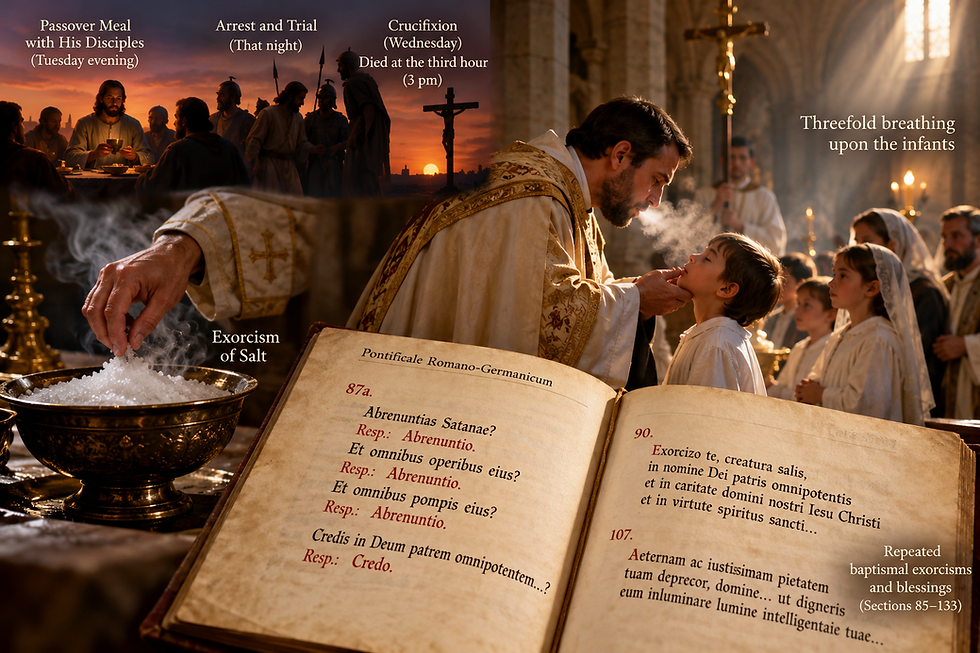
In Section XCIX, which we have examined through paragraph 133, the ceremonies surrounding baptism include exorcistic prayers, signs of the cross, ritual breathing, exorcised salt and prescribed actions performed upon infants.
Such rites demonstrate how highly developed the ecclesiastical ceremonial system had become by the tenth century.
But where did Christ establish these particular procedures?
Where did He command the ritual exorcism of salt, repeated breathing over infants or elaborate consecrations through which spiritual power was attributed to material substances?
And where did He instruct His apostles that later religious officials would possess an expanding ceremonial authority over spiritual beings?
Kieckhefer's Chapter 6 now gives us a much more precise historical context for asking those questions.
We have an earlier ninth-century ecclesiastical exorcism employing extensive sacred invocations.
We have the tenth-century Pontifical preserving elaborate official religious ceremonies.
And we have a fifteenth-century necromantic handbook appropriating the names of Christ, the saints, baptism, the Eucharist and similar formulas of command for illicit purposes.
The historical evidence does not prove that every ecclesiastical rite was magical, nor that the Church officially authorised necromancy (although one might reasonably wonder why an institution so emphatically opposed to dealings with the dead insists upon keeping their bones beneath its altars. Apparently, being dead is no obstacle to a place of honour in the sanctuary!).
But it does demonstrate that the distinction between official religious ceremony and forbidden conjuration could involve closely related ritual language, with the central difference lying in the intended use of spiritual authority.
The next stage of our investigation must therefore compare the actual Latin formulas rather than merely the outward objects used.
Which words appear in both texts? Which invocations can be traced through earlier manuscripts? Which formulas originated in baptismal exorcisms, and when were they expanded or adapted? How did claims concerning sacramental power develop within medieval theology?
These are historical questions that can be tested against surviving evidence.
But a still more fundamental biblical question must never be lost.
Where did Jesus Christ command His followers to establish this elaborate system of ritual power?
Christ's Authority Was Never a Magical Formula
The central issue running through these three chapters is the attempted appropriation of divine authority.
The operator invokes Christ's blood to obtain favour with a prelate.
A wax image is baptised to compel a woman's affection.
A consecrated paten is reportedly used to seek spirit revelations.
Children are instructed to command apparitions through sacred names.
A conjuration claims that baptism and the sacraments have given the operator power over a spirit.
Another formula effectively presents the magician's personal desires as commands issued by Jesus Christ.
These are not ordinary acts of Christian worship. They are attempts to employ sacred language for purposes incompatible with the Gospel.
And they expose a dangerous misunderstanding: the assumption that religious words or ceremonial acts confer a power which may then be exercised according to the will of the performer.
Jesus Christ never taught His followers to regard His name as a formula through which they could obtain control over people or spirits.
He warned that even those claiming to cast out devils and perform wonderful works in His name might be rejected if they practised iniquity.
“And then will I profess unto them, I never knew you: depart from me, ye that work iniquity.” — Matthew 7:23 (KJV)
The warning is unmistakable.
Performing extraordinary works in Christ's name is not the same thing as belonging to Him.
Possessing religious knowledge is not the same thing as obeying Him.
And occupying an office within a religious institution is not, by itself, proof of divine authority.
Christ declared:
“All power is given unto me in heaven and in earth.” — Matthew 28:18 (KJV)
He is the one mediator between God and men.
The apostles were chosen and commissioned by Him. Their authority rested upon His command, not upon their possession of mysterious formulas, ceremonial garments or knowledge of supernatural hierarchies.
The entire history exposed by these manuscripts should therefore be judged against His teaching.
The Abuse of Spiritual Authority and the Vulnerable
There is one further issue we must confront.
Kieckhefer's investigations reveal not only illicit attempts to command spirits, but also the willingness of some operators to use supposed spiritual power against vulnerable people.
Women were represented as objects whose affections could be compelled. Children were employed as mediums for forbidden revelations. Accusations against innocent people could be justified through claims of supernatural knowledge. Religious figures were sometimes implicated in attempts to obtain power or sexual access through coercion.
These documented themes do not establish that ritual magic caused later institutional sexual abuse, nor do they prove that every accused medieval cleric was guilty.
But they reveal a serious moral danger that transcends the medieval setting: the desire to exercise power over another human being while claiming sacred or supernatural authority.
Wherever spiritual office becomes a shield for manipulation, intimidation or exploitation, Christ's teaching has been contradicted.
Children are not instruments through which adults may pursue forbidden knowledge.
Women are not objects whose wills may be overcome by religious threats or magical coercion.
And religious authority does not confer permission to exploit those who trust it.
The Gospel requires the very opposite.
Christ's command was to serve, to protect the vulnerable and to reject the desire for personal dominion.
That standard must apply to every institution claiming His name.
By Their Sorceries Were the Nations Deceived
The first six chapters of Richard Kieckhefer's Forbidden Rites have now revealed an extraordinary body of historical evidence.
We have examined priests accused of possessing or employing books of necromancy, a monk claiming Marian revelations in connection with ritual knowledge, magical writings instructing operators to use the Mass and Eucharist to consecrate forbidden experiments, clerics accused of attempting sexual coercion, a surviving manuscript explicitly baptising wax images, and religious figures accused of involving children in divination.
We have encountered supposed spiritual kings, named demons, planetary influences and magical formulas invoking Christ's blood, Mary's virginity, the saints, the popes of Rome and the sacraments.
Most significantly, we have examined a conjuration which explicitly claims spiritual authority through baptism and the sacraments, alongside older ecclesiastical exorcisms whose structures closely resemble those of later necromantic formulas.
The evidence demands careful historical distinctions. The existence of a magical instruction does not prove the supernatural operation succeeded. An allegation against a priest is not proof of guilt. The appropriation of Christian rituals by necromancers does not demonstrate that Christianity itself originated in magic, or that ecclesiastical authorities approved those appropriations.
Nevertheless, those distinctions do not lessen the seriousness of what the manuscripts actually contain.
They reveal how the language of Christianity could be employed in attempts to acquire powers, compel spirits and dominate other human beings in ways Christ never authorised.
And that is where the biblical warning becomes unavoidable.
Revelation 18:23 declares that the nations were deceived through sorceries.
Revelation 18:4 commands God's people to come out of Babylon so that they do not partake of her sins.
We should not identify a particular institution with Babylon merely because a medieval magical text borrowed its religious language. But neither should the warning be ignored when religious authority is invoked to justify practices contrary to Christ's commands.
The decisive test must always be the truth of His teaching.
Christ did not command His followers to obtain occult knowledge through children, use the Eucharist for personal domination, baptise magical images, invoke unknown spiritual rulers or compel demons into service.
Nor did He promise that institutional authority would make disobedience holy.
The apostles proclaimed Christ's Gospel. In Acts 19, converts who had practised curious arts brought their magical books together and burned them.
They did not consecrate those books.
They did not preserve forbidden operations under Christian names.
They abandoned them.
That is the example Scripture places before us.
And so the question we must ask of every religious ceremony, every spiritual claim and every institution purporting to act in Christ's name remains the same:
Where did Jesus Christ command it?
Not where a medieval council approved it. Not where a theologian defended it. Not where a bishop permitted it, a pope established it, or a visionary claimed heavenly authorisation.
Where did Christ Himself command it, and where did His apostles teach it?
For all authority belongs to Him.
And neither the Mass, the priestly stole, baptismal words, religious images, claims of angelic apparitions nor the invocation of His name can make a forbidden act righteous.
If the nations were deceived through sorceries, then Christians should be especially watchful when the pursuit of forbidden power appears beneath the outward garments of religion. For the greatest danger is not merely that men might practise witchcraft openly, but that they might attempt to disguise the desire for power beneath the sacred name of Jesus Christ.
Are we being controlled by the seed of the serpent?
Historical Sources and Manuscript References
The principal source for this investigation is Richard Kieckhefer, Forbidden Rites: A Necromancer's Manual of the Fifteenth Century (1997; American edition 1998), Chapters 4–6, printed pp. 79–174, together with the accompanying Latin edition of Munich Clm 849, especially experiments 3, 4, 12, 27, 32, 38 and 41.
The most important surviving ritual passages are found in Clm 849, fols. 8r–13v, 29v–31v, 44v–47v, 59v–62v, 96v–99v and 106r–106v, with related versions of the Mirage conjuration in the additional material at fols. 109r–118r and 139r–146r.
For the case of Peter Recordi, Kieckhefer cites Henry Charles Lea, A History of the Inquisition of the Middle Ages, volume III, pp. 657–659, and Joseph Hansen's collection of medieval witchcraft documents.
For William Netherstreet, see Margaret Aston, Thomas Arundel: A Study of Church Life in the Reign of Richard II (1967), pp. 63 and 404–405.
For the Tournai priest, see Paul Fredericq, editor, Corpus documentorum inquisitionis haereticae pravitatis Neerlandicae, volume I, pp. 428–429.
For William Sadyngstone and the Leicester proceedings, consult Kieckhefer, Chapter 5, p. 114 and note 20, which identifies the ecclesiastical visitation evidence.
For John Haddon and William Lee, see C. Trice Martin, “Clerical Life in the Fifteenth Century, as Illustrated by Proceedings of the Court of Chancery,” Archaeologia, volume 60 (1907), pp. 377–378.
For Johannes Hartlieb, consult Das Buch aller verbotenen Künste, particularly the chapters discussing divination and forbidden arts, cited throughout Kieckhefer's Chapters 4 and 5.
For the ninth-century ecclesiastical exorcism, see Adolf Franz, Die kirchlichen Benediktionen im Mittelalter, volume II (1909), pp. 587–596.
For the late-fifteenth-century Roman exorcism manual, see Coniuratio malignorum spirituum in corporibus hominum existentium prout in Sancto Petro, printed by Stephan Plannck around 1492 and Eucharius Silber around 1495.
For the sermon story involving Peter of Ardene and Roger Bacon, see A. G. Little, editor, Liber exemplorum ad usum praedicantium (1908), p. 22.
For the Romano-Germanic Pontifical, see Cyrille Vogel and Reinhard Elze, editors, Le Pontifical romano-germanique du dixième siècle, three volumes, Studi e Testi 226, 227 and 269 (Vatican City, 1963–1972), particularly Section XCIX.
All biblical quotations are from the King James Version.

Comments