Babylon Rising: The Great Illusion Before the End of the World
- Michelle Hayman

- Nov 28, 2025
- 19 min read
Duality in Jewish mysticism is not a doctrine of two gods or competing cosmic forces. It is the experience of one divine reality expressed through two dimensions of human life: the spiritual and the physical. Many Jewish thinkers who root themselves firmly in the Hebrew Scriptures describe humans as beings who straddle both heaven and earth, carrying the tension and purpose of that dual existence.
Nachmanides (Ramban), in his commentary on Genesis, emphasizes that the human is created from both the dust of the earth and the breath of God. For him, this dual origin defines our nature. We are at once earthly and transcendent. The Hebrew Bible portrays humanity this way from the beginning, and Ramban simply highlights what the text already implies: the human being is the intersection of matter and spirit. In mystical terms, this is the central duality.
Rabbi Moshe Chaim Luzzatto (Ramchal), particularly in “Derech Hashem” and “Da’at Tevunot,” describes the human as a creature set between two realms. According to him, there is an upper world of divine clarity and a lower world of concealment. God places humans within the tension between these realms because only a being who experiences duality can freely choose closeness to God. Ramchal’s entire spiritual anthropology assumes the authority of the Hebrew Scriptures, especially the idea that God created humans “in His image,” yet embedded them in a world of struggle.
The Zohar, while mystical and symbolic, also views duality through the lens of Scripture. When it comments on verses like “You shall choose life” or “The soul of a person is the lamp of the Lord,” it interprets these passages as describing two inclinations within each person. Later Hasidic thinkers treat this dual structure as the foundation for spiritual growth. They emphasize that the lower impulses are not enemies but potential energies waiting to be elevated. This idea is drawn from biblical narratives that portray struggle as the arena of transformation, such as Jacob wrestling the angel or Israel’s command to refine its heart.
Rabbi Schneur Zalman of Liadi, in the Tanya, gives one of the clearest mystical explanations while consistently grounding his thought in the Torah. He writes about the divine soul and the animal soul, explaining that every human carries these two centers of desire. Both are part of God’s design, and neither contradicts biblical monotheism. The divine soul seeks unity with God; the animal soul seeks individuation and physical life. The Torah itself presumes both sides: it commands love of God while also regulating physical appetites and emotions. The Tanya is simply a mystical interpretation of that biblical psychology.
Jewish mysticism therefore understands human duality as the tension God intentionally placed within creation. It is not an accident of nature but a structure embedded in the world and the human being. The Hebrew Scriptures often describe this tension through symbolic pairs: heaven and earth, spirit and flesh, blessing and curse, life and death, commandment and choice. Mystical authors simply read these pairs as reflections of an inner human landscape.
The purpose of this duality, according to these teachers, is tikkun: the possibility of elevating the lower through the higher. Humans, because they bridge the two realms, can reveal God in a concealed world. This is the meaning of being created in the divine image: not a static dignity, but the capacity to bring unity into a divided reality.
In Jewish mysticism, duality is therefore not a flaw. It is the stage on which the human story unfolds. It is the arena of growth, responsibility, and intimacy with God. Through choosing the good, refining one’s impulses, and living consciously in both dimensions, the human being fulfills the purpose outlined in the Hebrew Scriptures: to walk with God while standing firmly on earth.
First, the foundational Hebrew Scriptures (which Christians accept as their Old Testament) already describe humans as a union of two realms. Genesis says that God formed man from the dust and breathed into him the breath of life. This single sentence affirms the mystical view that humans are both earthly and divine in their construction: material body and spiritual essence.
Ecclesiastes describes this duality openly, saying that the body returns to the dust and the spirit returns to God who gave it. The text treats the human being as a composite of two distinct expressions of life, one rooted in creation and one rooted in God Himself.
The Christian New Testament continues and strengthens this biblical duality. Paul in Romans speaks of two “laws” within the human being: the law of the mind that seeks what is Godly and the law of the flesh that pulls downward. This mirrors the Jewish idea of the divine soul and the animal soul. Paul is essentially describing an inner conflict between a higher calling and a lower impulse, which is the same dynamic Jewish mysticism highlights.
In Galatians Paul speaks again of the flesh and the spirit as two inner tendencies that “are opposed to each other.” This is the same structure that the Hebrew Bible presents when it speaks of the inclination to good and the inclination to evil. Paul simply uses different language to describe the same internal tension.
Jesus in the Gospels acknowledges this dual nature when he tells his disciples that the spirit is willing but the flesh is weak. This statement is a concise summary of the entire idea: the human being contains a component oriented toward God and another oriented toward physicality, comfort, and fear. Both exist within the same person.
James speaks of a “double minded” human being, which does not mean hypocritical but divided between two impulses. The biblical worldview accepts this split as part of human nature.
Even Peter’s language about believers being “in the world but not of it” expresses the same structure. Humans participate in physical life while carrying a higher identity.
None of these Christian passages introduce a new anthropology. They simply echo and expand what the Hebrew Scriptures already teach and what Jewish mysticism describes: that humanity is a meeting point between the upper and lower worlds.
Thus, Christians who hold the Bible as authoritative can see that the mystical idea of human duality is not contradictory to biblical faith. It is rooted in Genesis, affirmed by Israel’s wisdom literature, and acknowledged by Jesus and the apostles.
In the world of Western occultism, the path to “godhood” is often presented as a heroic ascent, but the real structure of these systems reveals something very different. At the center of many esoteric orders stands the figure of Osiris, a deity not of the divine realm but of the underworld, the dead, and the lower astral plane. His light is not the pure light of heaven but the flickering radiance of the first spiritual heaven, a realm filled with confusion, shadows, and conflicting forces. When modern occultists speak of ascending through Osiris, they are not rising toward a transcendent source; they are descending into a realm where light and darkness blur together.
Eliphas Levi, one of the foundational thinkers of ceremonial magic, admitted openly that the astral light is morally neutral and dangerous. He described it as a field of influence where angels and demons coexist, where visions can elevate or destroy the magician. Levi warned that this light can deceive, seduce, and overwhelm, and that the path of the initiate demands navigating forces that are not benevolent. For him, the Osirian descent was not a journey into purity but into a realm where the untrained seeker risks madness, delusion, and spiritual inversion. Levi acknowledged that what appears as enlightenment can in fact be darkness masquerading as illumination.
Many occult writers draw connections between Osiris, the “light-bringer,” and the figure of Lucifer. In this interpretive tradition, Osiris represents the ruler of a lower spiritual realm, the underworld, and the first heaven rather than a transcendent divine source. Critics of occult systems often note that this fits the broader theme of “false light,” a form of illumination that originates in the chthonic world rather than in a pure divine realm.
Some commentators extend this symbolic reading to global religious institutions, arguing that certain types of religious architecture and imagery reflect cosmological beliefs tied to the lower realm rather than the highest heaven. Under this interpretive lens, the papal tiara with its three tiers is sometimes described symbolically as representing the three classical realms: the earthly world, the sky or first heaven, and the underworld. Scholars of symbolism emphasize that this is not the Catholic Church’s own teaching, but rather how critics and esoteric observers interpret the imagery.
The Vatican obelisk, like many ancient obelisks, is often discussed by critics as a remnant of solar worship because obelisks historically symbolized the sun’s power in ancient Egypt. Again, this is symbolic criticism, not Catholic doctrine. Similarly, the sunburst imagery seen in objects like the monstrance is interpreted by some observers through a comparative-religion lens as reflecting archetypal solar symbolism. Critics sometimes contrast this imagery with the material wealth of Catholic institutions and the poverty of surrounding regions, presenting it as an example of the tension between symbolic grandeur and social need.
In this broader symbolic framework, the rituals of the Hermetic Order of the Golden Dawn fit the same archetype. Their system is built upon the Osiris formula: the initiate must symbolically die, descend into the chthonic realm, face the guardians of death, and emerge with new power. But the power gained is not divine elevation; it is influence within the lower spiritual realm. That realm, described by occultists themselves, is populated by ghosts, elemental beings, shadow forms, astral distortions, and chaotic psychic energies. It is not a place of moral clarity but a place of mixed and deceptive illumination.
For critics of esoteric systems, this is the core issue. When a spiritual path draws its imagery, power, or symbolism from the underworld and the first heaven rather than from a transcendent divine source, the light it offers is inherently ambiguous. It can appear brilliant while leading the seeker deeper into confusion, ego, and shadow rather than into genuine transformation. In this interpretive framework, Osiris, the astral realm, and solar or chthonic imagery across cultures form a pattern: a pursuit of illumination that originates below, not above.
“Take heed therefore that the light which is in thee be not darkness.”
(Luke 11:35, KJV)
Aleister Crowley removed even the pretense of moral ascent. For him, the occult path was a deliberate embrace of forces that traditional religions consider dangerous or corrupt. Crowley did not hide this; he reveled in it, calling himself “The Beast” and openly teaching that the seeker should cast aside divine law in favor of the unchecked human will. In his system, Osiris is not a guide toward divine purity but a symbol of dying to moral constraint so that the ego may rise enthroned. Crowley’s version of Osirian initiation is a process of dismantling the conscience, breaking inherited boundaries, and awakening the deeper, often darker layers of the self. The “godhood” promised here is not transcendence but domination by one’s own will, which he believed should replace all higher authority.
Some readers associate these themes with secret societies, often interpreting symbols such as the “Great Architect of the Universe” or the use of Egyptian imagery as signs of a hidden allegiance to Lucifer or Osiris. Figures like Albert Pike and Manly P. Hall, though not representatives of all Masons, blended Masonic language with Hermetic, Egyptian, and Luciferian symbolism in their personal writings. This fusion created a cultural environment in which many later esoteric groups embraced Egyptian deities, astral hierarchies, and the Osirian cycle as part of their initiatory framework.
Across these occult systems, the pattern remains consistent. The path to so-called godhood requires entering a realm that is not divine but liminal, not pure but contaminated, not heavenly but chthonic. The initiate is led downward, not upward. The light encountered is not the clear, uncreated light of a transcendent source but the unstable, morally ambiguous glow of the astral plane. It is a light that can imitate truth while masking deception. The traditions themselves acknowledge that danger. Levi feared madness. The Golden Dawn warned of obsession. Crowley embraced the beast nature. In every case, the seeker risks mistaking a shadowed light for genuine spiritual illumination.
This is what makes occult ascent inherently perilous. When a person seeks divinity through the underworld, the first heaven, or the astral realm, they are not rising toward unity with a higher moral or spiritual source. They are stepping into a domain where ego, instinct, and shadow thrive. The path promises enlightenment, but its methods encourage the dissolution of conscience, the exaltation of personal will, and the magnification of the lower self. It offers a crown, but the crown is forged in darkness, not in light. The danger is not simply that the seeker is misled, but that the very light they pursue blinds them from recognizing the darkness within it.
The pursuit of occult power has always claimed to offer ascent, but the core of these systems reveals something much darker: the seeker is not rising upward but moving sideways into a realm of shadows, illusions, and forces that bear no resemblance to a truly divine source. The recurring figure at the heart of these traditions is Osiris, not a god of heaven but a ruler of the dead, a king of the underworld whose authority belongs to the first spiritual layer beneath the physical world. When esoteric orders elevate Osiris as the archetype of initiation, they are placing the seeker into a realm where death, fragmentation, and shadow-light form the structure of spiritual development.
Historically, Osiris was never portrayed as a pure or heavenly deity. He was torn apart, resurrected in pieces, enthroned in darkness, and crowned over a realm where spirits wander and moral clarity dissolves. For the Egyptians, this was not a god of the divine throne; it was a god of the liminal space between life and decay. When modern occultists adopted Osiris as the gateway to supposed enlightenment, they were not following a path into transcendence. They were aligning themselves with the psychic environment associated with the dead and the astral shadows that drift in the lower heavens.
Eliphas Levi, one of the earliest architects of modern magic, looked directly into this realm and admitted its unstable nature. Levi wrote about the astral light as a dangerous ocean of influence, a place where truth and error coexist and where the magician is constantly at risk of drowning in his own illusions. Levi understood that the forces of this plane are morally ambiguous, capable of producing visions that appear holy while carrying the essence of corruption. He warned repeatedly that the initiate could easily confuse false illumination with true insight. Levi’s symbolic use of Osiris reflected this danger: a god who rules in darkness and whose resurrection does not bring purity but a deeper entanglement with the shadowed fabric of the soul.
The Golden Dawn expanded Levi’s ideas and formalized them into elaborate rituals. Their entire structure rests on the Osiris formula of death and rebirth: the initiate symbolically dies, passes through the veil of the underworld, confronts the guardians of the dead, and is reassembled into a new being. But this reconstruction is not the cleansing of the soul. It is the rebuilding of the psyche under the influence of astral forces. The Golden Dawn’s own texts caution initiates about obsession, astral predators (masquerading as angels), and the danger of mistaking psychic impressions for genuine revelation. Their system creates a controlled descent into the astral realm, teaching the initiate how to navigate and harness forces that are inherently volatile and deceptive. Power is gained, but not purity. Knowledge is acquired, but not truth.
Aleister Crowley pushed these ideas into even darker territory. Crowley openly celebrated the forces that older traditions feared. He did not attempt to hide the nature of the power he sought; he embraced it, declaring himself “The Beast” and exalting the idea that the human will should replace divine authority. Crowley understood Osiris not as a path to redemption but as a ritualized death of conscience. In his system, godhood is achieved by dissolving moral boundaries and descending into the raw energies of the lower self. Crowley portrayed the Osirian descent as a necessary shattering, a ritualistic breaking of the psychic vessel that allows the deeper, darker layers of the will to emerge. What he called liberation was, in practice, the enthronement of the ego over the soul.
Many people associate these currents with secret societies, especially because certain occult authors like Albert Pike and Manly P. Hall blended Masonic symbolism with Hermetic, Egyptian, and Luciferian imagery. Even if Freemasonry itself does not teach these doctrines, the writings of Pike, Hall, and other esoteric thinkers created a cultural environment where Masonic symbols were absorbed into broader occult systems. When Pike wrote about the “light-bearer” or Hall described hidden architects and Egyptian mysteries, they were not offering a benign explanation of symbolism. They were drawing from the same reservoir of underworld motifs that inspired the Golden Dawn, the OTO, and countless other esoteric movements. This intermingling of symbols deepened the perception that beneath the surface of certain orders lies a connection to the same astral currents associated with Osiris.
A consistent pattern emerges across all these traditions. The seeker is taught to believe he is ascending, but every step draws him deeper into the densest layer of spiritual reality: the astral world, a domain tied to instinct, shadow, desire, and psychic distortion. This realm is not morally neutral. It is unstable, deceptive, and capable of mimicking spiritual truth with uncanny precision. The light it offers is seductive, but it is not the light of a higher source. It is the reflection of psychic energies, spiritual fragments, and the collective residue of human consciousness and disembodied forms.
The qliphothic interpretation from later occultists makes this even more explicit. In the kabbalistic shadow tradition, the qliphoth are shells, husks, and distortions; energies that mimic the divine while being severed from its life-giving center. The astral realm corresponds to these shells, the domain where forces appear brilliant but are spiritually hollow. The magician who enters this realm in search of power steps into an inverted reflection of the true spiritual world. He sees images that glow with significance, but their source is decayed. He feels empowered, but the power binds him more closely to the lower nature. He believes he is rising, but he is sinking deeper into an inverted structure.
Even modern New Age teachings mirror this pattern. Behind the language of light activation, ascension, and cosmic awakening lies the same astral environment, dressed in newly sanitized vocabulary. The intuitive visions, channeled entities, and “higher self” communications of the New Age movement belong to the same realm the Golden Dawn and Crowley navigated. The motifs are more palatable, but the source remains the same: the first heaven, not the highest; the astral plane, not the divine; the mixed light of Osiris, not the pure light of transcendence.
The occult path promises godhood, but the godhood it offers is confined to the lower spiritual strata. It is a throne built in shadow. It amplifies the ego, not the soul. It awakens psychic faculties while darkening discernment. It grants power that comes at the cost of clarity, and illumination that blinds more than it reveals. At its core, it is a system in which the seeker strives to become a god by descending into the realm of the dead and mistaken light for truth. The danger is not simply that the light is dim. The danger is that it appears bright enough to deceive.
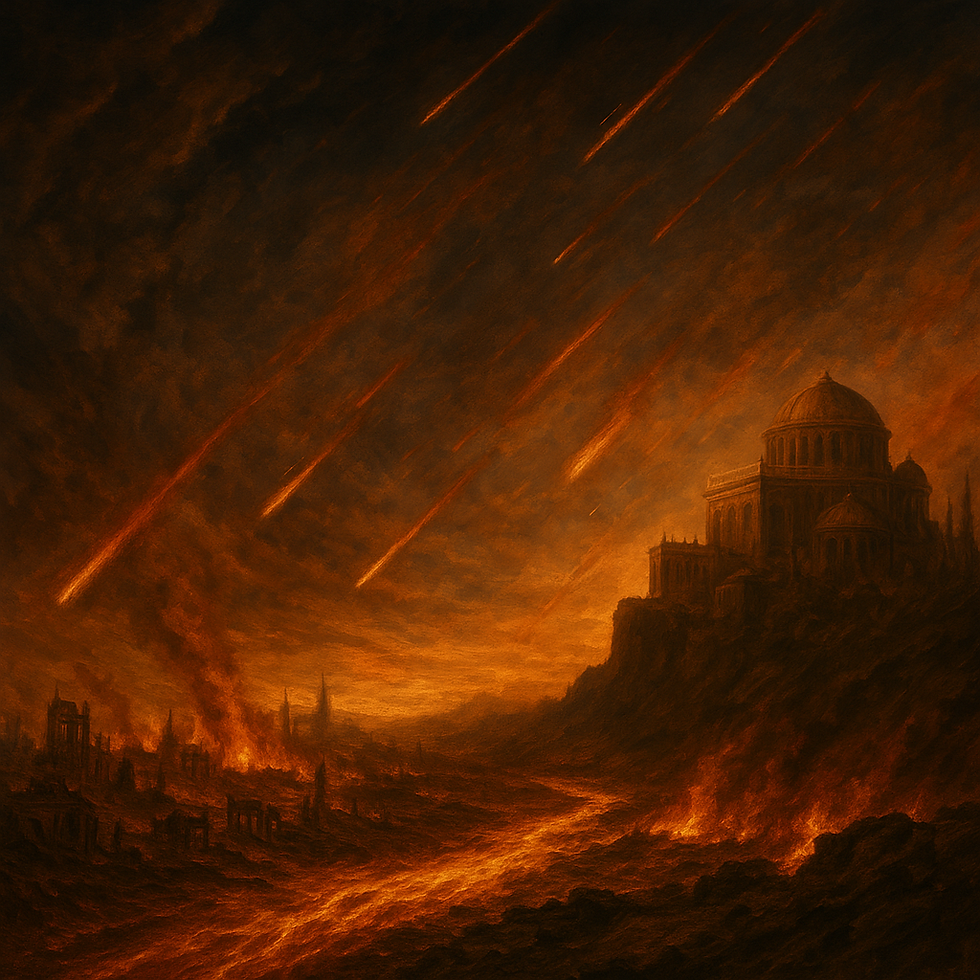
When Scripture speaks of “the last days,” it is describing the final stage of human history leading up to the return of Christ, the judgment of the nations, the fall of the final Babylon, and the destruction and renewal of the created order. The Book of Revelation is the closing prophetic testimony of this sequence. It is not symbolic poetry; it is the culmination of every prophetic thread from Genesis to Malachi and from Matthew to Jude.
Peter says plainly, “The heavens and the earth which are now…are reserved for fire.” Paul says that creation groans for its final liberation. Isaiah says the heavens will be rolled up like a scroll. And Revelation brings all these strands together into a single sweeping narrative of the end of the age.
In biblical terms, “the last days” refers to several overlapping realities:
First, it is the period in which the gospel goes out to all nations while the world simultaneously hardens in rebellion. Revelation portrays this as the time when the faithful remain steadfast while the kingdoms of the earth unite in spiritual deception. The last days are marked by a global, unified rebellion; the culmination of human pride, political power, religious confusion, and spiritual delusion.
Second, it is the rise of the final Babylon. Revelation presents Babylon not merely as a city or empire but as the ultimate manifestation of world systems organized in opposition to God. It is political. It is religious. It is economic. And it is explicitly spiritual, animated by forces that deceive the nations and offer a counterfeit path to enlightenment and unity. This is the last great rebellion before judgment falls.
Third, the last days culminate in divine intervention. Revelation is clear that human civilization does not end by accident or by natural decay but by the direct action of God. Christ returns. The nations are judged. The beastly systems fall. Satan is cast down. The present earth and heavens pass away. Peter echoes this when he says the elements will melt with fervent heat. Revelation completes this imagery by showing heaven and earth fleeing from the presence of the Judge.
Fourth, the last days include the unveiling of deception that has been growing since Eden. Jesus said the last days would be like the days of Noah, a time when humanity is overwhelmed by spiritual corruption and moral blindness while believing itself enlightened. Revelation calls this “the strong delusion”: a false light, a false peace, a false unity, a false Christ. It is the final flowering of the ancient lie that humans can obtain godhood apart from God.
Finally, the last days lead directly to the new creation. Revelation does not end with destruction alone. After the earth and the elements are dissolved, John sees a new heaven and a new earth. The old order is gone. Babylon is gone. Death is gone. The sea; a biblical symbol of chaos; is gone. Nothing of the ancient rebellion survives. The last days are not just the end of world history; they are the end of rebellion itself. They clear the way for the eternal kingdom.
This is why Revelation is the final prophetic book. It completes the canon by completing the story: creation, fall, redemption, judgment, renewal. There is no prophecy after Revelation because there is no history after Revelation. Everything that remains belongs to the new heavens and the new earth.
This is how Scripture frames the last days: not as a vague warning but as a precise, unavoidable sequence leading to the end of the present world and the unveiling of the world to come. The Bible warns that humanity will be drawn into a system that looks enlightened, compassionate, and progressive, yet is driven by the same ancient forces that corrupted the world before the flood. Scripture calls this end-time power Babylon; a seductive, global spiritual-political order that deceives the nations with its enchantments and offers a false path to spiritual evolution.
Babylon is not merely a civilization of the past. It is a spiritual pattern, a kingdom of rebellion that rises whenever humanity exalts itself above God. In Genesis, Babylon appears as the tower of human pride. In Daniel, it becomes a kingdom that worships its own glory. In Revelation, it emerges again as a worldwide system intoxicated with spiritual deception and political dominance.
Revelation does not present Babylon as an atheistic empire. It presents her as profoundly religious. She is clothed in gold, scarlet, and purple; symbols of spiritual authority and royal power. She holds a golden cup, but it is filled with abominations. She claims enlightenment, but her light is counterfeit. She speaks the language of unity, peace, and spiritual awakening, but she leads nations into darkness. This is why Christ warned, “Take heed that the light within you be not darkness.”
In our generation, multitudes are embracing new spiritual movements that promise enlightenment, ascension, and higher consciousness. These systems speak of Christ not as Lord but as an energy, an archetype, or a state of mind. They promise that humanity is evolving into godhood, that divine power lies within, and that salvation comes by accessing the hidden realms of the cosmos. But this is not new. It is the oldest lie ever spoken: “You shall be as gods.”
Ecclesiastes declares that there is nothing new under the sun. What humanity calls awakening today is the same deception that led the watchers astray in the days of Noah, the same seduction that corrupted ancient civilizations, and the same spiritual rebellion that Scripture says will rise again at the end of the age. Daniel foretold that in the final kingdom, “they shall mingle themselves with the seed of men”; a mysterious prophecy that many interpreters understand as a return of deceptive, non-human forces interacting with humanity in ways that mirror the days before the flood.
It is in this context that the modern fascination with UFOs, extraterrestrial “teachers,” and cosmic messengers becomes spiritually significant. Regardless of one’s position on the phenomenon, the messages attributed to these beings consistently promote doctrines that align with Babylon’s false light: humans evolving into gods, rejecting divine authority, embracing global spiritual unity, and receiving hidden knowledge from beings who present themselves as enlightened guides. Scripture repeatedly warns that deceptive spirits will masquerade as angels of light, offering revelations that lead humanity away from the truth.
Paul wrote that in the last days, people would “give heed to seducing spirits and doctrines of demons.” Revelation warns that unclean spirits would go out to deceive the kings of the earth. Jesus Himself said that false christs and false prophets would arise and perform signs capable of deceiving even the elect.
The danger of the end times is not merely political oppression; it is spiritual seduction. It is a counterfeit kingdom in which religious language is used to hide rebellion, and spiritual experiences are used to disguise bondage. The elites of Babylon are not merely human rulers but spiritual powers working through human pride, ambition, and blindness. Men and women intoxicated by their own ego; believing themselves enlightened, gods on earth, awakened, or evolved; become instruments of a kingdom that opposes God while claiming to represent light.
The final Babylon is a mirror of Eden’s deception: a promise of wisdom, evolution, and godhood. But behind the promise stands the same ancient enemy, offering humanity the same choice; to seek light apart from its true source. Those who cannot see past their own brilliance are the first to fall into darkness. And those who follow leaders who promise spiritual evolution without repentance follow them into destruction.
Scripture warns that Babylon will rise quickly and fall suddenly. Her fall is not merely geopolitical. It is spiritual. Her collapse reveals the emptiness of her wisdom and the darkness of her light. The call from heaven rings out: “Come out of her, my people, that you be not partakers of her sins.”
The warning is as urgent now as it was when written.
As spiritual warfare intensifies and the final conflict draws near, Revelation makes clear that a dividing line will appear in the world. It will not be drawn by politics, institutions, or nations, but by worship; by who remains loyal to the commandments of God when everything around them demands compromise. Scripture is unambiguous: those who stand in the last days are described as “they who keep the commandments of God and the faith of Jesus.” That word has not changed. The commandments have not faded. The Sabbath, the seventh day blessed and sanctified at creation, remains what it has always been; a sign of allegiance to the Creator, a reminder that worship belongs to the One who made heaven and earth.
Human traditions have tried to reshape what God established, and history is filled with moments when institutions replaced divine instruction with human authority. Yet Scripture continually draws the faithful back to the ancient paths; to the law written not by councils but by the hand of God. Today Friday, as in the days of the apostles, the Sabbath begins at sunset, marking sacred time not by earthly power but by the rhythm God set at the beginning of the world. It is an invitation to step out of the noise, repent, and return to the presence of the One who dwells in the true divine realm.
In a world saturated with counterfeit light, false spirituality, and movements that promise enlightenment apart from the Creator, the Sabbath becomes more than rest; it becomes a declaration. It says we reject the illusions of this age. We refuse the systems that exalt man above God. We turn away from the ancient deceptions that invite humans to become gods through hidden knowledge, esoteric rites, the worship of created symbols, and Lucifer/Osiris. We choose instead the simplicity and power of obedience, the humility of repentance, and the joy of entering God’s presence.
The battle is reaching its climax. Babylon’s illusions are growing strong. But those who stand; truly stand, are those who cling to the commandments of God, trust the testimony of Christ, and welcome the holiness of the seventh day as the apostles once did. As the sun sets, the call still echoes: return, repent, and welcome the presence of the living God. For soon the line will be drawn, the false lights exposed, and only those anchored in the truth will remain unshaken.
Repent and Believe the Gospel of Christ


Comments