From Scripture to Stars: How Astrology Entered the Church
- Michelle Hayman

- Apr 22
- 18 min read
The attitude of the Catholic Church toward astrology was never uniform or absolute, but rather carefully differentiated according to theological principles. What was consistently rejected was deterministic astrology—that is, the claim that the stars govern human will, fix individual destiny, or render moral responsibility meaningless. Such a position was seen as incompatible with the doctrines of free will and divine providence, since it would imply that human actions are necessitated by celestial forces rather than freely chosen under God.
At the same time, a more limited form of astrology, often referred to as natural astrology, was in many periods tolerated, albeit cautiously. This referred to the belief that celestial bodies exert influence over the material world: the weather, the seasons, and even the human body. Within this framework, the stars could affect physical dispositions without determining the rational soul. This distinction was articulated most clearly by Thomas Aquinas, who maintained that while the heavens may incline the body, the intellect and will remain free and directly subject to God.
Papal interventions reflect this nuanced position. Certain popes issued explicit condemnations of astrological practices, but these were typically directed at what was known as judicial astrology—the attempt to predict specific events such as death, political outcomes, or personal fate. For example, Sixtus V and later Urban VIII condemned such practices, especially where they implied necessity or certainty about future human actions. However, these condemnations did not amount to a wholesale rejection of all forms of astrology; rather, they targeted those uses that infringed upon theological doctrines of freedom and providence.
In this broader intellectual context, the Renaissance revival of ancient philosophy played a decisive role. Under the patronage of Cosimo de’ Medici, the Florentine court became a center for the recovery and translation of Greek and late ancient texts. Cosimo commissioned Marsilio Ficino to translate the Corpus Hermeticum, a collection of writings attributed to the ancient figure Hermes Trismegistus, which were believed at the time to contain a primordial theology predating even Moses. Ficino’s work did not merely recover these texts but integrated them into a Christian framework, presenting Hermetic philosophy as compatible with, and even supportive of, Christian doctrine.
Ezekiel 20:7–8
“Then said I unto them, Cast ye away every man the abominations of his eyes, and defile not yourselves with the idols of Egypt: I am the Lord your God. But they rebelled against me… they did not every man cast away the abominations of their eyes, neither did they forsake the idols of Egypt.”
Isaiah 31:1
“Woe to them that go down to Egypt for help… but they look not unto the Holy One of Israel.”
Through Ficino, ideas of cosmic harmony, spiritual correspondences, and the animation of the universe entered more deeply into Renaissance "Christian" thought. His notion of a universe bound together by sympathies, where celestial, natural, and spiritual realms reflect one another—provided a philosophical basis for a refined form of astrology understood as part of natural philosophy rather than illicit magic. While never formally adopted as doctrine, these ideas circulated widely among educated clergy and intellectuals, subtly influencing theological and cosmological discussions within Catholic Europe.
It is within this intellectual lineage that Tommaso Campanella must be situated. Campanella inherits, transforms, and radicalizes elements of Ficino’s synthesis. Like Ficino, he affirms a cosmos structured by divine reason and permeated by meaningful correspondences; however, he places greater emphasis on the real causal efficacy of celestial bodies within the natural order. At the same time, he remains careful to subordinate all such influences to God, insisting that celestial forces act only as secondary causes and cannot override the freedom of the human soul.
Thus, Campanella’s project can be understood as a continuation of the Medicean and Ficinian attempt to reconcile ancient cosmological wisdom, especially Hermetic and astrological traditions—with Christian theology. The result is a system in which astral influence is neither dismissed nor absolutized, but integrated into a hierarchical vision of reality governed ultimately by divine providence.
The underlying issue in all these debates was not simply whether astrology was true or false, but whether the structure of the cosmos could exert influence on human beings without displacing divine authority. The Church’s eventual position can be summarized as a distinction: celestial bodies may influence the material and bodily realm, but they cannot determine the human will, nor can they override God’s governance of history and salvation.
NB: the very term “hierarchy,” now so central to how the Church speaks about order, authority, and even heaven itself, was not inherited from Scripture but was first formulated by Pseudo-Dionysius the Areopagite, a pseudonymous author writing centuries after the apostles under the assumed name of a convert of Paul. His works, deeply shaped by Neoplatonic philosophy rather than biblical language, introduced a system of descending ranks—angelic and ecclesiastical—through which divine light was said to flow. Although later recognized as falsely attributed and philosophically indebted to pagan sources, his writings were nevertheless received, preserved, and elevated within the Church, profoundly influencing thinkers such as Thomas Aquinas. What began as a constructed term within a non-apostolic framework became foundational to Christian vocabulary, raising the deeper question of how such concepts were adopted and normalized despite their origins.
What Tommaso Campanella is doing in his work is not a fringe curiosity of Renaissance thought, nor a harmless philosophical exercise. It is a deliberate attempt to take a system long associated with divination and integrate it into the intellectual and theological life of the Catholic Church. And what makes this especially troubling is that this was not done from outside the Church in opposition to it, but from within it, under its structures, using its language, and appealing to its greatest authorities.
Campanella was not an outsider railing against Christianity. He was a Dominican friar, formed inside the same theological tradition that produced Thomas Aquinas. He was educated, examined, and shaped within the Catholic intellectual system. Even when he came under suspicion and spent years imprisoned, his works were still read, circulated, and ultimately printed within Catholic Europe. His astrology was not hidden in secrecy; it was published in Lyon and explicitly presented as something that could be read “in the Church of God with much usefulness.”
That alone should raise a serious question. How does a system that Scripture repeatedly warns against become something that can be openly taught, defended, and justified using Scripture itself?
Campanella’s method is subtle and strategic. He does not present astrology as divination in the condemned sense. Instead, he reframes it as a natural science. He insists that it is “physical,” meaning grounded in nature, not superstition. He repeatedly distances himself from what he calls the errors of the Arabs, the Jews, and the pagans, as though the problem with astrology were not the practice itself but the way it had been misused.
But this is where the first major shift occurs. The Bible does not condemn astrology only in its superstitious excesses. It condemns the entire posture of seeking knowledge of events, destinies, and hidden influences through the heavens.
Deuteronomy 18:10–12 states plainly, “There shall not be found among you anyone who practices divination, or tells fortunes, or interprets omens… For whoever does these things is an abomination to the Lord.” There is no distinction here between “superstitious astrology” and “natural astrology.” The issue is not method refinement. The issue is the act itself: seeking knowledge through signs in creation rather than from God.
Campanella knows this objection exists, and he anticipates it. His response is not to deny Scripture but to reinterpret it. He argues that the stars do not determine the will, only the body. He insists that human freedom remains intact, that the soul is not compelled, and that therefore astrology does not violate divine providence. In doing so, he leans heavily on the authority of Aquinas, who allowed that celestial bodies could influence material conditions without overriding free will.
This becomes the foundation of his entire defense. If the stars only influence the body, and not the soul, then astrology becomes permissible. It becomes a way of reading natural causes rather than predicting fixed destiny.
But this distinction collapses under scrutiny. Because Campanella does not stop at describing weather patterns or seasonal changes. He extends astrology into nearly every domain of human life. He describes how celestial configurations relate to health, to temperament, to political change, to the rise and fall of empires, to the timing of actions, and even to the choice of when to undertake important decisions. His work systematically builds a framework in which the heavens are read as a structured system of signs that can be interpreted to guide human behavior.
This is no longer a passive observation of nature. This is a functional system of divination.
Isaiah 47:13 speaks directly to this mindset: “Let now the astrologers, the stargazers, the monthly prognosticators stand up, and save you from what shall come upon you.” The tone is not one of cautious acceptance but of judgment and exposure. The reliance on celestial signs for knowledge of events is presented as futile and misplaced.
Campanella attempts to neutralize this by redefining what astrology is doing. He claims that the stars do not cause events in a deterministic sense, but rather act as signs. He even appeals to biblical moments, such as the star seen by the Magi or the prophecy of Balaam, to argue that God has used celestial signs to reveal things in the past.
But this argument confuses two fundamentally different categories. In Scripture, when God uses a sign, it is God who reveals its meaning. The Magi did not construct a system of interpretation to decode the heavens; they responded to a specific, divinely given sign. The prophets did not read patterns in the sky to predict events; they received direct revelation.
Jeremiah 10:2 addresses this directly: “Thus says the Lord: Do not learn the way of the nations, nor be dismayed at the signs of heaven because the nations are dismayed at them.” The issue is not whether signs can exist. The issue is whether humans are to interpret and rely on them as a system.
Campanella’s project depends on crossing that line.
He goes further still. He constructs an entire theory of causation in which God is the primary cause, but secondary causes, celestial bodies, intelligences, and natural forces—carry out His governance of the world. In this framework, astrology becomes a way of reading those secondary causes. It becomes, in his words, partly demonstrative and partly conjectural, like medicine.
This analogy is crucial. By comparing astrology to medicine, he attempts to give it legitimacy as a practical science. Just as a physician reads symptoms to diagnose a condition, the astrologer reads the heavens to understand influences and tendencies.
But this comparison fails at its core. Medicine deals with observable, repeatable physical processes. Astrology, as Campanella constructs it, deals with symbolic correspondences, hidden sympathies, and inferred relationships between celestial configurations and human affairs. It moves from observation into interpretation, from interpretation into prediction, and from prediction into guidance.
This is precisely the territory Scripture warns against.
What is most striking, however, is not simply Campanella’s argument, but the fact that it was allowed to exist and circulate within the Catholic intellectual world. He appeals constantly to Church authorities. He cites Aquinas, Albertus Magnus, Augustine, Ambrose, Jerome. He frames his work as aligned with their teachings. He does not present himself as challenging the Church, but as working within its "tradition".
And this is where the deeper issue emerges.
The Church had already developed a conceptual space in which something like this could exist. By distinguishing between “natural” and “judicial” astrology, it allowed a category in which celestial influence could be discussed without immediately being condemned. By emphasizing secondary causes and the mediation of divine providence through natural processes, it created a framework that could be extended.
Campanella simply pushes that framework to its limit.
He does not invent Christian astrology. He systematizes it.
He takes what was tolerated in fragments and builds it into a comprehensive system that touches nearly every aspect of life. He argues that astrology can guide physicians, farmers, and even political decisions. He suggests that the heavens can be read to understand changes in nations and religions. He insists that this knowledge is not only permissible but useful.
At that point, the distinction between “natural influence” and “divinatory practice” becomes almost meaningless.
Because the function is the same.
To read the heavens for knowledge of events, to interpret signs for guidance, to align actions with perceived celestial influences—this is exactly what Scripture consistently rejects.
The deeper contradiction is this. Campanella insists that astrology does not diminish God’s sovereignty or human freedom. But in practice, his system encourages a reliance on created signs to navigate life. It shifts attention from direct trust in God’s providence to the interpretation of patterns in creation.
This is not a minor theological nuance. It is a reorientation.
Proverbs 3:5–6 says, “Trust in the Lord with all your heart, and do not lean on your own understanding.” Campanella’s astrology, however carefully framed, is a structured form of leaning on human interpretation of the heavens.
And this brings us back to the central question.
How did this become acceptable?
Not universally accepted, but tolerated, debated, printed, and studied within the Church.
The answer is not that the Church fully embraced astrology in its condemned form. It is that a conceptual space was opened, through distinctions, qualifications, and philosophical frameworks—in which astrology could be redefined and reintroduced.
Campanella steps into that space and fills it completely.
What remains is a system that claims to honor God, preserve free will, and align with Scripture, while simultaneously reconstructing a practice that Scripture repeatedly warns against.
And that is the tension that cannot be resolved simply by changing definitions.
Because the issue is not only what astrology claims to be.
The issue is what it does.

If this were only a matter of one Dominican friar speculating at the edges of theology, it would not demand such attention. But what emerges from Campanella is not an isolated curiosity—it is the exposure of a deeper accommodation that had already taken place. He could only write as he did because something in the intellectual and cultural life of the Roman Catholic world had already made room for it.
The Church never formally canonized astrology as doctrine, yet it undeniably absorbed elements of it into its intellectual bloodstream. Medieval and Renaissance Catholic scholars inherited a worldview in which the cosmos was ordered, meaningful, and interconnected. The heavens were not empty; they were structured, symbolic, and active. The zodiac itself—Aries, Taurus, Gemini, and the rest—was not originally a Christian invention, but it was not rejected outright either. Instead, it was studied, diagrammed, and incorporated into astronomical teaching, cathedral art, calendars, and medical theory.
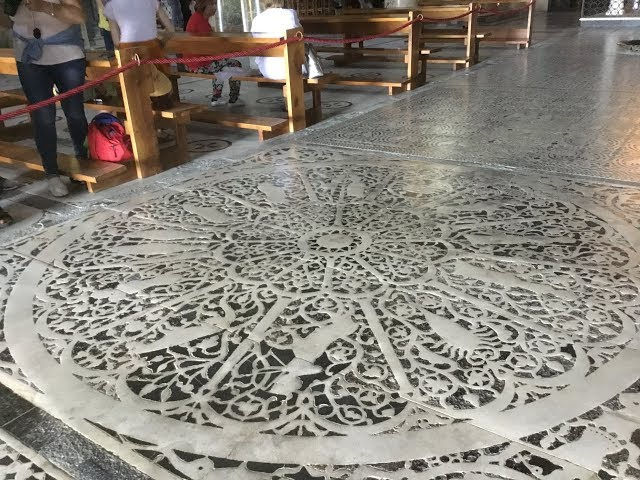
One only has to look at medieval manuscripts, cathedral floors, or liturgical calendars to see the zodiac embedded into Christian culture. The signs were associated with months, agricultural cycles, even aspects of the human body in medical astrology. This was often justified as harmless or “natural,” part of understanding God’s creation. But that raises a serious question: at what point does observing creation become interpreting it as a coded system of influence?
Campanella clearly crosses that line. He does not treat the zodiac as symbolic decoration or seasonal markers. He treats it as a structured system of meaning tied to human life, behavior, and historical change. He builds on older traditions, Ptolemaic, Arabic, and medieval—and brings them into a theological framework. He argues that the signs and planetary configurations are not merely descriptive but indicative, even directive in certain contexts.
Yet the Church had long maintained, at least in principle, that deterministic astrology was incompatible with Christian teaching. The Catechism much later would echo this clearly, stating that all forms of divination, including astrology, are to be rejected because they contradict the honor, respect, and loving fear owed to God alone. Even earlier, figures like Augustine sharply criticized astrology for undermining moral responsibility and for claiming knowledge that belongs to God.
And yet, despite those condemnations, a softer version persisted. The distinction between “natural astrology” and “judicial astrology” became a kind of theological loophole. Natural astrology—concerning weather, seasons, bodily humors—was tolerated. Judicial astrology; predicting human events and destinies, was condemned. But in practice, the boundary between the two was never stable.
Campanella’s work exposes how easily that boundary collapses.
If the stars influence the body, and the body influences the passions, and the passions incline behavior, then astrology has effectively re-entered the domain of human action. Even if the will remains technically free, the system still encourages reading celestial patterns as meaningful guides. It becomes a way of interpreting life through the heavens.
So the question presses harder.
If Scripture warns against seeking knowledge from the signs of heaven, why preserve a system built around those very signs? If the Magi followed a star by divine revelation, does that justify constructing an entire interpretive framework to read all stars? If God uses creation as a sign, does that give humanity permission to systematize those signs into predictive tools?
Or is that precisely the step Scripture warns against?
There is also a deeper tension in how the zodiac itself is treated. In Christian theology, time is ultimately ordered not by celestial cycles but by God’s redemptive acts, creation, covenant, incarnation, resurrection. The liturgical year reflects this. And yet the zodiac represents a different structuring of time, one rooted in cyclical celestial movement rather than divine history.
Why then was it allowed to sit alongside Christian timekeeping?
Was it simply a practical tool for marking seasons? Or did it carry with it a quiet assumption—that the heavens themselves encode patterns that can be read for meaning beyond what God has explicitly revealed?
Campanella seems to assume the latter.
He insists that astrology, properly understood, does not compete with God but operates under Him. He presents it as a way of reading secondary causes, of understanding how divine providence unfolds through nature. But this raises a critical problem. Christianity does affirm secondary causes, but it does not authorize their interpretation as a system of hidden knowledge about future events or human affairs.
The distinction matters.
Observing that the sun affects seasons is not the same as inferring that planetary configurations indicate political upheaval or personal destiny. Recognizing natural rhythms is not the same as constructing a symbolic language of the heavens.
So again the question must be asked.
Where exactly did the line move?
At what point did a forbidden practice become a tolerated science? Was it through philosophical refinement, through appeals to authorities like Aquinas, through the prestige of ancient learning? Or was it simply that the cultural inheritance of Greco-Roman cosmology proved too deeply embedded to fully remove?
And if that is the case, then what Campanella represents is not an anomaly, but a culmination.
He takes what had been partially accepted and makes it explicit. He draws out the implications that were already present. He shows how a system can be built that appears to honor God, preserve freedom, and remain within theological bounds, while still functioning in a way that Scripture repeatedly cautions against.
That is what makes his work so revealing.
It forces the question that cannot be avoided.
If something must be so carefully redefined, qualified, and defended in order to fit within Christianity, is it truly compatible with it? Or is it being reshaped just enough to remain, while its core function quietly persists?
And if the latter is true, then the issue is no longer historical curiosity.
It becomes a question of discernment.
Not only about Campanella, but about the boundaries between observing creation, interpreting it, and ultimately trusting it in ways that may displace what Scripture reserves for God alone.
What emerges from Campanella is not a harmless philosophical exercise, nor a neutral inquiry into nature, but a deliberate and systematic attempt to rehabilitate a condemned practice by clothing it in theological language and embedding it within the intellectual life of the Church. This is not accidental. It is not naïve. It is strategic. Campanella was not an outsider throwing stones at Christianity; he was a Dominican friar, formed within the structures of the Roman Catholic Church, operating under its authority, appealing to its greatest theologians, and writing in a way that assumes his work can be read, discussed, and transmitted within that very institution. That alone should arrest attention. He is not opposing the Church. He is speaking from within it. And yet what he constructs is a system that Scripture repeatedly warns against in the strongest possible terms.
He begins by establishing a foundation that appears unassailable: God is the first cause of all things. Everything proceeds from divine providence. Nothing escapes His governance. This is orthodox language, and it is used with precision. But immediately beneath this foundation, Campanella introduces a second layer, one that quietly shifts the ground. The stars (angels, according to scripture) he says, are true causes of changes in the world below. Not merely signs. Not merely markers. Causes. He carefully qualifies this by saying they do not compel the rational will, only dispose the body and its passions. This distinction is drawn from scholastic theology, particularly from the interpretation of St. Thomas Aquinas. But what is being done with that distinction is far more expansive than Thomas ever intended. If the body is disposed, and the passions are stirred, and the passions incline the will, then the stars have effectively entered the sphere of human action. The door is opened, and Campanella walks through it without hesitation.
From there, he builds an entire architecture. The heavens are divided, measured, structured. The zodiac is not treated as a poetic or symbolic framework but as a real system of division corresponding to earthly effects. The sky is partitioned into houses, quarters, angles, each with distinct qualities—hot, cold, moist, dry, masculine, feminine—each corresponding to stages of life, regions of the world, dispositions of people. The planets are assigned dignities, powers, thrones, exaltations, depressions. They are said to rejoice, to suffer, to gain strength, to lose it. Their positions are not neutral; they are charged with meaning. Their relationships—conjunctions, oppositions, trines, squares—are not merely geometrical; they are causal configurations that produce measurable effects in the world below. Campanella does not hesitate to say that from these configurations one may judge changes in the air, the sea, the earth, the abundance or scarcity of goods, the rise and fall of monarchies, the transfer of laws, the transformation of religions, and the fortunes of individual lives. This is not observation. This is interpretation. It is a system of reading the future from the heavens.
And yet he insists this is not forbidden. He explicitly addresses the objection that Scripture condemns such practices. He does not deny the biblical texts. Instead, he reinterprets them.
When Jeremiah says, “Learn not the way of the heathen, and be not dismayed at the signs of heaven,” Campanella argues that this refers only to superstitious or idolatrous misuse, not to the true philosophical understanding of celestial influence. When Isaiah mocks the astrologers and stargazers, Campanella again limits the scope of the condemnation, suggesting that false practitioners are in view, not the refined science he proposes. He appeals to examples such as the star of the Magi, as if a singular divine act of revelation authorizes a permanent human system of celestial interpretation. But this is a profound inversion. The Magi did not construct a system and then discover Christ. God intervened and used a sign for His own purpose. Scripture never presents that event as a model to be replicated. It presents it as an exception that points beyond itself.
The force of the biblical prohibitions cannot be so easily dissolved. They are not framed as technical corrections. They are framed as boundaries. “There shall not be found among you… a diviner of times… or an observer of times” (Deuteronomy 18:10). The language is comprehensive. It does not distinguish between crude and refined forms. It does not say “avoid the ignorant versions.” It forbids the practice as it existed among the nations, and that practice was precisely the attempt to read the heavens as a source of knowledge about human affairs. Isaiah does not rebuke astrologers because they are unskilled. He declares them powerless and destined for judgment. Jeremiah does not caution against misinterpretation. He commands separation from the entire way of the nations. These are not adjustments. They are rejections.
Campanella’s response is not to confront this directly, but to relocate astrology into a different category. He calls it natural. He calls it philosophical. He embeds it within a framework of causation that appears rational and ordered. But the substance remains. He still teaches that eclipses, comets, and planetary alignments signify events. He still teaches that the positions of the heavens at a given moment can be used to understand what will follow. He still teaches that one may judge the beginnings and outcomes of human actions by consulting celestial configurations. This is not a minor overlap with what Scripture forbids. It is the very thing described, refined and systematized.
The same expansion appears in his treatment of nations and peoples. He adopts and extends the idea that different regions are governed by different planetary influences. Entire cultures are described as Jovial, Martial, Saturnine, Venereal. The Jews are described in terms of Saturnine disposition. Europeans, Africans, Asians are categorized according to celestial patterns. Climate, character, law, and religion are all tied to the stars. This is not merely descriptive geography. It is a cosmological anthropology in which human identity is read through the heavens. But Scripture does not ground human difference in planetary influence. It grounds it in creation and in the moral history of humanity. “God hath made of one blood all nations of men.” The reduction of peoples to celestial types introduces a competing explanation of human nature, one that subtly shifts responsibility from moral and spiritual causes to cosmic ones.
This raises a question that cannot be avoided. If a system must be so carefully qualified, so heavily defended, so intricately aligned with accepted authorities in order to remain within the Church, what does that say about its true status? Why does it require such sustained justification? Why must it constantly insist that it does not contradict Scripture, that it does not undermine free will, that it does not engage in forbidden practices? The repetition itself is revealing. It suggests an awareness of the tension that cannot be fully resolved.
The deeper issue is not whether the heavens have order or influence. Scripture affirms that they do. The issue is whether that order is given to humanity as a readable code for predicting and interpreting the course of human life. Campanella answers yes, cautiously but clearly. Scripture answers no, consistently and emphatically. “The secret things belong unto the Lord our God: but those things which are revealed belong unto us.” The attempt to access what has not been revealed, even through a system that appears natural and rational, crosses a boundary that Scripture establishes for a reason.
And so the contradiction stands. A Dominican friar, drawing on the authority of the Church, constructs a comprehensive system for reading the heavens as a guide to earthly events, insists that it is compatible with Christian doctrine, and expects it to be received within the intellectual life of Christianity. At the same time, the biblical witness repeatedly warns against precisely this kind of practice, not in its crude forms only, but in its essence. The question is no longer whether Campanella can be defended. The question is how such a system could be allowed to take root, to be taught, to be transmitted, and to persist under the name of a faith that explicitly warns against it.
For those interested in Campanella’s work, I have translated roughly a third of it from Latin into English, as no known translations currently exist. I have also included the original text for reference.


Comments