When Men Defined What Christ Did Not
- Michelle Hayman

- Apr 18
- 28 min read
Any real understanding of the Eucharist has to begin with one place: its institution by Christ Himself. But to grasp what happened there, three things must be kept in view. First, who Christ is—fully God and fully man—so that His words and actions carry divine reality, not just symbolism. Second, the world He stepped into, where the idea of communion with God through a sacred meal was already deeply rooted in both Jewish worship and wider religious practice. And third, the fact that in the New Testament, the Eucharist appears as something already woven into the ordinary life of the Church, assumed, practiced, and central from the beginning.
At its origin, then, the Eucharist is not an idol to be observed or worshipped, but an act to be entered into, a living participation in the union between God and man made possible in Christ.

In the New Testament, the Eucharist is not presented as something rare or occasional, but as a normal and integrated part of early Christian life. Paul speaks of it as something instituted by Christ and already established within the Church (1 Corinthians 11:23–26), addressing not its introduction but abuses in its regular practice.
In Acts, “the breaking of bread” is closely tied to the daily life of believers. They are described as continuing together with one accord, and breaking bread from house to house (Acts 2:42, 46), suggesting a frequent, even daily sharing within the community. This language reflects something habitual rather than occasional.
At the same time, there are also indications of more structured gatherings, such as the meeting at Troas on the first day of the week (Acts 20:7), showing that alongside daily fellowship, certain patterns of assembly were beginning to emerge, likely shaped by practical circumstances, including Roman oppression
The New Testament gives us four accounts of how the Eucharist was first instituted, one from Paul and three from the Gospels (Mark, Matthew, and Luke). Although they are written at different times and with slight differences in wording, they all describe the same essential event: Jesus sharing a meal with His disciples on the night before His death.
In each account, Jesus takes bread, gives thanks, breaks it, and gives it to His disciples, saying that it is His body. Then He takes a cup of wine, gives thanks, and tells them it is His blood, connected to a new covenant. He also tells them to continue doing this in remembrance of Him.
Even though the details vary slightly, some emphasize remembrance, others forgiveness, others the covenant, the core actions and meaning remain the same. Together, these accounts show a consistent pattern: the Eucharist begins as a shared meal in which Jesus identifies the bread and wine with Himself and commands His followers to continue the practice.
Paul discusses the Eucharist in the context of real-life issues within the early Church, including the problem of food sacrificed to idols. Rather than treating this as a separate matter, he uses it to explain what the Eucharist is. When Christians bless the cup and break the bread, they are participating in the blood and body of Christ. In the same way, those who eat from pagan sacrifices are understood to share in what those sacrifices represent.
Because of this, Paul insists that these two forms of participation cannot be mixed. One cannot partake of the Lord’s table and at the same time share in another. This shows that the Eucharist is not treated as a mere symbol, but as a real participation in Christ Himself. It is also presented as the basis of unity, since all who share in the one bread become one body.
In another passage, Paul addresses disorder in the communal meals and again refers back to the institution of the Eucharist. He warns that receiving it in an unworthy manner makes a person accountable for the body and blood of the Lord. To receive without properly recognizing what is taking place is to bring judgment upon oneself. This reinforces the idea that the Eucharist involves a real participation, not something empty or merely symbolic.
Paul also describes the act of eating and drinking as a proclamation of the Lord’s death. While this includes remembrance within the community, the language suggests something more than simple recall. It points toward a presentation of Christ’s death in connection with the act itself.
Paul’s teaching on the Eucharist appears in the middle of a very real issue in the early Church: believers were already encountering, and in some cases eating, food that had been sacrificed to idols.
Instead of treating that as a separate problem, Paul uses it to explain what the Eucharist actually is. He tells them to flee from idolatry, and then draws a direct comparison. When Christians bless the cup and break the bread, are they not sharing in the blood and body of Christ? And if that is true, what does it mean to eat from pagan sacrifices? Does that not also involve a kind of sharing—participation in what stands behind those offerings?
Paul’s logic is clear and unavoidable: participation in a sacrificial meal creates a real connection. Israel itself, he says, shared in the altar by eating the sacrifices. So if that is true in Israel, and true among the nations, then the Eucharist must also be understood in the same category. It is not an empty sign, it is fellowship, a real participation in Christ.
This raises a sharp boundary. If participation is real, then it cannot be divided. You cannot share in the Lord’s table and also share in another. You cannot drink from both. The act itself binds you to what it represents.
Paul then turns to another issue, disorder in the communal gatherings—but the same understanding remains. He reminds them of the institution of the Eucharist and warns that receiving it carelessly is not a small matter. To eat and drink “unworthily” is to become accountable for the body and blood of the Lord. To receive without discerning what is taking place is to bring judgment.
So again, the weight of the act forces the question:
What exactly are they receiving, if mishandling it carries this kind of consequence?
Why would this be dangerous, if it were only symbolic?
Paul also says that in eating and drinking, believers “proclaim the Lord’s death.” This is more than private remembrance. It is a public act, a declaration.
Paul places all of this within a larger reality. The Eucharist is not isolated. Believers are made one body in Christ, and this unity is expressed and sustained through participation in Him. What happens in the Eucharist is tied directly to what they are.
And beyond that, Paul describes the whole Christian life in sacrificial terms. Believers offer themselves, their lives, their actions, as offerings to God. In that context, the Eucharist stands at the center, not as a detached ritual, but as part of a living pattern of participation, unity, and sacrifice.
This becomes even clearer when we come to the discourse at Capernaum. After feeding the five thousand, Jesus shifts the focus away from ordinary bread and begins speaking about “the bread of life.” The miracle itself is not the end, it points beyond itself. Just as the manna in the wilderness sustained Israel only temporarily, so now Christ presents Himself as the true bread that gives eternal life.
It is in this context that He speaks the difficult words about eating His flesh and drinking His blood. But the reaction of His hearers is revealing. They immediately interpret Him in a physical sense—“How can this man give us his flesh to eat?”—and stumble over it. Yet this kind of misunderstanding is a familiar pattern. Again and again, people take Christ’s words in a purely literal, earthly way, and miss the deeper meaning He is pointing toward.
What follows is crucial. Instead of confirming a crude, physical interpretation, Jesus redirects them: “The Spirit is the life-giver; the flesh profiteth nothing: the words that I have spoken unto you are spirit, and are life.” The emphasis shifts away from material flesh as such and toward the life-giving work of the Spirit. His words are not empty, but neither are they to be reduced to a merely physical act.
At the same time, the language remains strong because the reality it points to is real. To eat His flesh and drink His blood is to receive Him fully—to share in His life in such a way that He abides in the believer and the believer in Him. This is not the language of mere symbolism, but neither is it the language of physical consumption. It is the language of participation, of union, of life given and received.
Seen in this light, the discourse does not teach a literal eating of Christ’s physical flesh and blood in a crude sense. Rather, it describes a real and necessary participation in Him, a sharing in the life made possible through His death and resurrection, and brought about by the Spirit.
The Early Church (Ante-Nicene Fathers)
When we move from the New Testament into the writings of the early Church, we find clear continuity, but also the beginnings of "development". The Eucharist remains central, and it is still understood as something real, not merely symbolic. Writers such as Ignatius of Antioch speak of it in very strong terms, identifying it with the flesh of Christ, especially in opposition to those who denied that Christ truly came in the flesh. Justin Martyr likewise describes the Eucharist as more than ordinary food, presenting it as the means by which believers receive Christ. Irenaeus connects it to the broader work of redemption, showing how it unites the material and the spiritual in the life of the believer.
Yet despite this strong language, the Eucharist is still firmly rooted in the act of eating and drinking within the community. It remains a shared meal, something received rather than observed. The realism of the language does not lead to separation from the act itself. There is no suggestion at this stage that the Eucharist exists as an object apart from its use, nor that it is to be approached through acts of adoration outside of participation.
At the same time, the idea of sacrifice becomes more clearly expressed. The Eucharist is increasingly described in sacrificial terms, often in connection with Old Testament imagery such as the “pure offering” spoken of by the prophet Malachi. However, this is not presented as a new or independent sacrifice, but as something bound up with Christ’s own sacrifice and the offering of the Church (called out assembly) in union with Him.
The language used by the Fathers reflects a careful balance. The Eucharist is spoken of as the body and blood of Christ, but it is also described as a figure, symbol, or type. These terms are not treated as contradictory. Rather, they attempt to express a reality that is both true and mysterious, without collapsing it into either mere symbolism or a crude physical interpretation.
There is also a growing emphasis on order and reverence. The Eucharist is associated with consecration through prayer, and with proper preparation on the part of those who receive it. Access becomes more clearly defined, limited to those within the Church and living rightly. Yet even here, the focus remains on reception. The Eucharist is something to be partaken of, not something to be set before the eyes for contemplation.
What is most significant is what has not yet appeared. There is no practice of elevating the elements for viewing, no reservation of them for devotion, and no development of a culture in which the Eucharist is treated as an object of adoration (an idol). The emphasis remains on participation, communion, and shared life.
In this period, then, the language surrounding the Eucharist becomes richer and more defined, but its essential character remains unchanged. It is still something believers enter into, not something they stand before.
The Period of the Great Councils
In the period of the great councils, the Church begins to speak about the Eucharist with greater precision. This is not yet the fully developed doctrine of later centuries, but there is a noticeable shift in emphasis. What had previously been expressed in a more fluid and devotional way now begins to be examined, clarified, and in some cases defined more carefully.
The Eucharist continues to be described in a variety of ways. It is still called a figure or symbol, yet at the same time it is spoken of as truly being the body and blood of Christ. These two strands of language remain side by side, but there is a growing tendency to stress the reality of the gift more strongly. The elements are no longer spoken of simply in relation to the act of receiving; attention begins to turn toward what they are in themselves after consecration.
This leads to increased reflection on the effect of consecration. The bread and wine are understood to be changed in some sense, though the manner of this change is not clearly defined. Some writers emphasize that the bread and wine remain what they are outwardly, while others stress that they have become the body and blood of Christ in a deeper, spiritual reality. The lack of a single explanation shows that the Church is still grappling with how to speak about the mystery.
Alongside this, there is a continued insistence that the presence of Christ in the Eucharist is spiritual rather than material in a crude sense. The body of Christ present in the Eucharist is not separated from His risen and glorified life. It is not a return to a merely physical condition, but participation in the living Christ as He now is. This preserves a connection with the earlier understanding of the Eucharist as something entered into, rather than something handled as a physical object.
At the same time, however, new elements begin to appear. There are early references to reverence shown toward the Eucharist that go beyond the act of receiving it. While still not widespread or fully developed, these hints suggest the beginnings of a shift in how the consecrated elements are regarded. The Eucharist is starting, in some contexts, to be treated as something that possesses a kind of standing presence.
The sacrificial aspect also becomes more fully articulated. The Eucharist is increasingly connected not only with the death of Christ but also with His risen and ascended life. It is understood as the offering of the Church in union with Christ, reaching its culmination in communion. Yet even here, the act of participation remains central; the sacrifice is not complete apart from the sharing in it.
What emerges in this period is a tension that had not been present before. On the one hand, the Eucharist is still fundamentally a participatory act, rooted in communion with Christ. On the other hand, the beginnings of a more object-centered way of thinking can be seen, as attention shifts toward the nature of the elements themselves and the change that takes place in them.
The development is not yet complete, and the earlier understanding has not been abandoned. But the direction of movement is becoming clearer. The Eucharist is beginning to be thought of not only as something believers partake in, but also as something that, in some sense, exists independently of that participation.
Questions
When does the focus begin to move from participation to the nature of the elements themselves?
How does the introduction of “change” in the bread and wine affect how the Eucharist is understood?
Why does increased emphasis on what the elements “are” risk separating them from the act of eating and drinking?
How does defining the Eucharist more precisely begin to move it away from mystery and toward objectification?
What is the significance of early references to reverence toward the elements outside of communion?
Eastern Theology
When we turn to the Eastern Church, a different pattern emerges. While there is development over time, it does not follow the same direction as the West. The Eucharist continues to be spoken of in strong terms, and the reality of Christ’s presence is never denied, yet the approach remains deeply rooted in mystery rather than definition.
Eastern writers freely affirm that the bread and wine become the body and blood of Christ, but they do not attempt to explain how this happens in a precise or philosophical way. The change is acknowledged, but it is left as something belonging to the divine mystery. There is no sustained effort to analyze the nature of the elements or to define the manner of Christ’s presence in technical terms. Instead, the emphasis remains on what the Eucharist does, how it unites believers to Christ and brings them into participation in His life.
This sense of participation continues to shape the Eastern understanding. The Eucharist is seen as a means by which believers are brought into communion not only with Christ, but with the heavenly reality itself. In the liturgy, earthly worship is understood to be joined with the worship of heaven. The focus is not on isolating the elements, but on entering into the divine life through them.
The sacrificial language also remains, but it is consistently connected to Christ’s one sacrifice and His ongoing heavenly life. The Eucharist is not treated as a separate or repeated sacrifice in isolation, but as the Church’s participation in what Christ has already accomplished and continues to make present. The emphasis falls on union rather than repetition.
At the same time, there is a clear sense of reverence and holiness surrounding the Eucharist. The elements are treated with great care and respect, and the liturgy itself is marked by solemnity. However, this reverence does not develop into a distinct practice of adoration directed toward the elements outside of their use. The Eucharist is not removed from the act of communion and turned into an object of independent devotion.
Across the centuries, from early Byzantine writers through later councils and confessions, this pattern remains consistent. Even when stronger language of change is adopted in response to external influences or controversies, the Eastern Church resists defining that change in a rigid or philosophical manner. The mystery is preserved, and the focus remains on participation in the life of Christ.
What becomes clear in comparison with the West is that the shift seen earlier does not fully take hold here. While the Eucharist is deeply revered and strongly affirmed as the body and blood of Christ, it is not separated from the act of receiving it. It remains something into which the believer enters, not something set apart for contemplation.
Western Theology (6th–10th Centuries)
In the early medieval West, the direction that began in the previous period becomes more noticeable. The Eucharist is still treated with reverence and remains central to Christian life, but the way it is spoken about begins to shift more clearly toward defining what it is, rather than simply participating in it.
Writers of this period continue to affirm that the Eucharist is the body and blood of Christ, and the language of sacrifice remains firmly in place. The liturgy reflects this, and the connection with Christ’s offering is still understood as something the Church shares in rather than repeats independently. Yet alongside this continuity, there is an increasing concern to explain how the bread and wine relate to the body and blood of Christ.
This concern becomes especially clear in the debates of the ninth century. Paschasius Radbertus argues strongly that after consecration the bread and wine are truly and literally the body and blood of Christ in the fullest sense. In contrast, Ratramnus maintains that while the Eucharist is indeed the body and blood of Christ, it is so in a spiritual and mystical way rather than in a direct physical sense. Both agree that Christ is truly given, but they differ in how that reality is to be understood.
What is significant is not simply the disagreement, but the fact that the question is now being asked in this form at all. The focus is no longer only on participation in Christ through the Eucharist, but on determining what exactly the elements become. The Eucharist begins to be treated as something that can be analyzed and defined in itself.
At the same time, the act of reception remains important, and there is no full development yet of practices that separate the Eucharist from communion. However, the groundwork is being laid for such a separation. As attention shifts more and more toward the nature of the elements, the possibility emerges of treating them as possessing a presence that exists independently of their being eaten and drunk.
The language of reverence also continues to grow. The Eucharist is increasingly regarded with awe, and its holiness is emphasized more strongly. While this still exists within the context of the liturgy, it begins to prepare the way for later "developments" in which the elements themselves become the focus of devotion.
This marks an important stage in the overall development. The shift is not yet complete, but the direction is becoming clear: the Eucharist is gradually moving from being something entered into toward something increasingly considered in itself, an idol.
“Woe unto them that are wise in their own eyes, and prudent in their own sight.”
— Book of Isaiah 5:21
Western Theology (11th–12th Centuries)
By the eleventh and twelfth centuries, the earlier movement in Western theology reaches a decisive stage. What had begun as a growing interest in defining the Eucharist now becomes a central theological concern, and the question of what the elements are in themselves moves to the forefront.
This is seen most clearly in the controversy surrounding Berengar of Tours. Berengar resisted the idea that the bread and wine are changed into the physical body and blood of Christ in a literal sense. In response, figures such as Lanfranc strongly defended the position that a real and objective change takes place. The debate forces the Church to speak more precisely than before, and in doing so it shifts the focus further away from participation and toward definition.
As a result, the language used becomes increasingly explicit. The Eucharist is no longer simply affirmed as the body and blood of Christ in a mysterious or spiritual sense, but is now described in terms that suggest a real transformation of the elements themselves. The idea that the bread and wine remain outwardly the same while inwardly becoming something else begins to take shape more clearly.
Theologians of this period continue to emphasize that Christ is truly present, but they now seek to explain how this can be so. This leads to the use of more technical distinctions, particularly as philosophical categories begin to be applied. The mystery is no longer allowed to remain as it is; it is analyzed, defined, and arranged. In this, the pride of man is revealed—preferring the confidence of his own understanding over what was simply given.
At the same time, the sacrificial understanding of the Eucharist is further developed. It is increasingly described as an offering made by the Church, closely connected to the sacrifice of Christ. While still linked to His one sacrifice, the language begins to suggest a more distinct action taking place within the rite itself. The Eucharist is no longer only participation in a sacrifice, but is spoken of in ways that make it appear as a sacrificial act in its own right.
Alongside these developments, the role of the priest becomes more sharply defined. The Eucharist is increasingly seen as something performed by the priest on behalf of the people, rather than as a shared act of the whole community. This contributes further to the separation between the act and the participants, and prepares the way for later practices in which the people become observers rather than active participants.
Although the Eucharist is still received, the emphasis is no longer primarily on communion. The act of consecration begins to take precedence over the act of eating and drinking. What happens at the altar becomes more important than what is received by the faithful.
In this period, then, the shift becomes unmistakable. The Eucharist is being redefined in terms of what it is, how it changes, and how it is offered. The earlier understanding of it as a participatory sharing in Christ is still present, but it is no longer central. Instead, the Eucharist is increasingly treated as an idol of theological definition and priestly action.
The act that had once been a shared meal of participation begins to take on the character of a performed action, something carried out with intention, form, and effect. The words of Christ, originally spoken within the simplicity of a meal, begin to be treated as a formula whose correct use brings about a change in the elements themselves. Attention shifts from the act of eating and drinking to the moment of consecration, and from the community’s participation to the action performed by the priest.
When read alongside later thinkers such as Marsilio Ficino and Tommaso Campanella, (see last post) this development becomes even more striking. In their thought, words, gestures, and intention are understood to have real power to effect change, to draw down spiritual realities into material forms. This way of thinking helps to illuminate what is happening in the theology of the Eucharist: the consecration is no longer simply a thanksgiving within a meal, but begins to resemble a kind of enacted formula, where specific words and actions are believed to bring about a transformation.
Yet when one returns to the Gospel accounts, this framework is not present. Christ does not institute a ritual in the sense of a precise, repeatable operation designed to effect a change in bread and wine as objects in themselves. He gives bread and wine within a meal, speaks of them in relation to His impending death, and commands His disciples to do this in remembrance of Him. The emphasis falls on the act as a whole, taking, giving, eating, and drinking, within a relationship of remembrance and participation. There is no indication that the power lies in the exact repetition of words, nor that a transformation occurs independently of the act of receiving.
As the centuries progress, however, the center of gravity shifts. What Christ gave as something to be shared becomes something to be enacted. The consecration begins to be treated as an action that produces a result, even apart from the communion of the faithful. In this way, the Eucharist moves closer to being understood not simply as a means of union with Christ, but as something brought into being through a ritual act.
Western Theology (13th Century)
By the thirteenth century, the development that had been building in the West reaches its most defined and structured form. What was previously debated is now formalized, and the Eucharist is no longer only described in terms of participation, but is fully articulated in terms of what it is in itself and how it comes to be so.
The teaching of figures such as Thomas Aquinas gives this development its clearest expression. The change in the bread and wine is now explained philosophically: the substance is said to become the body and blood of Christ, while the outward appearances remain. This provides a precise explanation of what earlier centuries had left as mystery. The Eucharist is now something whose inner reality is defined independently of its reception.
At the same time, the moment of consecration becomes the decisive point. The words spoken by the priest are no longer simply part of a thanksgiving within a meal, but are understood as effecting the change itself. The focus shifts almost entirely to what happens at that moment. What Christ gave within a shared act is now treated as something brought about through a specific form of words and action.
This is also the period in which new practices emerge that make this shift visible. The elevation of the host after consecration becomes common, allowing the people to see and adore what has been consecrated. The feast of Corpus Christi is established, further centering devotion on the consecrated elements themselves. The Eucharist is increasingly reserved, displayed, and venerated outside of communion.
In this setting, the act of participation begins to recede. Communion by the people becomes less frequent, while the act performed by the priest becomes central. The Eucharist is no longer primarily something shared, but something presented. The presence of Christ is treated as something that remains in the elements and can be approached apart from eating and drinking.
The combination of defined change, effective words, and ritual action brings the Eucharist very close to being understood as something produced through a controlled and repeatable act. The priest, using the correct form and intention, performs an action that is believed to bring about the presence of Christ in the elements.
When this is placed alongside the broader intellectual currents that later thinkers such as Marsilio Ficino and Tommaso Campanella articulate more explicitly, the resemblance becomes difficult to ignore. The idea that spiritual reality can be made present in material form through words, intention, and ritual structure aligns with patterns found in theurgical thought. Whether or not this is consciously intended, the structure has shifted in that direction.
Yet this stands in contrast with the Gospel accounts. Christ does not present His words as a formula to be repeated in order to effect a change in matter. He does not isolate a moment within the meal as the point at which something is brought into being. Instead, He gives bread and wine within a relational act of remembrance, directing His disciples toward participation in His life and death.
By the thirteenth century, however, the emphasis has moved decisively. The Eucharist is now something that can be brought about, defined, and even displayed. The act of consecration takes on a character that is no longer simply participatory, but operative. What was once inseparable from the act of eating has become something that exists prior to and apart from it.
This marks the point at which the Eucharist has effectively become an object of devotion. It is no longer only the means by which believers enter into union with Christ, but something that can be approached, revered, and contemplated in itself.
Questions:
If Christ intended the Eucharist to be effected by a precise ritual formula, why do the Gospel accounts present it simply as a shared act of eating and drinking without prescribing a fixed operative method?
At what point does the shift occur from participation in Christ through eating to the belief that spoken words over the elements themselves cause a transformation independent of reception?
If the power of the Eucharist lies in consecration rather than communion, does this not imply that the act functions as an operation performed on matter rather than a relational participation in Christ?
How does the idea that specific words and priestly intention bring about Christ’s presence differ in structure from theurgical concepts where spiritual realities are invoked into material forms?
If the consecrated elements are treated as containing a presence that remains apart from their use, what prevents this from becoming devotion to an object rather than participation in a living relationship?
Western Theology (14th–15th Centuries)
By the fourteenth and fifteenth centuries, the development that had reached its full form in the previous period begins to show both consolidation and reaction. On the one hand, the established understanding of the Eucharist as something effected through consecration and existing in itself is firmly maintained. On the other hand, voices begin to emerge that question or resist aspects of this "development".
The dominant view continues to affirm that a real change takes place in the elements through the words and action of the priest. The Eucharist is treated as something that, once consecrated, possesses an enduring presence. This is reflected not only in theological writings but also in devotional life. The consecrated host is elevated, reserved, and adored. Processions and feasts further reinforce its role as an object of devotion. The center of gravity has now clearly moved away from participation toward presence as something to be approached and contemplated. The bread has been made into an idol.
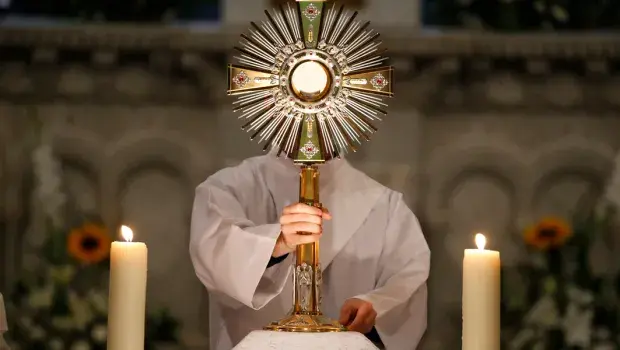
Communion among the laity becomes increasingly infrequent, sometimes reduced to rare occasions. The focus of the liturgy rests primarily on what the priest does at the altar, while the people take on a more passive role. The Eucharist is no longer experienced primarily as something shared, but as something witnessed.
Yet within this context, challenges begin to arise. Figures such as John Wycliffe question the prevailing explanations of the Eucharist, particularly the idea of a complete change in the substance of the elements. Others, including Jan Hus, raise concerns about the separation between clergy and laity and advocate for a return to more frequent communion. These movements do not fully dismantle the established doctrine, but they expose tensions within it.
What becomes increasingly clear is that the Eucharist is now understood within a framework where specific words, intention, and ritual action are believed to bring about a change in the elements, and where that change results in a presence that can be approached independently of participation. The structure is no longer simply that of a shared act of remembrance and union, but of an operation that produces a result.
What began as a meal in which believers shared in Christ has become something that can be enacted, preserved, and venerated (worshipped). The role of the priest, the importance of the words spoken, and the treatment of the elements themselves all point toward a system in which spiritual reality is understood to be made present in material form through ritual means. Campanella described it as “natural magic”.
At the same time, the emergence of dissenting voices shows that this development was not without question. The tension between participation and objectification becomes more visible, and the groundwork is laid for the more explicit challenges that will follow in the Reformation.
The Reformation Period
By the sixteenth century, the medieval understanding of the Eucharist is no longer simply assumed; it is directly confronted. What had developed over centuries, especially the idea of a change effected through consecration and the treatment of the Eucharist as an object of devotion—is now questioned at its foundations. At the same time, it is also formally defined and defended.
On the Roman side, this doctrine reaches its most fixed expression. Under Pope Leo X and later more decisively at the Council of Trent under Pope Paul III, the Church affirms that the bread and wine are changed in substance into the body and blood of Christ. This change is declared to occur through the words of consecration spoken by the priest. The Eucharist is upheld as a true sacrifice, and the practices that had developed, adoration, reservation, and elevation, are not only preserved but confirmed. What had gradually taken shape is now no longer developing; it is fixed.
Yet this consolidation does not occur in isolation. It takes place within the intellectual and cultural world shaped by the Renaissance. The same period that sees doctrine formally defined is directly connected to the legacy of Cosimo de' Medici and his successors, whose patronage helped revive ancient Hermetic and Neoplatonic thought. Through the work of Marsilio Ficino, texts attributed to Hermes Trismegistus were translated and circulated, promoting a worldview in which the material and spiritual realms were deeply interconnected.
As shown by Frances Yates, this revival was not merely philosophical. It carried with it the idea, often described as a form of natural magic, that spiritual or divine powers could be drawn down into material forms through the correct use of words, symbols, and ritual action. The cosmos was understood as ordered in such a way that, through knowledge and intention, higher realities could be made present within lower ones.
This intellectual current intersects directly with the Church at its highest levels. The Medici family (bankers), which funded and promoted this revival, also produced popes, including Leo X, placing this way of thinking within the very environment in which Eucharistic doctrine was being defined and defended. The overlap is not merely historical, but conceptual. The Eucharist, as it had come to be understood, now involved a precise form of words spoken by an authorized figure, bringing about a real change in material elements and resulting in a presence that could be approached, preserved, and adored.
Set alongside this framework, the structural similarity is difficult to ignore. In both cases, there is an operative act in which spiritual reality is made present through form, word, and intention. What had originally been given by Christ as a shared act of remembrance and participation, taking, eating, and drinking, has, by this stage, taken on the character of something effected. The emphasis has shifted from entering into communion with Christ to the bringing about of His presence within the elements.
It is precisely this shift that the Reformers, in different ways, begin to challenge. Martin Luther rejects the idea of the Mass as a sacrifice offered by the priest and opposes the philosophical framework of transubstantiation, yet still affirms a real presence tied to reception. Huldrych Zwingli goes further, emphasizing the Eucharist as a memorial and denying any real transformation of the elements. John Calvin maintains a middle position, affirming a real participation in Christ, but locating it in the work of the Spirit rather than in a change of substance. In England, Thomas Cranmer similarly rejects both transubstantiation and the sacrificial character of the Mass, returning the emphasis to communion, remembrance, and participation.
What is striking in this period is that the central issue is no longer simply how to describe the Eucharist, but what it fundamentally is. Is it something effected by ritual action and existing in itself, or is it something that takes place in the act of participation by faith? The Roman position maintains that through the correct words, intention, and priestly action, a real change is brought about in the elements, and that Christ’s presence remains in them independently of their reception. The Reformers, in different ways, resist this, seeking to reconnect the Eucharist with participation rather than with a transformation of matter through ritual.
The result is a decisive reorientation. What begins in the Gospels as a participatory meal grounded in relationship is, over time, reframed within a system that bears the marks of operative ritual. In that shift, Christianity is drawn, subtly but significantly, into a pattern that resembles the logic of natural magic: not simply receiving what is given, but effecting what is to be made present.
Questions:
Where did Christ ever give permission for His simple act of thanksgiving—taking bread, giving thanks, and sharing it—to be transformed into a ritual system shaped by later philosophical traditions?
If all believers are made priests in Christ, on what authority does a separate priesthood arise claiming exclusive power to effect a change in bread and wine through specific words and actions? Apostolic succession was originally appealed to as a defense against heresy, not as proof of an unbroken chain of power, and no clear or verifiable continuous line exists to justify such authority.
At what point was the command to “take and eat” replaced by a system in which the act is performed over the elements, and the people stand as observers rather than participants?
If Christ’s words are spirit and life, why are they treated as a formula that produces a result in matter, rather than as an invitation into union with Him?
When a system teaches that divine presence is brought into material form through controlled ritual action, how is this not a departure from the Gospel and a return to a pattern where access to God is mediated, restricted, and placed under human authority?
Doctrine Enforced Without Christ’s Authority
When the historical record is allowed to speak plainly, the conclusion is unavoidable: the doctrine of the Eucharist as finally defined in the medieval Church is not established by any further command of Christ, but by a succession of human authorities who progressively defined, enforced, and defended it.
Christ institutes a meal. He takes bread, gives thanks, breaks it, and gives it to His disciples, saying, “Do this in remembrance of me.” He gives no instruction concerning a change of substance. He gives no command establishing a priesthood with power to effect such a change. The act is relational, participatory, and grounded in remembrance and union with Him.
Yet over time, this simplicity is replaced.
By the eleventh century, controversy forces definition. Berengar of Tours is compelled under threat to affirm that the bread and wine are no longer what they were. The issue is no longer how believers participate in Christ, but what has happened to the elements themselves.
In 1215, under Pope Innocent III, the Fourth Lateran Council declares that the bread and wine are “transubstantiated” into the body and blood of Christ. This term is not drawn from Scripture. It is a philosophical definition, now made binding by authority.
In the thirteenth century, under Pope Urban IV, the Feast of Corpus Christi is instituted, and with it the public adoration of the consecrated host. The Eucharist is no longer simply received, it is displayed, elevated, and worshipped as an idol.
By the sixteenth century, at the Council of Trent under Pope Paul III, the doctrine is fixed with finality. The Church declares that the change of substance occurs through the words of consecration spoken by the priest, and it pronounces anathema on anyone who denies it. The system is complete: a defined transformation, effected by a designated minister, through prescribed words.
But this doctrine is not only defined, it is enforced.
In medieval and early modern Europe, denial of transubstantiation was treated as heresy, and heresy as a capital crime. Under ecclesiastical authority, those who refused to conform were handed over to the civil power for execution.
Jan Hus was burned at the stake in 1415 at the Council of Constance, in part for positions that challenged the Church’s sacramental system. In England, William Sawtrey was burned in 1401, the first under the statute De heretico comburendo, for denying the doctrine of the Eucharist. Others followed, men and women who rejected the idea that the consecrated host was literally Christ’s body were imprisoned and executed.
In the sixteenth century, this continued on both sides of the divide. Under Henry VIII and Mary I in England, individuals such as John Frith and later Protestant martyrs were burned for denying transubstantiation. The doctrine became a line over which death was administered.
There is no precise number that can be isolated for those executed solely on this point, because charges were often combined. But historically, it is beyond dispute that many were put to death under accusations that included denial of the Eucharistic doctrine, and that this teaching became one of the central tests by which "orthodoxy"—and therefore life or death—was determined.
This is the turning point that cannot be ignored.
A doctrine for which Christ gave no explicit command beyond remembrance became, through councils, papal decrees, and institutional power, a doctrine enforced by law, defended by coercion, and upheld even to the point of execution.
At no stage in this development is there any new word from Christ authorizing such authority. The power claimed is not grounded in a fresh command, but in institutional continuity, councils, popes, and systems asserting the right to define what must be believed.
At the same time, the nature of the Eucharist itself has been transformed. What was given as a shared participation in Christ becomes something effected through correct words, correct intention, and correct office. The presence is treated as something produced, contained, and preserved. The act of communion gives way to the control of a substance.
The result is a complete reorientation. The meal becomes a mechanism. Participation becomes observation. Remembrance becomes transformation. And the simple command of Christ is overshadowed by a structure that claims the authority to define, enforce, and even kill in its defense.
The question, then, stands with full weight:
Where did Christ grant men the authority to define in philosophical terms what He left in mystery, to enforce as law what He gave as remembrance, and to bind under threat of death what He never commanded?
Until that question is answered, the development cannot be justified as preservation. It stands as something added, established by power, not by the explicit will of Christ.
“Vengeance is mine; I will repay, saith the Lord.”
— Book of Romans 12:19
Happy Sabbath.


Comments