Osiris the Radiant Orb vs. Yahweh Incarnate: The Ancient War of Powers

The Egyptian Book of the Dead offers one of the clearest windows into the ancient religious world that surrounded; and opposed; the faith of Israel. While Scripture places all spiritual authority under Yahweh, the God of Abraham, Isaac, and Jacob, Egypt developed a vast and intricate system of deities, funerary rites, and solar mythologies. At the center of this system stands Osiris, repeatedly called the “Bull of Amenta” in the Book of the Dead. In the biblical worldview, such figures are not merely cultural symbols but spiritual adversaries; expressions of the powers and principalities that drew nations away from the worship of the true God.
From this perspective, the title “Bull of Amenta” becomes especially revealing. Amenta, the western land of the dead, is portrayed in Egyptian thought as the realm where Osiris reigns as lord of the underworld. As the “Bull,” he embodies generative potency, resurrection power, and judicial authority over the deceased; roles the Bible reserves exclusively for Yahweh (Jesus/Yeshua incarnate) Egypt ascribed to Osiris the authority to protect, judge, and regenerate the souls entering the Duat, a direct theological contradiction to the God who alone gives life and raises the dead.
This title also exposes the core of Egyptian solar theology. Osiris’s role in the underworld intersects with Ra’s nightly descent into the west, blending the sun’s daily cycle with themes of death and return. In this fusion the Egyptians located divine potency in the sun itself; its strength, its disappearance, its re-emergence. For biblical faith, this is a classic pattern of ancient idolatry: attributing divine power to created things rather than to the Creator.
Approaching the Book of the Dead from a biblical Christian standpoint therefore means examining Osiris not as an object of fascination or devotion, but as a central figure in an adversarial religious system; one that shaped the world in which Scripture was written and frequently stood in opposition to Yahweh’s revelation.
In what follows, we will explore Osiris as the Bull of Amenta, the solar doctrines surrounding him, the symbolism of the sun-disk and four cardinal directions, and how these elements reveal the theological conflict between Egyptian religion and the worship of the God of Israel. This is not an endorsement of Egyptian belief, but a study of the spiritual and symbolic world that the Bible consistently defines as the realm of the adversary; Satan in Hebrew.
In the Book of the Dead, the deceased approaches the radiant orb; the Sun itself; as the supreme source of life, salvation, and resurrection. Osiris, enthroned within the solar cycle, is invoked as “the Bull of Amenta,” ruler of the western realm of the dead and lord of the daily rising of the sun. The worshiper pleads:
“O thou radiant Orb, who arisest each day from the Horizon, shine upon the face of the Osiris N… let him journey with thee in the Maatit boat and finish his course in the Sektit boat.”
It was theology: Osiris was the god who governed the rising and dying sun, the one who carried souls through the cycle of cosmic death and rebirth. Ancient Egypt looked to the created luminary, the blazing solar disk, as the singular source of divine power. Osiris became, effectively, the “god of this world”; a title Scripture explicitly gives to the Adversary:
“The god of this world hath blinded the minds of unbelievers.” 2 Corinthians 4:4
The parallel is unmistakable.Where Scripture reveals Yahweh as Creator, Egypt enthroned the sun as sovereign.Where Scripture identifies Christ as “the true light which gives light to every man” (John 1:9), Egypt identified Osiris-Ra as the light that must be appeased at dawn and dusk. Where the Bible declares that “by Him all things were made” (John 1:3), Egyptian religion claimed that all life flowed from the radiant disk.
The passage from the Book of the Dead lays bare this rivalry:
The deceased asks the sun to shine upon him; yet Scripture says the true light is Christ (John 8:12).
The deceased asks the sun to carry him in its morning and evening boats; yet Scripture says only Christ carries His people beyond death (John 5:24).
The deceased seeks salvation through Osiris's solar journey; yet Scripture says salvation is found in no other name (Acts 4:12).
Egypt required the worshiper to propitiate the sun in the morning and again at the gloaming. But Scripture declares that at the cross Jesus made one perfect propitiation forever (Hebrews 10:12).
The Egyptian system places Osiris, the dying-and-rising solar lord, at the center of the world’s spiritual order. Scripture identifies this pattern precisely:
“They exchanged the glory of the incorruptible God for the image of created things—the sun, moon, and stars.”Romans 1:23,25
Osiris is not merely a mythic figure; he is the archetype of the ancient adversarial solar religion, the spiritual power behind nations that turned creation itself into a god. Christ is not merely a teacher; He is Yahweh incarnate, the true Light who exposes and overthrows the counterfeit.
Thus, when the Book of the Dead pleads with the radiant orb to carry the soul through its celestial voyage, it is the voice of a world system aligned with “the prince of the power of the air” (Ephesians 2:2). And when Christ rises; not daily, but once for all; it is the definitive declaration that the Sun is not lord, Osiris is not savior, and the “god of this world” has been judged (John 12:31).
The ancient conflict is clear:The god of this world enthroned in the sun vs. the God of heaven revealed in the flesh (Christ, the anointed). Osiris the radiant orb vs. Yahweh the True Light. The counterfeit resurrection vs. the Resurrection and the Life.
Osiris as the Sun (Book of the Dead, pp. 23–24)
On pages 23–24 of the Book of the Dead, the deceased; called “Osiris N”; offers a lengthy prayer to the rising, shining, and setting Sun, addressing it as Horus of the Horizons, Khepera the Self-Originating One, and Ra united with Ma’at. The passage repeatedly appeals to the literal Solar Orb, asking to behold “thy rays,” to see “thy Orb each day,” to ride in the morning bark and evening bark, to thrive under “thy beams,” and to adore the Sun at its rising and at its setting when “thy mother Nut enfoldeth thee.” Every line describes the visible Sun’s daily journey across the sky; from sunrise to zenith to sunset to its night voyage through the underworld. Because all the dead are renamed “Osiris,” and because the worship is directed to the Sun itself, the text leaves no ambiguity: Osiris is the Sun, the radiant disk, the blazing god that rules heaven, earth, and the underworld.
In this system, salvation depends on attaching oneself to the Sun’s cycle; its rising for life, its setting for death, and its return for rebirth. The Sun becomes creator, sustainer, judge, and redeemer. This stands in direct contradiction to biblical revelation, where worship of the heavenly bodies is repeatedly condemned (Deuteronomy 4:19), and where the roles claimed by Osiris-Ra belong only to Yahweh in Christ, the true Light of the world (John 8:12), while the Sun itself is merely a created luminary (Genesis 1:16). Far from being the giver of life, the Solar Osiris represents the ancient “god of this world” who blinds the minds of the nations (2 Corinthians 4:4), drawing them into the worship of creation rather than the Creator.
The cosmology expressed in the Book of the Dead, especially on pages 23–25, reveals a world built entirely around the sun, the sky, and the waters of creation. Osiris-Ra, the Solar Disk, is praised as the one who rises from the womb of the sky-goddess Nut, emerges from the primeval waters, and brings light to “the whole circumference which the Solar Orb enlighteneth.” This threefold pattern; sun above, sky surrounding, and waters below; became the foundation of Egyptian religion, kingship, and architecture, and its influence spread throughout the ancient world.
An obelisk is not merely a monument but a frozen sunbeam. Its tall shaft represents the ray of Ra, while its golden pyramidion marks the first flash of sunrise. Obelisks were traditionally raised over water basins or underground reservoirs that symbolized the primordial waters of Nun. This explains why Cleopatra’s Needle in London stands above a flooded shaft. The structure reenacts the moment when the solar ray pierces the waters of creation. To erect an obelisk was to declare loyalty to Ra, the “Mighty Enlightener.”
In Egyptian thought, Nut swallowed the sun each evening and gave birth to him again at dawn. A dome therefore serves as the architectural image of the sky itself. When you place an obelisk before a dome, you recreate the Egyptian act of creation: the sun’s ray rising beneath the sky-womb. This pairing appears in major cities worldwide, including Vatican City, Washington D.C., Paris, and London.
The vesica piscis, the almond-shaped opening often used in sacred geometry and religious imagery, originates in the Egyptian idea of the horizon-womb. The opening between the two halves of the sky is the shape from which the sun is born each morning. Over time, this symbol developed into the fish-sign, the mandorla, the sacred doorway, and the halo-shape behind holy figures, but its origin is Egyptian: the daily birth of the sun.
The mitre worn by high priests, popes, and ancient Mesopotamian fish-gods also comes from this solar-water symbolism. Its two points represent the twin horizon peaks between which the sun rises. The space between them reflects the horizon opening, while the tall structure mirrors the ascending sun-flame. The mitre encodes the full solar-birth cycle: water, fish symbolism, horizon, and rising sun. This is why fish deities such as Dagon and Oannes wear similar headgear. Even the Egyptian Ant-fish and Abtu-fish, mentioned in the Book of the Dead, participate in this solar symbolism. The Ant-fish appears at sunrise, emerging from the “emerald stream,” signalling the first spark of dawn. The Abtu-fish marks sunset and the sun’s descent into the west. Together they represent the birth and death of the solar orb.
These symbols survive globally. Whenever you see an obelisk facing a dome; Washington Monument and the Capitol Dome, the Vatican Obelisk and St. Peter’s Dome, the Luxor Obelisk in Paris with its surrounding domed structures; you are looking at an Egyptian solar arrangement. These designs reflect solar power, cosmic order, divine kingship, and the union between heaven and earth. The architecture proclaims the same theology the Book of the Dead teaches: Osiris (Satan: the adversary) is the Sun, the radiant orb who gives life, governs the heavens, and rules the underworld.
The Bible identifies this worldview as the deception of the nations. Scripture repeatedly warns against lifting one’s eyes to the sun and worshiping it. Deuteronomy 4:19 and Romans 1:23–25 condemn exchanging the glory of the Creator for the created light in the sky. Paul identifies the force behind such worship as “the god of this world” who blinds the minds of unbelievers (2 Corinthians 4:4). Egypt’s Osiris-Ra claims the roles of creator, sustainer, judge, and redeemer, while Scripture reveals that these belong only to Yahweh in Christ, the true Light who has come into the world. Egypt’s god perpetually rises and sets in an endless cycle. Christ rises once for all and reigns eternally.
The Egyptian text goes on to describe the blessed realm of the dead, the Aaru or “Fields of Reeds,” a paradise of abundance where the justified soul lives eternally under the light of the sun-god. This idea is not unique to Egypt. The Roman poet Virgil describes the same concept in the Elysian Fields of the Aeneid, Book VI, where the righteous dead dwell in a land of spring and sunlight. The connection matters because Virgil’s writings are directly quoted on the back of the United States one-dollar bill in the phrase “Novus Ordo Seclorum,” (New order of the ages) which comes from Virgil’s Fourth Eclogue. The American motto deliberately uses a line that originally celebrated the dawn of a new golden age under a divine child associated with the renewal of the world. In other words, the modern seal draws from a pagan poetic vision that parallels the Egyptian idea of a renewed solar age blessed by the god of light.
The link becomes clearer when we consider the eagle. In Rome, Greece, and Egypt, the eagle was the bird of the sun, the creature who carried the solar divinity or symbolized his ascent. In Egyptian theology the eagle or falcon is the bird of Horus and Osiris, the solar-lord who rises into the sky. Rome later adopted this same solar bird as the sign of imperial authority. So on the Great Seal of the United States, the eagle is not merely a national emblem but a continuation of the ancient solar symbol that once represented the divine kingship of Osiris and the authority of the rising sun. When placed next to a motto sourced from Virgil’s prophecy of a new age, the symbolism echoes the old pattern: the union of religious-political power (Babylon) with the imagery of solar rebirth and the blessed afterlife, themes that formed the backbone of both Egyptian and Greco-Roman religious thought.
When you look closely at the one-dollar bill, nearly every element on the Great Seal can be traced to the ancient solar rites associated with Osiris, Ra, and Horus. The most obvious piece is the unfinished pyramid crowned with the luminous eye, which is the Eye of Horus or Ra, the symbol of the all-seeing solar god. But the symbolism does not end there. The eagle on the front of the seal is itself the ancient solar bird. In Egypt, the falcon or eagle represented Horus and Osiris, the deified sun who rose into the sky. Rome adopted the same bird as the emblem of imperial authority, which is why it appears again in the American adaptation. The eagle is a solar creature.
The thirteen-fold patterns throughout the seal are also significant. The Egyptians used repeated numbers in solar cycles, and the pattern of ascension through ordered stages appears in both temple architecture and the ritual ascent of the soul. The glory burst above the eagle’s head; sometimes called the “constellation”; is a classic solar glory or “khabs” burst seen behind deities associated with radiant light. It mirrors the golden radiance behind Osiris and Horus in many temple inscriptions. It also contains a six-pointed star arrangement, which in Egyptian symbolism represented the union of heaven and earth under the sun’s authority. That same configuration appears around images of the solar disk.
The shield in front of the eagle contains vertical stripes representing rays of light or streams, another Egyptian motif used for the power of Ra. The eagle grasping the olive branch and arrows echoes the ancient dual-aspect kingship of the solar god; giver of life, bringer of death; just as Osiris was god of both fertility and judgment (angel of Death). Even the Latin motto “Annuit Coeptis” can be traced to the idea of divine favor granted to a chosen ruler, which mirrors the Egyptian belief that the king ruled by the blessing of Ra.
The entire structure of the Great Seal can be read as a modern adaptation of an older theological pattern: heavenly light above the pyramid, the solar eye watching over the ascent of mankind, the solar bird bearing royal authority, and the prophetic Virgilian slogan announcing a new age. These are not random artistic decisions. They replicate the core motifs of ancient solar kingship, Osirian resurrection ideology, and the belief that a new world order begins under the illumination of the rising sun. Whether by conscious design or cultural inheritance, the dollar bill preserves the fundamental architecture of the old solar cult: the eye of the sun, the sun’s mountain (the pyramid), the sun-bird, the sun-burst, and the promise of a renewed age.
If we understand Osiris as the archetypal “beast”; the resurrected solar lord who rules the world through light, kingship, and idolatry; then the symbolism found on the dollar bill fits naturally into a larger pattern that Scripture associates with the “mark of the beast.” Revelation describes the beast as a world-ruling power tied to worship, economic control, and the image of a revived deity-king. In Egyptian religion, Osiris embodies all of this. He is the slain god who returns, the lord of the sun, the ruler of the underworld, and the one whose image, eye, and symbol governed both religious life and worldly authority.
Revelation’s “mark of the beast” is ultimately about allegiance, not a single object. It represents participation in a world system built around a false resurrection and a counterfeit savior. In Egypt, the entire society participated in the cult of Osiris: the king was his embodiment, the priests bore his insignia, the dead were renamed after him, and the living conducted their daily lives under the symbols of his eye and his solar authority. People were effectively marked by the solar cult; through amulets, tattoos, scarabs, seals, and ritual associations.
In Revelation, the beast functions the same way. The mark identifies those who belong to the world-power that exalts a false savior and a false resurrection. Osiris is the original pattern for this: the dead god who rises, the solar lord who claims the power of creation, and the figure through whom nations receive blessing or curse. The dollar bill, with its eye of light, pyramid of ascension, solar eagle, and Virgil’s prophecy of a new age, mirrors the exact motifs used in the Osirian cult. These symbols do not constitute the mark of the beast themselves, but they echo the ideology behind it: the exaltation of the solar-lord, the reliance on a world order grounded in human power, and the unification of political authority with ancient religious imagery.
Revelation warns that the final world-system will again center itself around a resurrected figure, a global order, and a visual symbol that represents allegiance to a false god who claims the authority of the Creator.
The four-eyed cosmic cross in Chapter 148 of the Book of the Dead shows that Egypt used the cross-shape as the map of divine solar dominion. The center was the abode of Osiris as the reborn sun; the four arms were his directional radiances and the Eyes that governed the universe.
Rome inherited Egypt’s solar theology. By the time of the late Empire, the chief god was Sol Invictus, the Unconquered Sun, whose imagery mirrors the Egyptian Osiris-Ra at every level. Sol Invictus was depicted with rays around the head, identified with death and rebirth in the underworld, and invoked as the power who governs the four regions of the earth. The Romans adopted Egyptian motifs through centuries of cultural fusion: obelisks, solar crowns, falcon-eagles, and the cosmic cross of the four directions. Sol Invictus became the state deity under Aurelian in the third century, long before Constantine, and he represented the same solar cycle, resurrection pattern, and world-ruling light that Osiris embodied thousands of years earlier.
Once this is understood, the Roman cross takes on its original meaning. The cross on which Christ was crucified was not invented as a neutral execution device. The Romans already used the cross as a solar emblem. The crux quadrata and crux immissa both resembled the cosmic solar axis: heaven above, earth below, and the arms stretching east and west. This shape was the symbol of Sol Invictus long before it became a punishment stake. It was the diagram of the fourfold sun, the same shape as the Egyptian map of Osiris’s Eyes over the cosmos. The victim fixed to such a structure was placed upon the world-axis of the sun-god, suspended on the sign of cosmic dominion. For Rome, the cross belonged to the solar religion that Egypt pioneered.
When Christ willingly gave His life and was nailed to the Roman cross, He was placed upon the sign of the unconquered sun; not as an offering to Sol Invictus or Osiris, but as the true Light confronting the counterfeit. The empire used the symbol of the solar world-order to destroy Him, but in doing so they exposed the old pattern: the solar cross of the nations against the true Son of God. In Egyptian terms, Christ was put upon the sign of Osiris. In Roman terms, He was placed upon the sign of Sol Invictus. In biblical terms, the powers of this world used the symbol of the beast to slay the Lamb.
The four-eyed cross of Egypt becomes the solar cross of Rome. Osiris becomes Sol Invictus. The Eye of Ra becomes the radiant halo of the Roman sun-god. And the execution cross is already the emblem of the world’s solar deity. Christ was not simply killed on a Roman instrument; He was nailed to the symbol of the ancient solar beast, conquering it by rising again and overturning the entire mythology of the sun-god who dies and rises eternally. Christ broke the cycle, defeated the counterfeit resurrection, and exposed the illusions behind the cosmic cross that once represented the dominion of Osiris and Sol Invictus.
           (N)
       Eye of Ra
            |
(W) — Eye —Sun— Eye — (E)
            |
        Eye of Horus
            (S)
Does this not reveal why Rome shifted the day of worship from Yahweh’s Sabbath (Saturday) to Sunday; the day consecrated to the Sun-god, the lord of the underworld and the ancient solar powers?
Not Convinced?
THE COSMIC CROSS OF OSIRIS: WHY THE CROSS IS A SUN-GOD SYMBOL LONG BEFORE ROME
Chapter 148 of the Egyptian Book of the Dead preserves one of the oldest cosmological diagrams ever recorded; a four-directional map of heaven governed by the Eyes of the Sun and Moon. When reconstructed, the geometry is unavoidably cross-shaped. This is not Christian. It is a solar map. It is the structure of heaven according to the priests of Osiris and Ra.
The Egyptians visualized the sky as a giant barque (ship) steered by four cosmic rudders. These rudders, placed in the North, South, East, and West, keep the heavens stable. At each rudder the texts place an Eye; either the Eye of Ra, the Eye of Horus, or the Lunar Eye associated with Thoth. It is a fourfold perception system governing the world.
North receives the Solar Eye of Ra, connected to the imperishable circumpolar stars. East receives the rising Solar Eye, the domain of Horus-of-the-Horizon. West receives the restored Eye of Horus, symbol of completion and entry into Amenta, the land of the dead. South receives the Lunar Eye, tied to the decans and the moon’s cycles. When these four Eyes are placed in their correct positions, the diagram forms a perfect cross: a vertical axis of north–south light, and a horizontal axis of east–west illumination.
This cross is not a crucifix. It is the cosmic structure of Osiris’s universe. It is a directional light-map, projecting the power of the Sun into all four quarters. The center of the cross; the intersection of the four Eyes; is the throne-space of Ra and Osiris. It is where the initiate stands to be reborn, illuminated from every direction, transformed into an akh (a glorified being). Egyptian priests called it the place of total perception, where the Sun sees and governs the whole cosmos.
Egyptian symbolism uses this fourfold pattern everywhere: the Four Sons of Horus around the sarcophagus, the four canopic vases, the four supports of the sky, the four gates of heaven, the four papyrus moorings of Nut, and the four steering-oars of the solar barque. The shape is always the same: a cosmic cross stabilizing the universe. Chapter 148 (CXLVIII.) is the clearest textual example.
This matters because the cross long predates Christianity as a religious symbol. In Egypt it is a map of divine radiance. The Shenu ring uses a cross-form beneath a circle to represent the eternal solar circuit. The Djed pillar, symbol of Osiris, displays stacked horizontal bars; another form of the cosmic cross. The ankh itself is a cross topped with a solar oval. All of these combine the vertical axis of heaven and earth with the horizontal axis of the four directions, forming the sign of solar governance.
Rome inherited and adapted this solar cosmology. Sol Invictus, the Unconquered Sun, became the supreme deity of the empire. His cult used the same four-directional solar imagery, the same radiating head, and the same cosmic axis. Sol Invictus is simply the Roman expression of the older Osiris–Ra system. The cross-form; vertical world-axis with horizontal arms; was already a solar emblem in Rome before it became an execution tool.
This is why the Roman cross cannot be understood without its pre-Christian background. For Rome, the cross was the world-axis of the Sun, the sign of the unconquered solar deity whose light reigns over the nations. When Christ was crucified, the Romans were not inventing a new shape. They were placing Him upon the ancient solar sign that represented Osiris, Ra, and Sol Invictus. The empire used the symbol of the cosmic sun-god to destroy the Messiah of Israel.
Understanding Chapter 148 makes this clear. The Egyptian cross of the four Eyes is the blueprint of the cosmic world-order ruled by the sun-god. The Roman cross is simply the later political form of the same geometry. And in this way the crucifixion becomes not only a historical event, but the collision of two world-systems: the ancient solar cult of the nations versus Yahweh incarnate, the true Light who exposes and overturns the false illumination of the cosmic beast.
WHY EASTER IS NOT THE RESURRECTION OF CHRIST, BUT THE RESURRECTION OF OSIRIS
When we examine the roots of the Easter season; its timing, symbolism, and heavenly alignment; it becomes clear that Easter is not built on the biblical timeline of Christ’s resurrection. Instead, it follows the far older pattern of the resurrection of Osiris, the Egyptian god whose annual rebirth was tied to the turning of the heavens at the spring equinox.
The Osirian cycle is a seasonal resurrection myth. Osiris is the seed in the earth, the green vegetation rising from the dark soil, the returning vitality of the Nile floodplain. Egyptian texts describe him as “the Green One,” “Lord of the Growing Grain,” and “He who renews himself in the month of flowers.” His entire myth revolves around the moment when the Sun, the plants, and the light itself return in strength; exactly what happens at the equinox, when daylight finally conquers darkness.
Egyptian temples reinforce this connection. The main Osiris axis at Abydos and the temple of Isis at Philae are aligned toward the rising Sun at the equinoctial season. Archaeologists like Belmonte and Lull have shown that equinox-oriented alignments appear in key Osirian complexes, linking the god’s resurrection to the moment when the Sun crosses the celestial equator and light begins to dominate the year. Osiris rises when the Sun rises in strength.
Osiris is identified with Ra, Atum, Horus, the Bennu bird; every form of rising light and returning life. Isis and Nephthys are called the rays of light cast right and left by the Sun. Osiris’s resurrection is the triumph of light after darkness; the very definition of the equinox.
This is why early Mediterranean cultures associated resurrection, rebirth, and new life with the spring equinox long before Christianity appeared. The equinox meant the victory of the younger Horus over Set, the defeat of winter, and the renewal of Osiris in the green fields of Egypt. The world was saturated with this solar-rebirth pattern.
And this brings us to Rome.
Rome inherited Egypt’s solar theology and repackaged Osiris-Ra as Sol Invictus, the Unconquered Sun; the god who dies, descends, and rises again in triumph. Sol Invictus was celebrated at two key solar points: the winter solstice and the spring equinox. These were the turning points of the sun’s power, the moments when the solar deity reasserted dominion over darkness.
The shift of the resurrection celebration to the Sunday after the first full moon after the equinox is not based on the biblical Passover chronology. It is based on the solar schedule of Osiris, Tammuz, Adonis, Attis, Dionysus, and Sol Invictus. The timing is astronomical, not scriptural. It is tied to the heavens; the very thing Yahweh explicitly forbids: “Take heed lest you lift your eyes to heaven and worship the sun, moon, and stars” (Deut. 4:19). Divine events were never to be fixed to celestial cycles, because that was the hallmark of pagan religion. The resurrection of Christ is tied to Passover. Passover is fixed by the month of Abib, the ripening of barley, not the equinox. But Rome replaced the biblical calendar with a solar one.
Instead of celebrating the resurrection according to Yahweh’s appointed times, Rome attached it to the moment when the Sun conquers darkness; the same season in which Osiris is resurrected and Sol Invictus returns. Easter, as a yearly solar-rebirth festival, sits perfectly on the Osirian template. It is the equinox resurrection of the ancient sun-god, not the scriptural timeline of the Son of God.
In short: Osiris rises with the equinox. Sol Invictus rises with the equinox. Rome built its entire religious framework around the equinox. And Easter; placed on that same celestial timetable; is no exception. This is why pope Gregory XIII rushed to overhaul the calendar through the papal bull Inter gravissimas: not to honor the biblical Passover timeline, but to force Easter back into alignment with the spring equinox, where the solar gods had always been celebrated. The moment the calendar drifted away from the equinox, Rome intervened. That alone exposes what is really driving the date. Beneath the church language lies the same ancient solar pattern that governed Osiris, Ra, and Sol Invictus. Christ’s resurrection is true, historical, and anchored in Yahweh’s appointed times; but Rome’s Easter is fixed to the cycle of the sun-god, not to the command of the God of Scripture.
When the biblical timeline is followed step by step, the Friday–Sunday crucifixion narrative collapses—it simply does not match Scripture. See my breakdown of the timeline:
THE LIVING DISK WITH EYES: HOW OSIRIS EXPLAINS THE IMAGE OF THE BEAST
One of the most revealing statements in the Book of the Dead is the description of Osiris as “a living disk with eyes.” This phrase is not poetry; it is theology. In Egypt, a “living disk” means a solar disk, not a dead ornament. It is the Sun itself understood as a conscious, resurrected deity. And when that disk is drawn or described with two Eyes, the meaning is unmistakable: Osiris possesses the Right Eye (Sun) and the Left Eye (Moon). The commentary states directly: “He of the Pair of Eyes is always Osiris.”
Osiris is therefore the totality of cosmic perception: solar light, lunar light, daytime order, nighttime regulation. He is the resurrected Sun who sees in every direction. When the Egyptians place Eyes at the four cardinal points; as Chapter 148 explicitly describes; they are mapping the universe as a cosmic cross of sight, with Osiris’s living disk at its center.
This diagram unlocks the imagery of Revelation. The “image of the beast” is not merely an idol but a living thing; an image that speaks, sees, and exerts authority (Revelation 13). Egypt had this thousands of years earlier: a living solar disk with Eyes, radiating power across the four quarters of the earth. A deity represented as a round, luminous, all-seeing disk is the perfect ancient model for a world-dominating idol endowed with sight and voice. Osiris as the living disk with eyes is the archetype of the beast’s image: a world-ruling, light-bearing, solar authority demanding global allegiance.
And the ritual continued in daily worship. Egyptians produced round sacred cakes; solar disks made of grain; that symbolically represented Osiris. These were not random foods. Archaeology and temple texts confirm that Egyptians baked round bread shaped as:
solar disks, the Eye of Horus, the Djed, Osiris-beds of sprouted grain.
In temple liturgies priests declared: “The god lives in his bread.” Osiris, as the grain-god and green god, literally was the bread they offered. In festivals, and especially in the Osiris mysteries, people consumed cakes grown from “Osiris grain-beds”; molds shaped like Osiris, filled with soil and grain that sprouted into green shoots. These shoots represented the resurrected body of Osiris, and bread made from them was eaten to share the god’s life-force.
Egyptian texts go so far as to call this sacred bread “the flesh of Osiris.” It was symbolic; not cannibalistic; but it served the same ritual logic: by eating the solar disk of Osiris, worshipers partook in his life, death, and resurrection. The disk they ate represented the Sun. The god within it was the solar Osiris-Ra. The act was sacramental: ingesting the divinity of the solar resurrection god.
This is precisely why the contrast with the earliest Christian Eucharist is so important. The anti-Nicene Fathers; writers before the institutional distortions of Rome; along with the Didache (Teaching of the Apostles) testify that the first believers practiced a simple remembrance meal: shared bread, shared cup, thanksgiving, no invocation of a Sun-disk, no mystical transmutation, no eating of flesh. It was a memorial of Christ’s sacrifice, not a sacramental absorption of divine essence. It was gratitude, not ritual ingestion. There was no solar symbolism, no round “disk” bread representing a deity’s body, no consumption of the god’s life-force. The earliest Christians refused to treat bread as a deity; they thanked God for it. They remembered Christ; they did not eat Him.
Rome would later blend its own solar traditions with Christianity, but the primitive church did not know this practice. The Egyptian ritual of eating the solar disk is the ancient counterfeit. The Christian remembrance meal is the revelation of truth: Christ broken for us, not in a magical ritual, but remembered in love and thanksgiving.
Osiris as the living disk with Eyes stands at the center of ancient sun-religion. His Eye-cross cosmogram explains the imagery of Revelation. His solar cakes explain the pagan logic behind eating the body of a god. And the earliest Christian witness confirms that the Lord’s Supper was never meant to imitate the pagan solar meal. It was; and remains; an act of remembrance, thanksgiving, and devotion to Yahweh incarnate, not participation in the solar resurrection cycle of the beast.
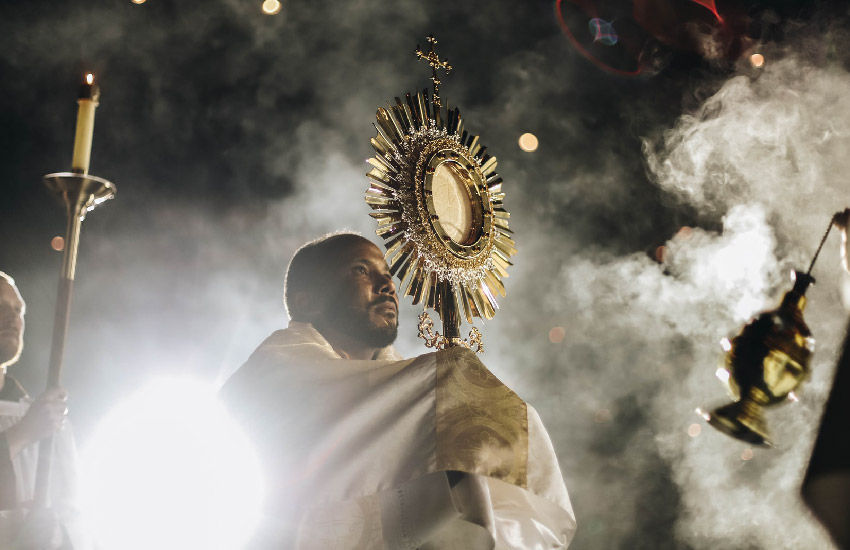
“And they burned incense unto Baal, to the sun, and to the moon, and to the planets, and to all the host of heaven.”— 2 Kings 23:5 (KJV)


On page 102 of the attached PDF, the Egyptian text explains that the “glorified dead” were not ordinary human beings who had already lived and died. They are described as the younglings of the god Shu and as human beings, but not yet born. The text calls them “men of a future generation.” Queen Hatshepsut, in her obelisk inscription, refers to them in connection with a period of 120 years, meaning the coming century, “men of the next century” as we would say now. Before they appear on earth, these future humans are said to circle around the Sun, and the glorified dead converse with them (Book of the Dead, chapter 124). This entire view rests on the Egyptian doctrine of the preexistence of souls, held not by philosophers or poets, but as a popular, literal belief of the Egyptian people. Souls existed before birth, orbiting the sun-god, waiting to descend into physical life.
Rome held a nearly identical belief. The Roman Manes, the “divine ancestors,” were thought to become powerful, luminous spirits after death. They watched over the living, received offerings, and acted as intermediaries. In both Egypt and Rome, the glorified dead were considered godlike beings with influence over the world.
The Bible gives this same category a different name: the Rephaim. Rather than glorified beings, Scripture calls them the dead, the shades, the disembodied spirits, the underworld entities that “shall not rise” (Isaiah 26:14). Where Egypt saw radiant beings circling the Sun, Yahweh saw the spirits of the dead awaiting judgment. Where Egypt honored them as future humans, Yahweh warned His people never to call upon them or imitate the practices of the nations who did (Deuteronomy 18:10–12). Where Rome exalted the ancestors as divine, Scripture reveals that the nations offered sacrifices to demons, not to God (1 Corinthians 10:20).
This helps explain why, according to Revelation, the saints; those who belong to Christ; are killed. The world system described in Revelation mirrors the ancient patterns of Egypt and Rome: the worship of the resurrected solar god, the honoring of the image of the beast, and allegiance to the powers behind the dead. The saints refuse to participate in this system. They stand against the worship of the glorified dead, the solar cycle of Osiris, the ancestral spirits, the pre-existent souls of Egyptian doctrine, and the image of the beast that demands universal devotion.
The Romans and Egyptians believed the glorified dead surrounded the Sun and influenced the living. The God of the Bible calls these spirits Rephaim. Christ, Yahweh incarnate, destroyed the one who held the power of death and exposed the darkness behind the so-called “glorified” ones (Hebrews 2:14). Believers testify that only Christ rose from the dead, only Christ reigns eternally, and only Christ gives life. This puts them in direct conflict with the ancient religion of the nations. The world’s system exalts the dead; Christ exalts the living. The nations worship the solar spirits of the underworld; believers worship the One who conquered death.
This is why Revelation describes a global war against the saints. They refuse the ancient cosmology in which the glorified dead rule the living. They reject the pre-existent souls circling the Sun, the Osirian resurrection myth, and the worship of the image of the beast. They refuse to honor the solar powers that Egypt, Rome, and the nations revered. They testify instead that Christ is the true God, the living God, Yahweh in the flesh, and that His resurrection is not tied to the heavens, not tied to the equinox, and not tied to the cycles of the dead.
On this point, it is worth asking soberly: Who is the false prophet and the man of sin that Scripture warns about? When people wear the cross, do they truly know which power that symbol originally belonged to? Why was Yahweh’s Sabbath replaced? Who granted Rome the authority it claims? How can the pope call himself the representative of Yahweh on earth when Rome has violated Yahweh’s eternal covenant from the beginning? Why did Vatican officials assist Nazis in escaping justice? Why do the Jesuits exist to uphold the papal throne rather than the gospel of Christ? And why is the papal throne entirely absent from the pages of Scripture? Why does Satan's obelisk still sit in the Vatican?

From a biblical standpoint, this Egyptian scene is not just a harmless symbol. It represents the same category of deception as the Tree of the Knowledge of Good and Evil. The sacred tree in the image offers “life,” “knowledge,” and “resurrection”; but not from Yahweh (the Holy Tree of life). It offers these things through Osiris-Ra, a sun-god who rules the underworld, not the heavens. The underworld because he was cast down due to his pride.
The solar disk shining through the branches is a promise of immortality and enlightenment through a false deity. In essence, it is a counterfeit tree, offering a counterfeit path to godhood, a counterfeit resurrection, and a counterfeit source of hidden knowledge. And Scripture is clear: the God of Israel does not dwell in the underworld; He is the God of the heavens, enthroned above all creation. Any “life” offered from the realm of the dead is a lie. Any “resurrection” offered by the underworld is corruption. Any “secret knowledge” offered through the sun-god is rebellion.
In Genesis, the serpent offered immortality, enlightenment, and hidden wisdom apart from Yahweh. Egypt reenacts the same pattern: a sacred tree, a forbidden source of divine knowledge, and the promise of rising through a god who reigns in the grave. This is the core of all ancient apostasy; seeking divine power from the realm of death. The Egyptian initiate reaches toward the tree to receive resurrection from Osiris, the lord of the underworld. But the God of the Bible offers resurrection from heaven, not from darkness. He gives life through His Spirit, not through the solar cycle. And He declares that those who seek life from the dead become like the dead. What this image shows is simply the ancient lie in its purest form: salvation, knowledge, and eternal life offered by the god of the underworld, not by Yahweh, the living God who dwells in the heavens.
Take heed therefore that the light which is in thee be not darkness.”
— Luke 11:35 (KJV)
The Book of The Dead
Refer also to yesterday’s post on the worship of the dead and the Rephaim.


Comments