Lucifer’s Light: The Hidden Sun God
- Michelle Hayman

- Jul 19, 2025
- 23 min read
Helena P. Blavatsky, founder of Theosophy, argued in Isis Unveiled (1877) that ancient editors of scripture obscured a solar meaning in the Hebrew divine name “Al” or “El.” She cites Sir William Drummond’s assertion that the Hebrew place-name Beth-El literally meant “house of the Sun” rather than “house of God,” claiming that “El, in the composition of these Canaanite names, does not signify Deus, but Sol.” According to Blavatsky, early Christian theologians deliberately replaced or reinterpreted “Al/El” to hide the fact that “the Jehovah of Moses and the sun were identical”. She suggests that if the original term “Al” had been left unchanged in the Hebrew texts, the public would have seen Moses’ God as a solar deity . Blavatsky thus portrays ancient Judaism (and by extension Christianity) as having a covert sun-worship element which only initiates understood, while uninitiated multitudes might have accused Moses of outright Zabaism (astral worship) .

Blavatsky’s interpretation implies that El (or Al); a name of God in Semitic languages; was originally a title of the sun. She even notes another scholar’s claim that “Beth-El means the house of the Sun in its literal translation, and not of God.” In her view, mainstream theology “disfigured” this ancient truth . These Theosophic claims equating the Biblical El with the solar orb set the stage for Theosophy’s broader reverence for solar symbols and “astral light,” but they have been sharply criticized by both Christian authorities and Hebraic scholars, as we will see.


Patristic Rebuttal: Irenaeus on God vs. Sun Worship
Early Christian Fathers forcefully rejected identifying the Biblical God with the sun. Saint Irenaeus, writing in the 2nd century (long before Blavatsky), emphasized that the sun is a creature made by the one true God, not a deity itself. In Against Heresies he writes: “As the sun, that creature of God, is one and the same throughout the whole world, so also the preaching of the truth shines everywhere” . By calling the sun “that creature of God,” Irenaeus underscores that however magnificent, the sun is a created object subject to the Creator, thus not to be worshipped.
Romans 1:25 (KJV):
"Who changed the truth of God into a lie, and worshipped and served the creature more than the Creator, who is blessed for ever. Amen."
Irenaeus specifically warned against the pagan error of conflating any aspect of creation with the Creator. Quoting the Biblical law, he reminds readers: “Lest when looking towards heaven, and observing the sun, and the moon, and the stars… you should adore and serve them.” . Here Irenaeus invokes Deuteronomy 4:19, where Moses explicitly forbids worship of the sun, moon, or stars. This indicates that Judeo-Christian tradition viewed sun-worship as a grave misstep. Irenaeus and other Fathers battled Gnostic and pagan tendencies to idolize celestial bodies; they upheld that the true God “makes His sun to rise on the good and evil” (as Jesus said ) but is not Himself the sun. Any doctrine equating Jehovah or Christ with the solar disk would, in Irenaeus’s eyes, be a pernicious heresy. This patristic stance stands in direct opposition to Blavatsky’s claim that Jehovah = the sun, highlighting a fundamental doctrinal divide: Christian theology distinguished the Creator from creation (even the brightest creation), whereas Theosophical syncretism blurred that line.
Notably, Irenaeus also catalogued and refuted various Gnostic sects who indulged in astral-mythological speculation. For example, some Gnostics assigned spiritual powers to planetary spheres or luminaries, a practice Irenaeus condemned as contrary to the Gospel. The early Church thus provides a rebuttal framework: venerating the sun or equating divine names with the sun is seen as a confusion of the material symbol with the true God. The sun, for Christians, “proclaims the glory of God” but is never itself the Lord – a view diametrically opposed to Blavatsky’s solar interpretation of “Al.”

Hebrew Linguistic Analysis; El Means God, Not "Sun"
Blavatsky’s linking of the Hebrew אל (El or Al) to the sun does not withstand traditional Hebrew philology. In Biblical Hebrew, El simply means “God” (related to Elohim) and is used as a title for the Almighty – but never as the word for “sun.” For example, the place-name Bethel (בֵּית אֵל) is explicitly explained in Genesis as “House of God.” After Jacob’s vision of the heavenly ladder, “he… named the place Bethel, ‘House of God’.” . The word El in Bethel is understood by all credible scholars and rabbinic tradition to refer to God, not the sun. Indeed, a standard reference notes: “Bethel (Hebrew: Bēṯ ʾĒl, ‘House of El’ or ‘House of God’)” .
Hebrew has a separate word for “sun” – שמש (shemesh) – and this appears in place-names that truly do denote solar worship, such as Beth-Shemesh. Tellingly, Beth-Shemesh in Hebrew means “House of the Sun.” As a city name, it likely indicated a center of Canaanite sun worship . The Bible mentions multiple locations named Beth-Shemesh, and they are understood to be sites where the sun-god was venerated. The fact that Hebrew differentiates Beth-El (House of God) from Beth-Shemesh (House of the Sun) is powerful evidence against Blavatsky’s claim. If ancient Israelites had meant to call a place “House of the Sun,” they would use Shemesh, not El. Sir William Drummond’s 19th-century conjecture that Beth-El really meant sun-temple is a fringe interpretation rejected by mainstream linguists.
Furthermore, in Hebrew theology, El is one of the names or titles of the Supreme God. For instance, the biblical patriarch Jacob uses El in compound names for God (El Bethel meaning “God of Bethel” ). The Brown–Driver–Briggs Hebrew Lexicon and other authorities list אֵל (El) as meaning “God, deity, power” – with no hint of “sun.” Etymologically, El is related to words for strength or might, fitting a deity, not specifically the sun. An etymology source confirms: “אל (’el) usually refers to Elohim… the Hebrew word for God” . Traditional rabbinic commentators (e.g. Rashi) simply gloss Bethel as “Beth Elohim”, house of God’s presence, with no allusion to solar cult.

2 Corinthians 11:14 (KJV):
"And no marvel; for Satan himself is transformed into an angel of light."
Satan, whose name means 'adversary,' is identified with the sun god; Lucifer; who opposes the Almighty; even the cross, once a symbol of a solar deity, bears witness to this ancient deception
In sum, Hebrew philology refutes identifying “Al” with the sun. The word for sun (shemesh or ḥammah) is entirely distinct. The notion that Al/El secretly meant the sun appears in some esoteric 19th-century works like Drummond’s Oedipus Judaicus (1811), which Blavatsky cites , but this has no support in Jewish tradition. On the contrary, Judaism condemned sun-worship in the strongest terms (see Ezekiel 8:16-18). The Mishnah and later rabbinic writings classify worshipping the sun as one of the forms of idolatry that ancient Israelites sometimes fell into and prophets vehemently opposed. Thus, from a Jewish perspective, equating the name of God (El) with a sun-deity would be a grave error – precisely the kind of error prophets like Jeremiah castigated (Jer. 8:2 speaks of the Israelites wrongly worshipping “the sun and the moon and all the host of heaven”).
Theosophy, Lucifer, and the “Light-Bearer” Sun
Blavatsky’s Theosophy exalted Lucifer – whose name means “light-bearer” (Latin for the Morning Star) – as a positive emblem of enlightenment. In fact, Blavatsky provocatively named her theosophical journal “Lucifer” in 1887, aiming to rehabilitate that name. In her view, the figure of Lucifer (often identified with the rebellious angel or Satan in Christian tradition) actually represented the principle of divine Wisdom and the spark of mind in humanity. She wrote: “Lucifer represents life, thought, progress, civilization, liberty, independence. Lucifer is the Logos, the Serpent, the Savior.” Such statements turn the Christian cosmology on its head – making the “Serpent” of Eden into a savior bringing enlightenment. Blavatsky even declared that “Satan, the Lord of Phosphorus (Light), is in us: it is our Mind” – i.e. the intellectual liberator. This Theosophical reverence for Lucifer as the bearer of light aligns with its reverence for the sun (the physical bearer of light in the sky) as a symbol of spiritual illumination.


Blavatsky and her successors explicitly denied that Lucifer/Satan is an evil tempter. Instead, they recast Lucifer as a misunderstood symbol of the light of Truth and the mind. In The Secret Doctrine, Blavatsky argued that the “Fall” was in fact the gift of mind and soul to humanity, and thus a fall upward initiated by a Luciferian spirit of enlightenment . This contrarian interpretation is fundamental to Theosophy’s rejection of Christian orthodoxy. Theosophists often point out that “Lucifer” in Latin simply denotes Venus as the morning star, the bringer of dawn – not a demon except by later church association.
Alice A. Bailey, who carried the Theosophical torch in the 20th century, continued this theme. She even founded the Lucifer Publishing Company in 1922 (though due to public controversy it was renamed Lucis Trust in 1923) . Bailey taught that “Lucifer” is not a devil but the “light-bearer” who enables humanity’s evolution. In Bailey’s writings (inspired, she claimed, by a Tibetan master), Luciferian imagery abounds – for example, she speaks of the “planetary Logos” and the “spiritual sun” as sources of illumination. The very title of one of her books, “Initiation: Human and Solar”, reveals the confluence of human spiritual progress with solar symbolism. Bailey believed a new age of worldwide religion would center on worship of “the Christ” as a cosmic principle – essentially a Sun of the spiritual cosmos – rather than on the personal Jesus of Nazareth. She and Blavatsky both saw Lucifer as a force of enlightenment, analogous to the Prometheus myth who stole fire from the gods to uplift mankind.
Critics (especially Christian writers) have characterized Theosophy as Luciferian in the sense of literally venerating Lucifer. Theosophy’s open embrace of Lucifer as positive earned it the enduring suspicion of the Church. Blavatsky did not shy away from controversy: she once wrote “And now it stands proven that Satan or Lucifer is… the real creator and benefactor, the father of spiritual mankind” . Such statements cement Theosophy’s stance that Lucifer = the true light-bringer, essentially merging the concept of the intellectual sun (Lucifer the morning star) with the concept of divine wisdom.
Blavatsky and Bailey promoted a form of sun worship in disguise – not worship of the physical sun as such, but of what it symbolized: the inner spiritual Sun (sometimes called the “Central Spiritual Sun” in Theosophical literature ). They frequently use solar language for God or the cosmic principle (e.g. “Solar Logos”). Lucifer, the light-bearer, is akin to the dawn sun in their doctrine – a source of illumination breaking the darkness of ignorance. This Theosophical sun/Lucifer veneration is utterly contrary to orthodox Judeo-Christian theology, which casts Lucifer as a fallen angel and abhors sun-worship. It is, however, quite in line with many esoteric and pagan traditions that honored the sun and the morning star. Theosophy revived those traditions under an erudite modern guise.


Masonic Solar Symbolism and Obelisks – From Lodges to the Vatican
Belief in the sun as sacred or symbolic of deity extends beyond Theosophy into Freemasonry and related esoteric societies. Masonic tradition, while not explicitly “sun-worshiping,” abounds in solar symbolism. Masonic lodges are geographically oriented east-west, and the Worshipful Master occupies the Eastern chair (symbolic of the rising sun). The Lodge lights and rituals often reference the sun’s course, moon, and stars. Two pillars of Solomon’s temple (Boaz and Jachin), important in Masonry, have been allegorically linked to the tropics (Cancer and Capricorn) through which the sun passes. In short, sun motifs represent enlightenment, the Great Architect’s light, and the unifying light of truth in Masonry.
One striking solar symbol common to Masonry and ancient paganism is the obelisk. Obelisks – tall stone pillars with pyramidions – were worshipped in ancient Egypt as petrified sunbeams, dedicated to the sun god Ra. In modern times, Freemasons took great interest in Egyptian symbols; for instance, the erection of the Washington Monument (an obelisk) in the U.S. capital involved Masonic cornerstone ceremonies, and obelisks feature in cemeteries and public spaces often with Masonic patronage. Obelisks and sunbursts also appear in some Masonic regalia and architecture.
Intriguingly, an Egyptian obelisk stands at the heart of Vatican City, in St. Peter’s Square. This 25-meter monolith once stood at Heliopolis in Egypt, was brought to Rome by Caligula, and eventually was placed by pope Sixtus V in front of St. Peter’s Basilica in 1586. Conspiracy theorists often point to it as evidence of “sun worship” infiltrating the Church. The layout of St. Peter’s Square, designed by Bernini, features an oval piazza with radiating patterns; some note it resembles a giant sun wheel or mandala, with the obelisk as the gnomon of a sundial (indeed, the obelisk actually functions as a sundial, casting a shadow on markers in the pavement at noon) . They also point out that the square’s design includes an eight-rayed pattern – often interpreted as a solar wheel symbolic of pagan deities (eight-rayed stars were associated, for example, with Isis/Cybele). While art historians view Bernini’s design as primarily symbolizing the embracing arms of the Church (the colonnades), it is true that a large eight-rayed compass rose or sunburst is embedded in the plaza’s geometry, coinciding with the obelisk’s center.

Though the Church officially reinterprets the Vatican obelisk as a monument to Christian triumph, the symbolism remains unmistakable. Once crowned with a golden orb honoring the sun god, it now bears a cross; yet the structure itself, a pagan solar pillar, was never removed. The so-called 'victory over paganism' involved not destruction, but appropriation. The obelisk still stands at the heart of St. Peter’s Square, encircled by a radiating colonnade—forming what many recognize as a stylized sun wheel. Far from erasing sun worship, the cross atop the obelisk merely masks it. Even the cross itself, far from being a uniquely Christian symbol, traces back to ancient solar iconography—the four points representing the cardinal directions and the solar cycle. Pope Sixtus V, who performed a formal exorcism during its erection, could not strip it of its ancient identity. Beneath layers of Christian narrative lies a deeper, older truth: the Church did not conquer the solar cult; it absorbed it.
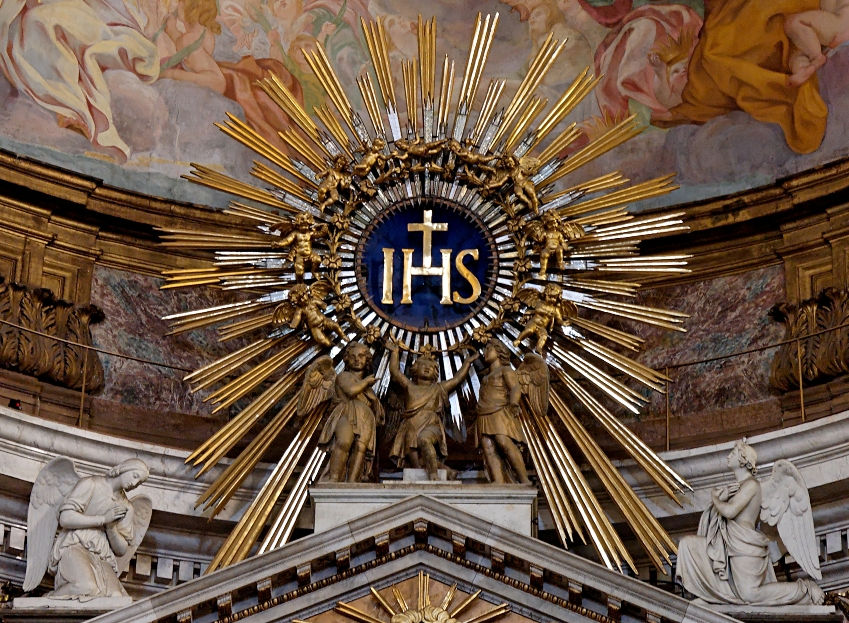
It is worth noting that the Jesuit order’s emblem itself contains a radiating sunburst. The Jesuit seal features the monogram “IHS” within a stylized sun; a symbol adopted in the 16th century by Ignatius of Loyola to signify Christ as “the sun of righteousness” (Malachi 4:2), shining light upon the world. However, once again, the Roman Catholic Church interprets this title in a literal, solar sense rather than its intended spiritual meaning. The verse speaks of divine healing and justice, not heliocentric worship. Christ is not the solar deity—Lucifer is traditionally associated with the light-bringer, the morning star, and the arc of the sun. By placing a radiant sun at the heart of its emblem, the Jesuit order blurs the line between biblical truth and ancient solar veneration, perpetuating symbols that many argue are more aligned with Luciferian imagery than with the spiritual Christ of Scripture.
Masonic and occult solar symbols like obelisks, sun-wheels, and radiant globes undeniably appear in many civic and religious contexts, including in Rome. The Vatican obelisk is historically a solar monument, and modern Catholic explanations acknowledge its pagan origin while asserting a Christian repurposing . Still, the visual parallel between St. Peter’s Square and ancient sun-temples is often cited by those who see a secret continuity between Theosophical/Masonic sun veneration and elements of Catholic aesthetics. They argue that these symbols suggest a hidden unity of purpose or at least a dialog between the Church and esoteric fraternities. Whether one accepts that or not, the symbols themselves are real: a sun obelisk at Christianity’s heart, solar emblems in Jesuit and papal art, and even the Pope’s title “Pontifex Maximus,” once held by Roman high priests who oversaw state sun-cults, all provide tantalizing fodder for speculation about “sun worship” at high levels.
Could this shed light on the scripture that speaks of “the man of sin” who sits in the temple of God, presenting himself as God; the Antichrist? (2 Thessalonians 2:4). This verse warns of a figure who does not merely oppose God, but imitates Him, enthroning himself in a place of divine authority while exalting himself above all that is sacred. The imagery of the pope seated on a golden throne, robed in splendor, surrounded by opulence and ritual, evokes this very deception; a man draped in the symbols of holiness, yet echoing the ancient traditions of sun-worship and imperial divinity. The gold, the throne, and the setting reflect not Christ’s humility, but Lucifer’s pride, fulfilling the prophecy of one who pretends to be God while leading many astray.

Regarding papal involvement in global politics (especially American affairs), one can note that for centuries the papacy has been a significant geopolitical player. In recent decades, the Vatican has engaged in diplomacy worldwide. Pope Francis (a Jesuit from Argentina) had not only spoken on global issues like climate change and migration but even mediated in political disputes (for example, he was instrumental in the Cuba–US rapprochement in 2014). Some American observers see the pope’s influence in world affairs – addressing the US Congress, the UN, etc. – as part of a broader spiritual-political agenda. Conspiracists sometimes link this to the old notion of a “Black Pope” (the Jesuit Superior General) wielding hidden power. While such claims veer into conjecture, it is true that Francis’s papacy marked an unprecedented alignment: the first Jesuit Pope, arriving at a time of resurgent interest in global governance and interfaith unity. To those suspicious of Theosophy and Masonry, Francis’s background is intriguing: the Jesuits have been accused by some of syncretism in the past, and Argentina – his homeland – carries its own esoteric legacy, as we shall explore.

From Theosophy to Thule: Aryan Root-Races and Nazi Sun Lore
Theosophy’s doctrines did not remain confined to benign metaphysics; they had a dark side influence on racial ideology in the early 20th century. Blavatsky taught a schema of “Root Races” – successive great civilizations of humanity, each with its own traits. According to The Secret Doctrine, the present Fifth Root Race is the Aryan race , which Blavatsky saw as intellectually and spiritually preeminent. Although Blavatsky’s writings extolled the Aryans in a mystical, non-nationalistic sense (tracing them back to Atlantis and sacred Tibet), the very idea of Aryan supremacy was eagerly adopted by certain German occultists.


By the early 1900s in Central Europe, Theosophy had given rise to offshoots like Ariosophy – an occult movement explicitly combining Aryan racial mystique with anti-Semitism. Guido von List and Jörg Lanz von Liebenfels, for example, blended Theosophical root-race theory with Germanic pagan lore, teaching that “Aryan” (or “Ario-German”) people were the bearers of divine soul-force, while other races (especially Jews) were soulless or demonic “creatures.” This was a distortion of Blavatsky – who, despite her own prejudices, did not advocate violence or identify Aryans narrowly with contemporary Germans . Nonetheless, Theosophy’s racial hierarchy laid the conceptual groundwork: “The superiority of the Aryan race is a cornerstone of Theosophic beliefs.” .

In the 1910s, the Thule Society in Munich became a crucible for turning these ideas into militant ideology. Thule was an occult-nationalist group obsessed with Aryan origins (Thule being a mythical northern homeland) and with combating Jews and communists (which might explain the wars). It blended Ariosophists’ racial mysticism with political action. Notably, Thule members adopted rune symbols and swastikas as sacred signs; they also practiced rites venerating Germanic gods and the “sun-wheel.” The swastika itself, which Thule propagandized and which the Nazi Party later adopted as its emblem, is an ancient solar symbol (used in many cultures to represent the revolving sun or the cycle of life). The Thule Society’s emblem featured a dagger over a swastika. Members believed they were descendants of a great Aryan race and saw Jews as subhumans thwarting Germany’s destiny .
When Adolf Hitler rose to lead the German Workers’ Party (soon renamed National Socialist German Workers’ Party – the Nazi Party), he drew into his movement several Thule members (e.g. Rudolf Hess, Alfred Rosenberg) who carried these occult racial notions. Hitler himself was not an occultist in the strict sense, but Nazi ideology incorporated many of the mythic-racial themes: the Aryan race as culture-founder, the need to purge “inferior” races, a revival of ancient Nordic pagan virtues, etc. Heinrich Himmler’s SS in particular became a vehicle for implementing a kind of neo-pagan, sun-cult-infused racial religion.
Himmler was fascinated by esoteric lore – from Arthurian legend to Vedic scripture – and sought to “re-paganize” German spirituality along racial lines. He envisioned the SS as a new knightly order of Aryan warrior-priests . Under Himmler, the SS created rituals explicitly tied to the solar calendar: they celebrated the summer and winter solstices with bonfires and sunwheel insignia . SS weddings and naming ceremonies were redesigned with pagan symbolism, invoking nature and ancestral Germanic gods rather than Christian sacraments . At the SS castle of Wewelsburg, intended as a cult center, Himmler installed a Black Sun symbol in the floor – a mosaic of twelve radiating runes in a circular sun-wheel arrangement. This Black Sun was meant to be an esoteric emblem of the SS’s source of power. As one analysis describes: “The symbol of the Black Sun unites the three most important symbols of Nazi ideology – the sun wheel, the swastika and the stylized victory rune.” . In effect, the Nazi “religion” was a solar cult of the alleged Aryan race-soul. They appropriated runes (ancient letters imbued with magic, e.g. the SS “double lightning bolt” sig-runes) and many solar emblems (the swastika, sun-wheels, oak-leaf sunbursts, etc.) as their insignia.
If, as Revelation implies, there is a black sun behind the visible light of the sun, could this explain how Lucifer masquerades as an angel of light—his brightness masking inner darkness? And might the white pope symbolize the outward light of spiritual authority, while the black pope represents the hidden force behind the throne?
Revelation 18:23 (KJV):
"For thy merchants were the great men of the earth; for by thy sorceries were all nations deceived."
The Thule Society’s pamphlets and Dietrich Eckart’s writings (he was Hitler’s mentor from the Thule circle) were filled with mythic anti-Semitism – Jews were accused of secretly controlling world affairs and diluting Aryan purity (a theme also oddly echoed by Blavatsky, who once referred to Jews as an “unspiritual” race in an 1870s article). In Mein Kampf, Hitler doesn’t cite Blavatsky, but he does refer to Providence selecting the Aryans as a master race – a concept arguably secularized from mystical sources. A researcher in Yad Vashem’s archives succinctly notes: “Theosophy… took root in Germany… The superiority of the Aryan race [in Theosophy]… Ariosophy, extant in pre-Hitler Germany, was closer to Nazi ideology… The occult, antisemitic Thule Society provided the missing militancy, combining racial superiority, militancy, and mythological antisemitism in the early days of Nazi ideology.” This shows a direct ideological continuum from Blavatskian root-race lore to Nazi racial dogma, with intermediate “Aryan cult” movements making the ideas more extreme and politicized.
During the Third Reich, Nazi propaganda invoked sun imagery heavily. The party rallies at Nuremberg ended with torchlight processions and a giant illuminated swastika – effectively a sunwheel – in the night sky. The SS published occult-influenced literature on early Aryans worshipping a sun-god. Even the term “Third Reich” had a quasi-mystical connotation of a new Golden Age (often associated with a solar metaphor). Meanwhile, runic symbols adorned uniforms and publications: the “Sieg” rune (for victory) was twin-linked as the SS symbol; the “Othala” rune (for heritage) was used by a Volksbund; the sun-cross appeared in various contexts, and the swastika (an ancient Indo-European sun sign) was of course omnipresent on flags, arm-bands, and badges. Nazi mystics like Himmler truly believed they were reconnecting with an archaic Indo-Aryan sun-cult, bringing a rebirth of pagan virtue to counter what they saw as the “decadence” of Judeo-Christian modernity .
Aftermath: Nazi Escape, the Sun in Argentina
In 1945, the Nazi regime was crushed, but curiously, symbols of the sun and legends of Aryan destiny did not disappear – they migrated, along with some of the people who upheld them. Thousands of Nazis and fascists fled Europe after World War II via “ratlines” – clandestine escape routes often overseen or abetted by Catholic clergymen . Many of these escapees found refuge in South America, especially Argentina. Argentina’s president Juan Perón quietly welcomed scores of ex-Nazis and collaborators into his country in the late 1940s. Among the notable fugitives were Adolf Eichmann (architect of the Holocaust) and Josef Mengele (“Angel of Death” of Auschwitz), both of whom lived in Argentina under aliases for years.
The Vatican’s role in these escapes remains controversial. Historical evidence shows that some Vatican officials and networks of priests facilitated the flight of Nazis – whether out of anti-communist sentiment, misplaced compassion, or for material gain. For example, Bishop Alois Hudal in Rome was notorious for supplying false papers and sanctuary to wanted war criminals (he believed many were “innocent patriots” and specifically helped SS man Franz Stangl and others) . A German historian noted “It would have been much more difficult for [Nazi fugitives] to flee if the Catholic Church had not protected many of them.” . The ratline network through Italy (often called the “monastery route”) moved fugitives from monasteries in Tyrol and Rome to ports where they sailed to Latin America . Once in Argentina, these ex-Nazis blended into the large German-immigrant communities or were employed by the government. Eichmann, for instance, obtained an Argentine visa under the name “Ricardo Klement” and later expressed gratitude by converting to Catholicism while in exile .
This fascinating historical footnote connects to our theme in two symbolic ways:
First, the national flag of Argentina prominently features a radiant golden sun – the “Sun of May.” This emblem, added to the flag in 1818, is a human-faced solar disk with 32 rays (16 straight, 16 wavy) . It commemorates the May Revolution of 1810 (which led to Argentina’s independence) and is widely acknowledged to represent the Inca sun-god Inti . In other words, the primary symbol of Argentina is literally a sun, derived from indigenous solar deity imagery. This is richly ironic given the influx of sun-myth-obsessed Nazis into that country. One might say the “Sun of May” welcomed the Black Sun. Of course, historically the sun on the flag was intended as a benign symbol of enlightenment and freedom (much as the Masonic-inspired Latin American revolutionaries loved solar emblems – note many flags in the region have suns). But conspiracy theorists revel in this coincidence: Nazi sun-cultists ending up under the Sun of Inti, often with the logistical aid of Catholic clergy – it seems to tie all our threads together.
Second, decades later in 2013, pope Francis was elected as the first pope from Argentina – and notably, the first Jesuit pope. Born Jorge Mario Bergoglio in Buenos Aires, During Argentina’s Dirty War (1976–1983), Jorge Mario Bergoglio; pope Francis; was a Jesuit provincial leader. His role remains controversial: some praise him for quietly helping dissidents escape, while critics allege he failed to protect or even may have exposed certain priests to the regime. The full truth remains debated, as much of the historical record is murky., but more pertinent here is his Jesuit formation. The Jesuit order’s seal, as mentioned, is a sunburst with the Christogram “IHS.” And intriguingly, pope Francis chose as his papal coat of arms a version of his Jesuit emblem: a blazing sun with “IHS” at center. Thus, the pope’s own insignia is a solar image. The coincidence that he hails from Argentina, the land of the Sun of May, and that he is a Jesuit (order of the “Sun” logo), and that he took the name Francis (St. Francis’s feast day falls around the autumn equinox, a solar calendar point) – all this provides copious material for those inclined to see a continuing thread of sun-worship or Illuminati symbolism linking Theosophy, Masonry, and the highest echelons of the Church.
More concretely, pope Francis has involved himself in global politics in unprecedented ways. From championing climate agreements (Laudato Si’) and open-border migration policies to mediating international disputes and promoting multilateralism, his actions align closely with the spiritual-political ideals often associated with the New Age or New World Order—concepts long promoted by Theosophists and their successors. These include the vision of an enlightened global governance, religious unity, and a coming world leader.
It’s perhaps no coincidence that Lucis Trust, founded by Theosophist Alice A. Bailey and formerly known as the Lucifer Publishing Company, is today a UN-accredited NGO, actively promoting the Great Invocation—a prayer calling for the arrival of “the Coming One” and the spread of global light.
Meanwhile, pope Francis spearheaded interfaith efforts like the Human Fraternity Document with the Grand Imam of Al-Azhar and voiced strong support for the United Nations' agendas. To many observers, this goes far beyond Christian ministry—appearing instead as an attempt to position the papacy as a spiritual head of a one-world religion, echoing the esoteric vision Theosophy laid out a century ago.
Unveiling Isis: Esoteric Truths Hidden in Plain Sight at the Vatican
In Isis Unveiled (1877), H.P. Blavatsky; co-founder of the Theosophical Society; offered a radical reinterpretation of religious history. To her, figures like Isis and Osiris were not just deities of ancient Egypt, but cosmic archetypes encoding spiritual truths obscured by centuries of dogma and distortion.
These ancient symbols, far from extinct, still surround us; hidden in plain sight. One of the most striking examples is the obelisk that rises from the center of St. Peter’s Square in the Vatican. According to esoteric traditions, this structure links directly to Osiris, the god of resurrection and solar power.
Osiris, in Egyptian lore, embodied the spirit of nature, death, and rebirth—closely associated with both the sun and the Nile, representing the elemental forces of fire and water. In esoteric symbolism, these forces are expressed by the upward-pointing triangle (fire) and the downward-pointing triangle (water). When combined, they form the hexagram, a powerful emblem in alchemy, Kabbalah, and Hermeticism; symbolizing the union of opposites, the harmony of spirit and matter, and the balance between the divine masculine and feminine. His counterpart, Isis, represented the divine feminine, nature, and hidden wisdom. Blavatsky saw them not as literal gods, but as personifications of universal forces: Osiris as the solar spirit or divine masculine, and Isis as the cosmic womb, the veiled source of life and truth.
Galatians 4:3 (KJV):
"Even so we, when we were children, were in bondage under the elements of the world:"
Paul is referring to the elemental forces of the world; often interpreted as legalistic religion, pagan systems, or cosmic powers; that once held people in spiritual bondage before the coming of Christ.
“To unveil Isis,” Blavatsky wrote, “is to unlock the spiritual realities concealed behind material appearances.” The mystery of Isis is not simply mythological; it is metaphysical. The ancient inscription said to appear at her temple in Sais captures this perfectly: “I, Isis, am all that has been, that is, or shall be, and no mortal man hath ever me unveiled.” For Blavatsky, unveiling Isis meant rediscovering the wisdom traditions behind all religions, transcending exoteric belief for inner gnosis.
God condemns her under later forms, particularly as Ishtar, Ashtoreth, or the Queen of Heaven.


Further deepening the symbolism is the shape known as the Vesica Piscis, the almond-shaped form created by overlapping circles. It is found across spiritual traditions, from Vedic yantras to Gothic cathedrals, and represents the generative portal of life; the womb of Isis. The very layout of St. Peter’s Square mimics this form, aligned with solar lines, with the obelisk placed at the center as the fertilizing sun.
Blavatsky believed such symbolism was not accidental but part of a hidden spiritual continuum stretching from Egypt to Rome to modern institutions. What appears as Christian architecture may in fact encode the same eternal truths once preserved in the temples of Isis.
“The world is full of forgotten symbols. To unveil Isis is to remember,” Blavatsky wrote. In her view, the spiritual legacy of humanity was never fully lost; only veiled by time and dogma.
Thus, the Vatican’s obelisk is neither a leftover from paganism nor merely a relic of empire. It is a living myth in stone, a convergence point for esoteric wisdom. Beneath the surface of institutional religion lies a deeper geometry, a cosmic blueprint pointing back to the union of Isis and Osiris; the eternal dance of creation.
So when we gaze upon the Vatican, we are not just seeing the seat of Catholic (not Christian) power. We are also witnessing echoes of an ancient spiritual code. The goddess still stands veiled at the heart of the Church.


The goddess Ishtar; known in Babylon as Inanna and later as Isis; appears on this Akkadian seal (c. 2350–2150 BCE) as the original Queen of Heaven. Armed and crowned with the horned helmet of divinity, she stands in dominion over a lion, a symbol of solar royalty that echoes through papal and royal heraldry to this day. Beside her shines the star of Shamash (Shemesh), the ancient sun god; who, in esoteric tradition, is none other than Osiris, and ultimately, Lucifer: the light-bearer, the hidden force behind sun worship across ages. This image reveals a convergence of divine feminine power, solar veneration, and imperial symbolism—still mirrored in the thrones, crests, and rituals of modern religious and political systems.
Sources:
H. P. Blavatsky, Isis Unveiled, Vol. I (1877), pp. 575–576 .
St. Irenaeus of Lyons, Against Heresies, Book I ch.10 & Book III ch.7 (2nd cent.) .
Hebrew Bible (Genesis 28:19, Deut. 4:19) and commentary; cf. Brown–Driver–Briggs Lexicon on El .
Lee Penn, “Beware! the New Age Movement…,” New Oxford Review (2000) .
Catholic Answers, “Obelisk in St. Peter’s Square” Q&A (Tom Nash) .
Oliver Pieper, “What did the Vatican know about Nazi escape routes?” Deutsche Welle (2020) .
Jeffrey Goldstein, “Anti-Semitism in Occultism and Nazism,” Yad Vashem Studies XIII (1979) .
James Twining, “The Black Sun and Wewelsburg Castle” (historical essay) .
Flag of Argentina – Wikipedia (re: Sun of May symbol) , etc.
Blavatsky quotes on Lucifer (AZ Quotes / The Secret Doctrine) .


Comments