The Hidden Origins of the Maltese Cross and the War of the Kittim
- Michelle Hayman

- Sep 5, 2025
- 7 min read

The Maltese Cross is often seen today as a Christian emblem, associated with knights, hospitals, and holy orders. But the true story of the cross stretches far back into the mists of antiquity, long before Christianity; into the world of the Hittites, the Sherden warriors, the Phoenicians, and the mysterious Etruscans.
What we find, when we peel back the layers, is a story of ancient fertility worship, of gods of the pit, and of the union of male and female principles that gave shape to the cosmos. And when we follow the trail forward into the Dead Sea Scrolls, the very same powers reappear under another name: the Kittim, the Sons of Darkness, culminating in the Roman Empire itself.

The Hittites and the Sherden
The Bronze Age Hittite empire of Anatolia (modern Turkey) was a powerhouse of religion and symbolism. When the Hittite world collapsed around 1200 BCE, chaos swept the Mediterranean. Egyptian records speak of the Sea Peoples, among them the Sherden (or Shardana), fierce warriors whose horned helmets and foreign gods struck terror into pharaohs.
These Sherden carried with them more than their swords. They bore symbols; crosses, circles, solar and lunar emblems; that spoke of a cosmology centered on the fertility of the earth and the potency of the heavens. Their gods were not meek shepherds but storm lords, underworld kings, and keepers of the abyss.
As the Phoenicians spread across the Mediterranean, they too carried the cross-symbol. Archaeologists have found cruciform engravings in Malta itself, carved on the living rock long before the island gave its name to the “Maltese Cross.”
But these were not Christian. Each arm of the cross was made of united male triads, the lingas, their heads meeting in the center to form the diamond, the yoni. It was the eternal mystery: sun and moon, Ouranos and Ge, Anu and Hea. The cross was a map of creation, a cosmic embrace where the serpent bloodline was born.
Gold amulets from Naples depict the same mystery; eggs, figs, and drops of seed, bound together into a cross within a circle. This was no ornament: it was an amulet of power, a talisman of the sacred union.
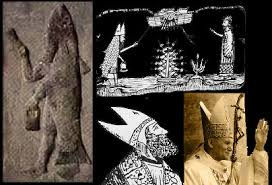
And then, out of this sea of wandering peoples, the Etruscans arose in Italy. Their origins were never native; they came from across the water, from Anatolia, the same lands where the Hittites once reigned. Some whisper they were kin to the Philistines; another offshoot of the Sea Peoples; who worshipped Dagan, the grain god, the chthonic Bel Harri, “Lord of the Pit.” The chief god of the Philistines; lord of grain and the underworld, a figure much like Egypt’s Osiris, whose own phallic emblem now stands before the Vatican.
The War Scroll and the Kittim
The story does not end with the Etruscans or even with the knights. Among the Dead Sea Scrolls, one of the most striking texts is the War Scroll (1QM), sometimes called The War of the Sons of Light against the Sons of Darkness. It paints an apocalyptic vision: God’s covenant people locked in battle against the forces of chaos, deception, and oppression. And at the center of this struggle stand the Kittim; the archetypal Sons of Darkness.
In the Qumran vision, the Kittim are not just a single nation but a recurring archetype: outsiders from the sea, bearers of strange gods, enemies of the covenant people. They represent empire itself; arrogant, expansionist, and destined to be judged.
The Hebrew Bible uses “Kittim” in multiple places, often pointing westward across the sea. The name is tied to Kition (a Phoenician colony in Cyprus), but its meaning quickly broadened. By the late biblical and Second Temple periods, “Kittim” had become a label for the Sea Peoples; those displaced tribes who burst out of Anatolia and the Aegean around 1200 BCE, wreaking havoc on Egypt, Canaan, and the Levant.
Egyptian records describe them: the Sherden, the Peleset (Philistines), the Lukka, the Shekelesh. These were the Kittim of memory; sea-raiders who defied kings and reshaped the map of the eastern Mediterranean. To the writers of Qumran, their shadow lingered still.

The Philistines themselves were one branch of these Sea Peoples, settling the coastal plain of Canaan and clashing constantly with Israel in the days of Samson, Saul, and David. Their god was Dagan, the grain-lord, the chthonic power later remembered as Bel Harri, “Lord of the Pit.”
As centuries passed, the identity of the Kittim shifted yet again. In the intertestamental books; Maccabees, Jubilees, and the Dead Sea Scrolls; the Kittim came to stand for the new oppressors from the West: the Greeks at first, and then the Romans.
By the time the War Scroll was copied at Qumran, the Kittim were none other than the legions of Rome. Their standards, their eagle banners, their overwhelming iron might; these were the final mask of the Sea Peoples, the last incarnation of the Sons of Darkness.

Osiris, Serapis, Zeus-Ammon, and the Beast from the Sea
The ancient powers wore many names, but behind them was the same spirit: the dying-and-rising god of grain, of the pit, of the bull, and of the serpent. From Egypt to Greece to Rome, he was worshipped, feared, and enthroned as king of the underworld.
In Egypt, Osiris was the god who died and rose again, buried like a seed and reborn from the earth. His cult was rooted in death and resurrection, the cycle of fertility and the mystery of the underworld. Osiris was fused with Apis the bull, a living beast regarded as the incarnate soul of the god. From this union came Serapis, the Greco-Egyptian deity exalted in Alexandria, crowned with wheat to symbolize his dominion over grain, sun, and fertility. In him were gathered all the marks of the ancient mystery: grain and harvest, fertility and seed, sun and resurrection, bull and beast, serpent and underworld. He was more than a god of death. He was a counterfeit messiah, a false savior.
In Greece, Osiris took on another mask as Zeus-Ammon. Ammon, the ram-horned god of Libya and Egypt, was joined to Zeus, the thunder-lord of the Hellenes. Statues of Zeus-Ammon reveal him crowned with ram’s horns, echoing the power of Osiris-Apis the bull. The Greeks themselves admitted that Zeus-Ammon was Osiris under another name, a blending of the sky-god and the lord of the dead. In both forms, he appeared as the horned beast: fertile, storm-driven, a power of seed, abyss, and pit.
The myths of Zeus reveal another layer still. He was not constant in form but always changing: sometimes a man, sometimes a serpent, sometimes a bull or even a swan. In these guises he overpowered women, taking them by deception, disguise, and force. This is not merely myth but the mark of an elemental spirit, the kind the Book of Enoch describes; spirits that can alter their form, shifting from angel to animal, from beast to man, driven by lust and corruption. Zeus-Ammon, Osiris, Serapis: each carried the same demonic power of transformation.
Prophecy casts its light upon this figure. Revelation speaks of a Beast rising from the sea, crowned with blasphemies. In the numerology of the Greeks, Serapios equals 666, the number of the Beast. He is the man of Serapis, the human mask of the pit-god. The bull, the serpent, the grain, the resurrection; all of these symbols gathered into one form, a false savior enthroned in Alexandria and carried into Rome. The god who changed his shape to ravish women, the same spirit warned of by Enoch, is the Beast that rises from the waters of chaos. Dagan of the Philistines, Osiris of Egypt, Zeus-Ammon of Greece, Serapis of Rome: all are masks of the same ancient power. He is the elemental deceiver, the shape-shifter, the bull and the serpent, the false savior who claims resurrection but rules the pit. And prophecy unmasks him at last as the Beast from the sea, the one numbered 666, the man of Serapis, whose reign stretches from Egypt to Rome; and into the present.
The story is remembered as the Rape of the Sabine Women: when Romulus (also a child of rape) and his followers, lacking wives, staged a festival, invited the Sabines, and then seized their daughters by force. This act of raptio was not just the birth of families; it was the birth of a bloodline, sown in violation and deceit. Rome’s very foundation was built on the seed of the serpent, just as in Eden the serpent sought to corrupt the seed of the woman.
From that day forward, there have been two bloodlines running through history: the covenant line, bearing God’s promise, and the serpent line, marked by violence, lust, and counterfeit power.

Through Alexander the Great, the horned lineage of Zeus-Ammon passed into empire. His coins showed the ram’s horns curling from his temples, a sign that he was not merely a man but the son of the god. This image of the horned child became a royal seal, carried into the Hellenistic kingdoms and adopted by Rome itself.
Rome absorbed everything. The rites of Osiris became the cult of Serapis. The wild frenzy of Dionysus became Bacchus and the Saturnalia. Bread and wine, once offered to Osiris and Dionysus as body and blood, became the sacred meal of mystery initiates. Bulls and goats were sacrificed in honor of gods who promised fertility and resurrection. Serpents slithered through Roman iconography as emblems of eternal return. The empire became the vessel for the same ancient stream of horn, bull, goat, and serpent.
And when Rome put on its final mask as Christian Rome, the symbols did not vanish; they were baptized and enthroned. In "St. Peter’s Square", an Egyptian obelisk; the very phallic symbol of Osiris; stands before the Vatican as a silent witness to the god of the pit. Papal decrees are issued as Bulls, bearing the name of the sacred beast that once carried the soul of Osiris. The bread and the wine are lifted in the Mass as the body and blood, the same elements that fed the mysteries of Dionysus and Serapis.
Thus the current runs unbroken: from Osiris the bull and Dionysus the goat, to Zeus-Ammon and Alexander with his horns, to Rome, and finally into the papal throne. The Vatican has clothed itself in Christian language, but the symbols of the horned child, the bull, the serpent, and the sacred meal remain. Rome did not destroy the mysteries; it enthroned them.


Comments