Councils, Indulgences, and the Claims of Rome
- Michelle Hayman

- 2 hours ago
- 24 min read
Part 8
Before continuing this examination of Denzinger and the decrees of the medieval Church, I want to remind readers why I have undertaken this study in the first place.
My purpose is not to attack individuals, nor to mock sincere believers. Rather, it is to test the claims of men against the Word of God, as Scripture repeatedly instructs us to do.
The Bereans were commended because they did not simply accept what they were taught, even when the teaching came from the Apostle Paul himself. Instead, they "searched the scriptures daily, whether those things were so" (Acts 17:11). Their example stands as a model for every Christian. Truth does not fear examination.
Paul repeatedly warned believers to exercise discernment. He wrote, "Prove all things; hold fast that which is good" (1 Thessalonians 5:21). He cautioned that grievous wolves would enter among the flock, and that men would arise speaking perverse things to draw away disciples after themselves. The Apostle John likewise instructed believers: "Beloved, believe not every spirit, but try the spirits whether they are of God" (1 John 4:1).
Even our Lord Jesus Christ warned against false prophets, false teachers, and religious leaders who elevated the traditions of men above the commandments of God. Time and again, Christ directed people back to the Scriptures with the question, "Have ye not read?"
It is therefore neither rebellion nor unbelief to examine religious claims. It is obedience.
For this reason, I have chosen to examine the historical decrees, doctrines, and pronouncements contained within Denzinger. If Rome claims authority over the Christian faith, claims the power to bind consciences, claims the ability to define doctrine, remit punishments, dispense indulgences, and speak on matters affecting eternal salvation, then those claims deserve careful scrutiny.
These are not trivial issues.
At stake are questions concerning salvation, repentance, forgiveness, authority, and the Gospel itself. If a doctrine is true, it should withstand examination in the light of Scripture. If it cannot, then Christians have a duty to acknowledge that fact regardless of tradition, popularity, or institutional authority.
The souls of men and women are far too precious to place unquestioning trust in any human institution. History is filled with examples of religious leaders, councils, and traditions that claimed divine authority while teaching things that must be tested against God's Word.
As we continue through these decrees, I encourage readers to do what the Bereans did. Open the Scriptures. Examine the evidence. Test every claim. Compare every doctrine with the Word of God.
For ultimately, our faith must rest not upon popes, councils, theologians, or traditions, but upon the truth revealed by God Himself.

Communion Under One Kind: When Tradition Replaced Practice
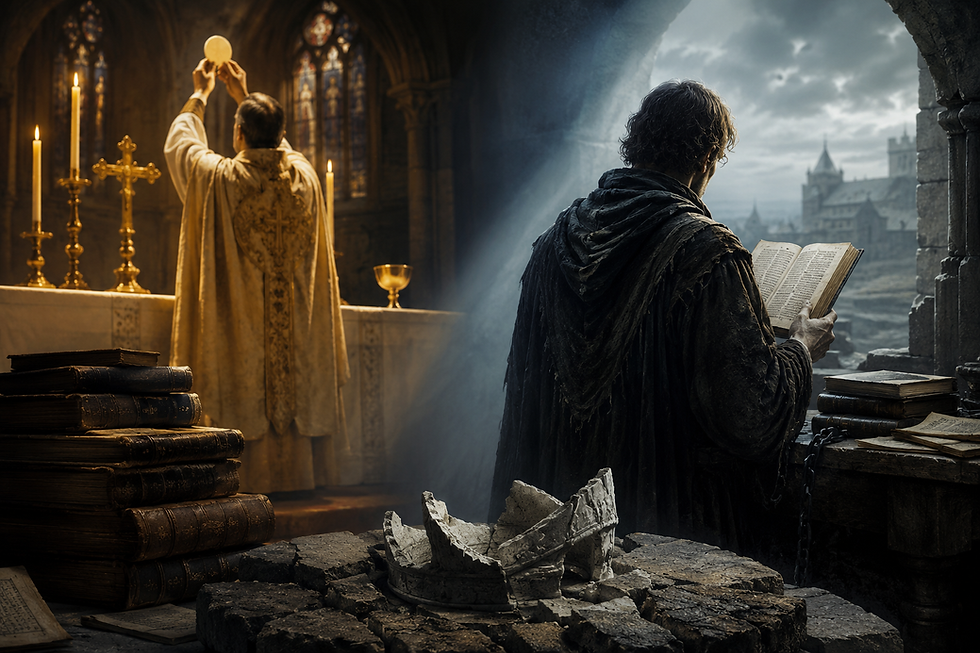
In 1415, the Council of Constance formally declared that the laity should ordinarily receive communion under the species of bread alone, while the chalice remained reserved to the clergy. What makes this decree remarkable is not merely the ruling itself, but the council's own admission concerning earlier Christian practice.
The decree openly acknowledges that Christ instituted the Eucharist under both bread and wine and that the faithful in the early Church received both elements. This is not disputed by the council. The historical reality is admitted at the outset. The apostles received both. The earliest Christians received both. The practice was widespread in the ancient Church.
The question therefore is not what the early Church did.
The question is why it was changed.
The council argues that practical concerns and ecclesiastical authority justified the alteration. Because Christ is believed to be fully present under either species, the faithful were no longer required to receive both bread and wine. The Church, it was argued, possessed the authority to regulate the administration of the sacrament and had done so for reasonable causes.
Yet this raises a deeper issue.
If receiving only the bread is sufficient because Christ is fully present under one species, why did Christ institute two? Why did the apostles distribute two? Why did the early Church maintain two for centuries?
The decree does not point to a newly discovered apostolic teaching. Rather, it appeals to custom, canon law, and the authority of the Church to modify an established practice.
This creates a recurring pattern found throughout many of the medieval decrees. The original practice is acknowledged. The practice is altered. The alteration becomes normative. Eventually, opposition to the alteration becomes heresy.
What is particularly striking is that those condemned at Constance were often advocating what the council itself admits had once been the ordinary practice of the Church. They were not introducing a new sacrament. They were asking for the restoration of what earlier generations of Christians had received.
The logic therefore becomes difficult to ignore. Christ distributes bread and wine. The apostles distribute bread and wine. The early Church distributes bread and wine. A later authority restricts one element. Then those who object to the restriction are condemned.
When a later institution modifies an earlier practice, where does ultimate authority reside? Does authority rest in preserving what was handed down from the beginning, or does it rest in the power of later generations to redefine how that inheritance is administered?
The Council of Constance answered that question decisively. The authority of the Church was considered sufficient to alter the practice while preserving the doctrine.
Whether that answer is convincing remains for the reader to decide.
The significance of the decree extends far beyond the chalice itself. At stake is a larger issue that appears repeatedly throughout these documents: the relationship between apostolic precedent and later ecclesiastical authority. Again and again, the question emerges whether the role of the Church is to preserve what it received or to exercise the authority to reshape how that inheritance is expressed.
This question becomes even more significant when viewed in light of the testimony of earlier church leaders. Pope Simplicius described the Scriptures as a pure, clear, and perfect fountain from which the Church draws its doctrine. Likewise, many early Christian writers emphasized that the faith had been delivered once to the saints and was to be faithfully preserved rather than expanded by human innovation. The concern repeatedly expressed by the Fathers was not the creation of new doctrines, but the safeguarding of the apostolic deposit entrusted to the Church.
Scripture itself carries the same warning. Moses instructed Israel not to add to or diminish from God's commandments (Deuteronomy 4:2). Solomon warned against adding to God's words lest one be found a liar (Proverbs 30:6). The Apostle Paul cautioned believers not to go beyond what is written (1 Corinthians 4:6), and the Book of Revelation closes with a solemn warning against adding to or taking away from the words of prophecy (Revelation 22:18-19). Throughout Scripture, the pattern is one of preservation rather than alteration.
The controversy over communion under one kind therefore becomes more than a dispute about bread and wine. Christ instituted the sacrament under both bread and wine, and the early Church practiced it accordingly. The Council of Constance acknowledged this historical reality, yet asserted the authority to alter the administration of the rite and to condemn those who appealed to the earlier practice.
The issue, therefore, is not merely sacramental. It becomes a test case for a much larger question: when later authority and earlier practice diverge, which one should define the faith of the Church? Should Christians look first to the example of Christ and the apostles, or to the decrees of later councils and ecclesiastical institutions? The answer to that question lies at the heart of the broader debate over tradition, authority, and the sufficiency of the apostolic faith.
John Hus and the Question of Authority
The condemnation of John Hus at the Council of Constance in 1415 is often remembered because it was followed by his execution. Yet the most revealing aspect of the decree is not the punishment itself, but the questions Hus was asking.
At the center of the controversy stood a simple issue: what gives a church leader authority?
Is authority inherent in an office, regardless of the person's conduct? Or does authority depend, at least in some measure, upon faithfulness to Christ?
Many of Hus's condemned propositions challenged the growing claims of papal and ecclesiastical power. He argued that Peter was not the head of the universal Church, that a pope living contrary to Christ could not truly be considered Christ's representative, and that conformity to Christ mattered more than institutional succession.
The council rejected these ideas. Yet the questions themselves are difficult to dismiss.
If a pope openly lives contrary to the example of Peter, in what sense is he Peter's successor? If a bishop exercises authority while disregarding the teachings of Christ, does office alone guarantee legitimacy? If apostolic succession is reduced to an unbroken chain of appointments while apostolic character becomes secondary, what exactly has been preserved?
The decree repeatedly defends institutional authority while Hus repeatedly directs attention to moral and spiritual authority. The clash is striking. One side emphasizes office. The other emphasizes conformity to Christ.
Particularly revealing is the condemnation of Hus's assertion that there is no clear evidence that the Church must always possess a single earthly head governing all Christians. Today this may seem an ordinary feature of Catholic theology, but the question remains historically significant. The New Testament speaks extensively of Christ as the head of the Church. It speaks of apostles, elders, bishops, pastors, and teachers. Yet the concept of a universal bishop exercising jurisdiction over the entire Christian world emerged gradually over centuries rather than appearing fully formed in the apostolic age.
Another condemned article stated that Christ could govern His Church through faithful disciples scattered throughout the world without the existence of such a universal head. The council regarded this as unacceptable. Yet the proposition raises an obvious question: if Christ is truly present with His people and continues to govern His Church through the Holy Spirit, why is a single earthly ruler indispensable?
The decree also condemns Hus for arguing that wicked popes and prelates should not automatically be regarded as true shepherds. History makes this issue difficult to ignore. By the time of Constance, Christendom had already witnessed corruption, simony, political intrigue, rival popes, and scandals among the highest ranks of the Church. Hus was asking whether office alone could sanctify conduct. The council answered yes. Hus answered no.
What makes the decree particularly fascinating is that many of the questions it condemns continue to be asked centuries later. Does legitimacy flow from succession or from faithfulness? Does authority reside primarily in an institution or in adherence to Christ? Can a leader who openly contradicts the example of the apostles still claim apostolic authority simply because he occupies apostolic office?
The council chose institutional continuity as the foundation of authority. Hus insisted that conformity to Christ was the higher test.
What followed remains one of the darkest episodes in medieval church history. Rather than merely refuting Hus's arguments, the Church condemned him and ultimately delivered him to execution. Whatever one thinks of every doctrine he taught, the spectacle of church authorities overseeing the death of a man whose chief crime was challenging ecclesiastical corruption raises profound moral questions.
Hus had argued that wicked clergy should not hide behind their office while living contrary to the teachings of Christ. He maintained that spiritual authority could not be separated from personal faithfulness and obedience to God. Instead of answering these concerns through reform, the institutional response was condemnation and force.
The irony is striking. A man warning against corruption within the Church was condemned by many of the very authorities whose conduct he questioned. To later generations, this appeared less like a defense of truth and more like the protection of power.
Christ instructed His followers to love their enemies, bless those who curse them, and overcome evil with good. The apostles preached repentance and persuasion, not coercion. Against that backdrop, the execution of Hus has often been viewed as a troubling contradiction between the teachings of Christ and the actions of those claiming to govern in His name.
Whether one agrees with all of Hus's conclusions or not, his death continues to stand as a reminder of the danger that arises whenever institutions place the preservation of their authority above the pursuit of truth and reform.
The controversy therefore extends far beyond the life of one reformer. It touches the recurring tension that runs throughout Christian history: whether the Church exists primarily as an institution governed from above, or as a body whose ultimate measure is its fidelity to Christ, regardless of rank, title, or office.
That question was not settled at Constance. It remains one of the central debates of Christianity to this day.
Florence and the Boundaries of Salvation
The Decree for the Jacobites issued by the Council of Florence in 1442 is one of the most sweeping statements of medieval Catholic doctrine. It addresses the Trinity, the Incarnation, the sacraments, the Old Testament law, baptism, and numerous ancient heresies. Much of it simply reaffirms doctrines that had been accepted by Christians for centuries.
Yet buried within the decree is one of the strongest statements on salvation ever issued by a medieval council.
Florence declares that not only pagans, but also Jews, heretics, and schismatics cannot attain eternal life unless they are joined to the Catholic Church before death. The decree goes even further. It states that no amount of almsgiving, charity, religious devotion, or even martyrdom can save a person who remains outside the unity of the Catholic Church.
The significance of this statement is difficult to overstate.
The apostles proclaimed salvation through Jesus Christ. They called people to repentance, faith, and obedience to the Gospel. Florence shifts the discussion to another question: what relationship must a person have to the visible Catholic Church in order to be saved?
The decree's answer is uncompromising.
Membership in the Church is not merely beneficial. It is presented as necessary. Outside her visible unity there is no salvation.
This raises an important historical question. When the apostles preached the Gospel throughout the Roman world, did they present salvation in these terms? Peter proclaimed Christ. Paul proclaimed Christ. John proclaimed Christ. Their message centered upon the person and work of Jesus.
Florence, however, places increasing emphasis upon ecclesiastical boundaries. The issue is no longer simply whether one belongs to Christ, but whether one belongs to a particular institution identified with Christ.
The decree also illustrates a broader pattern found throughout the medieval period. As doctrinal systems became more developed, the boundaries of orthodoxy became more sharply defined. Questions that had once been debated became settled. Settled doctrines became conditions of communion. Conditions of communion eventually became conditions of salvation.
The result is that the Church increasingly appears not merely as the guardian of salvation, but as the necessary channel through which salvation itself must flow.
This distinction matters.
There is a significant difference between saying that Christ established a Church to proclaim the Gospel and saying that eternal salvation is impossible apart from visible membership in that Church. The first proposition is accepted by nearly all Christians. The second became one of the most controversial claims in Christian history.
Florence therefore presents the reader with a profound question.
When Scripture speaks of salvation, is the primary emphasis upon union with Christ or upon union with an institution? Certainly the New Testament never separates Christ from His people. Yet the decree appears to move beyond this by making ecclesiastical membership itself a determining factor in eternal destiny.
The irony is that many of the communities Florence was attempting to reconcile already believed in the Trinity, the Incarnation, the divinity of Christ, the resurrection, and the authority of Scripture. Yet communion with Rome remained impossible unless they accepted not only these ancient doctrines, but also Rome's understanding of ecclesiastical authority and its exclusive claims regarding salvation.
Once again the reader encounters a recurring question throughout these decrees.
At what point does the defense of Christian unity become the identification of a single institution with the entirety of Christ's Church?
And when does belonging to Christ become overshadowed by belonging to the institution that claims to represent Him?
The Council of Florence answered those questions decisively. Whether its answers reflect the faith once delivered to the saints, or the culmination of centuries of ecclesiastical development, remains a matter for careful historical and theological reflection.
Pius II, General Councils, and the Concentration of Authority
In 1460 Pope Pius II issued the bull Exsecrabilis, condemning what he described as the "execrable and hitherto unheard of abuse" of appealing from the judgment of a pope to a future general council. Such appeals, he declared, were erroneous, detestable, and inspired by a spirit of rebellion.
At first glance this may appear to be little more than a disciplinary ruling. In reality, it represents one of the clearest statements of papal supremacy in the late medieval Church. By condemning appeals to a future council, Pius effectively closed the door on any higher earthly authority capable of reviewing or correcting papal decisions.
Yet this decree becomes particularly interesting when viewed in light of earlier church history.
For centuries, major doctrinal controversies were settled through councils. The Council of Nicaea, the Council of Constantinople, the Council of Ephesus, and the Council of Chalcedon all gathered bishops from across the Christian world to deliberate upon questions of faith. Their authority rested not upon the judgment of a single bishop, but upon the collective witness of the Church assembled in council.
Even the bishops of Rome participated within this conciliar framework.
During the Arian controversy, for example, the supporters of Athanasius appealed to Pope Julius I. Julius defended Athanasius and argued that Rome should have been consulted before his condemnation. Yet Julius did not attempt to settle the entire controversy by papal decree alone. The dispute continued to be addressed through synods and councils, culminating in wider ecclesiastical decisions involving bishops throughout the Church.
Likewise, the Tome of Leo, often cited as evidence of papal authority, did not become authoritative simply because Pope Leo I wrote it. At the Council of Chalcedon in 451, the bishops examined Leo's teaching and accepted it because they judged it consistent with apostolic doctrine. The council did not merely receive the document without examination; it evaluated and approved it within the context of a general council.
Throughout the first millennium, councils repeatedly played a central role in resolving disputes. Even popes frequently sought conciliar support for major decisions. Authority was exercised within a broader ecclesiastical structure in which bishops, synods, and councils all possessed significant roles.
This makes the decree of Pius II particularly significant.
Only a few decades earlier, the Council of Constance had asserted that a general council received its authority directly from Christ and that even popes were bound to obey it in certain matters. The conciliar movement represented one of the most serious attempts to limit papal power and prevent the abuses that had emerged during periods such as the Western Schism, when multiple men simultaneously claimed to be pope.
Pius II rejected this principle outright.
By condemning appeals from the pope to a future council, he effectively declared that no higher earthly tribunal existed within the Church. The council could no longer stand above the pope. The pope now stood above the council.
The shift is striking.
The early ecumenical councils functioned as assemblies before which even bishops of the greatest sees could be judged, corrected, or vindicated. By the fifteenth century, however, appeals to such assemblies were themselves condemned.
This raises an important historical question.
If a pope cannot be appealed to a council, and if a council cannot judge a pope, what mechanism remains for correcting error at the highest level of ecclesiastical authority?
The decree offers only one answer: none.
The authority once distributed among councils, synods, and bishops increasingly became concentrated in a single office. What had once been a conciliar model of governance gradually gave way to a monarchical one.
The significance of Exsecrabilis therefore extends far beyond a procedural dispute. It marks a decisive moment in the long development of papal supremacy. The very institution that had once helped shape doctrine alongside councils now claimed a position from which no council could receive an appeal against its judgments.
Once again, the reader encounters a recurring pattern throughout these decrees. Authority becomes progressively centralized. Alternative avenues of judgment are removed. Appeals are restricted. Powers once exercised collectively become concentrated in a single office.
Whether this represents the natural unfolding of Christ's intention for His Church or a departure from the more conciliar patterns of earlier centuries remains one of the most significant questions in the history of Christianity.
Christ, Muhammad, and the Challenge of Modern Interfaith Dialogue
Among the errors condemned by Pope Pius II in 1459 appears a proposition that sounds surprisingly familiar to modern ears:
"That Jesus Christ, Moses, and Mohammed ruled the world by the pleasure of their wills."
The proposition was condemned because it reduced Christ to the level of other religious founders. Moses, Christ, and Muhammad were treated as essentially the same type of figure—great leaders who established religious systems and exercised influence over humanity through their teachings and authority.
The Church rejected this outright.
For Christianity, Christ is not merely a prophet, reformer, or lawgiver. Moses was a servant of God. Muhammad claimed to be a prophet. Christ claimed something entirely different. He forgave sins, accepted worship, declared Himself one with the Father, and was proclaimed by the apostles as the incarnate Son of God. To place Him alongside other religious founders as though all occupied the same category was considered a denial of His unique identity.
What makes this condemnation particularly interesting is how sharply it contrasts with much of the language used in modern interfaith dialogue.
Today, religious leaders frequently emphasize common ground between Christianity, Judaism, and Islam. Discussions often focus on shared moral values, common ancestry, and mutual respect. Jesus, Moses, and Muhammad are regularly presented together as influential figures who helped shape the spiritual history of humanity.
Yet only a few centuries earlier, a pope condemned a proposition that effectively placed Christ and Muhammad within the same framework.
The contrast raises an obvious question.
If the medieval Church regarded such comparisons as erroneous, how should they be understood today?
The issue becomes even more striking when viewed alongside other declarations of the period. The Council of Florence, meeting only two decades before Pius II, declared that Jews, heretics, schismatics, and pagans could not attain eternal life apart from union with the Catholic Church. The language was direct, exclusive, and uncompromising. The Church understood itself as the unique ark of salvation established by Christ.
Modern Catholic teaching often employs a noticeably different tone. Documents such as Nostra Aetate encourage dialogue with Muslims and acknowledge that they worship the one God. Cooperation, mutual understanding, and peaceful relations are encouraged wherever possible.
The question is not whether Christians should treat others with charity and respect. Scripture commands precisely that. Christians are instructed to love their neighbours, pray for their enemies, and live peaceably with all men insofar as it depends on them.
The deeper question concerns truth.
Can Christ be spoken of as merely one great religious figure among many? Can He be grouped alongside Moses and Muhammad without diminishing the claims He made about Himself?
The New Testament consistently answers in the negative.
Jesus declared:
"I am the way, the truth, and the life: no man cometh unto the Father, but by me." (John 14:6)
Peter proclaimed:
"Neither is there salvation in any other: for there is none other name under heaven given among men, whereby we must be saved." (Acts 4:12)
Christ Himself warned:
"Think not that I am come to send peace on earth: I came not to send peace, but a sword." (Matthew 10:34)
In context, Christ was not advocating violence. Rather, He was describing the division that inevitably follows when truth confronts error and when some accept Him while others reject Him. The Gospel unites those who believe, but it also separates belief from unbelief.
This is where the tension between medieval declarations and modern dialogue becomes most apparent. Earlier councils and popes often emphasized distinction, separation, and doctrinal boundaries. Modern statements frequently emphasize cooperation and commonality.
Defenders of modern Catholic teaching argue that there is no contradiction. They maintain that respectful dialogue does not require surrendering the unique claims of Christ and that charity toward followers of other religions does not imply acceptance of their doctrines.
Critics, however, question whether the language of recent centuries can easily be reconciled with the sharper exclusivity found in Florence, Pius II, and other medieval pronouncements.
Whatever conclusion one reaches, the historical contrast is undeniable.
The same institution that now promotes extensive interfaith dialogue once condemned the idea that Christ could be placed alongside Muhammad as merely another religious leader. The same Church that today speaks of cooperation with other faiths once declared that those outside its visible unity could not attain eternal life.
These developments raise important questions about continuity, development, and the nature of Christian truth claims. Has the Church simply changed its tone while preserving its doctrine? Has its understanding developed over time? Or do these later approaches represent a significant departure from earlier positions?
The debate continues.
What remains unchanged, however, is the central claim of Christianity itself: that Jesus Christ is not merely one teacher among many, but the unique Son of God, crucified and risen, through whom alone salvation is offered to the world.
The Blood of Christ and the Limits of Definition
In 1464 Pope Pius II addressed a theological dispute that had arisen between members of the Franciscan and Dominican orders concerning the blood shed by Christ during His Passion.
The question was surprisingly technical.
During the three days between Christ's burial and resurrection, was the blood that had been shed from His body somehow separated from His divinity, or did it remain united to the divine nature of the Son of God?
Rather than defining an answer, Pius II took a different approach. He forbade further public disputation on the matter and prohibited either side from accusing the other of heresy or sin. The controversy was to remain unresolved until the Apostolic See issued a definitive judgment.
At first glance this may appear to be an obscure medieval argument with little practical importance. Yet the decree raises a fascinating historical question.
If the Church possessed a complete and fully articulated understanding of the faith from the beginning, why was there uncertainty concerning such a fundamental aspect of Christ's Passion more than fourteen centuries after His death and resurrection?
The dispute itself reveals how medieval theology increasingly ventured into questions that neither Scripture nor the earliest creeds explicitly addressed. The apostles proclaimed Christ crucified, buried, and risen. They taught His divinity, His humanity, and the saving power of His sacrifice. They did not leave behind detailed explanations concerning the precise relationship between Christ's shed blood and His divine nature during the period between His burial and resurrection.
Yet centuries later theologians found themselves debating precisely such questions.
What makes the decree particularly noteworthy is the pope's response. Rather than invoking an already established apostolic tradition, he acknowledged the existence of uncertainty. Neither position was declared heretical. Neither position was declared binding. The matter remained open.
This creates an interesting contrast with many other decrees found throughout Denzinger. Frequently the reader encounters precise definitions concerning purgatory, indulgences, papal authority, the sacraments, and numerous other theological subjects. Here, however, Rome effectively admits that a question remained unresolved.
The decree therefore serves as a reminder that not every theological issue had received a definitive answer, even in the fifteenth century. Some matters remained subjects of speculation, debate, and disagreement among respected theologians.
It also illustrates a broader pattern visible throughout church history. As theological reflection expanded, questions arose that the earliest generations of Christians had never explicitly considered. The resulting discussions often moved far beyond the simple affirmations of the apostolic age and into increasingly technical territory.
One is left to wonder whether such questions arise naturally from the faith once delivered to the saints or whether they represent the inevitable consequence of centuries of theological elaboration.
Whatever conclusion one reaches, the decree reveals something important. Even within a Church that increasingly claimed authority to define doctrine, there remained subjects upon which no final answer could yet be given.
In that respect, the document provides a rare glimpse of restraint. Rather than settling the controversy by force of authority, Pius II acknowledged the limits of what had been determined and ordered silence until a clearer judgment could be reached.
For historians, that silence may be as revealing as any definition.
Peter de Rivo, Prophecy, and the Certainty of God's Word
In 1474 Pope Sixtus IV condemned several propositions associated with Peter de Rivo concerning the truth of future events. At first glance, the controversy appears highly technical, touching upon subtle questions of logic and theology. Yet beneath the surface lay an important issue: when God speaks of future events, are those events already true before they occur?
The dispute centered on biblical prophecies and promises that, at the time they were spoken, had not yet been fulfilled. Peter de Rivo's position appeared to imply that statements concerning future events could not yet possess actual truth because the events themselves had not yet taken place.
Among the condemned propositions were interpretations of passages concerning the Virgin Mary, Christ's fulfillment of Old Testament prophecy, and prophetic declarations found throughout Scripture. The concern was that such reasoning seemed to suggest that God's promises and prophecies remained uncertain until the moment they came to pass.
The Church rejected this conclusion as contrary to the faith.
At the heart of the controversy was the nature of God's knowledge. Scripture repeatedly presents God as the One who declares "the end from the beginning" and whose purposes cannot fail. If prophetic statements are not already true before their fulfillment, then the certainty of divine revelation itself appears to be weakened.
For this reason, the Church maintained that prophetic declarations possess truth because they rest upon God's perfect knowledge. What is future from the perspective of humanity is not future to God. The Creator is not bound by time as His creatures are. He sees the whole of history at once, from beginning to end. Therefore, when God declares that something shall come to pass, the certainty of that event rests not upon human observation but upon divine knowledge.
The controversy also highlights a question that theologians have wrestled with for centuries. If God knows future events with certainty, does that mean human beings have no freedom? Medieval scholars devoted considerable effort to preserving both truths: God's perfect foreknowledge and man's moral responsibility. While the details of their explanations often became highly complex, the underlying concern was to avoid reducing human actions to mere necessity while maintaining the reliability of prophecy.
What makes this dispute noteworthy is that it touches upon the trustworthiness of God's Word itself. The prophets did not speak as men offering predictions or probabilities. They spoke because God had revealed His purposes. The promises concerning Christ, the warnings of judgment, and the hope of future redemption were proclaimed with certainty because their source was divine knowledge rather than human speculation.
The apostles shared the same confidence. Christ Himself spoke repeatedly of events that had not yet occurred, including His death, resurrection, and future return. The early Church did not view these declarations as uncertain possibilities but as realities guaranteed by the faithfulness of God.
The condemnation of Peter de Rivo therefore serves as a reminder that Christianity rests upon a God who knows and governs history. The future is uncertain to man, but it is never uncertain to God. Prophecy derives its authority not from the ability of human beings to foresee events but from the One who stands above time and directs all things according to His will.
Unlike many of the controversies of the late medieval period, this dispute was not primarily about ecclesiastical power, sacramental theology, or church authority. Instead, it concerned the certainty of divine revelation. The question was simple yet profound: when God speaks of the future, can His words be trusted completely?
The Church's answer was unequivocal. God's promises are true before their fulfillment because they proceed from the One whose knowledge cannot fail. The certainty of prophecy rests not upon the future itself, but upon the character of the God who declares it.
Sixtus IV, Indulgences for the Dead, and the Treasury of Merits
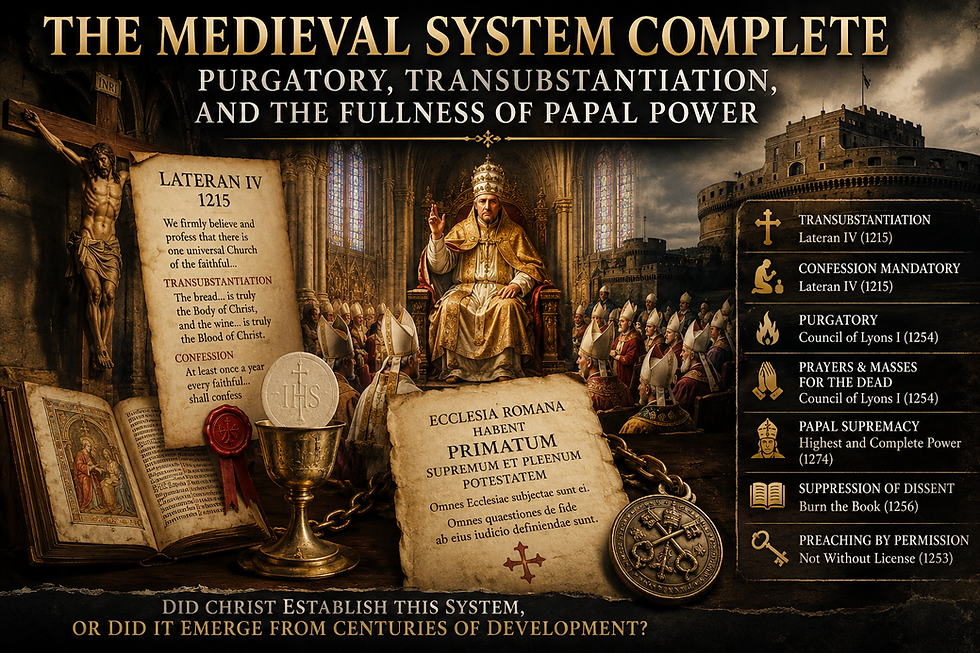
In 1476 Pope Sixtus IV issued a decree that reveals just how far the medieval system of indulgences had developed. The document states that the Church could draw from its spiritual treasury to assist souls suffering in purgatory and that those who contributed money toward the repair of a church could obtain a plenary remission of punishments on behalf of the dead.
The implications are profound.
According to the decree, souls who had died in God's grace but were still undergoing purgatorial punishments could be aided through financial contributions made by the living. Drawing upon what was called the "treasury of the Church," the pope claimed the authority to dispense remission of punishments for souls no longer able to help themselves.
This immediately raises a fundamental question: where does Scripture teach such a treasury exists?
The Bible certainly teaches that Christ possesses infinite merit. It teaches that His sacrifice is sufficient, complete, and perfect. Yet nowhere do the prophets, apostles, or Christ Himself speak of a treasury of accumulated merits administered by future church leaders and distributed through indulgences.
Even more striking is the identity of those who are said to contribute to this treasury.
Abraham was called the friend of God. Moses spoke with God face to face. David was a man after God's own heart. Isaiah beheld the Lord seated upon His throne. Ezekiel received visions of heaven itself. Yet not one of these men ever claimed to possess surplus merit that could be transferred to another soul after death.
Indeed, the testimony of Scripture points in the opposite direction.
Abraham died.
Moses died.
David died.
Isaiah died.
Ezekiel died.
All entered the grave as mortal men dependent entirely upon the mercy and promises of God.
If these giants of the faith could not save themselves from death, if they stood before God solely by His grace, by what authority can it be claimed that later church officials possess access to a reservoir of merits sufficient to reduce the punishments of others?
The contrast becomes even sharper when viewed through the lens of Christ's atonement.
Hebrews declares:
"For by one offering he hath perfected for ever them that are sanctified." (Hebrews 10:14)
Christ did not merely contribute merit toward salvation. He accomplished redemption. The New Testament repeatedly points believers to the finished work of Christ rather than to a storehouse of merits accumulated by saints.
Yet the indulgence system introduced an additional mechanism. Beyond Christ's sacrifice stood purgatorial punishments. Beyond purgatorial punishments stood indulgences. Beyond indulgences stood a treasury administered by ecclesiastical authority. And beyond that stood financial contributions capable of obtaining relief for the dead.
The decree therefore presents a remarkable concentration of spiritual authority.
A pope claims the ability to draw from an invisible treasury, apply its benefits to souls in another realm, reduce punishments assigned by divine justice, and do so in connection with donations given for church repairs.
This final point deserves particular attention.
The decree was not merely encouraging charitable giving or voluntary support for the Church. It explicitly connected financial contributions for the repair of a church building with the granting of a plenary remission of punishment for souls believed to be suffering in purgatory. In practical terms, money given for a physical project on earth was linked to spiritual benefits promised for the dead.
If the remission of punishments depends upon the authority of the Church's treasury, why should a financial contribution be attached to the transaction at all? If the souls in purgatory are suffering according to divine justice, by what principle does a donation toward a building project alter their condition?
The prophets never spoke in such terms.
Abraham never offered remission of punishment through donations.
Moses never collected contributions in exchange for relief from posthumous suffering.
David never claimed authority to shorten punishments beyond the grave.
Isaiah never taught that gifts toward the maintenance of the Temple could release departed souls.
Ezekiel never described a treasury of merits from which spiritual benefits could be distributed.
These men, despite their extraordinary faith and closeness to God, never claimed possession of surplus merit capable of being transferred to others. They stood before God as recipients of His mercy, not as administrators of a heavenly treasury.
The apostles likewise never exercised such powers.
Peter never offered remission of purgatorial punishments in exchange for contributions.
Paul never instructed believers to secure relief for departed relatives through financial gifts.
John never described a treasury of merits administered by church authorities.
Instead, the apostles consistently directed believers to Christ Himself.
This is one reason why indulgences became one of the most controversial practices in Christian history. The issue was not merely money. The deeper issue was authority. Who possesses the power to remit punishments beyond death? Who possesses the right to distribute spiritual merits? Who can alter penalties imposed by divine justice?
The medieval Church answered: the pope, acting through the treasury of the Church.
Many critics answered differently. They argued that such claims elevated ecclesiastical authority beyond anything found in Scripture and placed powers in the hands of church officials that neither prophets nor apostles ever claimed for themselves.
More troubling still was the appearance that spiritual benefits were being linked to financial transactions. Even if defenders insisted that grace itself was not being sold, the practical effect was that money given for ecclesiastical projects was connected to promises concerning the condition of souls after death. It is not difficult to understand why many believers came to view such arrangements with suspicion.
Whether one accepts or rejects the doctrine, the decree of Sixtus IV stands as one of the clearest examples of the medieval Church asserting extraordinary authority over the spiritual destiny of souls. It reveals a system in which the Church claimed not merely to proclaim salvation, but to administer posthumous punishments, dispense accumulated merits, and intervene in the condition of the dead through mechanisms unknown to the earliest Christian writings.
The reader is therefore left with a simple question: if Abraham, Moses, David, Isaiah, and Ezekiel stood before God dependent solely upon His mercy, by what authority can any later man claim to possess a treasury from which divine favors may be dispensed to others?

Comments